

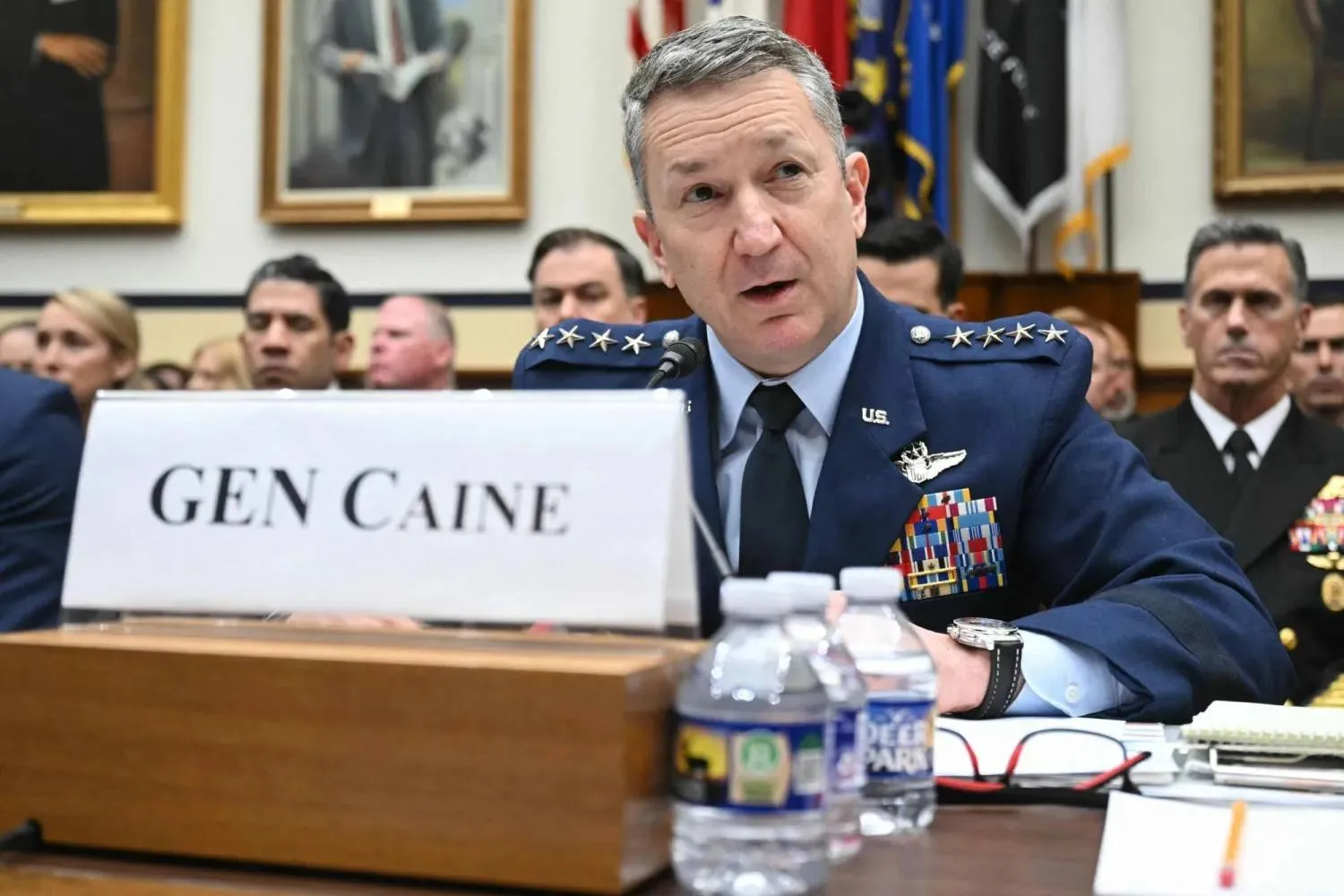

US Chairman of Joint Chiefs: Washington is ‘Looking for an Off-Ramp’ from Iran War

Chairman of the Joint Chiefs of Staff General Dan Caine testifies before the House Armed Services Committee in the Rayburn House Office Building in Washington, DC, on April 29, 2026 (AFP)
TT

US Chairman of Joint Chiefs: Washington is ‘Looking for an Off-Ramp’ from Iran War

Chairman of the Joint Chiefs of Staff General Dan Caine testifies before the House Armed Services Committee in the Rayburn House Office Building in Washington, DC, on April 29, 2026 (AFP)

Chairman of the Joint Chiefs General Dan Caine has privately made clear to other top Trump advisers that the US needs to find an off-ramp from the war with Iran — because the military options on the table to escalate the conflict could backfire and airpower alone is unlikely to achieve US President Donald Trump’s stated objectives, three sources familiar with the matter told CNN.

“Caine is looking for an off ramp,” one of the sources said bluntly.

Caine is not alone in his view that the war has reached a crossroads. He has discussed concerns about the military options for escalating the conflict and raised the prospect of finding an off-ramp from the war with other key Cabinet officials, including CIA Director John Ratcliffe, Secretary of State Marco Rubio and Vice President JD Vance, two of the sources said.

The top US general has recently met with some of those key, like-minded Trump advisers in an effort to facilitate interagency coordination and ensure they are on the same page ahead of meetings with the president.

The sources said the aim has been to make clear the limitations and pitfalls of the available military options, including those that do not involve putting US boots on the ground.

Trump Against Deploying Ground Troops

One source said Trump has consistently appeared averse to the idea of deploying ground troops in Iran, instead signaling he believes that air bombing can force them to agree to a deal on his terms.

Caine and others in Trump’s cabinet privately view that outcome as unlikely and instead have sought to develop other options that fit within the president’s own parameters, according to multiple sources familiar with recent discussions.

A White House official praised Caine’s contributions to Trump’s national security team, telling CNN: “General Caine is an incredible asset to President Trump’s national security team, and the overwhelming success of Operations Epic Fury, Midnight Hammer, and Absolute Resolve speaks for itself.”

“The General always provides accurate, unbiased information and a host of options to the Commander-in-Chief, who ultimately makes decisions based on what he feels is best for US national security,” the official added.

‘Airpower Has Its Limits’

The war has reached a point where many of Trump’s top national security officials, bolstered by military doctrine, assessments from the US intelligence community and common sense, believe what Caine himself told lawmakers during a public hearing late last month — “airpower has its limits.”

For those reasons, Caine and other Trump officials were wary of the latest plan late in July to launch new, more aggressive strikes due to concerns about the likely fallout that could come from escalating the conflict, even as the president appeared ready to initially greenlight what he described as a “massive” operation, one of the sources said, declining to elaborate on the operational details.

“The only ones in favor of the operation were elements of CENTCOM,” the source added, noting Israel also broadly supported an operation to escalate the conflict.

Trump ultimately decided to back off after talking with Middle East allies, a senior administration official told CNN, adding that the president is not taking the planned strikes off the table for a future date.

Dwindling US Stockpiles of Key Munitions

But dwindling US stockpiles of key munitions were also a factor, CNN has reported, as multiple sources said it was a concern.

Trump has repeatedly threatened to strike Iran’s energy infrastructure, a move sources said would also likely further alienate the Iranian population, rather than fuel blame toward the regime.

The US President has also considered bombing bridges, but doing so is similarly unlikely to yield productive results, per a second source.

But while Caine has raised concerns, he has also been mindful of preserving his relationship with Trump and been careful in how he conveys the potential downsides of military options when presenting them directly to the president, the sources said.

He has worked hard in his time as chairman to make sure he has Trump’s ear, at one point even trying to secure an office at the White House so he could brief the president more regularly and have a highly secure space to work from when he’s there, according to people familiar with the matter.

Potential Downsides of Military Options

Caine was “doing his job” by recently raising potential downsides of military options for escalating the conflict — including concerns about the already depleted US munitions stockpile — during a White House meeting with Trump and other top officials late last month, two sources familiar with the discussion said.

But during the same discussion, Caine also made clear to the president that if he wanted to go forward with those operations, “we could absolutely wreck them,” one of the sources familiar with that recent White House meeting told CNN about the chairman’s message.

Privately, however, Caine has been more direct in acknowledging the limits of air power and reiterating his view that bombing alone is unlikely to achieve Trump’s stated objectives, at this stage of the war, according to a third source familiar with the matter.

Some say Caine hasn’t been assertive enough with Trump. “He’s definitely pulling punches,” a source familiar with Caine’s interactions with Trump told CNN earlier this year, when comparing his White House conversations with his private discussions with military leaders about potentially launching the war.

Caine appears to have become more vocal about the potential second and third order effects of potential US escalation in recent weeks. CNN previously reported that he specifically raised concerns about the depleted US munitions stockpile during at least two recent meetings with Trump where options for escalating were discussed.

But at the same time, Caine has reiterated during those meetings that the US military can inflict massive damage on Iran if Trump ultimately decides to go forward with an operation that would escalate the war, according to a source familiar with one of those discussions.

Pre-War Warnings

Before the war began, Caine and other military leaders similarly warned Trump that a protracted military campaign could impact US weapons stockpiles. But now, senior US military commanders believe the munitions stockpile is “dangerously low,” a source previously told CNN, and Trump has become increasingly frustrated by how the issue appears to undermine his ability to credibly project strength in negotiations with Iran.

Caine has raised concerns about the dwindling US munitions stockpile during at least two recent meetings with Trump where potential options for escalating the conflict were discussed, CNN has reported.

Trump, meanwhile, appears more frustrated by the fact that the war’s impact of US munitions has been reported publicly — airing those grievances during a meeting with his Cabinet at Camp David last week.

The munitions shortage is also one reason the Pentagon and US Central Command have recently begun to reevaluate the US’ military strategy, CNN has reported. For example, a senior military official at CENTCOM recently sent a crowdsourcing email seeking new creative and unconventional ways to pressure and punish Iran, sources previously told CNN.



Iran Airlines Cancel Flights as US Sanctions Hit

Pedestrians walk past an office of Iranian airline Mahan Air in Baghdad, Iraq, Wednesday, Sept. 23, 2026. (AP Photo/Hadi Mizban)
TT

Iran Airlines Cancel Flights as US Sanctions Hit

Pedestrians walk past an office of Iranian airline Mahan Air in Baghdad, Iraq, Wednesday, Sept. 23, 2026. (AP Photo/Hadi Mizban)

Iranian airlines were forced to cancel some international flights on Wednesday after the US tightened sanctions on Iran's aviation industry in a new effort to cripple its economy.

A travel agent in Tehran told AFP that flights to Baghdad, Muscat, Qatar, Georgia and Azerbaijan had all been suspended, but routes to multiple other destinations remained available, including China.

US Treasury Secretary Scott Bessent announced the new measures on Monday as part of an earlier threat to impose "economic D-Day" on Iran, an attempt to force it into submission following their nearly seven-month war.

But Iran's aviation sector has already been a target of sanctions for years, and it remains unclear what the full impact will be and whether other countries will comply.

Even after the new sanctions took effect on Wednesday, a flight from Tehran operated by Mahan Air, one of Iran's biggest carriers, landed in Guangzhou in China, according to tracking data from FlightRadar24.

China on Tuesday said it opposes the US sanctions and called them illegal. A flight to Shanghai was also due to depart on Wednesday, according to Tehran's international airport.

Some flights to Istanbul were also scheduled, though others had been cancelled, the travel agent in Tehran told AFP.

"The situation is unstable and we are no longer selling tickets for the time being for fear of cancellations," the the agent said, requesting anonymity.

A Mahan flight from Kabul was also expected to arrive in Tehran around midday. According to the website for Tehran's international airport, other connections to Türkiye and Armenia also remained possible using smaller Iranian airlines, including Varesh.

Flights to Najaf in Iraq and Dubai in the United Arab Emirates were also scheduled.

Bessent on Monday vowed to "shut down" Iranian carriers and punish anyone doing business with them.

"If they land, you cannot provide them with fuel, you cannot provide them with landing services, you cannot sell them tickets or you will be knocked out of the dollar system," he warned other countries.

The restrictions will further complicate the ability of Iranians to travel abroad or return to their country.

Iranian media also reported cancellations, with the Tasnim news agency on Tuesday citing a civil aviation spokesman as saying that Baghdad and Muscat airports "will no longer accept" Iranian flights.

"Other international flights, including Istanbul, will operate as scheduled and as usual, and at present there are no problems with these flights," Tasnim said.

According to Tasnim, Iran's aviation authorities are in talks to reroute Baghdad flights to Najaf, a major destination for Iranian pilgrims.

In Iraq, while the government has not publicly announced plans to enforce the ban, several sources including a senior government official told AFP that Baghdad would comply with the US measures.


Analysts North Korea Appears to Have Tested Upgraded Hypersonic Weapon

This picture taken on September 21, 2026 and released by North Korea's official Korean Central News Agency (KCNA) on September 22, 2026, shows North Korean leader Kim Jong Un speaking at the 3rd Workshop for Officials in the Propaganda Sector of the Workers' Party of Korea in Pyongyang. (Photo by KCNA / KCNA VIA KNS / AFP)
TT

Analysts North Korea Appears to Have Tested Upgraded Hypersonic Weapon

This picture taken on September 21, 2026 and released by North Korea's official Korean Central News Agency (KCNA) on September 22, 2026, shows North Korean leader Kim Jong Un speaking at the 3rd Workshop for Officials in the Propaganda Sector of the Workers' Party of Korea in Pyongyang. (Photo by KCNA / KCNA VIA KNS / AFP)

North Korea appears to have tested a hypersonic weapon that could evade missile defenses and prove hard to track and intercept, analysts told AFP Wednesday.

South Korea and Japan said Pyongyang fired two short-range ballistic missiles off its east coast Sunday, condemning the launches as threats to regional peace and security.

North Korea did not identify the weapon, saying only that its missile bureau had "successfully tested a new type of weapon" in a demonstration of "ultra-modern defense technology.”

Analysts said the weapon appeared to be an upgraded version of North Korea's Hwasongpho-11Ma-1 hypersonic short-range ballistic missile.

With a range of 450 to 600 kilometers (around 280-370 miles), the hypersonic missile is "designed to strike key military facilities across the Korean peninsula within an extremely short period of time,” Yang Moo-jin, former president of the University of North Korean Studies in Seoul, told AFP.

Images released by Pyongyang's state media showed leader Kim Jong Un and his daughter Ju Ae watching a screen displaying what appeared to be the missile's flight path, labelled "Hwasongpho-11Ma-1 flight trajectory.”

The North Korean leader warned this week that the weapon's advances would give adversaries "an incurable headache and a very cruel and unavoidable blow,” according to the official Korean Central News Agency.

Despite long-running UN sanctions, North Korea has enshrined its status as a nuclear-armed state in law, with its leaders repeatedly declaring its atomic arsenal permanent and irreversible.

North Korea has also secured critical backing from Russia alongside its traditional ally China, leaving fewer incentives for it to engage in renewed diplomacy with Washington.

"North Korea may be talking up its own capabilities, but it has clearly reached the point where it can launch weapons of this caliber," Ahn Chan-il, a researcher originally from North Korea, told AFP.

"I believe these tests are less about upgrading its own military capabilities than testing weapons produced by its defense industry to meet Russia's wartime demand."

Since Russia launched its invasion of Ukraine in 2022, North Korea has become a key ally of the Kremlin, sending troops to support Moscow's war effort in return for economic benefits and military technology, analysts say.

Hong Sung-pyo, senior researcher at the Seoul-based Korea Institute for Military Affairs, said that if used against South Korea, the hypersonic weapon would pose a serious threat.

"But a single successful test is not enough to prove its capabilities. If deployed operationally, however, it would be extremely difficult to defend against," he told AFP.

"Because it maneuvers as it descends during the terminal phase of flight, it is harder to track and intercept than a conventional ballistic missile -- particularly at hypersonic speeds."


Tigray Rebel Forces Seize Ethiopia Regional Airport

(FILES) The charred remaining of a T-72 tank lay on the road that connects Shiraro to Shire on October 12, 2024.  (Photo by Michele Spatari / AFP)
(FILES) The charred remaining of a T-72 tank lay on the road that connects Shiraro to Shire on October 12, 2024. (Photo by Michele Spatari / AFP)
TT

Tigray Rebel Forces Seize Ethiopia Regional Airport

(FILES) The charred remaining of a T-72 tank lay on the road that connects Shiraro to Shire on October 12, 2024.  (Photo by Michele Spatari / AFP)
(FILES) The charred remaining of a T-72 tank lay on the road that connects Shiraro to Shire on October 12, 2024. (Photo by Michele Spatari / AFP)

Tigrayan rebel forces in northern Ethiopia have seized control of the airport in the regional capital, security and local sources told AFP on Wednesday, at a time of rising tensions with the federal government.

The Tigray People's Liberation Front (TPLF), which controls the region, fought a devastating civil war with the federal government in 2020-2022 that killed some 600,000 people, according to African Union estimates.

Sporadic clashes in recent months have raised fears of a return to war.

"While we were on our way to the airport for work, our supervisor called the driver and told him that the airport had been taken over by Tigray forces. Since there were no flights, he told us to return home," an employee at Alula Aba Nega Airport in the Tigrayan capital Mekelle told AFP.

The information was confirmed by a foreign security source based in Ethiopia.

A small number of federal police guard the airport, and their condition was unknown.

Flight Radar, an air traffic tracker, showed that Wednesday morning's flight between Mekelle and the federal capital, Addis Ababa, had been cancelled.

"Ethiopian Airlines has temporarily suspended flights to Mekele, Axum, and Shire effective today, due to the current situation in the Tigray region," the national carrier said in a statement.

On Sunday, the TPLF was announced as a member of a new alliance of anti-government armed groups from across the country.

Ethiopia faces a myriad of insurgencies, including in its most populous regions, Oromia and Amhara.

The TPLF ruled the whole of Ethiopia from 1991 to 2018 before being sidelined with the rise of Prime Minister Abiy Ahmed, eventually triggering the civil war.

The Pretoria Peace Agreement ended the war and maintained an uneasy calm until late 2025, when clashes resumed.

The federal government has since launched multiple drone strikes in Tigray and massed troops at the regional border.

Rights groups have accused the TPLF of a campaign of forced recruitment this year as it prepares for renewed conflict.

The region has not recovered from the last war, with around one million people still displaced and many aspects of the peace agreement still unfulfilled.

Ethiopian authorities have accused the TPLF of allying with neighboring Eritrea, as well as Ethiopian armed groups.

The federal government has a significant military advantage, having ramped up production of military drones since the last conflict.