


Crimea Strikes Could Rise Sevenfold if Western Funds Came Faster, Ukraine Drone Commander Says

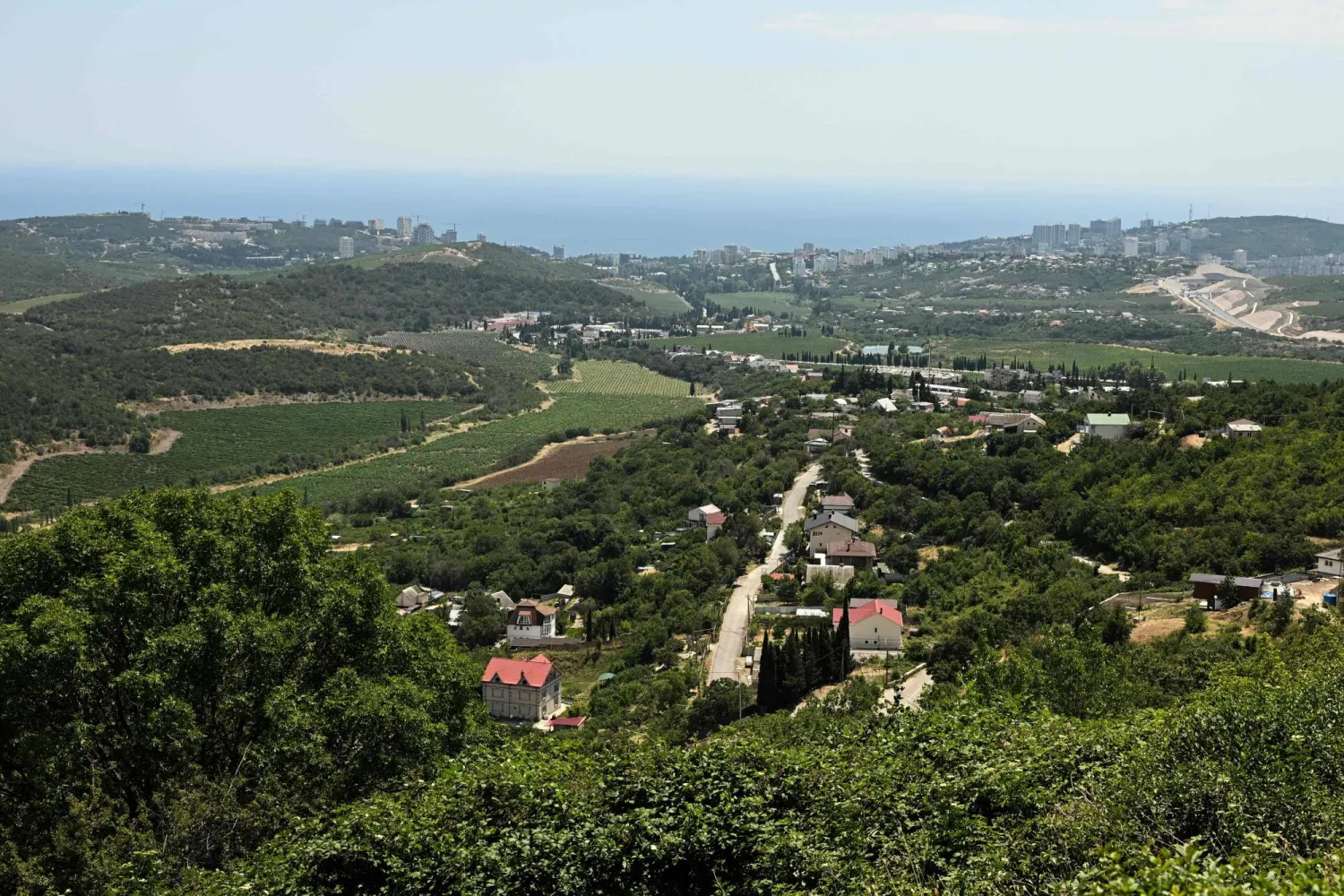
This photograph shows a general view of Crimean landscape with Alushta town in the background on July 21, 2026. (Photo by Igor IVANKO / AFP)
TT

Crimea Strikes Could Rise Sevenfold if Western Funds Came Faster, Ukraine Drone Commander Says

This photograph shows a general view of Crimean landscape with Alushta town in the background on July 21, 2026. (Photo by Igor IVANKO / AFP)

The commander leading Ukraine’s drone war says his country’s recent strikes in Crimea are the first phase of a campaign aimed at rendering the peninsula — illegally annexed by Russia in 2014 — unusable as a staging ground for Russian forces.

Maj. Robert “Magyar” Brovdi, one of Ukraine’s most prominent commanders among a new generation of soldiers, said his forces could strike seven times more military targets in Crimea if the money pledged by Western allies came faster.

“Crimea falls within the key conceptual pillars on the path to ending the war,” Brovdi told The Associated Press in an interview.

Despite that shortfall, Ukraine’s summer campaign in Crimea has already inflicted significant damage: striking rail bridges, oil depots and power infrastructure to disrupt supply lines and blind Russian air defenses as drones fly in.

Brovdi said his forces are equipped at just 14% of what they would need to carry out the Crimea campaign at full capacity.

A firm believer in numbers since his past life running an international grain trading business, Brovdi joined Ukraine’s territorial defense as a volunteer in the war’s opening days. He rose quickly, commanding one of the country’s most effective drone brigades before being tapped to lead a force with no precedent before this war — Ukraine’s Unmanned Systems Forces.

“It’s not that the production capacity of Ukrainian manufacturers doesn’t allow us to make the necessary quantities” of drones, Brovdi said. “It’s the banal problem of untimely financing, which our partners do allocate, but which moves significantly slower than our plans.”

A lover of the arts

A devoted patron of the arts, Brovdi's underground command post resembles a museum, with pieces of Ukrainian art on display, including by renowned painter Maria Prymachenko — each with small placards noting their titles and a QR code linking to more information. “Please don’t touch the sculpture,” reads a sign beneath one piece.

The artwork sits against a backdrop of dozens of screens streaming live footage from the front, along with real-time data that drives decisions on the battlefield. Soldiers can grab good coffee, pick a book, work out or rest in sleeping pods — a culture that feels closer to a Silicon Valley office than a war room.

They work around the clock to try to prevent Crimea from functioning as a staging ground for the Russian military, said Brovdi, whose call sign, Magyar, nods to his ethnic Hungarian roots in Zakarpattia, the western Ukrainian region bordering Hungary.

He pointed to one sign of progress — in four recent large-scale Russian missile barrages from the peninsula, only five missiles were launched in total, a drop he credited to the systematic destruction of Russian air defenses there. The AP couldn’t independently verify the claim.

To open that “window” for drones to strike the peninsula without being shot down en masse, his forces destroyed more than 300 air defense assets over recent months — surface-to-air systems, radar stations, electronic warfare equipment.

The window metaphor sends him into a sidetrack about something personal — he loves sleeping with one open, a pleasure he rarely gets anymore as one of Russia’s most hunted men, who spends most of his time in underground bunkers.

Forcing Russia out of Crimea

Much of Russia's Soviet-era air defense hardware runs on the power grid, which is one of the reasons Crimea's electrical infrastructure has become a recurring target. Russian soldiers become “blind,” left with just machine guns and rifles, he said. The tactic has also impacted access to power for civilians, and Brovdi said he has twice publicly apologized to Ukrainians living in Crimea for the disruptions.

Wherever Starlink connectivity reaches across Crimea, his forces can now destroy even the most heavily defended target using an average of just three drones, mixing munitions with different characteristics and warheads depending on what’s being hit. He described the strikes as deliberately calibrated — different munitions for a bridge pier than for a fuel truck or a moving train — and said his forces avoid hitting civilian infrastructure.

“Creating conditions that make it impossible for any kind of military capability ... to remain there will make Crimea uninteresting ... as a military staging ground,” he said.

Ukraine is also working to dismantle Crimea’s role as a naval base — a blow to Russia’s presence near NATO’s borders, he added.

The campaign’s early results have not been made public, Brovdi said. But roughly two weeks into the offensive that began in late June, he said Ukrainian intelligence indicated Russian authorities had ordered all military commands and security services to relocate off the peninsula, along with a covert order to remove secret archives and artworks. The AP could not independently verify the account.

Threats from Russia

Meanwhile, Russia is working to counter Ukraine’s edge. It is installing jamming systems at a scale that will, to some degree, degrade Starlink connectivity, Brovdi said.

Russia is also building its own satellite communications system to rival Starlink, he said. “This is a risk for the entire planet,” Brovdi said, “because a dictatorship will gain access to information across the whole globe.”

He also pointed to other threats facing Ukraine. The concentration of jet-powered Shahed drones, which are much harder for Ukraine to shoot down, has increased two and a half times in recent weeks, he said.

Russia's military can currently fire a simultaneous salvo of 77 ballistic missiles, he said, and plans to increase that to 200. That is one of Ukraine’s most vulnerable points, since the country is running short of interceptors for the US-made Patriot — the only system Ukraine has in its arsenal against ballistic missiles — meaning dozens fired by Russia during mass barrages get through and hit their targets.

“Even if they only manage half of that, it will all be flying at us,” Brovdi said. The only way to bring the number down, he said, is by striking every facility involved in producing those missiles — underscoring the importance of Ukraine’s long-range strikes deep inside Russian territory.

Ukraine's plan for Russia's Wildberries

Ukraine has increasingly targeted Wildberries, Russia’s largest online marketplace sometimes described as the country’s answer to Amazon, and Brovdi named it as a target.

“Wildberries is, first of all, a supply platform — it’s the war’s quartermaster,” he said, noting the company runs a dedicated section selling goods for Russia’s military.

At the same time, he said, the strikes on the retail chain are meant to make ordinary Russians feel the war directly, in hopes the resulting desire to end it could weigh on Russia’s ability to keep fighting.

Brovdi declined to give a timeline for the Wildberries campaign, saying only that the strikes will continue “until it becomes impossible for it to recover quickly.”

“Ultimately, Wildberries is, forgive the expression, a consumer gambling addiction,” he said, arguing that losing access to it — like restrictions on social media — creates an intrusion on one's personal life that most Russians feel.

“It turned out to be a sensitive sensor of the comfort of Russia’s massive population — people who consider themselves completely untouched by the actions of the aggressor country," he said.


Former Rivals Unite in New Front Against Ethiopia’s Abiy Ahmed

Ethiopian Prime Minister Abiy Ahmed is welcomed by President Ismail Guelleh during a visit to Djibouti on Thursday. (Ethiopian News Agency)
TT

Former Rivals Unite in New Front Against Ethiopia’s Abiy Ahmed

Ethiopian Prime Minister Abiy Ahmed is welcomed by President Ismail Guelleh during a visit to Djibouti on Thursday. (Ethiopian News Agency)

Abiy Ahmed came to power in 2018 on a promise of peace and unity for an Ethiopia scarred by decades of conflict. The path earned him a Nobel Peace Prize. Eight years later, some of his closest allies have become his enemies.

The break has taken a sharper turn. Former allies now lead an armed coalition seeking to end his rule and have gained ground in the north.

Tensions are also rising with Eritrea, which backed Abiy in his 2020 war against the Tigray People’s Liberation Front before the two countries fell out.

Experts who spoke to Asharq Al-Awsat disagree over whether the crisis will deepen or prove short-lived. They point to a widening rift between Abiy and his former allies, as well as outside support, particularly from Asmara.

An unlikely alliance

Ethiopia’s crisis entered a new phase on Sunday when seven armed groups announced the “Ethiopian Forces for Survival Alliance.”

Its members include the Tigray People’s Liberation Front, the Amhara Fano National Movement and the Oromo Liberation Army. The alliance says it aims to end Prime Minister Abiy Ahmed’s rule and form an inclusive transitional administration.

Until recently, some of its members were fighting on opposing sides, African affairs expert Ali Mahmoud Kalni told Asharq Al-Awsat. Fano’s shift in Amhara is “one of the clearest signs” that old alliances are changing, he said.

Fano factions fought alongside federal forces against the Tigray front in the 2020–2022 war. They later turned against the government as disputes grew over security in Amhara and arrangements following the Pretoria agreement.

A particular flashpoint was the government’s 2023 decision to disband regional special forces and absorb their members into the army and police.

The move raised widespread fears in Amhara that the region’s security forces would be weakened. Fano fighters and federal forces have clashed there since 2023.

In Tigray, the 2022 Pretoria agreement left disputes over territory, security and the front’s future relationship with the federal government unresolved. Renewed tensions in 2026 brought the Tigray front into the new armed alliance against Abiy.

In Oromia, the government’s conflict with the Oromo Liberation Army has continued. The movement returned to Ethiopia after Abiy took power, then resumed its armed campaign.

Kalni said the coalition’s formation showed how far the gap had widened between the federal government and regional armed groups. For now, he said, opposition to central government policies unites them more than a shared political program.

Ethiopian political analyst Zahed Zidan attributed their move toward coordination to regional complications and outside support.

He cited Eritrea’s stance, political hostility and regional and historical claims that the groups believe the federal government has ignored.

That rapprochement has come despite deep divisions among the groups themselves: Fano forces once backed the federal army against Tigray.

Fighting intensifies

A day after the Tigray front seized airports in northern Ethiopia, the Ethiopian army said on Thursday it had killed 272 rebels in fighting in the north.

Abiy, meanwhile, arrived in neighboring Djibouti to announce a joint project to strengthen economic ties. He did not directly comment on the fast-moving events.

US Ambassador to Ethiopia Ervin J. Massinga said on Wednesday he was disappointed by the Tigray People’s Liberation Front leadership’s decision to launch a large-scale attack.

“I am disappointed by the decision of the TPLF leadership, which the United States sanctioned earlier this year, to launch a large-scale attack today,” he said.

“Rejecting African Union-sponsored dialogue led by President Obasanjo and entering a fight that cannot be won does nothing for the people. Other armed groups would be wise to avoid this course.”

On Wednesday, Tigrayan rebels seized the airport in Mekelle, the regional capital, from federal police. Ethiopian Airlines suspended flights to the region because of “the current situation,” security and local sources told Reuters and Agence France-Presse.

Kalni said the alliance was a significant step for the armed opposition, bringing groups from Tigray, Amhara, Oromia and elsewhere under one political umbrella. But a common banner does not make a cohesive front, he said.

Disputes over land, identity, the structure of the state and the distribution of power remain, especially between Amhara and Tigray. Each movement also has its own local agenda and history with the government and the other groups.

With Ethiopia and Eritrea at odds, war in Sudan and powers competing for influence in the Red Sea region, an escalation inside Ethiopia could have consequences beyond its borders, Kalni said.

For Abiy’s government, the threat is that separate local conflicts could become a joint political and military campaign.

Zidan sees the alliance as temporary. Human losses and instability will grow before it ends, he said, because its members lack a common political or military basis for building a state.

He also cited the refusal of major groups in Afar and Benishangul-Gumuz to join, and said Ethiopians opposed the alliance and recognized outside influence behind it.


North Korea Rejects Call to Halt Nuclear Tests

North Korean leader Kim Jong Un visits the country's nuclear material production base and nuclear weapons institute, at an undisclosed location in North Korea, in this photo released by North Korea's official Korean Central News Agency on January 29, 2025. KCNA via REUTERS/File Photo
TT

North Korea Rejects Call to Halt Nuclear Tests

North Korean leader Kim Jong Un visits the country's nuclear material production base and nuclear weapons institute, at an undisclosed location in North Korea, in this photo released by North Korea's official Korean Central News Agency on January 29, 2025. KCNA via REUTERS/File Photo

North Korea's foreign ministry on Thursday rejected an international statement urging it to halt nuclear tests, with a spokesperson calling it "a grave political provocation against our state" by "hostile forces".

A meeting of ministers from the Friends of the Comprehensive Nuclear-Test-Ban Treaty — a grouping of Australia, Canada, Finland, Germany, Japan and the Netherlands — said any new nuclear test by North Korea would be irresponsible and unacceptable.

The meeting in New York on Tuesday urged Pyongyang to fully comply with all relevant United Nations Security Council resolutions.

The spokesperson for North Korea's foreign ministry described the country as a responsible nuclear-armed state, in a statement carried by state media KCNA, Reuters reported.

In another statement carried by KCNA earlier in the day, North Korea's foreign minister Choe Son Hui said Pyongyang's nuclear weapons status is irreversible.

Choe was responding to a separate meeting on the sidelines of the United Nations General Assembly this week between the United States, South Korea and Japan at which they reaffirmed their commitment to the complete denuclearisation of North Korea.

The Comprehensive Nuclear-Test-Ban Treaty, agreed in 1996, bans "any nuclear weapon test explosion or any other nuclear explosion" anywhere in the world, with the goal of reducing and ultimately eliminating nuclear weapons.


Russian Strikes Kill 8 in Ukraine, Damage Maternity Clinic

A woman walks in front of a house destroyed in a Russian strike on a residential neighbourhood in Kyiv, Ukraine, Thursday, Sept. 24, 2026. (AP Photo/Evgeniy Maloletka)
TT

Russian Strikes Kill 8 in Ukraine, Damage Maternity Clinic

A woman walks in front of a house destroyed in a Russian strike on a residential neighbourhood in Kyiv, Ukraine, Thursday, Sept. 24, 2026. (AP Photo/Evgeniy Maloletka)

Russian drone and missile strikes on Ukraine's capital Kyiv and its northeast killed eight people on Thursday in attacks that included a maternity hospital and a farm, officials said.

Moscow has stepped up its air war in recent months, deploying more of its faster and harder-to-stop drones while Ukraine is short of interceptors to down ballistic missiles.

Two people died in the latest assault on Kyiv, according to President Volodymyr Zelenskiy, who was in New York for the UN General Assembly.

"As people were sleeping, flashes from explosions ⁠lit up the sky," ⁠Zelenskiy said on Telegram.

"Once again, the main targets of their strike were Kyiv and civilian infrastructure, residential buildings, a maternity hospital, energy infrastructure, and logistics."

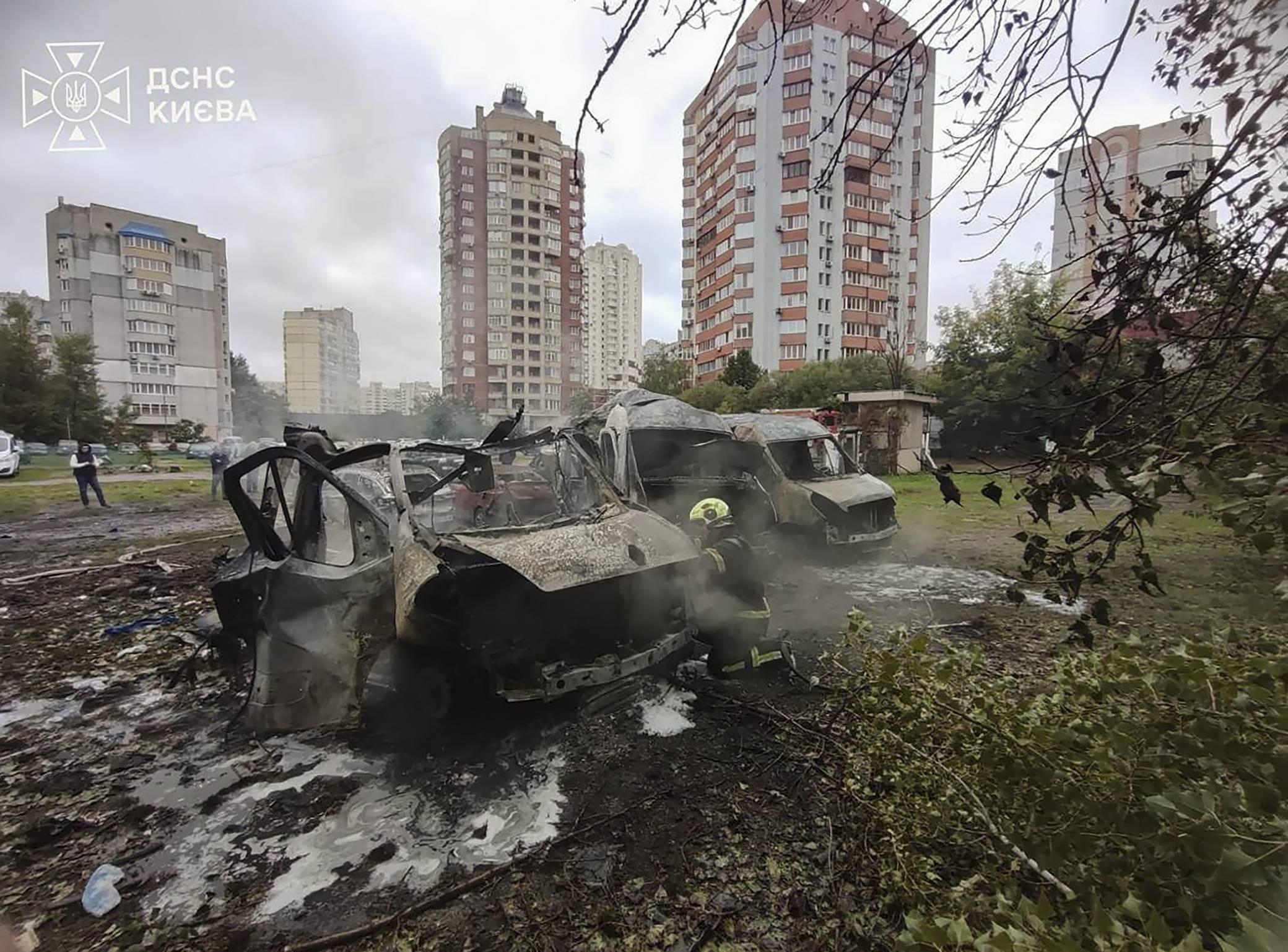
Police said nine homes, a post office, warehouses and dozens of cars were also damaged in Kyiv.

A separate Russian attack on a vegetable storage facility at a farm in a village of the northeastern Kharkiv region killed six people and injured a further ⁠12, prosecutors said.

The overnight barrage around Ukraine included an unspecified number of hypersonic and ballistic missiles, 282 drones and other weapons, Ukraine's air force said.

In Kyiv, eight people were injured as well as the two fatalities, one of whom was in the parking lot of the maternity hospital, Reuters quoted city mayor Vitali Klitschko as saying.

Part of the hospital's facade, windows and doors were damaged, officials said, adding that no patients or medics were injured.

A handout photo made available by the State Emergency Service (SES) shows Ukrainian rescuers working at the site of an overnight Russian attack on a residential area in Kyiv, Ukraine, 24 September 2026, amid the Russian invasion. EPA/STATE EMERGENCY SERVICE / HANDOUT

Authorities in the northwestern region of Rivne said infrastructure was damaged in overnight strikes that continued into Thursday morning, without providing further details. Volyn region bordering Poland also came under attack.

Insufficient pressure on Moscow ⁠was allowing ⁠it to launch repeated strikes, said Zelenskiy.

"Right now, the United States has the opportunity to respond strongly," he said. "We need ballistic interceptors to protect lives."

Russia's defense ministry said its forces hit Ukrainian defense facilities, logistics and telecoms centers, as well as vessels used by the military.

In the Black Sea port of Odesa, military administration head Serhiy Lysak said overnight Russian strikes damaged a medical facility and shattered windows in nearby houses and a school.

Moldova's President Maia Sandu said four Russian drones crossed into its airspace and at least one exploded, while Romania said a drone also crashed in its territory.

NATO alliance member Poland said it deployed aviation twice on Thursday due to Russian attacks on Ukraine.
