

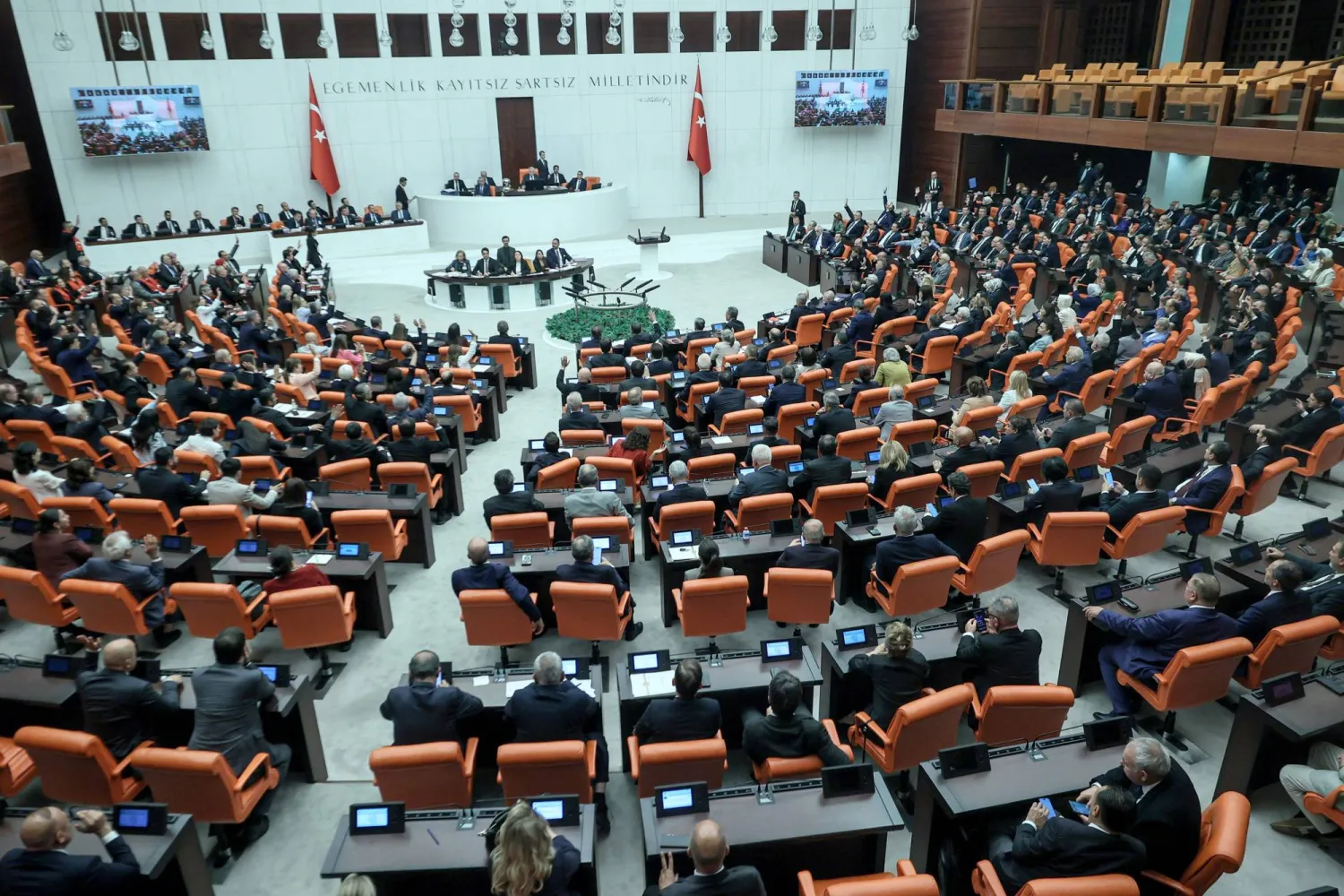

Türkiye MPs Back Historic Law on Reintegrating Kurdish Militants

Lawmakers take part in a voting session on a bill offering limited amnesty for Kurdish PKK militants at Grand National Assembly of Türkiye in Ankara on August 10, 2026. (AFP)
TT

Türkiye MPs Back Historic Law on Reintegrating Kurdish Militants

Lawmakers take part in a voting session on a bill offering limited amnesty for Kurdish PKK militants at Grand National Assembly of Türkiye in Ankara on August 10, 2026. (AFP)

Turkish lawmakers on Monday voted through a bill offering limited amnesty for Kurdish PKK militants, a key step in the peace process that seeks to end decades of deadly violence.

The law is Türkiye's first legislative step towards ending the conflict and comes 18 months after Abdullah Ocalan, the jailed founder of the Kurdistan Workers' Party (PKK), urged his followers to disarm.

After 12 hours of debate, lawmakers voted by 468 in favor to 88 against, with six abstentions, for the so-called "terror-free Türkiye law" which envisages a return to civilian life for some of the PKK fighters who lay down their weapons without granting a total amnesty.

But crucially, the text does not specify what will become of Ocalan, 77, who has spent the past 27 years being held in solitary confinement on Imrali prison island near Istanbul.

Ocalan has played a key role in efforts to end the conflict, issuing a historic call in February 2025 for his fighters to disarm and embrace democratic means to defend the rights of Türkiye's Kurdish minority.

Backed by President Recep Tayyip Erdogan's ruling Justice and Development Party (AKP) and the pro-Kurdish DEM party, the bill suspends prosecutions and prison sentences for some offences for between five and 10 years.

The move is expected to involve the release of around 3,500 PKK-linked detainees in an initial phase, lawmakers said -- around a third of the number held in Turkish prisons.

If those covered by the measure do not reoffend during that period, investigations would be dropped and sentences considered served.

But those involved in serious crimes such as murder would be excluded -- with the text making no mention of Ocalan.

Last week, Türkiye's vice president Cevdet Yilmaz told CNN Turk Ocalan's case "does not fall within the scope of this law" but said he would be "in a position to contribute to the peace process" without giving further details.

Following the vote, Yilmaz hailed the new law as a "historic step", saying "the 468 'yes' votes are of the utmost importance in terms of political consensus".

"We expect the disarmament and dissolution processes to be implemented as quickly as possible.. and subsequently for the relevant articles of the law to come into effect," he wrote on X.

- 'Crossing a historic threshold' -

Devlet Bahceli, a close Erdogan ally and head of the hardline nationalist MHP whose unexpected olive branch to Ocalan kickstarted the process in October 2024, also hailed the vote.

"May it bring good luck and success," he said, shaking hands with pro-Kurdish MPs from DEM -- which also played a key role in the process, with its lawmakers regularly visiting Ocalan on Imrali island to pass messages back and forth.

With the vote, Türkiye was "crossing a historic threshold", DEM MP Ceylan Akca told AFP.

"This is the first step of a long walk towards absolute and authentic equality. I choose to be optimistic," she said, admitting the vote had made her "more hopeful."

Ahead of the vote, the government had been keen to stress that the text was not a general amnesty law, aware of the misgivings of the Turkish public which has been scarred by decades of bloody conflict.

And the tension was evident as lawmakers held a heated debate in a session broadcast live on TRT public television.

"How can you negotiate with terrorists? ... You said they would be laying down their weapons unconditionally," said Turhan Comez, a lawmaker with the nationalist opposition Iyi party.

In May last year, the PKK announced it was disbanding following Ocalan's call and two months later, its militants took part in a historic disarmament ceremony in the mountains of northern Iraq where they began symbolically destroying their weapons.

But the PKK leadership has said excluding Ocalan from the legislation would be a red line, warning on Sunday that many of the bill's provisions would remain a "dead letter" if he were not freed.



Congo Says 2,000 People Have Died in Its Ebola Outbreak, the Fastest Growing on Record

 A health worker in protective gear looks on at an Ebola treatment center in Bunia, Congo, Monday, Aug. 10, 2026. (AP)
A health worker in protective gear looks on at an Ebola treatment center in Bunia, Congo, Monday, Aug. 10, 2026. (AP)
TT

Congo Says 2,000 People Have Died in Its Ebola Outbreak, the Fastest Growing on Record

 A health worker in protective gear looks on at an Ebola treatment center in Bunia, Congo, Monday, Aug. 10, 2026. (AP)
A health worker in protective gear looks on at an Ebola treatment center in Bunia, Congo, Monday, Aug. 10, 2026. (AP)

At least 2,000 people have died among the confirmed cases in Congo’s Ebola outbreak that is the fastest growing on record, according to the latest government data.

Data published overnight into Tuesday showed the outbreak has recorded a total of 4,381 confirmed cases, including 2,011 deaths. A total of 704 patients are in admission and isolation.

The grim toll comes nearly three months since the outbreak was declared on May 15. While it took about nine weeks for the outbreak to record 1,000 deaths, it’s taken just around three weeks to record the additional 1,000 deaths, underscoring the complaints from responders that help is not getting quickly enough to remote localities.

The Ebola outbreak is unlike most previous ones because the rare Bundibugyo virus responsible for it has no approved vaccines or treatments.

The World Health Organization said on Monday that it started in February, long before authorities detected it in one of Congo’s most remote and vulnerable areas.

The first Ebola virus to be identified was in 1976 near the Ebola River in what is now Congo. The current outbreak is the 17th — and largest — the Central African nation has faced.


Colombia Scrambles to Find Survivors as Quake Kills 132

Rescuers look for survivors amid the rubble of a collapsed building after an earthquake in Cali, Colombia on August 10, 2026. (AFP)
TT

Colombia Scrambles to Find Survivors as Quake Kills 132

Rescuers look for survivors amid the rubble of a collapsed building after an earthquake in Cali, Colombia on August 10, 2026. (AFP)

Colombian volunteers and rescuers cleared rubble with their bare hands and buckets to search for survivors early Tuesday after the country's strongest earthquake in a decade killed at least 132 people and smashed dozens of buildings.

The 7.4-magnitude quake struck cities across Colombia's western region shortly after 7:30 am (1230 GMT), sending panicked residents onto the streets, AFP journalists saw.

The quake killed 132 people and injured more than 570 as of Monday afternoon, according to the Colombian Association of Capital Cities, a group coordinating major cities across the country.

Colombian President Abelardo de la Espriella -- just three days after being sworn into the job -- declared a state of emergency and vowed a concerted rescue effort.

De la Espriella said earlier the death toll was 111.

The city of Pereira, which was among those hit hardest, was mostly plunged into darkness amid power outages on Monday night as volunteers probed for signs of life under collapsed buildings.

"We're without power. This seems honestly like a zombie city," resident Juan David Gaitan told AFP.

Tattoo artist Andres Hernandez said he was worried about his family and friends, adding that he would stay awake because structures around him were "on the verge of collapsing."

Hernandez recalled being asleep at home when the quake happened and rushing into the street for safety, as the quake devastated the city in the heart of Colombia's coffee-growing region.

"It was a movie scene, because I saw the poles, the cables, everything moving. I'm worried about my family, my friends," he said.

There were scenes of destruction in several cities, with furniture and fabrics sandwiched between concrete, walls and floors tossed into irregular angles, and cabling strewn across roads.

In Manizales, the quake crumpled a tower of the city's beloved neo-Gothic cathedral.

In Quibdo, the capital of Colombia's Choco department, local official Jenny Rivas said public services and communications "have been virtually shut down."

"People ran out naked, people jumped from the second floor of their homes," Quibdo resident and law student Wilmer Cuesta recalled.

Dentist Julian Pena said he "ran outside carrying nothing" after feeling very strong shaking and found hundreds doing the same.

"People were praying in the street. It was overwhelming," he told AFP.

"There are many buildings with gaps, with cracks. There are others that have completely collapsed."

- Overnight searches -

The quake was felt across Colombia, including the capital Bogota, where crowds rushed out into the street in their pyjamas.

At a depth of 110 kilometers (68 miles), the quake was also felt in neighboring Ecuador and Panama.

Experts at the US Geological Survey said the quake was likely caused by movement along a deep fault within the Nazca tectonic plate.

Hospitals in five Colombian cities were put on red alert Monday and a nighttime curfew was declared in Cali, according to local authorities.

At least six local airports suspended operations, the civil aeronautics agency said.

Colombian pop megastar Shakira led the calls for unity.

"All my strength and love to my homeland. Let's hold each other tight," she said.

In Cali, Colombia's third-largest city, volunteers quickly went to work with picks, basic tools and their hands to try to find survivors.

"Getting here was unbelievable. It felt like the end of the world -- cars and motorcycles driving the wrong way, everyone searching for their loved ones," said volunteer rescue worker Nelson Moreno.

"What we need now are flashlights and goggles" to keep working through the night, he said.

Rescuers formed human chains to remove bricks and masonry, stopping every few minutes to listen for signs of life from those trapped below.

"We are trying to get everyone out alive," said Andres Felipe Mejia, another volunteer.

"A lot of people have come, with supplies, with food, helping the firefighters, helping the people," he said.

- International support -

The devastation comes less than two months after powerful twin quakes rattled neighboring Venezuela, killing over 6,300 people and leaving tens of thousands homeless.

Messages of support came in from countries across the region and the world.

Secretary of State Marco Rubio said the United States was "closely monitoring" the situation and "stands ready to support the people of Colombia."

The US later announced $15.5 million in emergency relief.

European Union chief Ursula von der Leyen said the EU had mobilized Copernicus, a satellite service, to help with rescue operations.

Israel, Mexico, Ecuador and France also offered assistance.


Russian Barrage on Ukraine Kills 9, Wounds Dozens

An Ukrainian rescuer works at the site of a Russian strike in Zaporizhzhia on August 11, 2026, amid the Russian invasion of Ukraine. Darya NAZAROVA / AFP
TT

Russian Barrage on Ukraine Kills 9, Wounds Dozens

An Ukrainian rescuer works at the site of a Russian strike in Zaporizhzhia on August 11, 2026, amid the Russian invasion of Ukraine. Darya NAZAROVA / AFP

Russian attacks across Ukraine killed at least nine people overnight and wounded dozens, authorities said Tuesday, after Kyiv warned that Moscow had received more ballistic missiles from North Korea.

Russia has stepped up ballistic missile strikes on Ukrainian cities in recent weeks, with Ukraine responding with strikes deep inside Russian territory.

The overnight attacks spanned Kyiv, Zaporizhzhia and Dnipropetrovsk, regional authorities said.

Russia's defense ministry said its forces "delivered a group strike with high-precision ground-based weapons, hitting military-industrial enterprises and transport-logistics centers in the cities of Kyiv and Zaporizhzhia".

In Zaporizhzhia, Ivan Fedorov, head of the regional military administration, said Russian forces launched a "massive" attack using missiles and guided aerial bombs.

"Six people were killed and 19 others wounded," Fedorov wrote on Telegram, updating an earlier toll of five dead.

In the eastern Dnipropetrovsk region, Russian drone and artillery strikes on five districts killed three people and wounded five others, regional military administration head Oleksandr Ganzha said on Telegram.

In Kyiv, AFP journalists heard a series of explosions shortly after midnight after authorities issued a missile alert.

Mayor Vitali Klitschko said on social media that the capital was "under ballistic missile attack".

Ukraine's emergency service said a warehouse caught fire and one person was wounded.

President Volodymyr Zelensky had said earlier that Russia was preparing to deploy more North Korean troops and had received new ballistic missiles from Pyongyang.

Only certain air defense systems, including US Patriots, are capable of intercepting ballistic missiles.

A shortage of PAC-3 interceptors has worsened since the war launched by the United States and Israel against Iran in February.

At the same time, Ukraine has been increasing its strikes against Russian cities far from the border.