


Trump 'Low-key' Bets on Economic Pressure against Iran

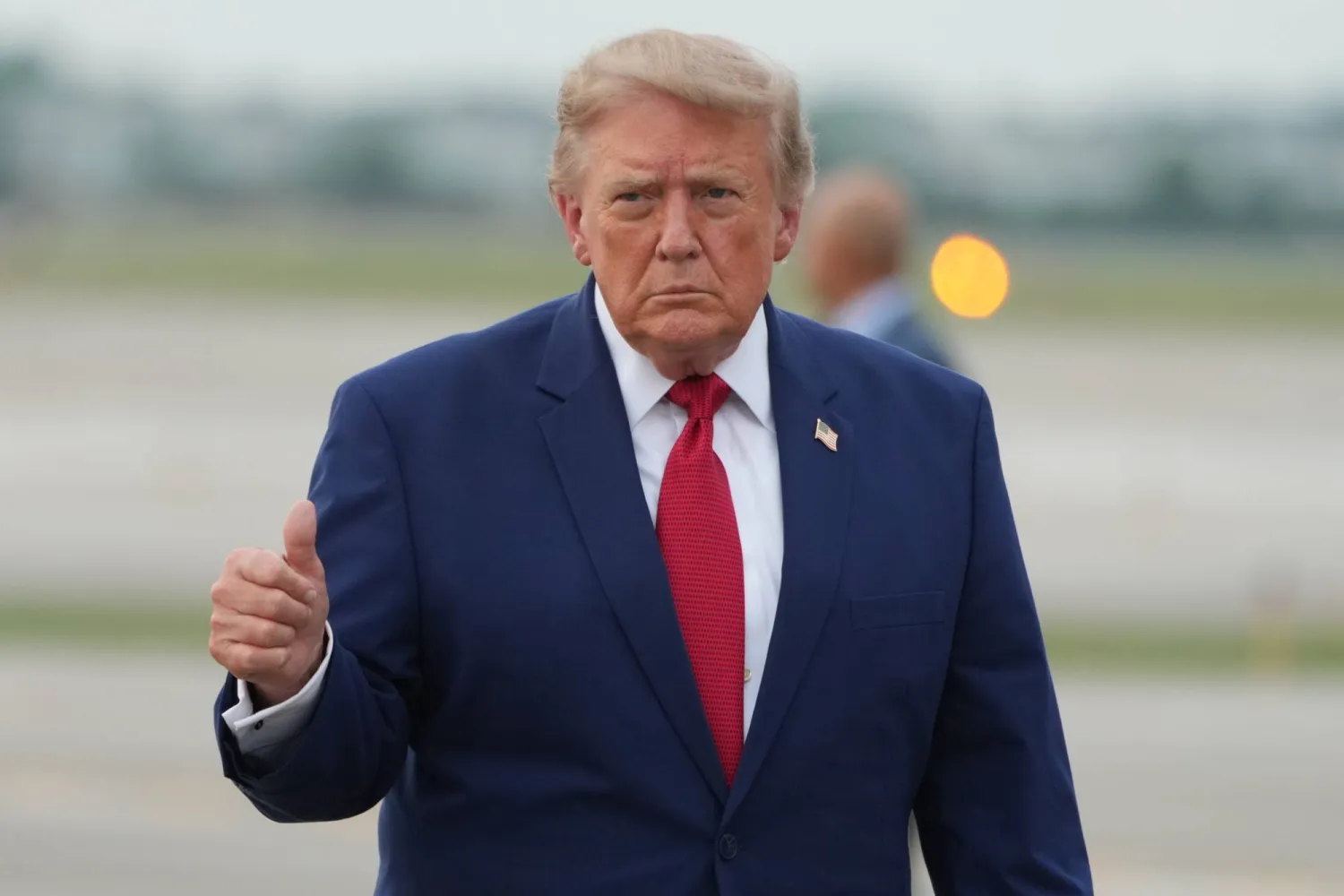
President Donald Trump walks from Marine One to board Air Force One at Cleveland Hopkins International Airport in Cleveland, Tuesday, Aug. 11, 2026. (AP Photo/Mark Schiefelbein)
TT

Trump 'Low-key' Bets on Economic Pressure against Iran

President Donald Trump walks from Marine One to board Air Force One at Cleveland Hopkins International Airport in Cleveland, Tuesday, Aug. 11, 2026. (AP Photo/Mark Schiefelbein)

Keeping a low profile doesn't come naturally to Donald Trump.

Yet that is the strategy the American president says he now favors in the war against Iran, and he is betting on economic pressure over diplomacy or new strikes.

"We are low-keying it," Trump told news site Axios by phone Sunday.

"We're only semi-negotiating with them. We are just watching Iran with its huge inflation and the fact they have no money."

The billionaire has since repeated that he is keeping the option of striking Tehran on the table, but prefers to stress the economic damage inflicted on the country through economic sanctions.

"Iran is broke, totally broke and they're not paying their soldiers," Trump said Monday in the Oval Office.

He has repeatedly claimed, most recently in a Truth Social post on Wednesday, that the country is experiencing inflation of over 300 percent.

He also claimed there is no urgency to act because the United States has "total control" of the Strait of Hormuz, a crucial waterway for the oil trade that has become the geopolitical flashpoint of the conflict.

- 'Terrible shape' -

In reality, Tehran is locking down the strategic passage while Washington is imposing its own blockade on Iranian ports.

"Iran is in terrible shape economically. It can't ship oil at any meaningful level. And it still labors under sanctions and still can't access its overseas assets," said Michael O'Hanlon, an expert from the Brookings Institution think tank.

"The question is, do its leaders really care? I think they care some, but not a lot."

The American president has, for the moment, muted both his threats of apocalyptic strikes and promises of imminent diplomatic breakthroughs -- messages that have been in constant rotation since he launched the war with Israel more than five months ago.

At the end of July, Washington announced new measures targeting Iran's Revolutionary Guard Corps (IRGC), the ideological arm of the Iranian military.

The Wall Street Journal reports that Trump's advisors have shown him data on the impact of American sanctions, which he is now reportedly considering tightening while he also mulls imposing new strictures.

That could be a tactical shift for an American president who, until recently, was threatening to unleash the most devastating strikes since World War II against Iran.

- Chess match -

The shift may also indicate the limited military options left available to the United States, where the press has reported that American munitions stockpiles have been heavily depleted.

Iran's foreign ministry spokesman Esmaeil Baqaei called the fresh push for sanctions a "retreat," noting the country has withstood US sanctions for decades.

"Whenever Washington proves itself incapable of pursuing diplomacy it retreats into sanctions; and whenever those sanctions fail to produce results, it simply increases the dose," Baqaei said in an X post this week.

"The real risk is that American politicians, clinging to this habit, will instead strangle their own remaining chances of a less humiliating exit from a crisis of their own making."

What remains to be seen is whether notoriously impatient Trump, who prefers the spectacle of combat sports like MMA and flashy "deals," will be able to stay true to the long-term strategy of economic pressure.

In his interview with Axios, Trump compared the conflict with Iran to a game of chess.

"Iranians have shown they are professional chess players," Baqaei told reporters in response to the comment.



Russian Attack Sets Ablaze Ukraine's Izmail Port infrastructure

A firefighter works at a compound of a port which was hit during overnight Russian drone strikes in the town of Izmail, amid Russia's attack on Ukraine, in Odesa region, Ukraine, May 19, 2026. (Press service of the State Emergency Service of Ukraine/Handout via Reuters)
TT

Russian Attack Sets Ablaze Ukraine's Izmail Port infrastructure

A firefighter works at a compound of a port which was hit during overnight Russian drone strikes in the town of Izmail, amid Russia's attack on Ukraine, in Odesa region, Ukraine, May 19, 2026. (Press service of the State Emergency Service of Ukraine/Handout via Reuters)

Russia struck the area around Ukraine's largest Danube port of Izmail overnight, causing damage and setting off a fire, regional authorities said ‌on the ‌Telegram messaging app.

Izmail, ‌near ⁠the Romanian border in ⁠the southern region of Odesa, handles grain and other commodities, and the attack ⁠comes a day after Ukraine ‌hit ‌Novorossiysk, a major ‌grain export hub in ‌Russia's part of the Black Sea, reported Reuters.

Romania, a member of NATO ‌and the European Union, scrambled two fighter jets, ⁠its ⁠defense ministry said on X, adding that an aerial target spent about 10 minutes in national airspace before leaving for Ukraine.


Zelensky: Ukraine Needs 5% of US Patriot Stocks to Get Through Winter

08 August 2026, Serbia, Belgrade: Ukraine's President Volodymyr Zelensky speaks during a joint press conference with Serbia's President Aleksandar Vucic following their meeting at the Palace of Serbia. Photo: Marko Dimic/ZUMA Press Wire/dpa
TT

Zelensky: Ukraine Needs 5% of US Patriot Stocks to Get Through Winter

08 August 2026, Serbia, Belgrade: Ukraine's President Volodymyr Zelensky speaks during a joint press conference with Serbia's President Aleksandar Vucic following their meeting at the Palace of Serbia. Photo: Marko Dimic/ZUMA Press Wire/dpa

Ukraine needs five percent of the United States' Patriot interceptor missiles to get through the winter and 10 percent to destroy all of Russia's ballistic projectiles, President Volodymyr Zelensky said in an interview published on Thursday.

Russia has recently been firing mass barrages at the Ukrainian capital Kyiv roughly once a week, killing civilians and damaging or destroying homes, said AFP.

In one attack, Ukraine failed to intercept any of the 28 ballistic missiles launched at it.

Speaking to CNN, Zelensky said Ukraine this year "had two-and-a-half times less interceptors than we had in 2025".

"Russia has two times more ballistic missiles per month than they had before," he said in English.

"This year, I'm asking American partners to sell me five percent of missiles (that) they have in their stocks.

"If they sell us five percent, we will go through the winter and save people's lives.

"If they can sell us 10 percent, we will destroy all the Russians' ballistic missiles."

Ukraine has reported an acute shortage of Patriot interceptors since the United States and Israel went to war with Iran in February, diverting supplies of the advanced systems.

Ballistic missiles are much harder to intercept than cruise missiles or drones because they move faster and follow steep trajectories.

Asked if the United States had responded to his requests, Zelensky said: "The answer is, for today is next. I have one percent."

"From one percent to five percent, I have some months and millions (of) phone calls and anything else.

"I do some things which I can't even share. It doesn't mean that it's out of the law. But I can't speak about it."

Ukraine's air force said on Wednesday it would stop publishing detailed figures on Russian ballistic missile strikes.

The restrictions will concern "the number of targets launched, shot down, suppressed or those that failed to reach their targets", communications chief Yuriy Ignat said on Facebook.

Real-time warnings would continue unchanged, and the air force would keep providing generalized figures on Russian missile launches, he said.

Last month, Russia fired more than 450 missiles at Ukraine, nearly 200 of them on ballistic trajectories.


Russia's Putin Visits Japan-claimed Islands for First Time; Tokyo Protests

 Russian President Vladimir Putin (C), accompanied by Pacific Fleet Commander-in-Chief Admiral Viktor Liina, visits the Guards missile cruiser Varyag during the final stage of the Pacific Fleet's exercises off the coast of Sakhalin region, Russia, 12 August 2026.  EPA/GAVRIIL GRIGOROV KREMLIN / POOL MANDATORY CREDIT
Russian President Vladimir Putin (C), accompanied by Pacific Fleet Commander-in-Chief Admiral Viktor Liina, visits the Guards missile cruiser Varyag during the final stage of the Pacific Fleet's exercises off the coast of Sakhalin region, Russia, 12 August 2026. EPA/GAVRIIL GRIGOROV KREMLIN / POOL MANDATORY CREDIT
TT

Russia's Putin Visits Japan-claimed Islands for First Time; Tokyo Protests

 Russian President Vladimir Putin (C), accompanied by Pacific Fleet Commander-in-Chief Admiral Viktor Liina, visits the Guards missile cruiser Varyag during the final stage of the Pacific Fleet's exercises off the coast of Sakhalin region, Russia, 12 August 2026.  EPA/GAVRIIL GRIGOROV KREMLIN / POOL MANDATORY CREDIT
Russian President Vladimir Putin (C), accompanied by Pacific Fleet Commander-in-Chief Admiral Viktor Liina, visits the Guards missile cruiser Varyag during the final stage of the Pacific Fleet's exercises off the coast of Sakhalin region, Russia, 12 August 2026. EPA/GAVRIIL GRIGOROV KREMLIN / POOL MANDATORY CREDIT

Russian President Vladimir Putin visited Iturup, a Japan-claimed island at the end of the Kuril chain near the island of Hokkaido, Russian media said on Thursday, a day after major naval drills and a missile firing by ally North Korea.

Moscow and Tokyo never ‌signed a ‌formal World War Two peace treaty as ‌the ⁠main hurdle was ⁠the unresolved territorial dispute over the islands, which Japan calls the Northern Territories, said Reuters.

On the trip, which state news agency TASS described as Putin's first in person to the island chain, he visited the Yasny fish-processing plant on Iturup, after overseeing the ⁠navy drills in Russia's far east.

Japan's foreign ‌minister protested against Putin's ‌visit on X.

"The northern territories, including Etorofu, are Japan's inherent territory ‌both historically and based on international law," said ‌Toshimitsu Motegi. "Japan strongly protests this visit."

Vesti TV channel images showed Putin in a dark suit, standing in a room looking at two large tuna and halibut on a table, ‌as two officials spoke about fishing and the migratory behavior of fish. He ⁠also stopped ⁠to try local fish roe.

"What lovely weather you have there, just like a resort!" Putin told a group of Iturup locals. "And we thought you arranged this!" a woman, who appeared to be in her 30s, joked back.

The visit follows Wednesday's firing of a ballistic missile by ally North Korea, towards waters off the east of the Korean peninsula, days ahead of major joint military exercises by Seoul and Washington long denounced by Pyongyang.