UN: Ebola Killing a Victim Every 30 Minutes in DR Congo

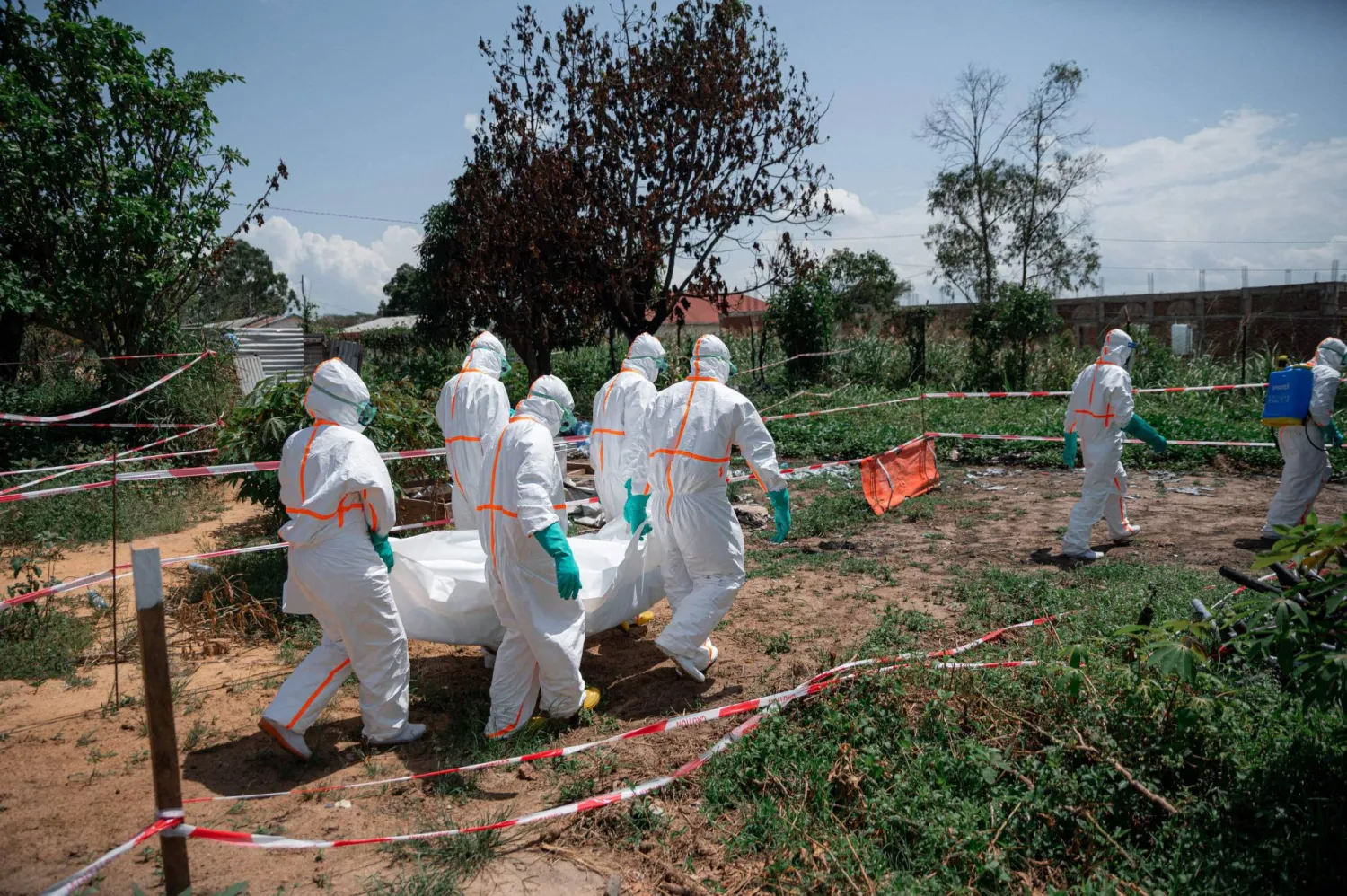
Volunteers of the Democratic Republic of Congo Red Cross wearing personal protective equipment carry the body of an Ebola virus disease victim from the morgue of the Rwampara health centre, Ituri Province, Democratic Republic of Congo, on June 8, 2026 before loading it into a vehicle for transfer to a cemetery as part of safe and dignified burial operations aimed at preventing the spread of the virus. (Photo by Jospin Mwisha / AFP)
TT

UN: Ebola Killing a Victim Every 30 Minutes in DR Congo

Volunteers of the Democratic Republic of Congo Red Cross wearing personal protective equipment carry the body of an Ebola virus disease victim from the morgue of the Rwampara health centre, Ituri Province, Democratic Republic of Congo, on June 8, 2026 before loading it into a vehicle for transfer to a cemetery as part of safe and dignified burial operations aimed at preventing the spread of the virus. (Photo by Jospin Mwisha / AFP)

The Ebola virus in the Democratic Republic of Congo is now killing a victim every 30 minutes, a top UN humanitarian official said Friday, calling for greater international action.

“The outbreak is the fastest growing on record,” Tom Fletcher, Under-Secretary-General for Humanitarian Affairs, said in a statement. “We need speed, scale and solidarity before this virus gets even further ahead of us.”

The outbreak has killed at least 2,128 people out of more than 4,500 confirmed cases since being declared in the DRC on May 15 and the UN has already said it is on course to become the deadliest Ebola eruption ever.

“Ebola is winning in the Democratic Republic of the Congo. We cannot let the virus outrun our response,” Fletcher said as he outlined the latest efforts to contain the virus, which spreads through contact with bodily fluids and causes a hemorrhagic fever.

“The epidemic is killing someone every 30 minutes,” he said, also warning that “many more people are at risk.”
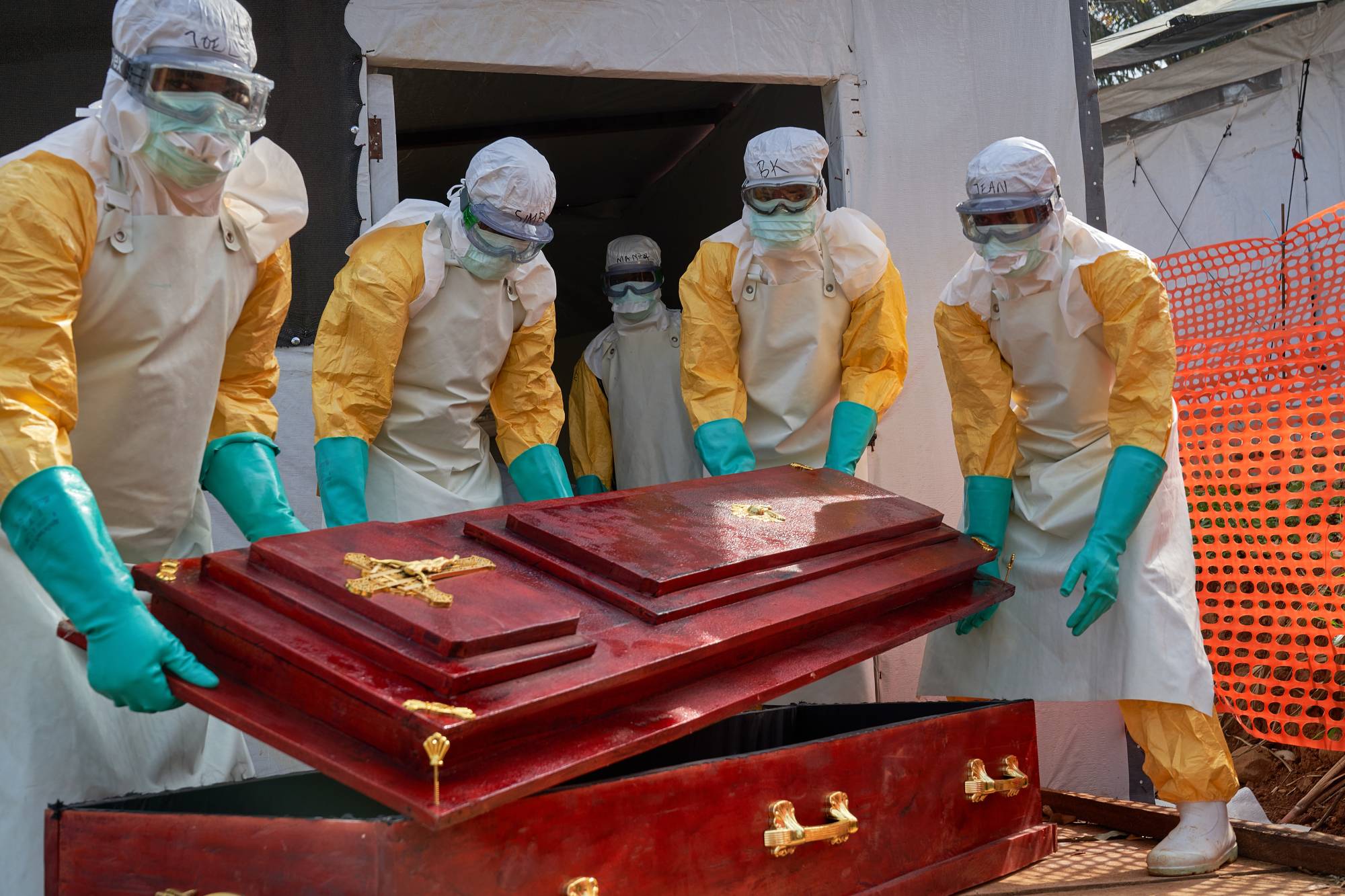
Staff carry a coffin for a victim of Ebola at the hospital in Mongbwalu, Ituri, Democratic Republic of Congo, 26 June 2026 (issued 30 June 2026). EPA/DIEUDONNE DIROLE

Fletcher said countries had now donated nearly $300 million to a fund to combat the outbreak.

After a meeting of UN agencies, he said he had allocated another $30.5 million from an emergency UN fund, which would be added to $24 million already allocated to help the DRC and four other countries to tackle the outbreak.

Cases have been reported in six DRC provinces, as well as Uganda. Cases have also been reported near the border with South Sudan. Fletcher said 20 extra staff had been sent to the Ebola “frontlines” but that more was required.

“We need to double the number of teams ensuring safe and dignified burials, triple the treatment capacity, improve contact tracing, and deploy more experienced managers,” said Fletcher. “Crucially, we must meet the immense needs for water, hygiene, health care and other basic services in the region.”

He said: “The world needs to wake up, and show up.”

This 17th outbreak of Ebola is caused by the Bundibugyo strain for which there is no known treatment or vaccine. Ebola has killed more than 15,000 people in Africa over the past 50 years. The deadliest Ebola outbreak from 2018 to 2020 killed nearly 2,300 people out of 3,500 recorded cases.


Algeria to Deploy Army Units to Niger to Protect Energy and Economic Interests

 People walk past Algerian flags outside the parliament building in Algeria, Sunday, Oct. 25, 2026. (AP)
People walk past Algerian flags outside the parliament building in Algeria, Sunday, Oct. 25, 2026. (AP)
TT

Algeria to Deploy Army Units to Niger to Protect Energy and Economic Interests

 People walk past Algerian flags outside the parliament building in Algeria, Sunday, Oct. 25, 2026. (AP)
People walk past Algerian flags outside the parliament building in Algeria, Sunday, Oct. 25, 2026. (AP)

Algeria will send army units to Niger to protect energy and economic interests, according to a statement from the presidency on Monday, marking Algeria's first foreign troop deployment since it sent forces to support Egypt in the 1973 war.

Algeria's parliament approved a resolution on Sunday authorizing ‌the deployment ‌of National Army units ‌to ⁠Madama in northern Niger, near ⁠the Libyan border.

The presidential statement did not say when the troops will be sent or how many there would be.

Military officers have ruled Niger, a nation rich ⁠in uranium, oil and gold resources, ‌since the ‌July 2023 coup that ousted President Mohamed Bazoum, ‌which Algeria opposed.

Relations worsened last ‌year, when Niger recalled its ambassador from Algiers after Algeria shot down a Malian drone near their border.

Algeria's interests in Niger ‌are mainly in energy. Its state-run Sonatrach is working with ⁠Niger ⁠and Nigeria on the Trans-Saharan Gas Pipeline, which is intended to create a new export corridor for African gas to international markets, particularly Europe.

Niger is battling insurgents linked to al-Qaeda and ISIS. The fighting has killed thousands and displaced millions across West Africa's central Sahel region over the past decade.


France's Macron to Visit Marseille after Protest Violence

Interior Minister Laurent Nunez said the outcome of Saturday's protests was more 'positive' than a week ago. Sylvain THOMAS / AFP
TT

France's Macron to Visit Marseille after Protest Violence

Interior Minister Laurent Nunez said the outcome of Saturday's protests was more 'positive' than a week ago. Sylvain THOMAS / AFP

The French government sought to draw a line Monday under weeks of protests that have been marred by violence, with President Emmanuel Macron headed to Marseille and the prime minister to meet with students demanding better school conditions.

France has been rocked by widespread anger over the rising cost of living, with nationwide demonstrations on October 17 degenerating into some of the country's worst rioting in years.

The demonstrations have come at a critical moment for France, six months ahead of a presidential election to replace centrist Macron.

The frontrunner -- far-right leader Marine le Pen -- held an election rally in Orleans Sunday, a day after yet more demonstrations also saw some violent clashes on the sidelines.

She vowed to "restore the rule of law" if elected next year. Polls show the protests and ensuing disorder have boosted her support, as the government and Macron faced sharp criticism over the unrest.

Authorities have admitted to security and intelligence failures that paved the way for the clashes, large-scale looting and vandalism of public property that erupted on October 17, and had stepped up security for Saturday's protests.

While Interior Minister Laurent Nunez said the outcome of Saturday's rallies was more "positive" than a week ago, street violence still erupted in the French capital and a number of other cities including Marseille.

The Elysee said Macron would visit the city hall in Marseille, France's second-largest city, on Monday, after it was damaged in the protest violence on October 17.

He was also due to meet shopkeepers who had fallen victim to looting and vandalism, the Elysee said.

"He will also pay tribute to and thank the internal security forces that helped restore republican order," the presidency said.

After this weekend's protests, many shopfronts in the city center were still boarded up early Monday, just hours before Macron's arrival.

Macron's visit was intended to demonstrate that "the state is present, standing firm and fulfilling its mission to protect," an aide said.

- 'High level of violence' -

A total of 1,435 people were arrested on the sidelines of the most recent weekend protests, Nunez said on Monday.

"The day was brought under control and there were no serious incidents," he told broadcaster BFMTV.

"Nevertheless, we saw a very high level of violence directed at the internal security forces," Nunez added.

He said that 267 police officers and gendarmes were injured, along with 150 protesters, including three who were seriously hurt in Toulouse, Reims and Clermont-Ferrand.

The unrest followed weeks of demonstrations by students campaigning for better learning conditions.

Several teenage protesters have been seriously injured and thousands arrested.

The police response to their demonstrations, which included blockades of schools, has been criticized as heavy-handed and sparked a broader movement against the cost of living and police violence.

In Paris on Monday, Lecornu was to meet student leaders, with National Education Minister Edouard Geffray and Higher Education Minister Philippe Baptiste joining him for the talks. Following that meeting, Geffray and Baptiste will hold a news conference.

Macron already met representatives of secondary school pupils last Friday, but they emerged from the talks urging students to keep protesting until the government put forward concrete proposals to address their demands.

On top of the protests, the country was last week shaken by a shooting that killed one person and wounded five, including a 12-year-old girl, outside Paris.

Macron has branded the shooting a "racist terrorist attack", as most of the victims were from foreign backgrounds.


Bangladesh Measles Crisis 'Warning Sign' of Other Outbreaks

A child receives treatment for measles at the Bangladesh Shishu Hospital & Institute in Dhaka on September 3. Salahuddin Ahmed / AFP
TT

Bangladesh Measles Crisis 'Warning Sign' of Other Outbreaks

A child receives treatment for measles at the Bangladesh Shishu Hospital & Institute in Dhaka on September 3. Salahuddin Ahmed / AFP

Experts have warned Bangladesh that deadly outbreaks of diphtheria, whooping cough and polio could follow an ongoing measles epidemic that has already killed over 1,200 children, according to a report seen by AFP on Monday.

"The measles outbreak is a litmus test and a warning sign of a deteriorating immunization system," said the report by an independent committee of national and international experts, which carried out its research earlier in October.

Bangladesh has struggled since March to contain the outbreak, which has killed more than 1,200 children and infected 220,000 people, making it the country's deadliest in decades, according to the Directorate General of Health Services (DGHS).

"If no urgent mitigation measures are taken, it is only a matter of time before there are large outbreaks of pertussis (whooping cough), diphtheria and even vaccine-derived poliovirus," added the report, which has been submitted to the government.

The health ministry pledged action on Monday.

"We are going to recruit vaccinators as quickly as possible as the first step towards implementing the recommendations," spokesman Zahid Raihan told AFP.

The government, supported by the World Health Organization (WHO), UNICEF, the Gavi vaccine alliance and other partners, deployed a 70-member team earlier this month to assess the country's immunization program.

The review found that just 82 percent of children were fully immunized, well below the national target of 95 percent. Around 40 percent of vaccinator posts remain vacant.

Bangladesh was long considered an immunization success story. Since its program began in 1979, the country has eliminated polio and neonatal tetanus and controlled rubella and hepatitis B.

A measles vaccination campaign planned for 2024 was delayed by the revolution that toppled former prime minister Sheikh Hasina, while strikes and political instability further disrupted a campaign in 2025.

Authorities have since launched a mass vaccination drive, but cases continue to climb.

Measles spreads easily through coughs and sneezes and has no specific treatment. Complications include brain swelling and severe breathing problems, with young children particularly vulnerable.

Whooping cough can cause severe illness and death in infants. Diphtheria can obstruct breathing and damage the heart and nerves, while vaccine-derived poliovirus can cause paralysis in under-immunized populations.