

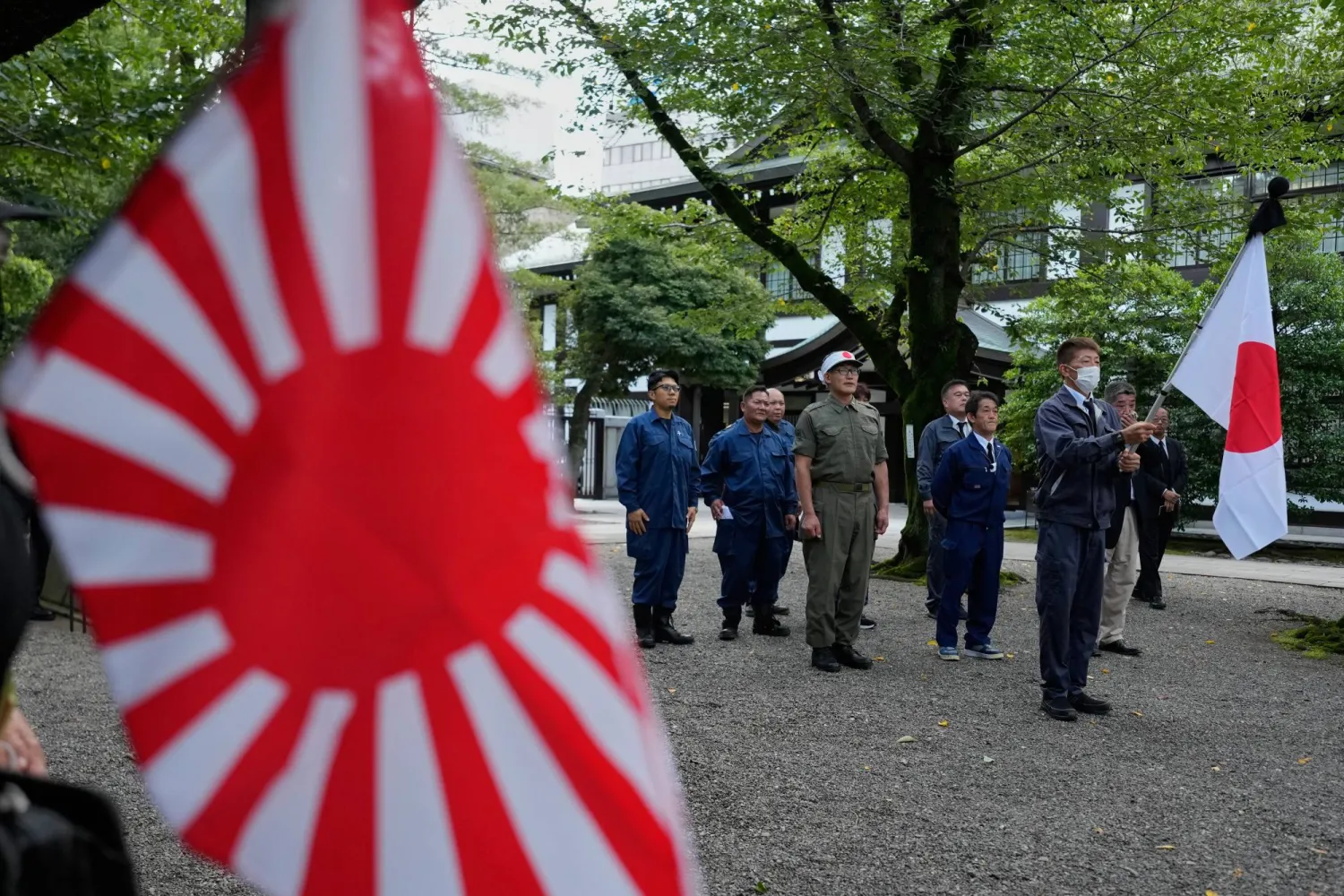

Japan's Takaichi Skips Controversial Yasukuni Shrine Visit on Anniversary of WWII Surrender

Visitors carry Japanese flags and a rising sun flag at Yasukuni Shrine, which honors Japan's war dead, including convicted war criminals, as the country marks the 81st anniversary of the end of World War II Saturday, Aug. 15, 2026, in Tokyo. (AP Photo/Eugene Hoshiko)
TT

Japan's Takaichi Skips Controversial Yasukuni Shrine Visit on Anniversary of WWII Surrender

Visitors carry Japanese flags and a rising sun flag at Yasukuni Shrine, which honors Japan's war dead, including convicted war criminals, as the country marks the 81st anniversary of the end of World War II Saturday, Aug. 15, 2026, in Tokyo. (AP Photo/Eugene Hoshiko)

Japanese Prime Minister Sanae Takaichi stayed away from Tokyo's controversial Yasukuni Shrine, apparently to prioritize diplomatic relations with China and South Korea, but did not mention her country’s wartime past in Asia or remorse over it in an address Saturday as Japan marked the 81st anniversary of its surrender in World War II.

Takaichi mourned the victims of major devastation in Hiroshima Nagasaki and Okinawa, as well as those who perished in overseas battlefronts, and thanked them for their sacrifice as the “foundation of Japan's peace and prosperity today.” She did not mention Japanese atrocities in Asia or apologize.

“Japan, since the end of the war, has consistently contributed to global peace and prosperity. We will never let the tragedy of the war be repeated," she said, adding that Japan can play a key role in addressing global challenges as “a dependable nation" in the region.

Visits by Japanese politicians to the Yasukuni Shrine, which also commemorates World War II war criminals, have been criticized by China and South Korea. They see it as showing a lack of remorse over Japan’s wartime atrocities.

Japanese Defense Minister Shinjiro Koizumi, another Cabinet minister and three executives from Takaichi's governing party showed up at the shrine earlier Saturday, The Associated Press reported.

Koizumi has regularly visited the controversial shrine to mark Japan's anniversary of the end of the war on Aug. 15 and other occasions. But as a defense minister pushing to increase Japan’s military capability and weapons sales under Takaichi’s hawkish government, his visit Saturday is seen as more contentious.

The previous shrine visit by a defense minister was in 2024 by Minoru Kihara, the current chief secretary and top government spokesperson for Takaichi’s government.

Japan’s Defense Ministry prohibits group visits by service members of the Self-Defense Forces, on grounds of constitutional separation of religion and state. Koizumi said in October it is natural for anyone in any country to pay respect for those who sacrificed their lives for their nation.

Koizumi did not comment on the visit Saturday and walked past journalists at the shrine.

He is the son of popular former Prime Minister Junichiro Koizumi, who outraged China when he visited Yasukuni as a serving leader in 2006.

Three executives from Takaichi’s governing Liberal Democratic Party also prayed together Saturday at the shrine and brought offerings in a rare joint visit on the prime minister's behalf that is seen as a move to make up for Takaichi’s absence and appeal to her right-wing supporters.

Party secretary-general Shunichi Suzuki told reporters he prayed while keeping in mind the prime minister's thoughts for “the spirits of the war dead” and that he brought Takaichi’s cash offerings in her capacity as party leader.

For Takaichi, appealing to right-wing voters is key at a time when her support is seen as rapidly falling, presumably over delayed economic measures addressing rising prices as well as scandals that include alleged negative election campaign videos and unpopular revisions to Japan's imperial family succession rules.

Takaichi has not visited the shrine since taking office but has sent offerings twice for the shrine’s biannual festivals.

Tensions between Japan and China escalated in November when the Japanese leader said a Chinese attack on Taiwan could constitute “a survival-threatening situation” for Japan requiring the use of force. The comments enraged Beijing.

Attention this week was on whether Takaichi, who has repeatedly said she would pray at the shrine on Aug. 15 despite the controversy, would keep her pledge and show up at Yasukuni on Saturday.

Earlier this week, Kihara said Takaichi would make an appropriate decision, followed by Japanese media saying she would not visit the shrine to keep Japan’s already difficult ties with Beijing from worsening and maintain good ties with Seoul.

Takaichi has repeatedly resisted acknowledging Japan's wartime aggression and atrocities, and denied that coercion was used against Korean laborers and women held as sex slaves for Japanese troops. She was previously part of a campaign to remove references to wartime sexual slavery, euphemistically known as “comfort women,” from school textbooks.

She has said she is from the postwar generation who has no responsibility for Japan's past actions and that she has no intention to apologize.

The country has faced revisionist pushbacks since the 2010s under nationalistic former Prime Minister Shinzo Abe, who pushed to correct a “self-deprecating view” of Japan’s wartime history and regain national pride. Takaichi considers Abe a mentor.

Since 2013, Japanese prime ministers have stopped apologizing to Asian victims for wartime atrocities, under a precedent set by Abe. Last year, however, former Prime Minister Shigeru Ishiba expressed “remorse” over the war and called it a mistake, though he fell short of mentioning Japan's aggression across Asia or apologizing.



UN Approves Resolution in Support of Map that Shows Africa's True Size

FILE PHOTO: A vendor sells a map of Africa along the streets of Bujumbura, Burundi April 24, 2015. REUTERS/Thomas Mukoya/File Photo
TT

UN Approves Resolution in Support of Map that Shows Africa's True Size

FILE PHOTO: A vendor sells a map of Africa along the streets of Bujumbura, Burundi April 24, 2015. REUTERS/Thomas Mukoya/File Photo

The United Nations on Friday voted for a shift away from the 16th-century Mercator global map towards one more accurately reflecting countries' true size, a resolution sponsored by African states to counter perceptions that the continent is peripheral.

Togo led the initiative to further the African Union campaign to limit use of the Mercator map, which distorts the relative size of land masses by expanding those nearer the poles. It makes Greenland appear roughly the same size ⁠as Africa, though Africa ⁠is about 14 times larger.

"A fair world begins with a fair map," Togo's Foreign Minister Robert Dussey told Reuters ahead of Friday's vote.

The resolution promotes the Equal Earth projection, which more accurately portrays the size of the continents.

It is not legally binding and it "in no way challenges the use of the Mercator projection for maritime and aerial navigation, for which it remains fully suited," the Togolese ministry ⁠said in a statement.

The resolution passed in the UN General Assembly by a vote of 164 to 1 with 6 abstentions.

The United States, the only country to vote against the resolution, said it promoted an "ideological agenda" and was a distraction from the "genuine problems of international peace, prosperity or good relations".

The Mercator map remains widely used in classrooms, but Togo hopes to change its school geography materials by the end of the year, Dussey told Reuters.

"Togo will be the first country to change our own geography books," Dussey said.

"In the classroom, we need to change it ⁠to give an ⁠example to all the countries in the world."

Togo will press other governments, schools, international organizations and technology companies to move away from the centuries-old Mercator projection, Dussey said, adding that Equal Earth offers "the best perception" of the world.

Togo plans to meet African Union member states and supporters from other regions within the next six months to agree on how to promote wider adoption, Dussey said.

Dussey said the discussion about next steps would need to include companies operating mapping, GPS and other location-based technologies.

Dussey linked the campaign to adopt the map to wider African efforts to confront colonial-era legacies, while saying it was not an attack on Europe or any other civilization.

The Mercator map's widespread use is a consequence of colonization, he said.

"The world is changing. Africa also is changing."


Philippine VP is Ordered Arrested for Threats Against the President

FILE -Philippine Vice President Sara Duterte gestures as she speaks during a press conference in Manila, Philippines on Friday, Feb. 7, 2025. (AP Photo/Basilio Sepe, File)
TT

Philippine VP is Ordered Arrested for Threats Against the President

FILE -Philippine Vice President Sara Duterte gestures as she speaks during a press conference in Manila, Philippines on Friday, Feb. 7, 2025. (AP Photo/Basilio Sepe, File)

A Philippine court ordered the arrest of Vice President Sara Duterte on Friday over charges that she publicly threatened to have the president and two other people assassinated.

Duterte was already impeached by the House of Representatives in May on the same charges as well as alleged financial anomalies, The Associated Press reported. Her troubles are part of a high-stakes political showdown pitting her against her rival, President Ferdinand Marcos Jr. A conviction could derail her plans to seek the presidency in 2028, when Marcos' six-year term ends.

A lawyer of the vice president, who has denied the charges, suggested she will post bail to avoid detention while facing trial by the Quezon City Regional Trial Court.

“She has no intention of evading the law and will continue to exercise all her legal remedies,” Paul Lawrence Lim said in a statement, without elaborating.

The charges stem from a threat made by Duterte in a 2024 online news conference to have Marcos, his wife and then-House of Representatives Speaker Martin Romualdez killed by an assassin if she herself was killed, as their political disputes escalated. The vice president then warned that her threat wasn’t a joke.

She later said she wasn’t threatening Marcos but was expressing concern for her own safety. Her remarks set off a criminal investigation and national security concerns.

Marcos and Duterte were running mates in the 2022 elections in a whirlwind alliance that combined the vote-getting power of two of the country’s most formidable political dynasties, but the union rapidly fell apart.

The vice president is the daughter of former President Rodrigo Duterte, Marcos’ predecessor. Rodrigo Duterte was arrested last year on orders of the International Criminal Court and detained in The Hague, where he is scheduled to face trial over alleged crimes against humanity on Nov. 30.

The charges are in connection with brutal anti-drugs crackdowns that left thousands of mostly poor suspects dead while Duterte was in power. He has denied authorizing extrajudicial killings but repeatedly threatened suspects with death while in office.

Last May, the House of Representatives, which is dominated by Marcos’ allies, voted overwhelmingly to impeach the vice president over alleged unexplained wealth, misuse of confidential state funds and her threats against Marcos, his wife and Romualdez.

The Philippine Senate, acting as an impeachment court, opened her televised trial in July.

If convicted of the charges, Duterte may be permanently disqualified from holding public office and will prohibit her from seeking the presidency in 2028.

Marcos and the Dutertes have contrasting geopolitical leanings. Marcos has expanded defense engagements with the United States, his country’s treaty ally, as his administration stood up to China’s increasingly aggressive actions in the disputed South China Sea.

Rodrigo Duterte had nurtured cozy ties with Chinese President Xi Jinping and Russian leader Vladimir Putin while threatening to sever ties with Washington. The vice president has come under fire for not condemning China’s assaults, including with the use of powerful water cannons, against Filipino forces and fishermen in the disputed waters.


US, Allies Want IAEA Board to Report Iran to UN Security Council

The logo of the International Atomic Energy Agency (IAEA) at the organization's headquarters in Vienna, Austria, March 6, 2023 (Reuters)
TT

US, Allies Want IAEA Board to Report Iran to UN Security Council

The logo of the International Atomic Energy Agency (IAEA) at the organization's headquarters in Vienna, Austria, March 6, 2023 (Reuters)

The US and its allies Britain, France and Germany are pushing other countries on the UN nuclear watchdog's board to pass a resolution next week reporting Iran to the UN Security Council for the first time in 20 years, diplomats said on Friday.

If passed, the resolution would follow up on one adopted on June 12 of last year declaring Iran in breach of its non-proliferation obligations for not fully cooperating with an investigation into uranium traces found at undeclared sites, Reuters reported.

Israel started bombing Iran's nuclear facilities the next day, soon joined by the United States, destroying or badly damaging Iran's uranium-enrichment plants.

Iran has not let International Atomic Energy Agency (IAEA) inspectors return to the bombed sites since then or verify what remains of its stocks of enriched uranium, some of which was enriched to up to 60% purity, a short step from weapons grade.

A resolution by the IAEA's 35-nation board reporting Iran to the Security Council would also be the culmination of a standoff over IAEA access to those sites, since the board has passed two resolutions in the past year demanding Iran declare its enriched uranium stocks and grant the IAEA full access to verify them.

A draft text for the resolution has yet to be formally submitted to the board and negotiations between countries over the exact wording are ongoing, diplomats said. A draft is usually formally submitted early in the week of a board meeting.

As a party to the nuclear Non-Proliferation Treaty (NPT), Iran has the right to develop nuclear technology, including enrichment, for peaceful purposes. Iran says it would never produce nuclear weapons.

It is, however, the only country to enrich to 60% without making a bomb. The amount it has enriched to that level is "a matter of serious concern" to the IAEA.

The IAEA believes well over 200 kg of that highly enriched uranium has survived the bombardments and is held in a tunnel complex at Isfahan and at the Natanz facility.