


Thousands Evacuate After Indonesia Quake Kills 51, Cuts Roads

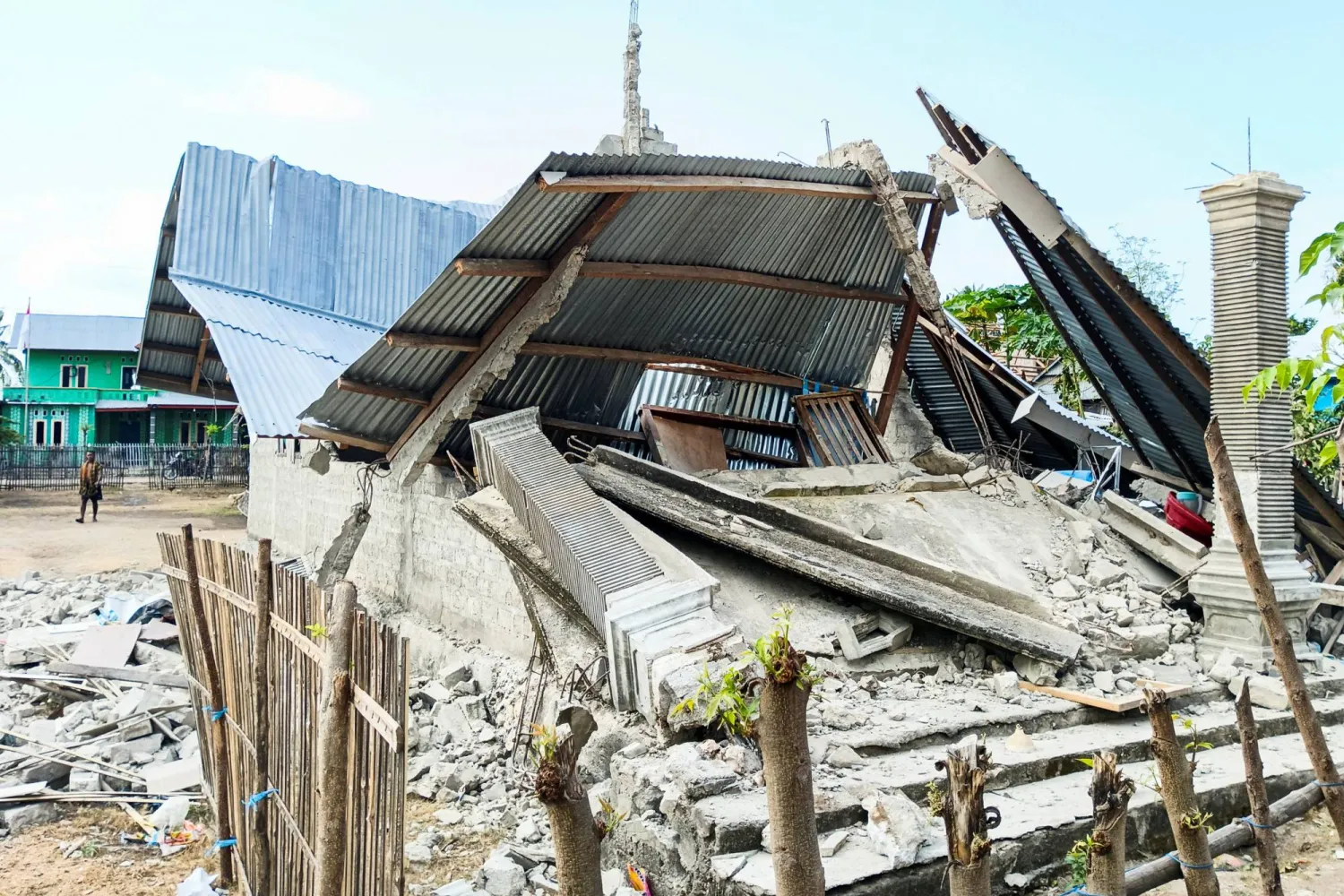
A person walks near a heavily-damaged house after an earthquake felt in Nanga Mbaur village, East Manggarai, East Nusa Tenggara province, Indonesia, August 16, 2026. (Reuters)
TT

Thousands Evacuate After Indonesia Quake Kills 51, Cuts Roads

A person walks near a heavily-damaged house after an earthquake felt in Nanga Mbaur village, East Manggarai, East Nusa Tenggara province, Indonesia, August 16, 2026. (Reuters)

Around 5,000 people have been evacuated after a magnitude-7.7 earthquake smashed an area in eastern Indonesia, killing at least 51, blocking roads and causing landslides, authorities said on Sunday.

Thirty-six people were seriously injured in the Saturday morning quake in East Nusa Tenggara province, while 77 had minor injuries, Deputy Health Minister Benjamin Paulus Octavianus told a televised meeting.

The quake, followed by some 341 aftershocks, is the Southeast Asian nation's deadliest since a 2022 quake killed hundreds in West Java.

More than 3,300 people in the ‌Sikka region ‌self-evacuated or were in a sports arena, said ‌the ⁠disaster mitigation agency BNPB.

Some ⁠Sikka residents were stranded outside collapsed homes under a makeshift tent made out of tarp, while some people received treatment in a tent outside a hospital in the port town of Maumere.

"I only brought my body," Abdul Mutas, 63, told Reuters after he and his family slept on a tarp surrounded by trees ⁠in the town of Sikka.

"The tides were rising, so ‌we ran," he said, describing their ‌reaction to the quake.

"Almost all of Sikka's residents didn't dare stay ‌indoors, so they slept on a porch or a tent ‌outside," Simon Subandi, deputy regent of Sikka, told news channel KompasTV.

More than 3,500 military and police officers have been deployed to the region, Cabinet Secretary Teddy Indra Wijaya said in a statement.

Rescuers reached parts of Maumere ‌that had been blocked by landslides, Indonesia's search and rescue agency said. There was no immediate count ⁠of those ⁠missing, but most of them were trapped under rubble, and more than 1,300 homes were damaged, BNPB said.

Twenty petrol stations were not operational due to power outages, said state energy firm Pertamina.

The East Nusa Tenggara government is considering declaring an emergency for the province, BNPB said, which would allow authorities to mobilize resources and funding.

The area of the quake was hit in 1992 by a magnitude-7.5 earthquake that caused extensive destruction, Indonesia's geophysics agency said.

Indonesia, a sprawling archipelago of 290 million people, straddles the "Pacific Ring of Fire", a seismically active zone where tectonic plates meet, triggering frequent earthquakes and volcanic eruptions.



IAEA Confirms Activity at Iran’s Pickaxe Mountain

The International Atomic Energy Agency (IAEA) flag flies during a special session of an IAEA Board of Governors meeting in Vienna, Austria, March 2, 2026. (AP)
TT

IAEA Confirms Activity at Iran’s Pickaxe Mountain

The International Atomic Energy Agency (IAEA) flag flies during a special session of an IAEA Board of Governors meeting in Vienna, Austria, March 2, 2026. (AP)

The United Nations atomic watchdog said on Thursday it has observed construction activity at Iran’s Pickaxe Mountain, a heavily-fortified site suspected of housing nuclear-related activities.

International Atomic Energy Agency chief Rafael Grossi said new movement at the complex had been spotted in remote imagery.

“There are some indications that there is movement around this construction site,” Grossi told Bloomberg Television.

“We don’t have any concrete information as to activities that may be taking place there,” he added.

Pickaxe Mountain, located in the Zagros Mountains roughly 220 kilometers south of Tehran, began drawing particular attention after an Iranian centrifuge workshop was sabotaged six years ago.

Iran said it intended to move sensitive nuclear-related infrastructure underground to protect it from attack.

“They said at the time, ‘we are going to put everything in tunnels, inside a mountain,’” Grossi told Bloomberg. “This was going to be impermeable and protected from attacks.”

Western intelligence suspects Iran is building an undeclared enrichment facility inside Pickaxe Mountain that could be used to enrich uranium.

On Wednesday, US President Donald Trump mentioned the Pickaxe at a Republican rally and said: “We notice there’s a little activity at Pickaxe. I would advise Iran not to get cute because we will have to hit them very hard.”

Trump has been threatening strikes on Pickaxe Mountain since at least mid-July.

Unverified nuclear stockpile

At the quarterly meeting of the IAEA board of governors in Vienna this week, Grossi said the UN watchdog has been completely blind regarding Iran's nuclear program since at least June 2025, when the US and Israel launched a 12-day conflict that included strikes on nuclear sites.

Prior to the June strikes, the IAEA calculated that Iran possessed approximately 440,9 kilograms of uranium enriched to 60%, which is close to the 90% needed to make a bomb and well above the 3.67% limit set by a 2015 now-defunct agreement with Iran.

On Wednesday, the UN atomic watchdog’s board reported Iran to the UN Security Council for the first time in 20 years, citing it for failure to cooperate in a long-running investigation into uranium traces detected by inspectors at undeclared sites.

The resolution accused Iran of failing to comply with its nuclear reporting obligations, citing it for failure to cooperate in a long-running investigation into uranium traces detected by inspectors at undeclared sites.

Tehran responds

In return, Iranian deputy Foreign Minister Kazem Gharibabadi slammed the IAEA for referring Iran's nuclear file to the UN Security Council.

Gharibabadi wrote in a post on X, “They attack Iran's safeguarded nuclear facilities, disrupt the normal process of verification, and then use that very disruption as a pretext to issue a resolution.”

He described the approach as “fabricated”, saying: “With these fabrications, you cannot make up for the failure of your policies and actions, nor achieve any result at the Security Council.”

Iran’s mission to the UN also denounced the resolution. “It follows a telling trend and facilitates further erosion and ultimate collapse of the proliferation regime as a whole,” the mission said in a post on X.

The resolution sparked criticism in Tehran. Politicians said Iran should accelerate the development of the nuclear program and reconsider its membership in the Nuclear Non-Proliferation Treaty.

Iranian deputy Rouhollah Najabat said that following the IAEA Board of Governors’ resolution, Tehran will accelerate the technical development of its nuclear program.

“Westerners should know that the path of threats and referring the case to the Security Council is ineffective,” Najabat said.

He added that Iran will make no concessions but will take a “more serious and firm” approach.

The deputy warned that the Iranian parliament will not remain “passive.”

Lawmaker Alireza Salimi, a member of parliament’s presiding board, said Iran had “serious options” for responding. “One of our options could be withdrawal from the NPT,” he said, adding: “Iran will certainly respond.”


Hormuz Shipping Traffic Falls to Single Digits

FILE PHOTO: Vessels near the Strait of Hormuz, as seen from Musandam, Oman, September 2, 2026. REUTERS/Stringer/File Photo
TT

Hormuz Shipping Traffic Falls to Single Digits

FILE PHOTO: Vessels near the Strait of Hormuz, as seen from Musandam, Oman, September 2, 2026. REUTERS/Stringer/File Photo

Vessel transits at the Strait of Hormuz fell to seven on Thursday from 11 the previous day, preliminary ship-tracking data showed on Friday, well below the 10-day average of 15.

Of the seven vessels, two Panamax ships exited the strait, one carrying fertilizer and the other sailing in ballast, according to data from ship tracker Kpler as of 0306 GMT.

Five vessels entered the strait, including a Panamax vessel carrying dry bulk cargo, a Handysize vessel laden with steel, a Handysize vessel carrying grains, a medium-range tanker loaded with dirty petroleum products, and a Supramax vessel carrying dry bulk cargo.

The ⁠figures exclude any ⁠vessels that might have crossed the strait with their Automatic Identification System transponders turned off to avoid detection.

Meanwhile, two ballast QatarEnergy-linked vessels, the Al Ghashamiya and the Al Daayen, appeared inside the Strait of Hormuz this week on September 9 and 6, respectively, after last being seen outside the waterway on September 6 and ⁠3.

Another QatarEnergy-controlled vessel, Al Marrouna, also exited the Strait of Hormuz this week, delivering a cargo from Ras Laffan to Pakistan on September 10. The voyage marked the first known LNG shipment aboard a Qatar-linked tanker since late July, when Al Areesh carried a cargo from Ras Laffan also to Pakistan.

Before the Iran war started on February 28, the strait typically handled about 125 large, commercial vessels per day, including tankers, gas carriers, bulkers and ⁠container vessels, accounting ⁠for some 20% of the world’s daily crude oil and liquefied natural gas supply.

A US blockade of Iran-related shipping has halted Iranian crude oil exports since it was reimposed in mid-July.


Zelenskyy Visits Canada to Seek Further Military Support for Ukraine

Ukrainian President Volodymyr Zelenskyy (archive)
TT

Zelenskyy Visits Canada to Seek Further Military Support for Ukraine

Ukrainian President Volodymyr Zelenskyy (archive)

Ukrainian President Volodymyr Zelenskyy was in Canada on Thursday for talks with Prime Minister Mark Carney, his latest international trip aimed at locking in future support for Ukraine’s fight against Russia’s invasion.

Ukraine is under pressure from Russia’s air war, which is using ballistic missiles and jet-powered drones to pierce defenses. Moscow’s attacks have targeted Ukraine’s power grid ahead of the upcoming winter as part of its campaign to demoralize civilians, Ukrainian officials say.

“The main focus will be on supporting Ukraine in protecting our skies and preparing for the winter,” Zelenskyy said of his Canada trip in a social media post. “We will discuss how to strengthen our resilience, support our people, and ensure that Ukraine has the capabilities it needs to defend itself.”

Canada and European countries are sending their own weaponry to Ukraine and are also buying American weapons for Kyiv under the so-called Prioritized Ukraine Requirements List, or PURL. The United States under President Donald Trump has stopped donating weapons to Ukraine, The Associated Press said.

Recent US efforts to stop the more than four years of fighting have delivered no significant breakthrough, although Washington-brokered talks between delegations from Moscow and Kyiv are expected to continue.

Zelenskyy’s arrival on Wednesday night in Calgary, Alberta, came the day after his flight from Moldova to Norway was delayed when authorities closed Moldova’s airspace because of a drone incursion.

The aerial drone battle between Russia and Ukraine has grown in scale since Russia’s all-out invasion in February 2022. Ukraine’s neighbors Romania and Moldova, and other European countries, have reported repeated drone incursions.

Ukraine's drones now reach targets in Siberia, officials say

A Ukrainian sea drone wounded 28 people, including two children, on the waterfront in the Russian city of Sochi, local officials said. They said that beach infrastructure had been damaged but did not provide further details.

Russia’s Ministry of Defense said Thursday that its forces shot down 448 Ukrainian drones overnight. The drones were destroyed over 13 Russian regions, as well as the annexed Ukrainian peninsula of Crimea and the Black and Caspian seas, the ministry said.

Falling debris from a Ukrainian drone set fire to a home in Russia’s southwestern Voronezh region, killing one woman and wounding two other people, local Gov. Alexander Gusev said Thursday.

Ukrainian forces struck eight Russian infrastructure targets supporting the war effort over the past 24 hours, including a refinery in the Yamalo-Nenets region and a port in Dagestan, Zelenskyy said Thursday.

Targets in the Moscow, Voronezh, Astrakhan and Bryansk regions were also hit, he said.

Those targets were hundreds of kilometers (miles) apart, underlining the scope and scale of Ukraine's domestically developed long-range drone technology that has unsettled Russia.

The previous day, Ukrainian forces struck an oil refinery more than 3,000 kilometers (1,800 miles) from Ukraine in Siberia, Ukraine’s General Staff said, confirming earlier reports.

Meantime, Russian forces launched 149 drones, many of them jet-propelled, at Ukraine overnight, Ukraine’s air force said Thursday.

One person was killed and two others wounded in a Russian drone attack on the Kyiv region on Thursday morning, regional head Tymur Tkachenko said.

At least 16 other civilians were wounded in other Ukrainian regions, according to local authorities.