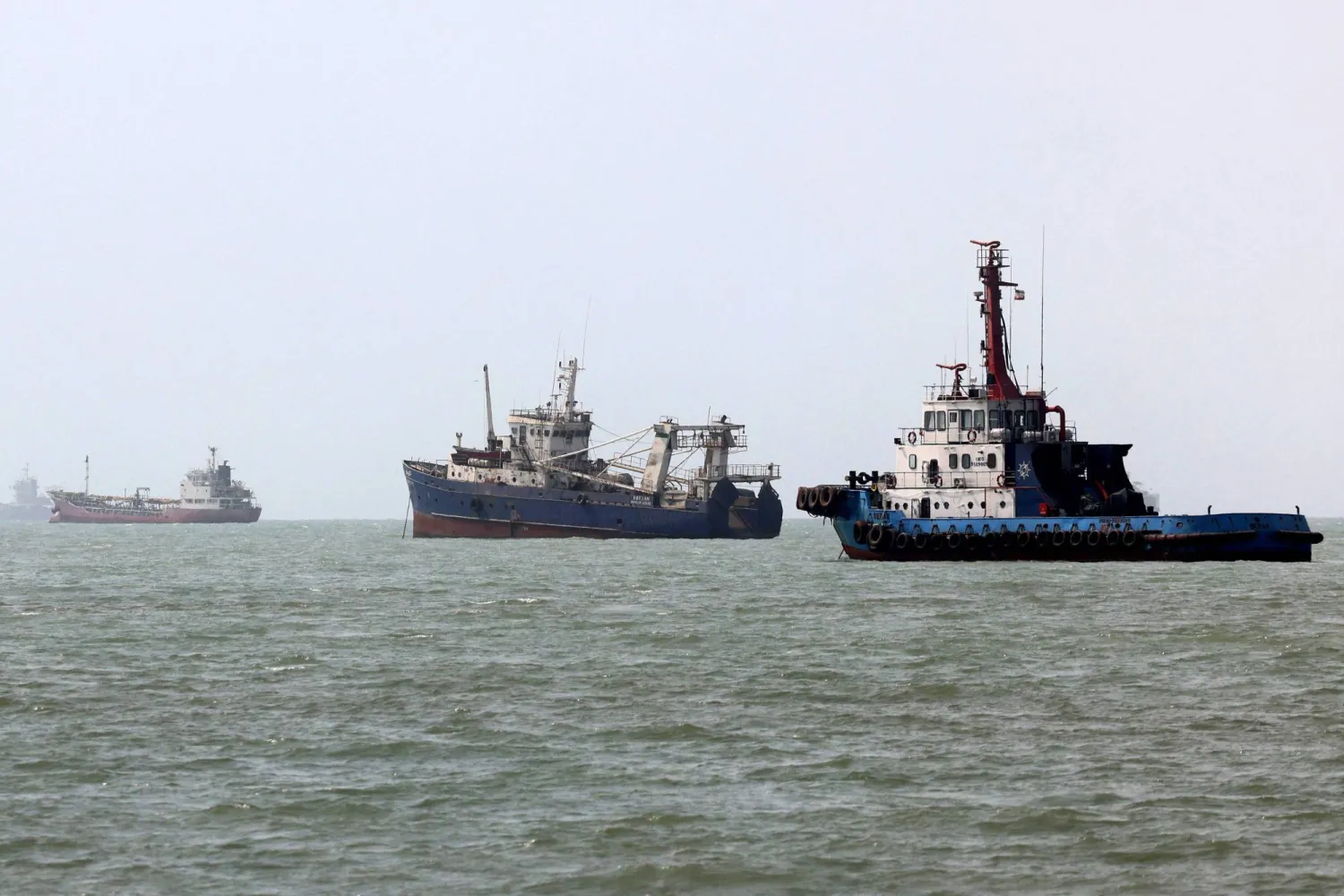
Hormuz Crossings Rise Slightly from Weekend, Remain in Single Digits

Archive photo of ships crossing the Strait of Hormuz (AFP)
TT

Hormuz Crossings Rise Slightly from Weekend, Remain in Single Digits

Archive photo of ships crossing the Strait of Hormuz (AFP)

Ship ‌crossings via the Strait of Hormuz were still in single digits on Monday, despite rising slightly from the weekend, according to preliminary shipping data on Tuesday, amid a stalemate in US and Iranian peace talks.

Six commodity ships transited the strait on Monday, of ‌which three were exiting ‌the Gulf and ‌three ⁠were entering, Kpler shiptracking ⁠data showed, compared with the 10-day average of 11 ships. Three ships transited on Saturday while two moved through the waterway on Sunday.

There were no very ⁠large crude carriers or tankers ‌carrying liquefied ‌natural gas passing through, reported Reuters.

Some vessels could be ‌passing through the strait ‌with their transponders switched off and they are not considered in the tally.

The very large gas carrier (VLGC) Xavia entered ‌the strait via the Iranian route under ballast, meaning empty ⁠of ⁠a cargo, according to the data. VLGCs are typically used to ship liquefied petroleum gases such as propane and butane.

A medium-range fuel tanker and an intermediate-range tanker also entered the Gulf, the data showed, while a medium-sized LPG carrier, a Panamax bulk carrier and a Panamax-sized fuel tanker exited the Gulf.


Trump Hints at Kim Contacts after Scaling Back Seoul Drills

(FILES) North Korea's leader Kim Jong Un and US President Donald Trump cross south of the Military Demarcation Line that divides North and South Korea, after Trump briefly stepped over to the northern side, in the Joint Security Area (JSA) of Panmunjom in the Demilitarized zone (DMZ) on June 30, 2019. (Photo by Brendan Smialowski / AFP)
TT

Trump Hints at Kim Contacts after Scaling Back Seoul Drills

(FILES) North Korea's leader Kim Jong Un and US President Donald Trump cross south of the Military Demarcation Line that divides North and South Korea, after Trump briefly stepped over to the northern side, in the Joint Security Area (JSA) of Panmunjom in the Demilitarized zone (DMZ) on June 30, 2019. (Photo by Brendan Smialowski / AFP)

US President Donald Trump said Monday that Kim Jong Un had responded to his recent overtures, a day after he scaled back military drills with South Korea and praised his relationship with the North Korean leader.

Trump said he was making the situation "much safer" through his ties to Kim, whom he met three times in his first spell in the White House but has yet to encounter during his second term, reported AFP.

While praising the leader of nuclear-armed North Korea, he rebuked key ally Seoul for failing to help Washington fight Iran -- a war Trump says is aimed at stopping Tehran from getting an atomic bomb.

Asked why Kim had not replied to his requests for a conversation since returning to office last year, Trump told reporters in the Oval Office: "How do you know he hasn't responded?"

When pressed about whether Kim had actually responded, Trump said: "Yeah, he has."

Asked what stage the conversations with Kim were at, Trump said "it's very positive," but provided no further detail.

Trump then doubled down on his praise for Kim, saying their ties reduced tensions.

"You see, I'm actually making it much safer. Kim Jong Un has always treated me with great respect," Trump said. "I understand him. He understands me."

- 'Strange' -

Trump initially took aim at South Korea on his Truth Social network on Sunday night, abruptly announcing that he had ordered the Pentagon to scale back "inappropriate and hostile" military drills with Seoul.

He also linked the decision to South Korea's refusal to help with the US-Israeli war with Iran.

"Wait a minute. We have 39,000 soldiers over there, guarding you from Kim Jong Un, your next-door neighbor, and you're not going to help us on a very easy military operation in Iran. That's strange," Trump said in the Oval Office.

Trump once again called into question US support for both South Korea and NATO allies that have refused to contribute to the Iran war.

"We can't go around and protect all of these countries, especially when they're not there to help us," he said.

South Korean officials said the exercises had begun as planned and that they hoped the personal chemistry between Trump and Kim would bring them back to talks.

On Tuesday, Seoul's presidential office said the drills did not reflect "any intention to attack North Korea or escalate tensions on the Korean peninsula."

President Lee Jae Myung reiterated that their fundamental purpose is "not to treat a specific entity as an adversary, but to safeguard the safe and peaceful daily lives of the people," his office added.

North Korea has not responded publicly, although it has previously voiced anger at the regular joint maneuvers that take place in the South.

The top US Senate Democrat on military affairs slammed Trump's order to downsize the drills, and said China and Russia were "watching how easily this president abandons America's allies."

"This is another inane, haphazard decision by President Trump and his chaotic administration," Senate Armed Services Committee ranking member Jack Reed said.

- Asian anxiety -

The 11-day Ulchi Freedom Shield exercises are designed to prepare for a possible war with North Korea.

Colonel Ryan Donald, spokesman for the US and South Korean Combined Forces Command, has said they will simulate combat against North Korean troops hardened by their deployment on Russia's side in its invasion of Ukraine.

Seoul's presidential office told AFP it remained in "close coordination" with Washington over the exercises.

Pyongyang decries the drills as dress rehearsals for an invasion.

The United States stations about 28,500 troops in South Korea to bolster the country's defenses, a legacy of the 1950-53 Korean War that ended with an armistice rather than a peace treaty.

But Trump's repeated criticism of time-honored alliances has cast doubt on US commitments to security in East Asia.

The announcement of the scaled-down drills came as the only US aircraft carrier operating in the Pacific region, the USS George Washington, is being redeployed to the Middle East to relieve the long-deployed USS Lincoln, which has been the focus of concerns over mental health and supply issues.


Erdogan Urges Trump to Pursue Talks with Iran, Offers Support

Turkish President Recep Tayyip Erdogan and Palestinian President Mahmoud Abbas (not pictured) attend a press conference following their meeting in Ankara, Türkiye, 12 August 2026. (EPA)
TT

Erdogan Urges Trump to Pursue Talks with Iran, Offers Support

Turkish President Recep Tayyip Erdogan and Palestinian President Mahmoud Abbas (not pictured) attend a press conference following their meeting in Ankara, Türkiye, 12 August 2026. (EPA)

Turkish President Recep Tayyip Erdogan urged US President Donald Trump in a phone call to pursue talks with Iran to de-escalate tensions between the two countries, and offered Ankara's support for peace efforts, the Turkish presidency said on Tuesday.

Türkiye, which has NATO's second-largest army and borders Iran, has repeatedly called for an end to the war. It has maintained close contact with the United States, Iran, and mediators such as Pakistan and Qatar, while also acting as an ‌intermediary between the parties.

"Erdogan ‌stated that it is of great ‌importance ⁠to make the utmost ⁠of diplomacy regarding the tensions between Iran and the United States, that we hope the talks will continue, and that Türkiye will continue to support peace efforts," the presidency said in a statement.

The call comes after a senior Iranian official told Reuters earlier on Monday that Iran would shift ⁠to a "fully offensive" military posture because efforts ‌to negotiate a permanent end ‌to the war have stalled, as Washington ruled out extending a temporary ‌ceasefire agreement.

Progress towards a resumption of oil tanker ‌traffic through the Strait of Hormuz has also stalled. Türkiye has criticized the US and Israeli assault on Iran, while also condemning the Iranian attacks on Gulf states and calling for the re-opening of ‌the strategic strait.

On Monday, Türkiye’s foreign minister discussed the strait's re-opening and the continuation of ⁠the ⁠ceasefire with his Iranian counterpart.

The presidency added that Erdogan and Trump also discussed bilateral ties, the war in Gaza, and a defense pact signed between Türkiye, Saudi Arabia, and Pakistan, adding that the Turkish leader praised the accord as a sign of a "strong stance" for regional stability and security.

It said Erdogan told Trump that Israel's attacks on Palestinians had increased at a time when the second phase of Trump's Gaza Peace Plan was supposed to come into effect.

The White House did not immediately respond to a request for comment on the call.


Pentagon Inks Tomahawk Deal Amid Reports of Missile Shortfall

A visitor walks past Raytheon stand at the 53rd International Paris Air Show at Le Bourget Airport near Paris, France June 21, 2019. (Reuters)
TT

Pentagon Inks Tomahawk Deal Amid Reports of Missile Shortfall

A visitor walks past Raytheon stand at the 53rd International Paris Air Show at Le Bourget Airport near Paris, France June 21, 2019. (Reuters)

The Pentagon announced a $22.9 billion contract with Raytheon on Monday for Tomahawk missiles amid reports of a shortfall due to the war with Iran.

Acting US Navy Secretary Hung Cao said the contract will "accelerate Tomahawk missile delivery to our warfighters at unprecedented speed."

"Guaranteeing our naval and joint forces have the lethal firepower they need to deter aggression and protect the homeland is paramount," Cao said in a statement. "The Department is utilizing every available tool to meet the demands of our current operations."

An analysis by the Center for Strategic and International Studies (CSIS) think tank released last month found that US stocks of Patriot and THAAD air defense missiles have been slashed by the conflict with Iran.

Before it began in late February, the United States had more than 2,300 Patriot and more than 450 THAAD interceptors -- figures that CSIS estimated have been roughly halved or more in the subsequent months of war.

The Washington Post reported this month that President Donald Trump had demanded answers from Pentagon chief Pete Hegseth about munitions shortages at a recent cabinet meeting.

Trump and Hegseth both later denied that the United States was faced with dwindling missile stocks.

Tomahawk missiles are mainly launched from submarines and warships and can travel more than 1,600 kilometers (1,000 miles).