Firefighters Push to ‘Encircle’ Belgian Wildfire

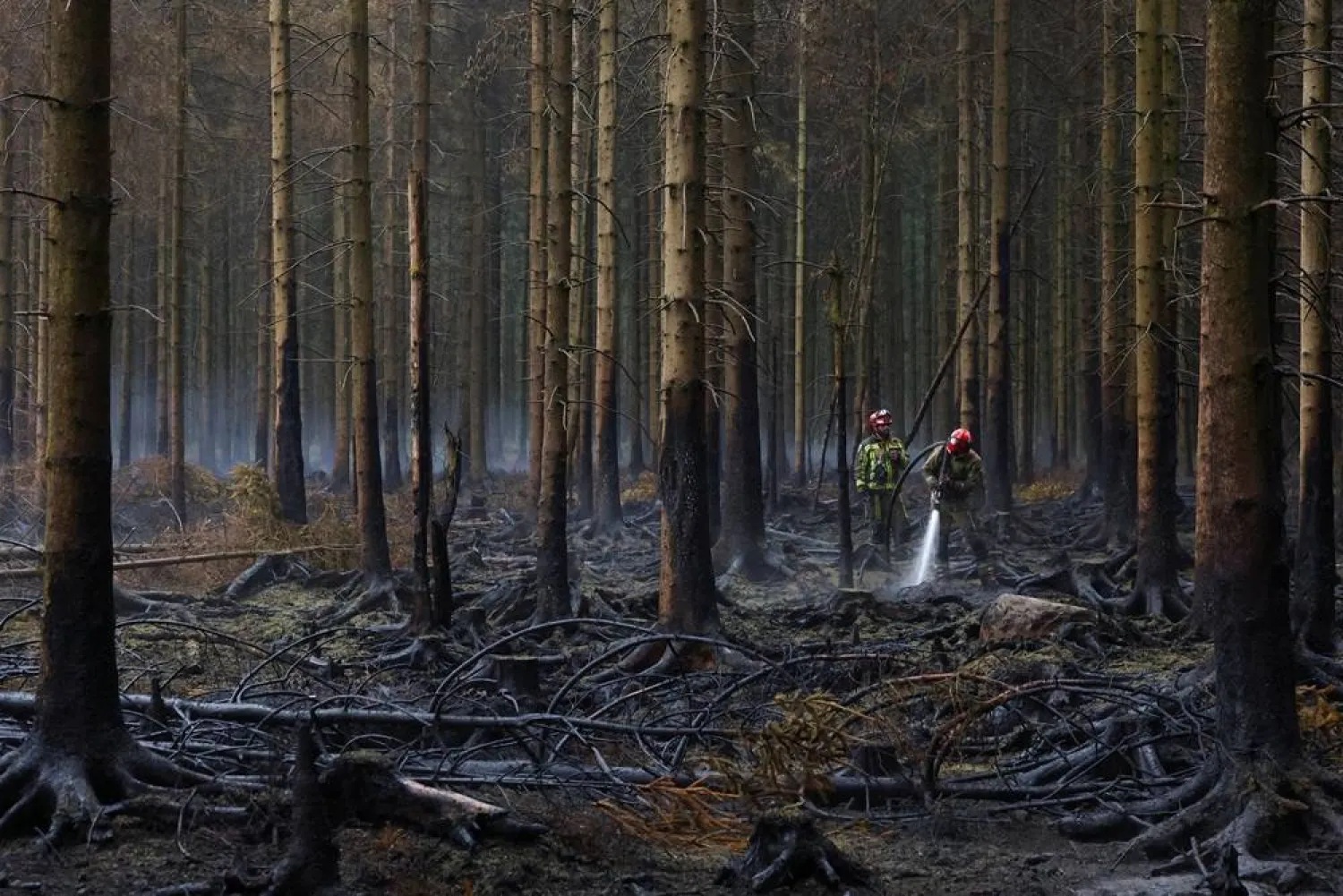
 Belgian firefighters work in a forest affected by a wildfire in Waimes, in the High Fens (Hautes Fagnes) region, Belgium, August 18, 2026. (Reuters)
Belgian firefighters work in a forest affected by a wildfire in Waimes, in the High Fens (Hautes Fagnes) region, Belgium, August 18, 2026. (Reuters)
TT

Firefighters Push to ‘Encircle’ Belgian Wildfire

 Belgian firefighters work in a forest affected by a wildfire in Waimes, in the High Fens (Hautes Fagnes) region, Belgium, August 18, 2026. (Reuters)
Belgian firefighters work in a forest affected by a wildfire in Waimes, in the High Fens (Hautes Fagnes) region, Belgium, August 18, 2026. (Reuters)

Firefighters launched a potentially decisive push Tuesday to encircle Belgium's largest wildfire in a century, despite wind and rain hampering air support operations over the High Fens nature reserve.

The blaze charring the vast expanse of boggy peatlands, pine trees and hiking trails grew over the weekend to half the size of Manhattan -- 3,000 hectares (7,500 acres) -- with hundreds of firefighters working night and day to wrestle it under control.

"We are trying to definitively encircle the fire today," regional government spokesperson Nicolas Yernaux told AFP.

In areas where firefighters could operate, he confirmed the fire was "under control and contained."

But a hard-to-access front towards the German border remains a concern -- with residents in the border town of Monschau already under evacuation orders due to the smoke hazard.

Firefighters worked through the night to make a crucial link-up between the eastern and northern fronts, under very difficult access conditions.

"We're talking about one or two kilometers, and we're on the verge of achieving it," Yernaux told AFP, despite "sustained winds" blowing towards the German border.

Water-bombing aircraft from several countries have been deployed -- with two Norwegian helicopters the latest to fly in on Monday night -- but they have been repeatedly grounded by low cloud and rain. There are also aircraft from Germany, Sweden and the Netherlands.

Yernaux said it was unclear given weather conditions when they would be able to take off again.

"There may be windows of opportunity this morning, but it may not be before tonight."

A huge area has been blanketed by a thick plume of yellowish smoke, with fumes detected as far as eastern France, where authorities issued an air-pollution alert.

The smoke triggered evacuations in one Belgian village and two hamlets of a second -- with residents of the hamlet of Sourbrodt given the green light to return home on Monday night.

- As long as it takes -

Europe has been swept by weeks of devastating wildfires fueled by dry conditions and a historically hot summer, with France, Greece, Portugal and Spain also battling major fires.

The High Fens blaze broke out in an area that was ravaged by massive fires in 1911, during a similar period of heatwaves.

It is the country's largest wildfire since.

During a visit on site with King Philippe on Monday, Belgium's interior minister Bernard Quintin told media it could take "several weeks" of soaking and dousing the area to prevent the fire from reigniting -- even once brought under control.

On-site operations have been made much harder by the fens' terrain -- a patchwork of heath, peat bogs and raised wooden boardwalks where heavy vehicles risk sinking into the ground -- and firefighters struggle to tackle the fire at close range.

They have been counting heavily on aerial assistance to bring the situation under control.

Local farmers have also poured in to help, working shifts to oversee a ballet of tractors pulling in tankers of water from a nearby lake.

"We'll take it in turns as long as it needs -- the team is all set," a farmer from nearby Waremme, told AFP Monday. "We'll keep going until the finish line."

Like much of Europe, Belgium has experienced a new spell of intense heat and drought in recent days.

Temperatures reached as high as 37C in some parts of the country last week, creating conditions conducive to wildfire outbreaks.


Russia’s Lavrov, China’s Wang Discuss Cooperation, Ukraine, Iran at Asia Security Meeting

In this handout photograph taken and released by the Russian Foreign Ministry on October 14, 2026, Russia's Foreign Minister Sergei Lavrov and China's Foreign Minister Wang Yi hold a meeting on the sidelines of the Seventh Summit of the Conference on Interaction and Confidence Building Measures in Asia (CICA) in Baku. (Handout /Russian Foreign Ministry / AFP)
TT

Russia’s Lavrov, China’s Wang Discuss Cooperation, Ukraine, Iran at Asia Security Meeting

In this handout photograph taken and released by the Russian Foreign Ministry on October 14, 2026, Russia's Foreign Minister Sergei Lavrov and China's Foreign Minister Wang Yi hold a meeting on the sidelines of the Seventh Summit of the Conference on Interaction and Confidence Building Measures in Asia (CICA) in Baku. (Handout /Russian Foreign Ministry / AFP)

The Russian ‌and Chinese foreign ministers discussed the state of bilateral cooperation as well as the crises in Ukraine and Iran during an Asia security meeting, the Russian Foreign Ministry said on Wednesday.

Russian President Vladimir Putin and his Chinese counterpart Xi Jinping reaffirmed ‌their strategic ‌alliance at a ‌regional summit ⁠last August and ⁠both praised prospects for closer cooperation.

The statement on Wednesday said Russian Foreign Minister Sergei Lavrov and his Chinese counterpart Wang Yi met in Azerbaijan at ⁠a meeting of the ‌Conference on ‌Interaction and Confidence Building Measures in Asia.

It ‌said the two ministers "praised the ‌development dynamics of comprehensive partnership and strategic cooperation" and "synchronized watches on bilateral political dialogue".

It said discussions ‌also focused on "relations with the United States and the situation ⁠around ⁠the Ukrainian and Iranian crises".

Both Russia and China have called for an end to the Iran conflict, saying it could expand and threaten stability throughout the region.

China has affirmed its "no limits" partnership with Russia throughout the 4-1/2-year-long war in Ukraine, while calling for diplomatic efforts to end the conflict.


Netanyahu Says He Is Not Seeking to Attack Iran Again Before Israel Election

Israeli Prime Minister Benjamin Netanyahu (C) attends a ceremony marking the opening of Colombia's new embassy in Jerusalem, at the Ministry of Foreign Affairs in Jerusalem, Israel, 14 October 2026. (EPA)
TT

Netanyahu Says He Is Not Seeking to Attack Iran Again Before Israel Election

Israeli Prime Minister Benjamin Netanyahu (C) attends a ceremony marking the opening of Colombia's new embassy in Jerusalem, at the Ministry of Foreign Affairs in Jerusalem, Israel, 14 October 2026. (EPA)

Israeli Prime Minister Benjamin Netanyahu said on Wednesday that he was not in favor of a preemptive strike against Iran before Israel's October 27 election but also warned Tehran and its proxies against striking Israel.

"It is not convenient for us, it's no good," Netanyahu said in an interview on Israel's Army Radio, when asked about the possibility of a preemptive strike and allegations by his political rivals that he was seeking a military confrontation ahead of the election.

"Even if Iran fires missiles at us they will blame me," Netanyahu ‌said, though ‌he also repeated his previous warnings to Iran, saying ‌Israel ⁠would respond forcefully ⁠if attacked.

He would not elaborate on the possibility of a preemptive strike after the election or about his recent discussions with Washington about Iran.

The United States and Iran have been at war since February 28 when the US and Israel attacked Iran and Tehran responded with its own strikes on Israel and Gulf states.

Israel and Iran have not traded ⁠fire since June.

Netanyahu said that Iran's proxies were looking to launch attacks ‌on Israel before the election.

Defense Minister Israel Katz, speaking from the self-declared security zone Israeli forces are ⁠occupying in southern Lebanon, ⁠warned Iran-backed Lebanese group Hezbollah against attacking Israel.

"Hezbollah will suffer a severe blow and lose additional territories in southern Lebanon within the Nabatieh and Litani regions, which will become part of Israel's permanent security zone. The army is prepared to carry out the maneuver," Katz said.

Katz said that a million Shiites would be displaced and that Hezbollah's stronghold in Beirut would not be spared.

Israel launched air strikes and a ground invasion in southern Lebanon this year in parallel with the war in Iran, after Hezbollah fired into Israel in revenge for the attacks against Tehran.

Hundreds of thousands of people from Lebanon's Shiite community, from which Hezbollah draws its support, were uprooted by the fighting.


Israel Army Chief Says Reinforcing Troops on All Fronts

Israeli army chief Lieutenant General Eyal Zamir. (Reuters file)
TT

Israel Army Chief Says Reinforcing Troops on All Fronts

Israeli army chief Lieutenant General Eyal Zamir. (Reuters file)

Israel's army chief said on Wednesday that the military was reinforcing troop levels "across all fronts", citing an increased risk of escalation as the country heads into elections this later month.

On a visit to the occupied West Bank, Lieutenant General Eyal Zamir said the potential for incidents on Israel's borders had grown because of the election period, with Prime Minister Benjamin Netanyahu facing a tight race to stay in power in the October 27 poll.

"In light of the increased number of alerts across all fronts and the sensitivity of this period, the potential for escalation has grown," he said, according to an Israeli military statement.

"We have reinforced our forces across all areas."

He added that the military had raised its level of readiness as it prepares "for scenarios in which attempts may be made to catch us by surprise".

Israel recently marked the third anniversary of Hamas's surprise October 7 attack, in which the group's fighters stormed into Israel with pickup trucks and paragliders and opened fire at sites including a music festival.

Citing the need for "vigilance", Zamir said the military was "at a high level of readiness to launch extensive offensive operations against anyone who attempts to harm Israeli civilians".

In Gaza, a year after a US-brokered ceasefire agreement between Israel and Hamas took effect, the Israeli army now controls more than 60 percent of the devastated Palestinian territory and its strikes are ongoing.

In Lebanon, violence has decreased in the south since a framework agreement between the government and Israel, which includes the disarmament of Hezbollah. But the implementation of that deal has stalled.

Israel has also faced incoming fire from Iran during the Middle East war, which began in February with US-Israeli strikes on the country.