


Seoul Detects North Korean Missile Launches after Trump Says to Meet Kim

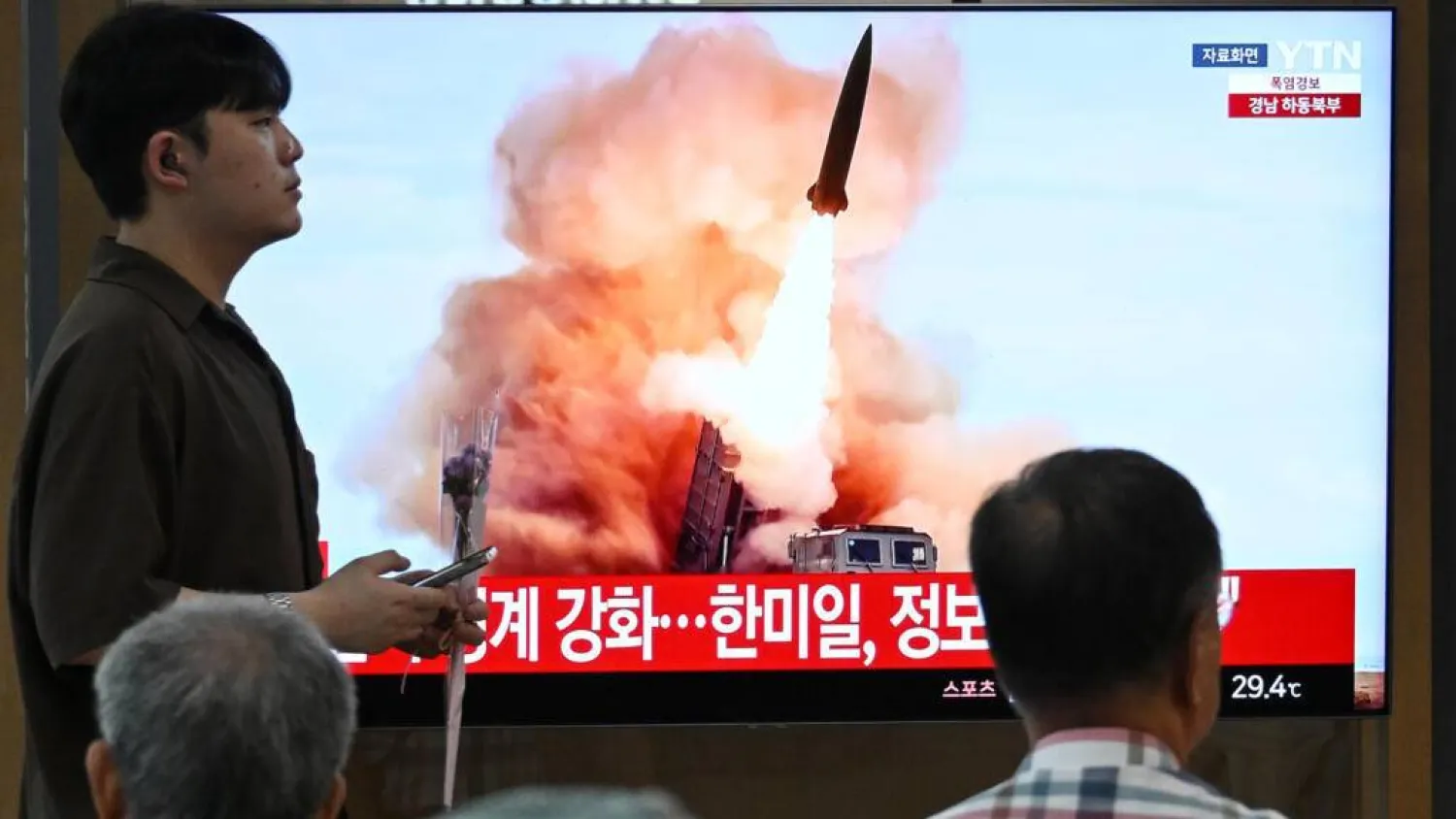
People watch a news broadcast with file footage of a North Korean missile test, at a train station in Seoul. Jung Yeon-je / AFP
TT

Seoul Detects North Korean Missile Launches after Trump Says to Meet Kim

People watch a news broadcast with file footage of a North Korean missile test, at a train station in Seoul. Jung Yeon-je / AFP

North Korea has fired several short-range ballistic missiles, Seoul's military said on Thursday, hours after US President Donald Trump said he would meet Pyongyang's Kim Jong Un this year.

The latest launches from the nuclear-armed North come as South Korea and the United States hold a shorter edition of their annual Ulchi Freedom Shield military exercises, following an order from Trump to scale them back.

Pyongyang has long condemned US-South Korea joint exercises as rehearsals for invasion, often staging missile launches around the drills.

Trump, seeking to revive the bond he claims to have forged with Kim in his first term, told reporters at the White House on Wednesday he plans to meet the North Korean leader later this year.

The US president also said it was important to "get along" with Kim, adding that Pyongyang now had 57 "very powerful" nuclear weapons. Seoul says there are around 80-120.

Hours after Trump's remarks, an official from Seoul's Joint Chiefs of Staff told AFP that the North fired "around 10 short-range ballistic missiles" from the Pyongyang area.

Japan earlier said a suspected "ballistic missile launched by North Korea a short while ago has already fallen", according to an X post from the prime minister's office.

Trump's sudden focus on Kim and his scaling back of joint US-South Korean military drills have alarmed Asian allies, while sparking speculation that he was seeking a foreign policy win as the Iran war stalls.

Kim Yo Jong, the powerful sister of the North Korean leader, said on Wednesday that her brother had "good memories and feelings" about Trump and that the relationship between the two leaders remains "excellent".

She said, however, that she was unaware of any current communication between the two leaders.

Her statement came hours after Seoul announced the Ulchi Freedom Shield exercises would end on Friday -- about a week earlier than planned -- "at the suggestion of the US side".

The Pentagon said the reduced drills would cause "no degradation to US training objectives".

The exercises are designed to prepare for a possible attack by North Korea.

The United States stations about 28,500 troops in South Korea to bolster the country's defenses, a legacy of the 1950-53 Korean War that ended with an armistice rather than a peace treaty.

South Korea's Defense Minister Ahn Gyu-back said Seoul remained opposed to officially recognizing the North as a nuclear-weapon state.

Asked whether Washington had "given up" on North Korea's denuclearization, Ahn said he did not believe so.

President Lee Jae Myung - who has long pushed for stronger homegrown defenses to reduce South Korea's reliance on the United States -- said on Wednesday he would "do his utmost" to support Trump's peacemaking efforts with the North.



Japan Train Hits Station Workers, 4 Killed

A man takes photographs of a Japanese government sign reading "Day of the Return of the Northern Territories, Day of Peace. The Northern Territories are an inherent part of Japan's territory." (Photo by Yuichi YAMAZAKI / AFP)
TT

Japan Train Hits Station Workers, 4 Killed

A man takes photographs of a Japanese government sign reading "Day of the Return of the Northern Territories, Day of Peace. The Northern Territories are an inherent part of Japan's territory." (Photo by Yuichi YAMAZAKI / AFP)

A train hit and killed four workers in Japan on Thursday, authorities said, a rare incident in a country renowned for its normally excellent rail safety record.

Local media reported that the four workers were removing weeds from the train tracks at Shin-Kanuma Station in Kanuma city north of Tokyo when the express train struck them.

"The four were confirmed dead," a fire department official told AFP.

Another official said that when emergency services arrived, three workers were trapped under the train, while one was on the platform.

The workers, all men, were in their 50s and 60s, Jiji Press reported. None of the roughly 50 passengers on the train suffered injuries.

The six-car train was the Spacia X express on the Tobu Nikko Line, connecting Greater Tokyo with popular tourist destination Nikko in the Tochigi region, media reports said.

The Tokyo-bound train was approaching its stop at Shin-Kanuma when the accident occurred, broadcaster NHK said, citing the operator.

"We heard this loud rumbling noise. Then the train came to an emergency stop with such sudden braking that it was impossible to stand," a 40-year-old man who was on the train told NHK.

"There was an announcement saying 'we will stop to identify where the noise came from', and then we were left unable to get off for a while," the man was quoted as saying.

Local media reported that the workers were part of a seven-person crew removing weeds from around the train tracks.

Japanese railways have one of the best safety records in the world.

Fatal accidents from malfunctioning trains are extremely rare in Japan due to high levels of maintenance and training, and use of advanced technology.

Japan's deadliest accident this century was in April 2005 when a rush-hour commuter train derailed and smashed into an apartment building in Amagasaki, in the country's west, killing 107 people and injured more than 500 others.

An accident involving a derailed cargo train and two passenger trains killed 161 people in 1963.

There has never been a passenger fatality from a derailment or a collision on Japan's network of "shinkansen" bullet trains since they entered service in 1964.


Iran Slams Trump's Economic Pressure Plan as a 'Diversion from America's Own Crisis'

FILED - 16 March 2018, Austria, Vienna: FILE PHOTO - Abbas Araghchi, Deputy Foreign Minister of Iran, gives an interview in Vienna. Photo: Farshid-Motahari Bina/dpa
TT

Iran Slams Trump's Economic Pressure Plan as a 'Diversion from America's Own Crisis'

FILED - 16 March 2018, Austria, Vienna: FILE PHOTO - Abbas Araghchi, Deputy Foreign Minister of Iran, gives an interview in Vienna. Photo: Farshid-Motahari Bina/dpa

Iran's Foreign Minister Abbas Araghchi on Thursday dismissed US President Donald Trump's economic punishment plan for Tehran as a continuation of "failed policies", which he said would bring Washington "further defeat".

"The so-called 'Economic D-Day' is a diversion from America's own crisis: unprecedented debt & surging interest costs. Doubling down on failed policies will only bring further defeat -- and enmity of Iranians," Araghchi said in a post on X.

"US economic terrorism threatens global economy and sovereignty worldwide."

In a post on his Truth Social, Trump said he was announcing "the MOST CRUSHING ECONOMIC OPERATION EVER TAKEN AGAINST ANY COUNTRY! This will be Economic Warfare and Isolation on an unprecedented scale."

"ANY country that allows its financial institutions, businesses, airports, or government entities to provide any type of lifeline to Iran will itself face TREMENDOUS Economic Consequences," he said.

War broke out between Iran and the United States on February 28 with US-Israeli attacks which triggered Iranian retaliation across the region.

An April 8 ceasefire put an end to the intense bombardment but sporadic clashes continued in and around the Strait of Hormuz, a vital energy conduit which Iran has blockaded and has since become flashpoint in the conflict.

Reopening the strait has become a US priority but Iran insists the waterway will remain closed until Washington lifts its naval blockade on Iranian ports, removes oil sanctions, and unfreezes Iran's assets abroad.

Trump has long pursued a "maximum pressure" policy of economic sanctions on Iran and reinstated those measures after he took office in January 2025, mirroring his approach during his first term.

Iran has dismissed the sanctions program as a failure, insisting that such measures and threats will not force it to change course.


NATO Prepared to Address Iranian Threats Extending to Europe

US Air Force planes on the tarmac of Sofia airport, Bulgaria, February 19, 2026. REUTERS/Stoyan Nenov/File Photo
TT

NATO Prepared to Address Iranian Threats Extending to Europe

US Air Force planes on the tarmac of Sofia airport, Bulgaria, February 19, 2026. REUTERS/Stoyan Nenov/File Photo

NATO is prepared to address any threat and will always do what is necessary to defend all allies, a NATO official said on Wednesday in response to questions about a report in the Financial Times that Iran has allegedly weighed attacking US military targets in Europe should Donald Trump escalate the war.

“As demonstrated earlier this year when NATO air defenses successfully intercepted ballistic missiles heading to Turkiye from Iran on four separate occasions, our deterrence and defense posture is strong and effective,” the official said.

Citing two regime insiders, the Financial Times reported on Wednesday that Iran has been weighing ways to broaden the confrontation beyond the Middle East if Washington intensifies military action.

One regime insider said Iran was preparing options to expand the conflict if Trump followed through on previous threats to attack Iranian infrastructure. Another said Tehran would place “no limits” on its response.

Iranian forces had assessed possible strikes against US assets in southeastern Europe, including Bulgaria, which approved the use of Bezmer Air Base by US refueling aircraft last month, the sources said.

Cyprus, where a British air base was hit by a drone in March, was also identified as a potential target for retaliation against a renewed US offensive, according to one of the sources.

Iran’s forces had separately examined attacks on subsea fiber-optic cables in the Strait of Hormuz if the conflict intensified, according to the report.

The sources described last month’s strike on a US base in Jordan, which killed three American service members, as Tehran’s most accurate long-range attack to date and evidence of its ability to hit targets farther afield.

“This was also a message to Europe: it can receive missiles, so it should know where it should stand in this war,” a first insider said. “A very big mistake, such as hitting our infrastructure, could make the war go beyond the region and reach Europe.”

Iranian Threats

Chief of the General Staff of Iran’s Armed Forces, Major General Ali Abdollahi, warned on Wednesday that any form of assistance to the US military will be interpreted by Tehran as active “complicity” with American forces.

In a statement posted on X, Abdollahi pointed to a rising concentration of US military aircraft across regional installations, saying, “It is improbable that this volume of military aircraft, particularly aerial refueling tankers, is operating out of regional bases without the awareness of host nations.”

He said Tehran will view any form of “assistance or facilitation” provided to the US military as direct military cooperation with American forces.

Also on Wednesday, Iran’s deputy Foreign Minister for Legal and International Affairs, Kazem Gharibabadi, emphasized that any country that hands its destiny over to foreigners will pay a heavy price.

He noted that today’s Iran determines its own future, with the nation refusing to retreat under pressure and standing firmer in the face of compulsion and threats.

Gharibabadi’s threats came after Bulgaria’s Parliament backed a government proposal to allow the US military to use an air base in the Balkan country to support US operations in the Middle East, while some expressed concern about becoming involved in the Iran war.

Legislators in Bulgaria voted to allow up to eight US KC-135 refueling aircraft along with 250 personnel and supporting equipment at Bezmer Air Base to Oct. 1.

Later, Iran's Foreign Minister Abbas Araghchi urged Bulgaria to reconsider its decision to allow the temporary deployment of US military aircraft at the ‌Bezmer air base, Iranian state media reported.

During a phone call last month with his Bulgarian counterpart, Velislava Petrova-Chamova, Araghchi said Sofia's approval of a US request to station military aircraft at the base to support military operations amounted to facilitating aggression against Iran, adding the move was unacceptable and contrary ⁠to the traditionally friendly relations between the two countries.

Ahead of the FT report, a senior Iranian official told Reuters on Monday that Iran will shift to a “fully offensive” military posture because efforts to negotiate a permanent end to the war with the US have stalled.

“Iranian entities must be prepared to escalate tensions in the Strait of Hormuz and wider region, as Iran will be ready to make decisions and take action on difficult decisions,” the Iranian official said, adding that Tehran would conduct a “timely and precise” military attack to break the US naval blockade if diplomacy failed.

Iran’s Medium-Range Missiles

Military analysts told the FT that Iran could deploy medium-range ballistic missiles against US assets in southern and southeastern Europe, such as its Shahab series. However, they said such missiles would likely struggle to cause significant damage at greater distances. The scale of any Iranian retaliation would depend on Washington’s next moves.

The analysts said heavier-duty missiles could also be deployed, but would have to carry a lighter payload to travel far enough — meaning damage would be minimal.

Douglas Barrie of the International Institute for Strategic Studies noted that earlier Iranian attempts against Diego Garcia indicated weapons exceeding 2,000 kilometers in range, making European contingencies more concrete, while unsuccessful outcomes exposed reliability, interception, and precision limitations.

In the weeks after the US and Israel launched the war in February, Washington accused Tehran of firing multiple missiles at Diego Garcia, the joint US-British military base in the Indian Ocean roughly 4,000 kilometers away. None of the missiles reached their target.

In March, Türkiye said NATO air defenses had intercepted several ballistic missiles launched from Iran. That same month, the British base at Akrotiri in Cyprus was hit by a drone.

Western officials assessed at the time that it was most likely an Iranian unmanned aircraft used by forces aligned with Tehran, rather than a direct strike by Iran itself.

And while reports said Iran will shift to a “fully offensive” military posture, Iranian Supreme Leader Mojtaba Khamenei has issued decrees appointing six military and IRGC officials to leadership positions.

He named Ahmad Vahidi as head of the IRGC, and Hossein Taeb as commander of the IRGC's Basij paramilitary. The appointments came after the preceding holders were killed in Israeli-US strikes during operations Roaring Lion and Epic Fury.

Yadollah Javani, the IRGC’s deputy for political affairs, told Iranian state television that Iran’s military actions had so far been defensive because its adversaries had started the war, but could become offensive in the future.

He said the armed forces would adopt new approaches following recent appointments and directives from Supreme Leader Mojtaba Khamenei and warned Iran’s adversaries to expect what he described as strategic surprises.

The threats reflect the mood inside Tehran, where a growing number of regime figures now see a resumption of hostilities as a matter of timing rather than likelihood.

At the same time, some within the Iranian regime are concerned that Tehran may be overplaying its hand. Many hardliners, however, believe the United States cannot be trusted to honor any agreement and argue that Iran must raise the cost for Washington to ensure it upholds its commitments under any eventual deal.

Among them is Mohsen Rezaei, a former commander of the Revolutionary Guards, whom Khamenei placed last week in the top post of the country’s security apparatus. Iranian analysts interpreted the move as a sign that figures such as Mohammad Bagher Ghalibaf, Tehran’s chief negotiator, have for now been sidelined, as prospects for a lasting agreement appear increasingly slim.

The second source said Iran was signaling that failure to reach an agreement with Ghalibaf would leave the West dealing with Rezaei instead, and summed up Tehran’s broader message as a warning that Washington should not push too far, since Iran was prepared to go further still.