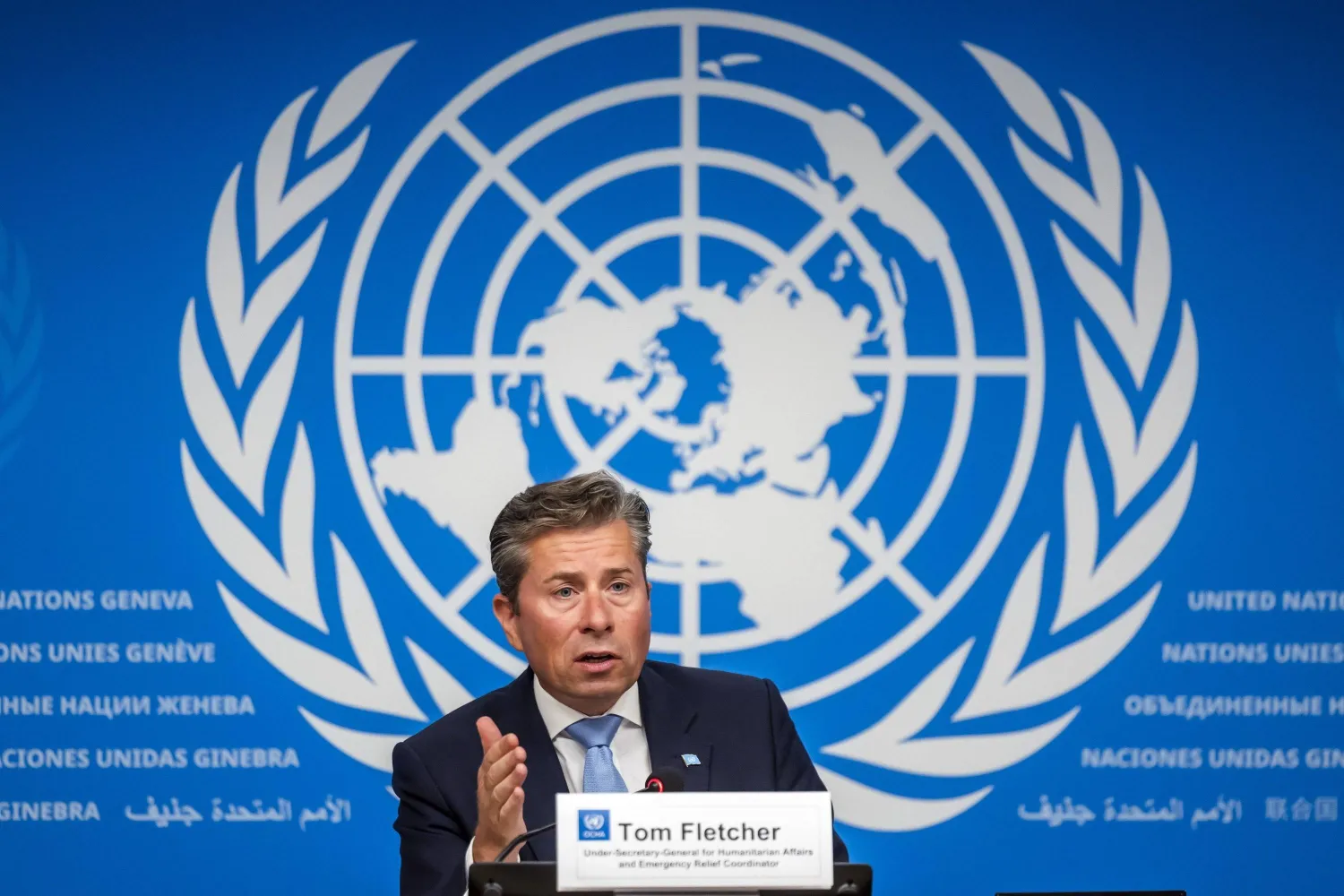
UN Aid Chief Warns Russian Drones Threaten Civilians and Aid Work in Ukraine

UN Under-Secretary-General for Humanitarian Affairs and Emergency Relief Coordinator Tom Fletcher briefs the media about the humanitarian crisis in the Gaza Strip during a press conference at the European headquarters of the United Nations (UNOG), Geneva, Switzerland, Aug. 22, 2025. (EPA)
TT

UN Aid Chief Warns Russian Drones Threaten Civilians and Aid Work in Ukraine

UN Under-Secretary-General for Humanitarian Affairs and Emergency Relief Coordinator Tom Fletcher briefs the media about the humanitarian crisis in the Gaza Strip during a press conference at the European headquarters of the United Nations (UNOG), Geneva, Switzerland, Aug. 22, 2025. (EPA)

The intensifying use of drones against civilians and humanitarian workers is a dangerous obstacle for aid operations in Ukraine, the UN's humanitarian chief, Tom Fletcher, said on Wednesday.

Fletcher spoke to The Associated Press in an interview after a visit to the southern city of Kherson, where he witnessed how communities there are coping while living under the constant threat of Russian drones. Fletcher described the visit to Kherson, split by the Dnipro River, which acts as an active front line, as “quite chilling."

Russian forces occupy the eastern bank, while Ukrainian forces hold the western bank. From across the water, kamikaze and surveillance drones routinely hunt and attack civilians, vehicles and public transit.

“It really gives us an insight into the dangers ahead of us,” he said.

The threat is also making it harder for humanitarian organizations to reach people who need assistance.

Fletcher spoke after attending a commemoration for two humanitarian workers who had died while doing their jobs.

“Drones are a real threat to not just civilians but the humanitarians who are here to protect them,” Fletcher said.

He said that aid workers are protected under international humanitarian law and yet marked humanitarian vehicles have still been hit. “So that does restrict what we can do," he said.

Local organizations are particularly exposed. More than two-thirds of operations funded through Ukraine's humanitarian fund are carried out by local organizations, according to Fletcher.

“They’re the ones who are saying most loudly to us, we’re not protected,” he said.

Fletcher said the UN needs more than $2 billion for its prioritized humanitarian response in Ukraine this year, with winter among his biggest concerns. Damage to civilian infrastructure, including electricity, water and gas systems, could once again leave millions vulnerable during the harsh winter months, raising fears of a repeat of last winter’s severe conditions.

The UN has sharply narrowed its humanitarian priorities all over the world as donor funding has fallen. Fletcher said the organization initially identified 87 million people facing the most severe humanitarian needs, but that figure has since risen to about 92 million with the onslaught of Ebola in Africa, the earthquake in Venezuela and other conflicts.

The UN is seeking $23 billion to provide life-saving assistance to those people and had raised about $11 billion, said Fletcher.

Ukraine is relatively well funded compared with many other crises, he added, with roughly 70–75% of its hyper-prioritized funding requirement covered. But even full funding of the humanitarian plan would address only part of Ukraine’s needs.

Fletcher also admitted that raising money for humanitarian operations has become more difficult as governments have increasingly redirected spending toward defense and domestic priorities.

“We’re in a more transactional world, I would say a more selfish world,” he said.

Fletcher said the UN now has to demonstrate that it is using limited taxpayer money efficiently and strategically.

“We have to show governments that we are spending their taxpayers’ money sensibly, wisely, in a prioritized way,” he said.

In a stark new assessment released on Wednesday, the UN warned that 907 aid workers were victims of violence last year and over 1,000 have been killed in three years. Fletcher said he could not reassure colleagues that those responsible would be held accountable based on how the international community has reacted.

He said accountability should extend beyond identifying the person who physically carried out an attack.

“I want to see investigations into the people who fired the weapon or flew the drone,” he said.


Military Helicopter Crashes in Southern Türkiye, Killing 4

Rescuers and security officers examine the wreckage of an ambulance helicopter after it collided with a hospital building and crashed into the ground, in Mugla, Türkiye, December 22, 2024. REUTERS/Kenan Gurbuz Purchase
TT

Military Helicopter Crashes in Southern Türkiye, Killing 4

Rescuers and security officers examine the wreckage of an ambulance helicopter after it collided with a hospital building and crashed into the ground, in Mugla, Türkiye, December 22, 2024. REUTERS/Kenan Gurbuz Purchase

A military helicopter crashed in southern Türkiye on Thursday, killing four personnel, the Turkish Defense Ministry said.

The aircraft crashed for unknown reasons in Samankoy, a neighborhood on the southern outskirts of the provincial capital Malatya in the early evening.

“As a result of an accident involving our S-70 helicopter in Malatya, for a reason not yet determined, 4 of our heroic comrades-in-arms aboard the helicopter were martyred,” the ministry said in a social media post.

“We pray that God will have mercy on our martyrs and offer our condolences and prayers for strength to their grieving families, our Turkish Armed Forces, and our noble nation.”

According to The Associated Press, TV images showed the wreckage of the helicopter burning near a cluster of buildings in an otherwise open area of land. The Demiroren News Agency reported that flames had spread to a nearby house but reported no casualties on the ground.

Police, firefighters and medical teams were dispatched to the crash.


Trump Says US Does Not Need Iran Deal

US President Donald Trump and Vice President JD Vance look on during a Veterans Day ceremony at Arlington National Cemetery in Arlington, Virginia, US, November 11, 2026. REUTERS/Kylie Cooper
TT

Trump Says US Does Not Need Iran Deal

US President Donald Trump and Vice President JD Vance look on during a Veterans Day ceremony at Arlington National Cemetery in Arlington, Virginia, US, November 11, 2026. REUTERS/Kylie Cooper

President Donald Trump said on Thursday the US does not need a deal with Iran and directed Vice President JD Vance, who has played a role in efforts to resolve the war, to focus "his complete and total attention" on alleged crime and corruption in Democratic-run cities and states.

Trump's directive came a day after the Wall Street Journal reported that Vance was considering face-to-face peace talks with a hard-line Iranian security official and a week after the vice president blamed the costly war with Iran for Republicans' midterm elections drubbing.

Trump's comments marked a shift in tone after he had suggested ⁠in recent weeks ⁠that Iran would be more willing to strike a deal in the eight-month conflict after the US elections.

"We don’t need a deal with Iran. Those days have long since passed. We’ve got their money, Hundreds of Billions of Dollars, and we’ve got their Strait!" Trump wrote on social media, referring to the Strait of Hormuz, the critical ⁠shipping route near Iran where the US military has been working to secure safe passage for international shipping.

Trump said he asked Vance to focus instead on a domestic issue the president previously put in his portfolio: leading an effort targeting alleged fraud in Democratic-run cities and states throughout the US.

"Our Budget could be quickly BALANCED with the correction of this large-scale criminal activity. CORRUPTION is in the Democrat Leadership’s blood!" Trump wrote on Thursday.

Vance's office did not immediately respond to a request for comment.

The Wall Street Journal reported on Wednesday that ⁠Vance was considering ⁠meeting with a senior Iranian security official, a move that would have put Vance at the center of peace negotiations. Reuters has not confirmed the potential talks.

Vance, who is viewed as a leading contender for the 2028 Republican presidential nomination, distanced himself from the war last week after Republicans' midterm election rout by Democrats.

The vice president blamed the costs of the Iran war in part for the party's losses. He also said an earlier recommendation to end the war was "sound advice."

Trump responded to Vance's position by defending the war as necessary to stop Iran from obtaining a nuclear weapon.


Iran: Four Tankers Struck by Explosions in Strait of Hormuz

Iran: Four Tankers Struck by Explosions in Strait of Hormuz
TT

Iran: Four Tankers Struck by Explosions in Strait of Hormuz

Iran: Four Tankers Struck by Explosions in Strait of Hormuz

Four oil tankers were hit by explosions in the Strait of Hormuz, Iran's military said on Thursday, adding that the vessels had ignored warnings and entered what it considers restricted areas of the strategic waterway.

Tankers are still facing attacks across the strait, despite a rebound in traffic and expectations of a de-escalation in the war between the United States and Iran that have been reflected in falling oil prices.

Iran's Revolutionary Guards Navy said two supertankers were disabled by explosions on Wednesday after they ignored ⁠warnings against using what ⁠it said was an "unauthorized route".

Reuters could not immediately verify the Iranian account.

The two vessels "exploded after hitting naval mines", Iranian state media reported, broadcasting what it said was video footage of the incidents.

Iran's army later said two other tankers had hit mines on Thursday afternoon while sailing through the eastern Strait of Hormuz after ignoring ⁠warnings and disabling their radar systems, state TV reported. The tankers entered a restricted area and subsequently caught fire, it reported.

Earlier in the US-Israeli war with Iran, which began in February, the IRGC Navy announced its attacks on tankers. More recently, however, it has instead reported that vessels have caught fire after hitting naval mines while traversing the southern part of the strait, which it has declared an unauthorized route.

In several of those cases, the United Kingdom Maritime Trade Operations agency (UKMTO) has said vessels had been struck by unknown projectiles.

The ⁠UKMTO said ⁠in reports on Thursday that a vessel was hit by an unidentified projectile about 14 nautical miles northwest of the UAE emirate of Ras Al-Khaimah on Wednesday while exiting the strait, causing a fire in its engine room.
Firefighting efforts were under way and all crew had been evacuated, it added.

At least 10 ships were hit in the first 10 days of November, after 37 attacks in October, which was the highest monthly tally since the conflict began in late February, according to data from the Washington Institute for Near East Policy.