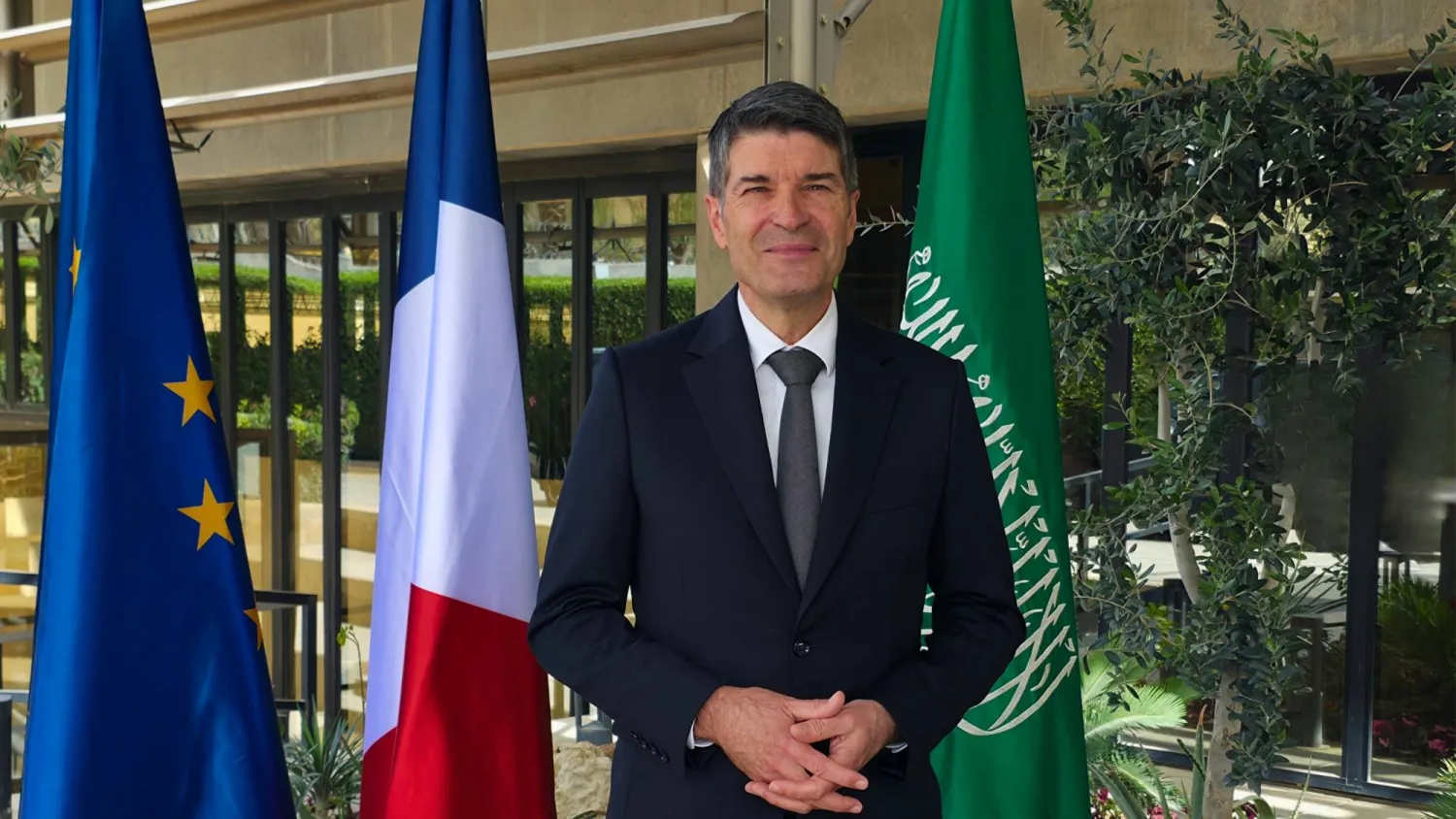
French Ambassador to Asharq Al-Awsat: Mohammed bin Salman’s Visit Paves Way for New Phase of Strategic Partnership

Patrick Maisonnave, French Ambassador to Saudi Arabia (Asharq Al-Awsat).
TT

French Ambassador to Asharq Al-Awsat: Mohammed bin Salman’s Visit Paves Way for New Phase of Strategic Partnership

Patrick Maisonnave, French Ambassador to Saudi Arabia (Asharq Al-Awsat).

A senior French official stressed that Saudi Crown Prince Mohammed bin Salman’s visit to France on Sunday means, in short, that Riyadh and Paris are entering a new phase of a genuine strategic partnership. He said the visit will address diplomacy, security, defense, investment, energy, culture, technology, and education.

Patrick Maisonnave, the French ambassador to Saudi Arabia, told Asharq Al-Awsat that the momentum is now being further strengthened through the visit of Crown Prince and Prime Minister Mohammed bin Salman to France and the first meeting of the French-Saudi Strategic Partnership Council.

According to Maisonnave, the council is particularly important because it provides a permanent institutional framework for this political ambition, allowing both countries to set priorities, measure progress, and develop long-term cooperation across the main pillars of the relationship.

He added that as the two countries seek to keep pace with profound geopolitical, economic, and technological changes, Mohammed bin Salman’s visit demonstrates a shared determination to move from a very strong bilateral partnership to a comprehensive strategic partnership.

He continued by saying that the readiness of the two leaderships to work together is not limited to bilateral issues, but also extends to regional stability, global challenges, and the major transformations shaping their societies, as the partnership enters a new phase with this visit.

He explained that the transformation Saudi Arabia is undergoing under Vision 2030, together with France’s strengths in sectors such as energy, infrastructure, culture, innovation, artificial intelligence, education, and creative industries, is creating new areas for convergence.

He stressed that the strategic dimension of the partnership lies precisely in this development, moving from a relationship based on strong cooperation to one increasingly grounded in shared objectives, long-term planning, and joint initiatives.

A Convergence Resilient to Challenges

Maisonnave affirmed that Riyadh and Paris have a well-established partnership and mutual trust that enable them to overcome the geopolitical challenges facing the region. He noted that the bilateral convergence translates into close coordination on the region’s most prominent crises.

He added that Paris and Riyadh are working together to support a two-state solution for Israelis and Palestinians and create the necessary political conditions for lasting peace. The two countries also share an interest in Yemen’s stability and in protecting freedom of navigation and the security of strategic maritime routes.

According to Maisonnave, the two countries support efforts to end the devastating war in Sudan and preserve the country’s unity and institutions. They also support Syria’s sovereignty, unity, and recovery, as well as the establishment of a stronger Lebanese state capable of exercising its authority, while reducing external interference and the influence of non-state armed groups.

He continued by saying that France and Saudi Arabia naturally have their own interests and perspectives, but have developed the ability to engage in frank dialogue, particularly during periods of regional tension and profound international changes. This has enabled the relationship not only to endure, but also to continually reinvent itself.

Ambassador Maisonnave said the distinctive nature of the Saudi-French relationship lies in its rare combination of historical depth, political trust, and a shared ability to look to the future. Over the past century, he explained, the two countries have built a relationship based on mutual respect, continuous dialogue, and, most importantly, strategic autonomy.

He added that the relationship is no longer defined solely by its history or traditional areas of cooperation. Instead, it is increasingly focused on what the two countries can build together over the coming decades. French President Emmanuel Macron’s visit to Saudi Arabia in December 2024 was a landmark moment that gave new political momentum to bilateral relations.

He attributed the resilience of bilateral relations since their establishment in 1926 to the fact that their strength lies in a century of accumulated trust, sustained political engagement at the highest levels, and a determination to adapt the partnership to each new historical period, despite some turning points along the way.

Maisonnave added that since diplomatic relations were established in 1926, France and Saudi Arabia have steadily expanded the scope of their cooperation. The relationship has accompanied the transformation of the Kingdom itself while responding at the same time to successive regional and international challenges. After 100 years, he said, the relationship is broader and deeper than at any previous stage in its history.

He continued by saying that this continuity is particularly evident today in diplomatic cooperation. At a time when the Middle East is going through one of its most significant periods of transformation, France and Saudi Arabia share a fundamental objective: preventing instability from becoming permanent and restoring the priority of diplomacy, state sovereignty, and international law.

Of particular importance, according to Maisonnave, is that this diplomatic coordination is developing alongside an equally deep economic and societal partnership. France is accompanying the transformation taking place in Saudi Arabia under Vision 2030 in areas ranging from investment and energy to culture, tourism, technology, education, and human capital development.

In his view, this gives the relationship an unprecedented scope, noting that strategic dialogue at the highest political levels is reinforced by growing ties between the two countries’ economies, institutions, and societies.

He also noted that the centenary of the establishment of diplomatic relations represents more than a commemoration of the past. It symbolizes the transition from one chapter to another in the history of the relationship.

Maisonnave explained that the first 100 years established and laid the foundations for a relationship based on trust. He stressed that the next 100 years must build on this legacy, making France and Saudi Arabia not merely partners in a changing world, but partners in shaping the future.


Greek Students, Teachers, Civil Servants Plan Protests

Protesters take part in a rally organized by teachers and students demanding improvements to education and measures to address the rising cost of living in Athens, Greece, Wednesday, Oct. 21, 2026. (AP Photo/Thanassis Stavrakis)
TT

Greek Students, Teachers, Civil Servants Plan Protests

Protesters take part in a rally organized by teachers and students demanding improvements to education and measures to address the rising cost of living in Athens, Greece, Wednesday, Oct. 21, 2026. (AP Photo/Thanassis Stavrakis)

Students, teachers and civil servants will rally in Greece on Wednesday to protest against the high cost of living, saying they face the same problems that sparked violent demonstrations in France at the weekend.

Gatherings are expected around midday (0900 GMT) in Athens and Thessaloniki, the country's second-largest city.

"In Greece like in France, we are demanding public, free education," Katia Koubousidou, head of a student union at the Aristotle University of Thessaloniki, told AFP.

"This will not be a one-off protest. We have a plan to continue our demonstrations."

Dozens of students set up tents in Syntagma Square, facing Parliament, in Athens, and on a pedestrian street in Thessaloniki on Tuesday.

The civil servants' union has also called for a work stoppage and a gathering in Athens.

Secondary school pupils and teachers are protesting about a lack of infrastructure, a shortage of staff and increased public spending on education.

The conservative Greek government has sought in recent days to avoid any parallel with the protests and violence in France.

Prime Minister Kyriakos Mitsotakis said on Monday that the country would "never return to the era of great social unrest" during the financial crisis over a decade ago, marked by unpopular austerity measures.

French cities were hit by some of the country's worst rioting in recent years on Saturday, with public buildings torched, hundreds of shops looted and more than 2,000 people arrested.


UKMTO: Ship Attacked Near Strait of Hormuz

FILE PHOTO: Vessels at the Strait of Hormuz, as seen from Musandam, Oman, October 12, 2026. REUTERS/Stringer/File Photo
TT

UKMTO: Ship Attacked Near Strait of Hormuz

FILE PHOTO: Vessels at the Strait of Hormuz, as seen from Musandam, Oman, October 12, 2026. REUTERS/Stringer/File Photo

A ship was struck on Wednesday by "an unknown projectile" off the coast of Oman, near the Strait of Hormuz, sparking a fire, a British maritime security agency said.

The tanker, 11 nautical miles (around 20 kilometres) off the town of Bukha, is "now at anchor,” the UKMTO reported.

"All crew are reported as safe. There is no reported environmental impact at this time," it said.

The Strait of Hormuz carried 20 percent of the world's oil and gas prior to the Middle East war, which erupted with US-Israeli strikes on Iran in late February.

Since then, Tehran has placed a chokehold on the shipping route and regularly targets ships that pass without its authorisation.

Washington has responded by maintaining a blockade on Iranian ports, and negotiations between the two countries are deadlocked.

Attacks on vessels attempting to cross the waterway have increased in recent days, as Washington escorts more ships through the strait and Tehran seeks to maintain control over their passage.


Russia Says It Will Respond to ‘Hostile’ Drone Deal with Ukraine by Japanese Company

Spokeswoman of Russian Foreign Ministry Maria Zakharova attends a press conference held by Foreign Minister Sergei Lavrov on the sidelines of a meeting of foreign ministers of the BRICS group of nations in the city of Nizhny Novgorod, Russia June 11, 2024. (Reuters)
TT

Russia Says It Will Respond to ‘Hostile’ Drone Deal with Ukraine by Japanese Company

Spokeswoman of Russian Foreign Ministry Maria Zakharova attends a press conference held by Foreign Minister Sergei Lavrov on the sidelines of a meeting of foreign ministers of the BRICS group of nations in the city of Nizhny Novgorod, Russia June 11, 2024. (Reuters)

Russia said on Wednesday that it considered a drone sale to Ukraine by a Japanese company to be a hostile step and warned of a harsh response.

Foreign Ministry spokeswoman ‌Maria Zakharova ‌said Moscow was responding ‌to ⁠an announcement by ⁠Japanese company Terra Drone last week that it had delivered a batch of drones to Ukraine.

"The Japanese ⁠authorities’ attempts to ‌justify ‌this by claiming that Terra Drone ‌Corporation’s cooperation with ‌the Ukrainian military is merely a 'private initiative' are entirely unconvincing," Zakharova said at her ‌weekly press conference.

"In this regard, we state ⁠clearly ⁠that such hostile moves against Russia will not go unanswered; they will be met with a firm response and measures that will be felt by Tokyo in the relevant areas."