

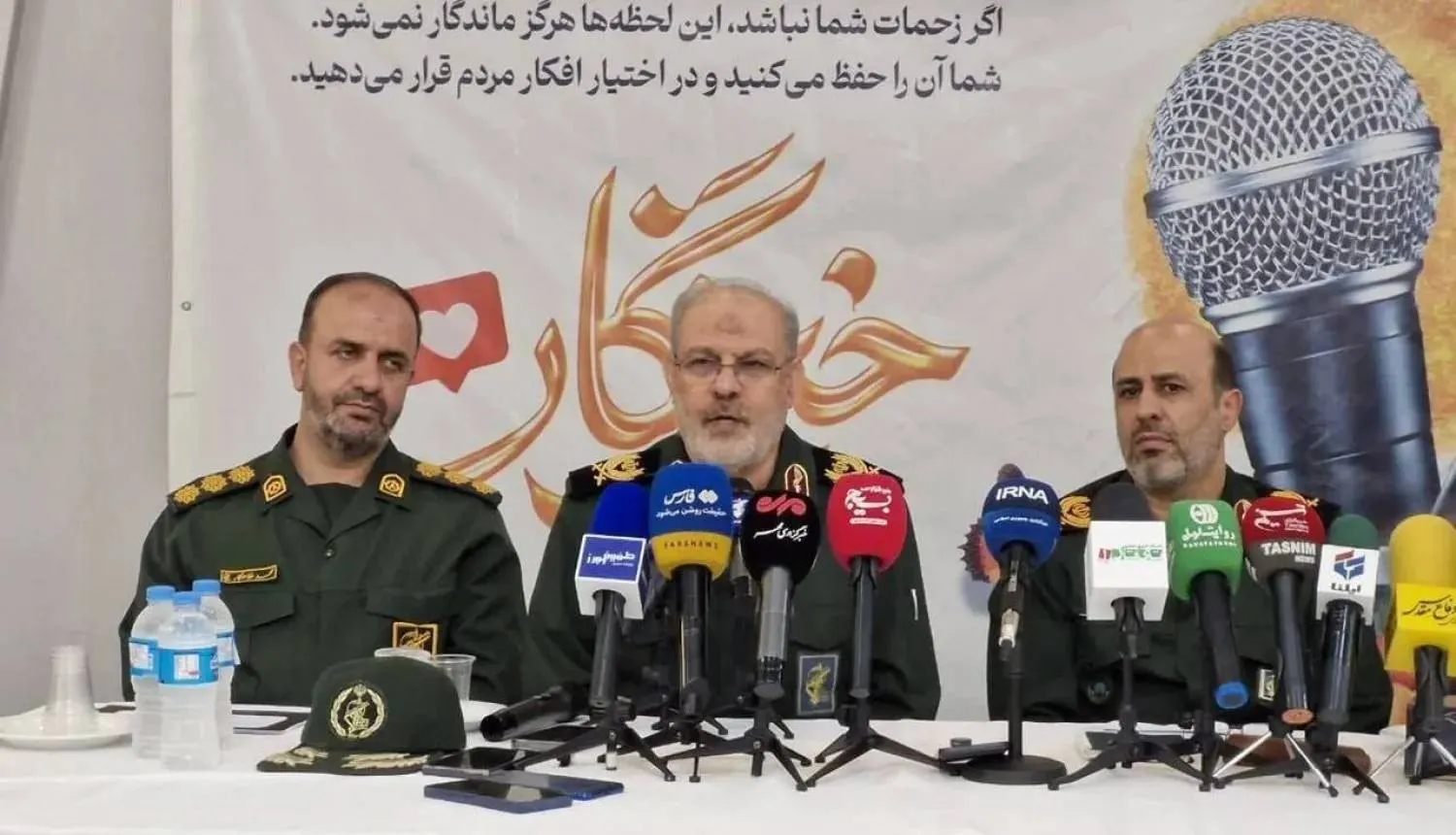

IRGC Says it Prepared Scenarios to Avoid US Sanctions

The Iranian Revolutionary Guard Corps (IRGC) spokesman, Hossein Mohebi (center), speaks at a press conference in Kharg, west Tehran (IRNA)
TT

IRGC Says it Prepared Scenarios to Avoid US Sanctions

The Iranian Revolutionary Guard Corps (IRGC) spokesman, Hossein Mohebi (center), speaks at a press conference in Kharg, west Tehran (IRNA)

Tehran has prepared economic scenarios, including expanding trade networks with regional allies to bypass tightening US sanctions, Hossein Mohebi, the Iranian Revolutionary Guard Corps (IRGC) spokesman said on Sunday, adding that the results of the new measures would become evident in the near future.

His comments came shortly before US Secretary of the Treasury Scott Bessent announced imposing new sanctions on Iran at dawn Monday, described as “the toughest in history.”

Speaking at a press conference on Sunday, Mohebi said: “We have scenarios to counter the adverse effects of the enemy’s war and can easily establish economic relations with countries.”

Cited by Tasnim, the IRGC spokesman said Iran is maintaining economic interactions “right under America’s nose” and bypassing US pressure, and that the results would become evident in the near future.

Mohebi, however, offered no specifics regarding nations, firms, or financial conduits used to bypass US restrictions, asserting only that Iran maintains broad alternative economic plans.

Last week, US President Donald Trump threatened “tremendous economic consequences” on any nation that does business with Iran, without offering details.

Mohebi said the economic warfare is nothing new, noting that the US has imposed sanctions on Iran’s economic sectors for 47 years.

The current US campaign, he added, is primarily aimed at shaping public perceptions and creating the belief that Washington is prevailing.

He described Trump’s announcement of a new economic campaign against Iran as an “implicit admission” that Washington had failed militarily.

Mohebi attributed a large part of his press conference to the nature of the ongoing war, saying the US-Iran war is multifaceted and not limited to military operations, but includes the economic and media sectors.

Touching on previous military confrontations with the US, Mohebi said that before the last war, Iranian forces had targeted “between 30 and 40 US warships” inside the Arabian Gulf.

He did not provide details of the names of the ships, the timing of the attacks or the extent of the damage. There is no independent evidence to prove his statements are correct.

The IRGC spokesperson said the US has no warships left in the Arabian Gulf, affirming a major retreat of American forces following the recent regional clashes. “US troops are now deployed 400 kilometers away from the Gulf waters,” he noted.

Addressing Washington, Mohebi said: “You mobilized all your military capabilities to close the Strait of Hormuz, but you couldn't.”

He warned that if Iran faces another threat, it could target energy pipelines, power plants and internet-connected systems.

Mohebi’s comments came as the Strait of Hormuz remains a focal point of the US-Iran conflict following the collapse of a sixty-day ceasefire negotiated in mid-June 2026.



UN: Millions May Be Forced to Move as Climate Change Hits South Asia

International Organization for Migration (IOM) chief Amy Pope, seen here in 2023, warned of a lack of urgency globally about the risks that vulnerable communities are facing. Fabrice COFFRINI / AFP
TT

UN: Millions May Be Forced to Move as Climate Change Hits South Asia

International Organization for Migration (IOM) chief Amy Pope, seen here in 2023, warned of a lack of urgency globally about the risks that vulnerable communities are facing. Fabrice COFFRINI / AFP

Climate change is threatening livelihoods and forcing people from their homes across South Asia, but technology and government action could help limit the damage, the UN migration chief told AFP on Friday.

Rising seas, flooding and drought threaten homes and farmland, Amy Pope, Director General of the International Organization for Migration (IOM), said during a visit to New Delhi.

In the Himalayas, she pointed to Nepal's August 26 disaster, when a mountain and glacier collapse triggered deadly flooding, where IOM sent humanitarian aid to help.

In a worst-case scenario, up to 40.5 million people in South Asia may be forced to move by 2050, according to IOM.

"When they can't produce food, when they can't feed their livestock, it increases the likelihood of displacement," said Pope. "The first adaptation is often for people to move."

Pope said climate change was also accelerating urbanization in India.

"As people seek shelter from heat, they're going into urban centers," she said.

- 'Migration as a tool' -

The risks are particularly acute in South Asia, where vast populations and limited resources leave many communities vulnerable.

"There's a lack of urgency globally about the risks that vulnerable communities are facing," Pope said, warning that funding to help residents prepare for climate change remained inadequate.

"The cost of a humanitarian disaster is in the billions. The cost of investing in some of the resilience measures can be far less," she said.

Better data and artificial intelligence could help governments identify communities at risk before disaster strikes, Pope said.

"With the advancements in AI forecasting, you can now better anticipate those communities that are at high risk of displacement," Pope said.

By combining weather forecasts with information about local livelihoods, authorities can identify which communities most need help.

"If you know a community is at risk, we don't need to wait until they're displaced to respond," she said.

Measures could include improving farming methods, training people for other jobs and, where necessary, relocating communities repeatedly hit by floods or drought.

Finding the money for such programs is a major obstacle, Pope said, with governments often struggling to navigate the systems available to fund climate adaptation.

India's investments in early-warning systems, disaster response and technology offer grounds for optimism, she said. But no government can meet the scale of the challenge alone.

International migration can also help people earn a living while filling labor shortages abroad.

South Asia already has established migration routes, offering opportunities to build on existing links.

"Here we have government partners who recognize both the threats to their communities but they're also using migration as a tool for development," Pope said.

She warned that growing demand for workers must be matched by safe, legal routes to employment.

Otherwise, migrants risk exploitation by traffickers and smugglers, including through fraudulent overseas job offers.

India's technological capacity could also help its workers compete internationally as artificial intelligence reshapes employment, Pope said.

AI could threaten some jobs, particularly those involving routine analysis of documents and reports, but other sectors still rely heavily on human labor.

"If we can marry that capacity with the labor mobility, so that the workers are being skilled for those jobs as they're emerging, they will be ahead," Pope said.

"This is a place where I have more optimism than in places where we're dealing with the most acute crises," she said.


Iran President Says Conflict in Mideast Amounts to 'Ecocide'

Iranian President Masoud Pezeshkian visits an exhibition that showcases the defense ministry's latest advancements in defense and space in Tehran. Photo: -/Iranian Presidency/dpa
TT

Iran President Says Conflict in Mideast Amounts to 'Ecocide'

Iranian President Masoud Pezeshkian visits an exhibition that showcases the defense ministry's latest advancements in defense and space in Tehran. Photo: -/Iranian Presidency/dpa

Iran's President Masoud Pezeshkian on Friday urged countries to condemn what he called "ecocide" in the Middle East caused by "wars of aggression".

Pezeshkian said the conflicts in Gaza and the wider Middle East had inflicted a significant toll on nature that extended beyond borders and required "international solutions", AFP said.

"What has occurred in our region as a result of wars of aggression is ecocide, or environmental genocide, and it must be condemned," Pezeshkian told a nature summit in Armenia attended by UN Secretary-General Antonio Guterres.


Rival Sahel Extremists Clash in Intensifying Turf war

A recent report revealed a surge in violent attacks linked to extremist groups in West Africa’s Sahel region. (AFP)
TT

Rival Sahel Extremists Clash in Intensifying Turf war

A recent report revealed a surge in violent attacks linked to extremist groups in West Africa’s Sahel region. (AFP)

Extremists from rival Al-Qaeda and ISIS factions in the Sahel have clashed recently on an unprecedented scale in the borderlands spanning Burkina Faso, Mali and Niger, with claims of hundreds of fighters killed.

The two extremist coalitions, which covet influence over the same areas and control of the same routes and local populations, have repeatedly clashed since 2019.

The rivalry also drives their constant expansion in the Sahel, which the ruling juntas in Ouagadougou, Bamako and Niamey have found difficult to contain, said AFP.

The clashes are "the most intense direct confrontation globally" between an Al-Qaeda branch and an ISIS-linked group, a report by UN experts submitted to the Security Council in early August said.

A semi-arid belt of land that stretches from the Atlantic Ocean along the southern rim of the Sahara desert to the Red Sea, Africa's Sahel has become the ground zero of global extremism.

Extremists have steadily expanded beyond the rural areas where they first took root, killing thousands, roiling governments and sowing terror.

Since September, fighting between ISIS - Sahel Province (ISSP) and the Al-Qaeda-linked group (JNIM) has escalated to unprecedented levels.

On Monday, the ISSP said it had killed more than 400 al-Qaeda fighters, including "several leaders", in clashes four days earlier in the Burkinabe province of Oudalan on the Mali and Niger borders.

"If the claimed death toll is confirmed, then it will be the deadliest single battle recorded between the two groups," Heni Nsaibia, an analyst at conflict monitor ACLED, said.

The toll has yet to be independently confirmed.

But if so, it would surpass the more than 200 deaths claimed by the ISSP in the same area in early September.

- 2,200 deaths since 2019 -

Between 2019 and last month, the two extremist groups fought more than 320 battles, resulting in about 2,200 deaths, Nsaibia said.

The latest clashes between fighters from JNIM and ISIS erupted on October 9 in the tri-border area, according to Wamaps, a collective of west African journalists.

The rivals are fighting over "the same potential living space and the same recruitment pools" in a "race for control of the borders between the three countries", Wassim Nasr, an expert on extremist groups and an associate researcher at The Soufan Center, said in a recent study.

Long confined to Mali and Burkina Faso, the fighting has in recent months spread to western Niger and even northwestern Nigeria, Nsaibia said.

From its Malian stronghold in Menaka, the ISSP has extended its influence into the Nigerien regions of Tahoua, Dosso and Maradi, up to the Nigerian border, Nasr said in the study.

This facilitates the transfer of fighters, equipment and expertise with ISWAP, the ISIS branch active in the Lake Chad basin, he added.

- Competing visions -

Behind the violence lies competing visions of extremism.

While JNIM carries out abuses against civilians, it focuses on developing local roots, building alliances with communities and concentrating attacks on state forces and foreign troops.

The ISIS group adopts a more hardline, transnational approach and does not shy away from targeting civilians who refuse to kowtow to its authority, Sahel specialist Hasret Kargin said.

Such "enduring ideological and strategic tensions" between the two groups are seen in reported defections -- albeit limited in number -- from JNIM to ISSP, the UN experts said in their report.

In July, JNIM claimed it had killed one of its commanders, who had defected to join ISIS.

However, despite the heavy losses the ISIS claims to have inflicted, JNIM remains the leading terror threat in the Sahel, the UN expert report said.

It estimated that its forces number between 7,000 and 8,000 fighters, compared with 2,000 members of ISIS.

"There is significant information indicating that JNIM has shifted substantial reinforcements to the area from other regions," Kargin said.

Given its numbers across the Sahel and its strength compared to the ISIS's Sahel branch, Kargin said he predicted that JNIM would launch "fierce counterattacks in the coming days".