

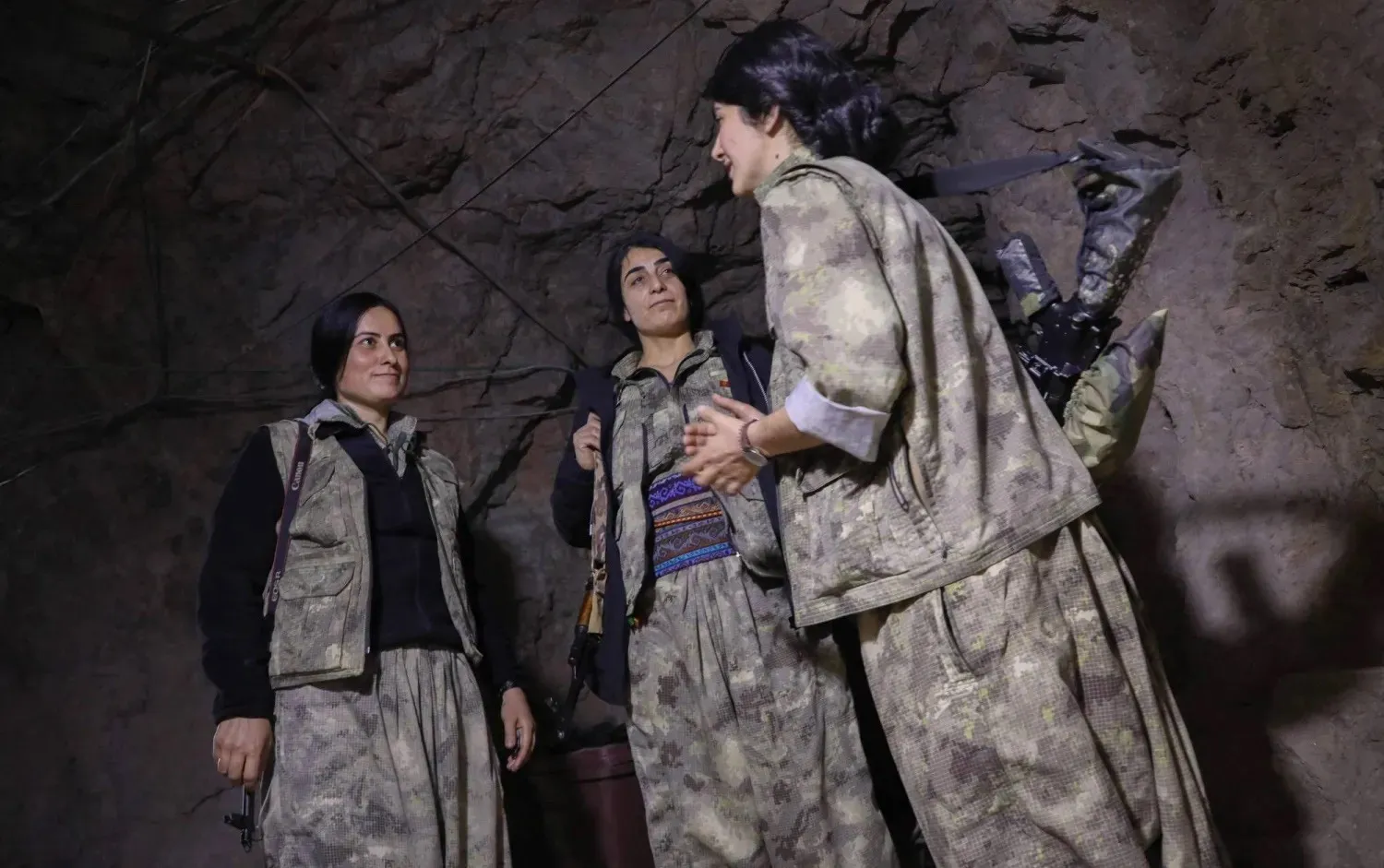

Türkiye Takes First Steps to Integrate PKK Members

A law passed by the Turkish parliament on August 10 allows for the conditional return of PKK members after their weapons have been verified. (AFP)
TT

Türkiye Takes First Steps to Integrate PKK Members

A law passed by the Turkish parliament on August 10 allows for the conditional return of PKK members after their weapons have been verified. (AFP)

Türkiye has begun implementing a law aimed at advancing the peace process based on the dissolution and disarmament of the Kurdistan Workers’ Party (PKK), which the government calls the “Terror-Free Türkiye” process.

The 12-article Law on Strengthening National Solidarity and Social Integration, known as the process’s “framework law,” was passed by parliament on August 10 and approved by President Recep Tayyip Erdogan eight days later.

Implementation begins Monday with the inaugural meeting of the Monitoring, Coordination and Implementation Council, chaired by Vice President Cevdet Yilmaz.

The council includes the justice, defense, interior and foreign ministers, as well as the intelligence chief and the secretaries-general of the presidency and National Security Council. It is tasked with verifying and endorsing the full dissolution and disarmament of the PKK.

Once the council issues a report confirming that process, the National Security Council will formally declare the end of the group’s existence, triggering a six-month process to reintegrate eligible members into Turkish society.

The one-time law will apply to PKK members in northern Iraq’s Qandil Mountains, Iran, Syria and Europe, as well as people prosecuted or wanted on charges of PKK membership and similar offenses.

Initial estimates put the number potentially covered at around 10,000, in addition to roughly 4,000 people held in Turkish prisons. Some 230 senior PKK leaders are excluded and are expected to reside in a safe area in Iraq’s Sulaymaniyah province.

Yilmaz said the council’s first meeting would discuss its working mechanisms and rules, as well as subcommittees to be formed according to the needs of the disarmament and dissolution process.

The council may request the creation of subcommittees to follow up on specific tasks. Parliament will also form a monitoring committee chaired by Speaker Numan Kurtulmus and comprising lawmakers from parties represented in parliament, except the nationalist IYI Party, which opposes the process and rejects any dialogue with imprisoned PKK leader Abdullah Ocalan.

Ocalan’s role

Pervin Buldan, deputy speaker of parliament and a lawmaker from the pro-Kurdish Peoples’ Equality and Democracy Party (DEM Party), said a subcommittee called the “Disarmament and Politicization Committee” would also be established.

Buldan, a member of the Imrali delegation involved in talks between Ocalan and the state, said Ocalan would sit on the committee, which would organize the disarmament process and political integration.

The Turkish government has neither confirmed nor denied plans for such a committee.

Nationalist Movement Party (MHP) leader Devlet Bahceli, whose party is the main ally of Erdogan’s ruling Justice and Development Party (AK Party) in the People’s Alliance, had called in May for an office or committee dealing with politicization, with Ocalan given the role of “peace and politicization coordinator.”

Bahceli has also repeatedly called for Ocalan to be granted the “right to hope,” which could open the possibility of release under a legal principle recognized by the European Court of Human Rights for prisoners who have served 25 years of an aggravated life sentence. Ocalan has spent 27 years in prison on Imrali Island in western Türkiye.

Buldan said the Imrali delegation also raised the need for a women’s committee during its August 13 meeting with Erdogan and in talks with other government officials.

A new Kurdish movement

Buldan described the law as fundamental but said Ocalan regarded it as merely a framework for addressing the Kurdish issue and intended to discuss how it could be developed in subsequent stages.

She quoted Ocalan as saying during his latest meeting with the Imrali delegation on August 1 that he had made considerable efforts to reach the current stage and is seeking to move from armed struggle to political struggle.

According to Buldan, Ocalan has discussed a new party to replace the DEM Party, changes to its charter, program and members, and a broader Kurdish movement. She said those issues would be discussed at a DEM Party congress in September.

How will the weapons be handled?

The pro-government Yeni Safak newspaper reported that a registration and monitoring system would be established to prevent surrendered PKK weapons from being transferred elsewhere or falling into the hands of other terrorist organizations.

Citing unidentified sources, it said weapons and ammunition would be handed to the Turkish Defense Ministry under intelligence supervision. A detailed inventory would be compiled and compared with intelligence reports to determine whether any arms or ammunition were missing.

After technical inspection, surrendered weapons would be divided into three categories.

Unused weapons and ammunition, including conventional arms compatible with NATO standards and technologically advanced drones, could be added to the Turkish military’s arsenal after the necessary inspections.

Weapons incompatible with Turkish military systems, but usable by other countries, could be sold, with proceeds going to the state treasury or exchanged for usable weapons.

Equipment unsuitable for military use, but valuable as raw material, would be melted down and recycled for projects run by Türkiye’s environment, industry and agriculture ministries.



Iran Dismisses US Threat of 'Economic D-day'

FILE - Iran's Ambassador to the International Atomic Energy Agency, IAEA, Kazem Gharibabadi, waits for the start of the IAEA board of governors meeting at the International Center in Vienna, Austria, Nov. 21, 2019. (AP Photo/Ronald Zak, file)
TT

Iran Dismisses US Threat of 'Economic D-day'

FILE - Iran's Ambassador to the International Atomic Energy Agency, IAEA, Kazem Gharibabadi, waits for the start of the IAEA board of governors meeting at the International Center in Vienna, Austria, Nov. 21, 2019. (AP Photo/Ronald Zak, file)

Iran on Monday dismissed Washington's declaration of a massive economic pressure campaign, saying it disproved US claims to have dismantled Tehran's military and nuclear capabilities.

"Your narrative doesn't add up: you say that Iran's military power has been 'dismantled', 100% of its military factories 'destroyed' and its nuclear program 'buried'," Kazem Gharibabadi, deputy foreign minister, said in a post on X.

Yet, he added, "there is a need for 'the largest financial invasion in history' and the mobilization of 'all institutions and powers' of the United States! Is this a victory or an admission of America's defeat?"

Earlier, US Treasury Secretary Scott Bessent wrote in the Financial Times that Washington was launching the "single greatest financial offensive marshalled against an adversary" -- calling it an "economic D-Day".

Bessent posted on X that the measure came after the United States "dismantled Iran's military capabilities, destroyed nearly 100 percent of its military factories, and buried its nuclear program."

He is scheduled to explain the new US sanctions on Iran on Monday.

Meanwhile, Iran's foreign ministry warned countries against joining the US economic campaign. Spokesman Esmaeil Baqaei said taking part would "definitely have its own consequences".

The United States and Israel triggered the Middle East war with a massive wave of strikes against Iran on February 28, triggering Iranian retaliation across the region.

An April 8 ceasefire ended nearly 40 days of intense bombardment, but control over the Strait of Hormuz soon emerged as a key flashpoint in the conflict.

Iran has controlled the vital energy conduit since the war began. Reopening the strait, vital for global oil and gas supplies, has become a US priority, but Tehran insists the waterway will remain closed until Washington lifts its naval blockade on Iranian ports, removes oil sanctions and unfreezes Iranian assets abroad.

Last week, US President Donald Trump announced that Washington would ramp up economic pressure on Iran "on an unprecedented scale."

Washington has urged other governments, including Beijing, to join efforts to further isolate Iran's economy.

In an article published on Monday in Iran's Ettela'at newspaper, Tehran's Foreign Minister Abbas Araghchi said relations with China "have taken on deeper, more structural, and more comprehensive dimensions."

Iran has faced US and international sanctions since the 1979 Iranian revolution.

Trump has repeatedly pursued a "maximum pressure" policy of economic sanctions against Iran, reinstating the approach after returning to office in January 2025 following a similar campaign during his first term.

Iran has repeatedly dismissed the sanctions policy as a failure, insisting that economic pressure and threats will not force it to change course.


US Cancels Joint Marine Drills with SKorea over Iran War

Apache choppers take off at Camp Humphreys in Pyeongtaek, South Korea, 04 March 2024, to join the Freedom Shield 2024 exercise on the first day of the 11-day annual South Korea-US joint drill against North Korean provocations.  EPA/YONHAP
Apache choppers take off at Camp Humphreys in Pyeongtaek, South Korea, 04 March 2024, to join the Freedom Shield 2024 exercise on the first day of the 11-day annual South Korea-US joint drill against North Korean provocations. EPA/YONHAP
TT

US Cancels Joint Marine Drills with SKorea over Iran War

Apache choppers take off at Camp Humphreys in Pyeongtaek, South Korea, 04 March 2024, to join the Freedom Shield 2024 exercise on the first day of the 11-day annual South Korea-US joint drill against North Korean provocations.  EPA/YONHAP
Apache choppers take off at Camp Humphreys in Pyeongtaek, South Korea, 04 March 2024, to join the Freedom Shield 2024 exercise on the first day of the 11-day annual South Korea-US joint drill against North Korean provocations. EPA/YONHAP

The United States cancelled a joint amphibious landing drill scheduled for next month with South Korea, Seoul's Marine Corps said on Monday, after Washington cited constraints on the availability of US forces due to the war in Iran.

The US Marine Corps formally notified its South Korean counterpart in June that force availability would be constrained for the division-level exercise, known as Ssangyong, a South Korean ⁠Marine Corps spokesperson ⁠told a press briefing.

The allies remain in close consultations on resuming the drills, Reuters quoted the spokesperson as saying. He did not specify what measures might be taken to prevent future cancellations or to make ⁠up for lost training opportunities.

US Forces Korea did not immediately respond to a request for comment.

The cancellation follows US President Donald Trump's surprise order to scale back a separate annual joint military exercise that ended last Friday, citing the cost and Seoul's refusal to take part in the Iran war.

Trump also wrote on his Truth Social ⁠platform ⁠that the Ulchi Freedom Shield drills sent "a signal that was totally inappropriate and hostile, to a Country that, as long as Donald J. Trump has been President, has been unthreatening and respectful."

Despite the reduction of the exercises, Pyongyang fired 10 short-range ballistic missiles last week and issued a statement denouncing the exercises.

North Korea has long condemned such joint exercises as rehearsals for invasion.


Oman FM to Visit Iran to Discuss Hormuz Strait

Oman's Foreign Minister Badr al-Busaidi. (Reuters file)
TT

Oman FM to Visit Iran to Discuss Hormuz Strait

Oman's Foreign Minister Badr al-Busaidi. (Reuters file)

Oman's Foreign Minister Badr al-Busaidi will visit Tehran on Tuesday to ‌continue talks between ‌Iran and ‌Oman ⁠on the Strait ⁠of Hormuz, Iran's Foreign Ministry Spokesperson Esmaeil ⁠Baghaei said ‌on ‌Monday.

Al-Busaidi will hold the "ongoing political consultations between the two sides, as two littoral states of the Strait of Hormuz, to help strengthen peace and security in the region," Baqaei added in a statement.

"The visit is aimed at strengthening Iran-Oman bilateral cooperation and al-Busaidi will meet with Iran's Foreign Minister Abbas Araghchi to discuss bilateral and regional issues," he went on to say.

Iran has exerted control over Hormuz, a key waterway for oil and gas shipping, since the outbreak of the war in the Middle East on February 28. It requires vessels to obtain permission and pay transit fees before using the waterway.

The United States wants the strait to return to its pre-war system of free navigation, while US President Donald Trump claims Washington "has total control" over Hormuz, through which around one fifth of the world's oil and LNG exports passed before the war.

Iran and Oman have been in talks to establish a new route through the strait, the only entrance to the Gulf and which separates their two countries, but a deal has not yet been finalized.

Tehran, however, says even if the talks bear fruit, that would not on its own open the waterway unless the US meets Iran's broader demands including the lifting of its blockade on Iranian ports.