


US Launches ‘Economic Onslaught’ Against Iran’s Financial Connections

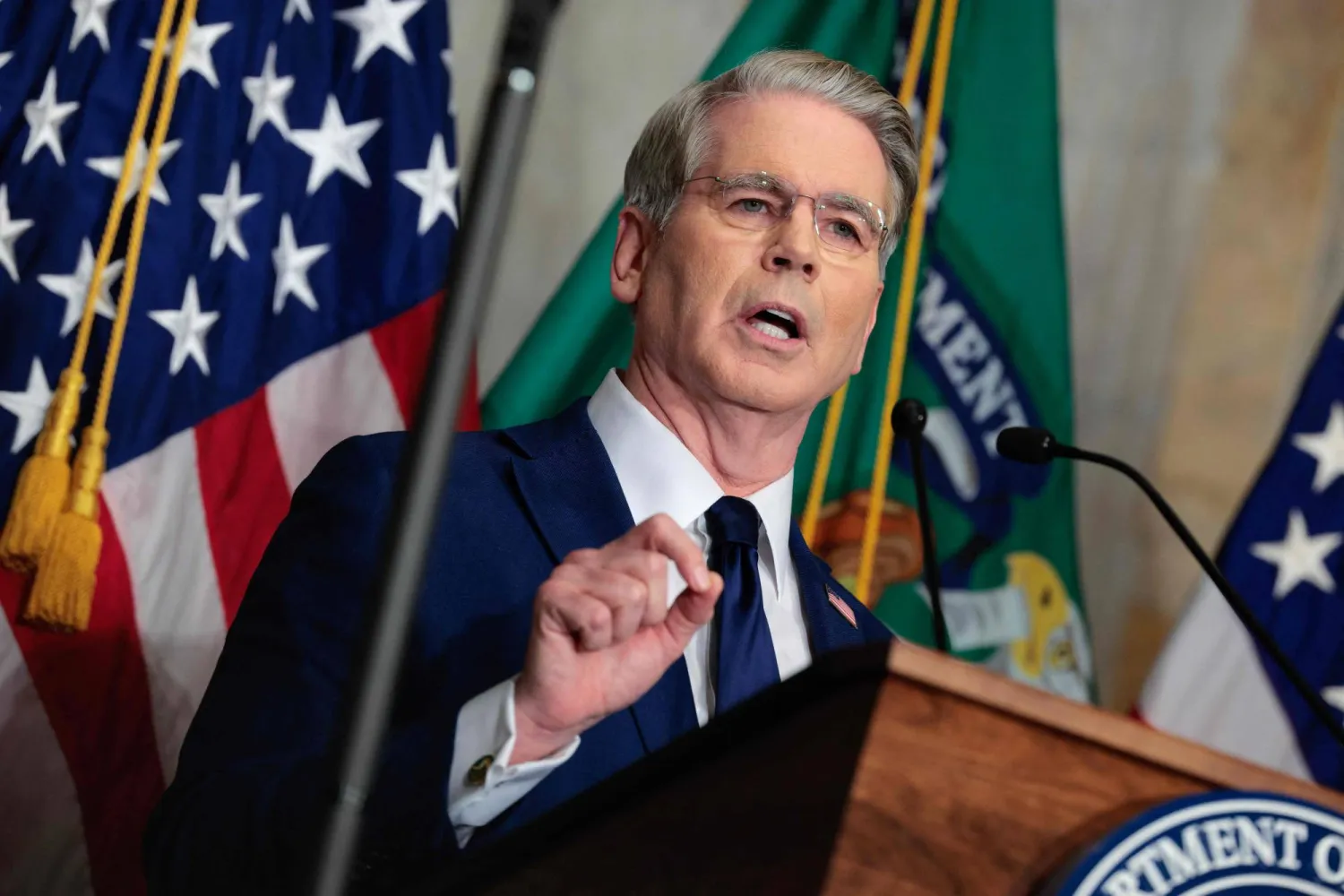
WASHINGTON, DC - AUGUST 24: US Treasury Secretary Scott Bessent announces a new set of sanctions against Iran in the Cash Room at the Treasury Department on August 24, 2026 in Washington, DC. Chip Somodevilla/Getty Images/AFP
TT

US Launches ‘Economic Onslaught’ Against Iran’s Financial Connections

WASHINGTON, DC - AUGUST 24: US Treasury Secretary Scott Bessent announces a new set of sanctions against Iran in the Cash Room at the Treasury Department on August 24, 2026 in Washington, DC. Chip Somodevilla/Getty Images/AFP

US Treasury Secretary Scott Bessent unveiled Monday what he described as an "economic D-Day" that aims to give a final warning to countries to sever their business ties with Iran or risk having key companies and entities cut off from the dollar-based financial system.

"We are launching an economic onslaught against Iran’s financial connections around ⁠the globe. Our ⁠objective is to sever every economic lifeline that sustains this tyrannical regime until Tehran stands alone," Bessent said.

He added that it’s “no longer acceptable to operate in the gray spaces” of the conflict.

He did not name what countries could face potential secondary sanctions from the United States.

“Let there be no ambiguity as to the position of the United States,” Bessent told a news conference. “An economic engagement of any kind with this murderous regime will expose those responsible to the full reach of American power.”

The US Treasury Department has mapped the networks, facilitators, and financial channels that Iran uses to smuggle oil and evade sanctions and said that Washington would be working with US partners to target any source of Iran's "illicit revenue."

The department said it has issued determinations against five sectors -- digital assets, technology, gold, ⁠aviation and shipping -- that the Iranian government is using to prop up its economy. The Treasury has also imposed sanctions on nearly 60 entities, individuals and vessels.

US President Donald Trump's war with Iran, which has pushed energy prices higher worldwide, is about to hit its six-month mark. While heavy fighting has ‌subsided, diplomatic efforts to end the war have stalled and oil and raw material shipping through the Strait of Hormuz ⁠remains blocked, ⁠keeping energy prices elevated.


Trump: We Support Al-Zaidi’s Efforts to Assert Iraqi State Authority

US President Donald Trump shakes hands with Iraqi Prime Minister Ali al-Zaidi as they participate in a bilateral meeting in the Oval Office at the White House in Washington, DC, US, July 14, 2026. REUTERS/Evan Vucci/File Photo
TT

Trump: We Support Al-Zaidi’s Efforts to Assert Iraqi State Authority

US President Donald Trump shakes hands with Iraqi Prime Minister Ali al-Zaidi as they participate in a bilateral meeting in the Oval Office at the White House in Washington, DC, US, July 14, 2026. REUTERS/Evan Vucci/File Photo

US President Donald Trump said Friday that the United States supports Iraqi Prime Minister Ali al-Zaidi's efforts to assert state authority throughout the country, including putting an end to Iraqi oil smuggling, Reuters reported.

In a post on Truth Social, Trump wrote: "We support Iraqi Prime Minister Ali al-Zaidi’s efforts to assert state authority throughout Iraq, stop the smuggling of Iraqi oil, end corruption, and bring all weapons under the exclusive control of the state."

He added: "We support Prime Minister al-Zaidi’s efforts to build a united, prosperous, and strong Iraq that makes its own political decisions."

Last week, Iraqi armed forces entered Jurf al-Sakhar, a stronghold of the Iran-backed Kataib Hezbollah militia south of Baghdad, following what authorities described as oil-smuggling operations in the area.

On Tuesday, al-Zaidi ordered that border crossings and several oilfields previously administered by the autonomous Kurdistan Region be placed under federal government control.

The Iraqi government recently uncovered large-scale oil theft and smuggling operations. Available information indicates that organized oil theft extends across most Iraqi oil-producing provinces, as well as areas through which oil pipelines pass.


Iran Guards Say Tanker Hits Mine Near Strait of Hormuz

In this handout photo provided by the Lewis Pugh Foundation, taken from a boat accompanying endurance swimmer Lewis Pugh, smoke rises from a burning liquefied petroleum gas tanker in the Strait of Hormuz off the Musandam Peninsula, Oman, Tuesday, Nov. 17, 2026. (Lewis Pugh Foundation via AP)
TT

Iran Guards Say Tanker Hits Mine Near Strait of Hormuz

In this handout photo provided by the Lewis Pugh Foundation, taken from a boat accompanying endurance swimmer Lewis Pugh, smoke rises from a burning liquefied petroleum gas tanker in the Strait of Hormuz off the Musandam Peninsula, Oman, Tuesday, Nov. 17, 2026. (Lewis Pugh Foundation via AP)

A tanker was hit by an explosion after striking a mine ⁠while attempting to ⁠cross the Strait of Hormuz ⁠through what the Revolutionary Guards’ navy called an unauthorized route, the Guards said in ⁠a ⁠statement carried by the state broadcaster IRIB on Friday.

The Guards said on Thursday that two tankers had exploded and caught fire after hitting sea mines north of Oman's Khasab port.

One of the vessels was a supertanker carrying more than 2 million barrels of crude oil, the Guards said in a statement carried by the semi-official Tasnim ⁠news agency.

Iran has ⁠long said that vessels cannot safely transit the Strait of Hormuz without coordinating with Tehran, citing the threat of sea mines among other risks.

Maritime security agencies, however have frequently reported incidents involving ships in the region as strikes by unknown projectiles, although ⁠they tend to cover fewer incidents than the number reported by the Guards and do not always align.


UN Warns Famine Risks Rising as Hunger Hotspots Increase

FILE PHOTO: Internally displaced Somali woman, Adar Hassan Abdulahi, helps her child feed on Plumpy'nut after being vaccinated, at the Tawakal 2 camp in Baidoa, southwest Somalia, June 24, 2025. REUTERS/Feisal Omar/File Photo
TT

UN Warns Famine Risks Rising as Hunger Hotspots Increase

FILE PHOTO: Internally displaced Somali woman, Adar Hassan Abdulahi, helps her child feed on Plumpy'nut after being vaccinated, at the Tawakal 2 camp in Baidoa, southwest Somalia, June 24, 2025. REUTERS/Feisal Omar/File Photo

Hunger is set to worsen significantly in 16 global hotspots over the coming six months, with famine threatening parts of Africa, two United Nations agencies warned on Friday.

The Food and Agriculture Organization (FAO) and World Food Programme (WFP) said Sudan, South Sudan, Somalia, northern Nigeria and Yemen faced the gravest threats, driven by conflict, displacement, economic hardship and extreme weather.

The number of hunger hotspots has risen from 13 in the previous report released in June, with Chad, Uganda, and parts of both southern Africa and Central America added to the list, while Lebanon was removed.

In the latest joint report covering December 2026 to May 2027, the agencies warned ⁠that shrinking humanitarian ⁠funding was undermining efforts to avert catastrophe.

Aid for the five countries facing the gravest hunger threats fell by two-thirds between 2022 and 2025, said Conor Elliott, a senior official in FAO's emergencies and resilience office.

"These are huge changes in international support," he said, warning that the cuts were also undermining the collection of data needed to assess ⁠the scale of the crisis.

According to Reuters, the report said armed conflict and violence were driving hunger in 12 of the 16 hotspots, while soaring food, energy and transport costs were further eroding people's ability to feed themselves.

The agencies said the developing El Niño weather pattern could aggravate the crisis, bringing drought and extreme temperatures to southern Africa and parts of central America, and potentially destructive flooding to parts of eastern Africa.

"There's going to be a very, very strong El Niño effect," said Elliott, warning that some areas were likely to ⁠swing from drought ⁠conditions to heavy rains in the coming months.

In Sudan, famine is a risk in 13 areas of North Darfur and South Kordofan through January 2027, with fighting disrupting food production, markets and aid deliveries.

The agencies also identified famine risks among displaced people in Somalia's Baidoa region and in parts of South Sudan, where escalating violence has compounded an already desperate humanitarian situation.

Afghanistan, Haiti, the Democratic Republic of Congo and the Palestinian enclave Gaza were also classified as areas of very high concern.

Gaza was downgraded from the highest level of concern following improvements in food security since an October 2025 ceasefire, although the agencies warned that conditions remained severe and fragile.
