


Tehran Races to Curb Inflation, Stem Rial’s Slide

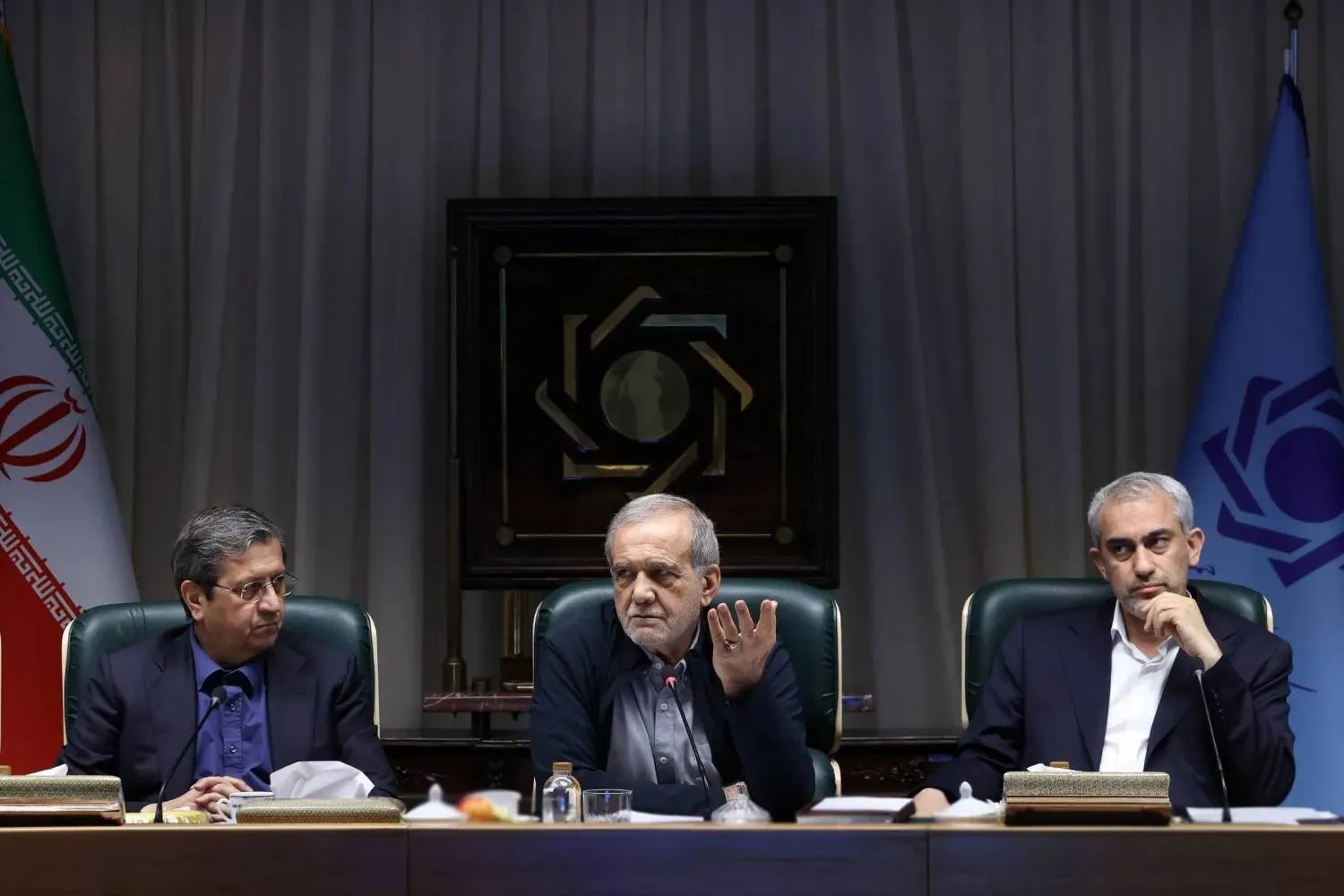
Iranian President Masoud Pezeshkian sits between Economy Minister Ali Madanizadeh and Central Bank Governor Abdolnasser Hemmati during a financial meeting on Wednesday. (Iranian Presidency)
TT

Tehran Races to Curb Inflation, Stem Rial’s Slide

Iranian President Masoud Pezeshkian sits between Economy Minister Ali Madanizadeh and Central Bank Governor Abdolnasser Hemmati during a financial meeting on Wednesday. (Iranian Presidency)

Iranian President Masoud Pezeshkian discussed the foreign exchange market, liquidity, inflation and the balance of payments during a three-hour meeting at the central bank, two days after the rial fell to a record low and Washington announced an expanded campaign to “choke” Iran’s economy.

Pezeshkian stressed the need to maintain economic stability and curb inflation expectations amid war, an economic blockade and external pressure, calling for full coordination between the central bank and institutions responsible for managing financial and currency markets, state news agency ISNA reported.

The Iranian president reviewed reports on liquidity levels, the foreign exchange market, the international balance of payments, monetary regulation policies and measures planned to steer the economy during and after the war.

Pezeshkian called for continued meetings with economic experts and for their proposals to be considered in shaping monetary, fiscal, banking, trade and corporate management policies. He also urged officials to explain the country’s economic problems to Iranians directly and transparently.

The meeting came after the United States imposed a new package of sanctions targeting about 60 individuals, entities and vessels, while expanding the risk of secondary sanctions to the digital assets, technology, gold, aviation and shipping sectors.

US Treasury Secretary Scott Bessent said Washington was seeking to sever “every economic lifeline” keeping the Iranian government afloat, pledging to hold accountable countries and companies that continue to deal with Tehran.

Pezeshkian said Tehran would continue to resist economic pressure, arguing that just as the United States had failed to achieve its objectives in the war, it would also fail through economic pressure.

Fuel stations

Pressure on the currency and prices coincided with disruption in the fuel market. Fuel stations in Tehran saw growing lines of cars and motorcycles on Tuesday after authorities announced a rare reduction in long-standing fuel quotas and imposed higher prices on purchases exceeding the allocated amounts.

Brent crude, meanwhile, fell below $90 a barrel on Tuesday as markets interpreted the new US sanctions as reducing, for now, the prospect of a resumption of large-scale military operations, despite continued risks to shipping through the Strait of Hormuz.

The dollar breached the 2-million-rial mark for the first time on Monday, trading at about 2.02 million rials on the open market, compared with an official central bank rate of about 1.5 million rials.

The dollar was worth about 1.65 million rials before the war began on Feb. 28, reflecting a further decline in the currency over the past six months.

Central Bank Governor Abdolnasser Hemmati sought to calm markets, describing the latest rise in foreign currency prices as “temporary” and saying the current volatility did not warrant a change in monetary policy direction.

He said the central bank had supplied the economy with an average of $175 million in foreign currency a day since the start of the Iranian year, compared with about $205 million during the same period a year earlier.

Hemmati announced a plan to allocate $20 billion to meet the industrial sector’s foreign-currency needs through the end of the year and pledged to supply the currency needed for medicines and essential goods.

He said the central bank had anticipated the outbreak of war since February and had therefore distributed foreign currency reserves across “different locations” that could be accessed when needed to secure essential supplies.

Hemmati described the past six months as “extremely difficult” but drew a distinction between enduring pressure and the “collapse” that authorities say the United States is seeking to force upon Iran’s economy.

He pledged to focus on curbing inflation and the currency’s decline, saying the central bank could not “print money without purpose and increase liquidity”.

Official data showed that annual inflation reached 66% in July, while consumer prices rose 87.9% from the same month a year earlier and food-price inflation reached 128%.

Rice prices have risen about 60% since the war began, while beef prices have increased by more than 150%, according to the Associated Press. The International Monetary Fund expects Iran’s economy to contract by more than 5%.

Financing production

The central bank plans to provide 700 trillion tomans to finance production through instruments it says do not rely on issuing new money.

Deputy Governor for Monetary Policy Vahid Majid said financing provided through instruments linked to production chains reached 197 trillion tomans during the first four months of the current Iranian year, as the bank seeks to expand “sustainable, non-inflationary financing”.

The central bank is also working to give exporters and importers greater flexibility in foreign currency trading, including by allowing direct agreements between the two sides and reducing the role of some intermediaries.

Hossein Tajiknejad, an official responsible for foreign currency allocation, said the central bank no longer purchased foreign banknotes itself but had allowed banks and importers to buy them at mutually agreed prices.

Tehran is also facing mounting restrictions on its foreign trade channels after the United Arab Emirates announced last week that it was suspending trade dealings with Iran, while the new US sanctions threaten companies and countries that continue to provide it with financial and commercial channels.

China, the largest buyer of Iranian oil and one of Tehran’s leading trading partners, warned that it would defend its interests after Washington announced the expansion of secondary sanctions.

Chinese Foreign Ministry spokesperson Lin Jian said the policy of “maximum pressure” and economic warfare would not resolve problems, warning that such measures could destabilize the global economic and financial system and harm other countries’ rights.

He said Beijing would “take all necessary measures” to protect its interests, posing a test of Washington’s ability to enforce the new restrictions on Iranian trade, particularly regarding Chinese-Iranian economic ties.

Iranian Economy Minister Ali Madanizadeh said his country had prepared a “two-year plan” to counter the new sanctions and that Washington would not achieve through economic pressure what, in his words, it had failed to achieve militarily.



Thousands Evacuated After ‘Unknown Substance’ Released at UK Concert

Authorities respond to an emergency incident during a concert by rapper Don Toliver at Co-op Live on November 22, 2026 in Manchester, England. (Getty Images/AFP)
TT

Thousands Evacuated After ‘Unknown Substance’ Released at UK Concert

Authorities respond to an emergency incident during a concert by rapper Don Toliver at Co-op Live on November 22, 2026 in Manchester, England. (Getty Images/AFP)

Thousands were evacuated from a concert at the UK's largest indoor arena after an "unknown substance" was released and several people reported suffering side-effects, police said Monday.

Some 12,000 people were attending the Sunday night show by US rapper Don Toliver at the Co-op Live arena in Manchester, northwest England.

Emergency services were called after "reports of people in the crowd suffering effects from an unknown substance", said Manchester police, which declared a major incident at the scene.

"Several people were treated on site, and one has been taken to hospital at this time," Greater Manchester Police's Steph Parker said, adding that the force was trying to "understand what this substance was".

The venue, which bills itself as the country's largest live entertainment arena, said it was working with police to "identify the cause of the incident".

The regional ambulance service said it assessed more than 50 people at the scene including some reporting "eye and respiratory symptoms", with "decontamination" being carried out at the venue.

Toliver, an American singer who has collaborated with musicians Travis Scott and Justin Bieber, is currently on the second leg of his "Nitrous" world tour and scheduled to play in London on Monday.


Armenia Proposes New Constitution in Step Towards Peace with Azerbaijan

In this file photo dated Oct 7, 2020, a boy cycles on a bridge decorated with flags of Armenia and the breakaway Nagorno-Karabakh region in Yerevan. (AFP)
TT

Armenia Proposes New Constitution in Step Towards Peace with Azerbaijan

In this file photo dated Oct 7, 2020, a boy cycles on a bridge decorated with flags of Armenia and the breakaway Nagorno-Karabakh region in Yerevan. (AFP)

Armenia published a ‌draft proposal of a new constitution on Monday in what is a key development towards signing a formal peace agreement with its neighbor and longtime foe Azerbaijan.

The South Caucasus neighbors had been at intermittent war since the late 1980s, mostly over the mountainous region of Nagorno-Karabakh, before reaching a preliminary US-brokered peace agreement last August.

Since then, they have ‌begun to rebuild ‌trade links and say they ‌are ⁠at a state ⁠of "real peace".

But for Azerbaijan, a central sticking point to signing a formal deal has been the preamble of Armenia's constitution, which contains a reference to another Soviet-era document calling for the reunification of Armenia and ⁠Nagorno-Karabakh, then an autonomous region in Soviet ‌Azerbaijan.

The proposed new ‌constitution rewrites the preamble and removes the reference ‌to which Baku has objected.

Armenia's Prime Minister ‌Nikol Pashinyan, who won re-election in June, has faced a wave of criticism from the opposition and some sections of the public.

They accuse him ‌of capitulating to Azerbaijan, particularly since the 2023 war, when Baku ⁠retook ⁠Karabakh in a lightning offensive that prompted nearly all of the territory's ethnic Armenian population to flee to Armenia.

Pashinyan is now under pressure to convince at least six opposition legislators to join his ruling Civil Contract party – which lacks a constitutional majority – to call for a constitutional referendum. The new charter will also undergo a public debate.

Armenia's opposition parties, dominated by pro-Russian groups, have already said they will not support Pashinyan's initiative.


North Carolina Win Gives Democrats Biggest US House Majority Since Early 1990s

 The US Capitol is seen at sunrise Friday, Nov. 20, 2026 in Washington. (AP)
The US Capitol is seen at sunrise Friday, Nov. 20, 2026 in Washington. (AP)
TT

North Carolina Win Gives Democrats Biggest US House Majority Since Early 1990s

 The US Capitol is seen at sunrise Friday, Nov. 20, 2026 in Washington. (AP)
The US Capitol is seen at sunrise Friday, Nov. 20, 2026 in Washington. (AP)

Democrats ‌have won at least 258 seats in the US House of Representatives after this month's midterm elections, securing the largest majority held by either party in Congress' lower chamber in more than three decades.

Democrats gained their 258th seat in next year's House on Sunday, when North Carolina Democrat Chuck Hubbard defeated his Republican opponent, according to the Associated Press. Four races remain uncalled in the House, which ‌has 435 seats.

House ‌Democratic leader Hakeem Jeffries of ‌New ⁠York, who is expected ⁠to become the chamber's first Black speaker, noted the milestone in a social media post.

"House Democrats have just secured the largest majority any party in Congress has held this century," he wrote, adding: "BOOM."

Democrats' landslide electoral victory in the US Senate ⁠and House underscored voters' deep frustration with ‌President Donald Trump's stewardship of ‌the economy and his decision to launch a war against ‌Iran in February, which drove gas prices ‌up sharply. In poll after poll, voters expressed anxiety about the cost of living and anger at the way Trump has handled the issue.

Democrats last won 258 seats ‌in 1992 and secured 257 in 2008, according to congressional records. Republican majorities in ⁠the ⁠House topped out at 247 for the 114th Congress from 2015 to 2017.

While Democrats next year will have the biggest House margin for either party since the early 1990s, some years in the 20th century saw far larger majorities. Democrats held 313 or more seats for much of the 1930s, and exceeded 290 seats in the mid-1960s and late 1970s.

Republicans had their largest House majorities in the 1920s, when they held as many as 302 seats.