


More than 1,300 are Missing in Nepal and Tibet after Catastrophic Floods Caused by Glacier Collapse

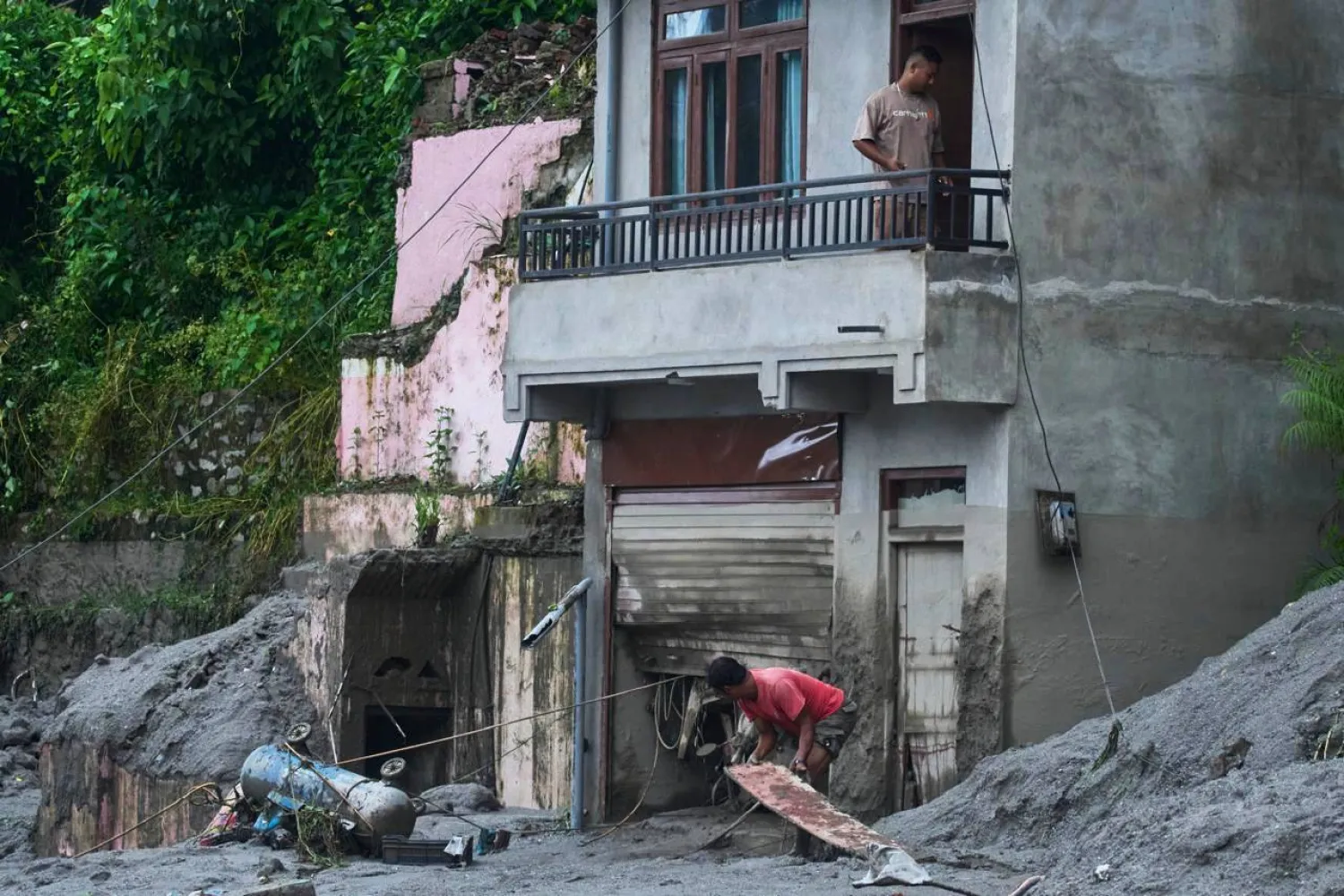
People amid damage in the aftermath of flash floods in Devighat in the Nuwakot district in Nepal, Thursday, Aug 27, 2026. (AP Photo/Niranjan Shrestha)
TT

More than 1,300 are Missing in Nepal and Tibet after Catastrophic Floods Caused by Glacier Collapse

People amid damage in the aftermath of flash floods in Devighat in the Nuwakot district in Nepal, Thursday, Aug 27, 2026. (AP Photo/Niranjan Shrestha)

Rescue teams searched on Thursday for hundreds of missing people along the Nepal-China border after a catastrophic and deadly torrent of floods and mud swept through several communities a day earlier following a glacier collapse.

The disaster left at least 168 people dead and more than 1,300 missing, including foreigners and pilgrims, and displaced hundreds of people across the Himalayan region.

Videos of the tragedy showed the flood swallowing up people as they tried to escape, and destroying buildings and bridges. On Thursday, drone footage from Nepal showed the scale of the destruction.

The region’s steep valleys are economic lifelines and travel corridors, but are precarious when disaster strikes. Images showed what appeared to be the second floors of buildings in Nuwakot slathered in mud after the torrent rushed by. Debris hung from tree branches and wires, vehicles were buried and some stunned survivors were caked in mud. The floods halted travel in some areas.

There was little time for anyone to flee.

Resident Jaleshwar Kumar Sahni received a phone call on Wednesday morning from an area close to the border that a lot of water was flowing through there, and later the flash floods destroyed everything in just 15 minutes.

“We don’t have anything left,” he said.

Warming climate threatens communities

The Himalayan mountain range spans several countries in South Asia and has many of the world’s highest peaks and remaining glaciers.

The steep slopes and the lush valleys below the Himalayan mountain range are especially vulnerable to flooding and landslides, and extreme weather events. Melting glaciers have become more common because of warming because of human-caused climate change.

Researchers in Kathmandu found earlier this year that glaciers across the Hindu Kush Himalaya region are melting faster, with ice loss rates doubling since 2000.

Helicopters deployed as roads were damaged

The disaster has left at least 165 dead and 826 people missing in Nepal, and three dead and 558 missing in Tibet, authorities said.

Nepalese officials said that dozens of bridges were destroyed and nearly 40 kilometers (25 miles) of roads were damaged, complicating search efforts.

The Nepalese army has rescued more than 100 people from flood-affected areas through helicopter operations on Thursday morning, army spokesperson Brig. Gen. Raja Ram Basnet said.

At least eight foreign nationals were airlifted to the country’s capital, Kathmandu, he said, adding that army teams also evacuated people trapped inside facilities linked to the Trishuli hydropower project.

Rescuers found bodies hundreds of kilometers downstream from the disaster zone in Chitwan district. Dozens of injured people have been transported to Kathmandu for advanced medical care.

Bishal Kumar Bhandari, chairman of the Nepal Red Cross Society, said they have shifted focus from rescue to large-scale relief operations in the flood-hit districts. He said that around 1,200 people were displaced from at least three villages.

In Tibet, a mudslide that struck near the land border crossing of Gyirong Port on Wednesday left mud in the surrounding areas more than 1½ meters (5 feet) deep on average, with some road sections exceeding 2 meters (6 feet), Chinese state broadcaster CCTV reported. Roads leading to the port were all damaged, while secondary collapses or landslides might occur as rain continued in the area, it added.

CCTV said that a barrier lake has also been discovered in the direction of the port, posing challenges to the rescue operation. Chinese authorities deployed a large military transport aircraft to send a team to the region, it said.

While electricity supply and communication resumed in the central urban areas in Gyirong town, those linked to the port were cut off, it said.

Hundreds of foreigners are missing

According to Nepal’s Tourism Board, 517 of the missing people in the country were foreigners and 178 of them were from India. It wasn't immediately clear how many missing Indian nationals were on a pilgrimage to Mount Kailash in Tibet, a sacred site for Hindus.

More than 60 of those unaccounted for in Nepal were from the US and the rest were from 30 other countries, ranging from Ukraine and the UK to South Africa and Japan, the Tourism Board said.

In addition, China’s Ministry of Foreign Affairs spokesperson Lin Jian said that nearly 100 Chinese citizens were missing on the Nepal side. CCTV earlier reported 260 of those missing in Tibet were foreigners.

Experts say glacier collapse caused devastating floods

The US Geological Survey first reported a magnitude 4.4 earthquake early Wednesday, about 66 kilometers (41 miles) north of Kathmandu, near the border.

The USGS later updated its analysis to say the seismic event it measured was a magnitude 5.2 glacier collapse that sent debris flowing downstream with catastrophic impact on communities. It said its determination was based on data from nearby seismic stations, long period seismic waves and satellite imagery, and that no earthquake had occurred.

Climate experts at the Kathmandu-based International Center for Integrated Mountain Development said an avalanche from a glacier likely caused Wednesday’s flash flood.

“Hydrological observations indicate the exceptional speed and magnitude of the flood wave,” they said in an emailed statement, noting that water levels at one point on the Trishuli river rose by as much as 9 meters (27 feet) over half an hour.

The Lhende Khola River, a tributary of the Bhotekoshi, had maximum flooding, they said.

The disaster in Nepal and Tibet is not a one-off. The increasingly unstable Himalayan ice system threatens communities, infrastructure and water supplies across one of the world’s most densely populated regions.

The region saw similar flash floods in August 2025, when a glacial lake in Tibet overflowed because of high temperatures. Nine people were killed, and critical infrastructure, including a bridge connecting Nepal and China, was damaged.



Far-Right Triumph in Eastern Germany Leaves Migrants Questioning Their Future

A general view taken on September 7, 2026 in Magdeburg, eastern Germany, shows Saxony-Anhalt's State Parliament, the day after the state election. (AFP)
TT

Far-Right Triumph in Eastern Germany Leaves Migrants Questioning Their Future

A general view taken on September 7, 2026 in Magdeburg, eastern Germany, shows Saxony-Anhalt's State Parliament, the day after the state election. (AFP)

Mamad Mohamad watched with mixed emotions as the far-right Alternative for Germany (AfD) swept to a historic victory on Sunday evening in the eastern state of Saxony-Anhalt.

A member of the Greens, the 46-year-old is set to become one of the first lawmakers with an immigrant background to enter the state parliament, alongside Mustafa Groener of the Left (Die Linke) party.

For Mohamad, who arrived in Germany from Syria as a 16-year-old Yazidi Kurd in 1996, it was a milestone that should have been a moment of celebration. Instead, he described it as a "poisoned victory".

"My heart was split," Mohamad said, recalling the first projections that showed the AfD outperforming expectations ‌while Chancellor Friedrich Merz's ‌governing conservatives slumped to a historic low.

'CULTURALLY ALIEN'

The AfD has long ‌campaigned ⁠for tighter immigration ⁠and asylum policies, arguing that Germany has lost control of its borders and that migration is putting heavy pressure on public services, security and social cohesion.

According to its election manifesto, an AfD-led Saxony-Anhalt would launch a state-level campaign to deport rejected asylum seekers.

The party also proposes encouraging businesses to adopt artificial intelligence and automation rather than rely on skilled migration from what it describes as "culturally alien" backgrounds.

The AfD rejects accusations that its rhetoric contributes to a hostile climate for migrants, insisting it opposes only illegal and uncontrolled ⁠migration.

"Everyone is warmly welcome who contributes positively to our society, who ‌wants to work here, who is qualified, who pays taxes, ‌and who abides by the law," AfD co-leader Alice Weidel said on Monday.

PACKED BAGS

The mood in Mohamad's ‌family was somber on Monday.

His daughter, he said, was reluctant to attend school, one of ‌several criticized by the AfD over projects that examine threats to democracy.

Though anxiety is running high in many immigrant communities, the result has prompted unease rather than surprise, said Undra Dressler, managing director of the State Network of Migrant Organizations in Saxony-Anhalt.

People with migrant backgrounds have long faced discrimination and structural barriers in access ‌to work, education, healthcare and public services, Dressler said.

"All of this is our reality," she told Reuters.

Sunday's result nevertheless marks a turning ⁠point, she said. "There are ⁠many people in our communities who say: 'We've already packed our bags and have concrete plans, and we'll be leaving soon,' or, in some cases, have already left."

Pascal Begrich, managing director of democracy advocacy group Miteinander, said he did not expect a large-scale exodus, partly because of economic realities, but agreed that many migrants but also employers were reassessing their future in Saxony-Anhalt.

"There are companies asking themselves whether they really want to locate here and whether they can ensure their workers will be safe," Begrich told Reuters.

CONSTITUTIONAL LIMITS

Mohamad said he feared the political shift could make it harder to attract newcomers to a state already grappling with demographic decline.

"Skilled workers and families will look elsewhere," he said.

Despite concerns about the state's political direction, both Dressler and Begrich stressed that any future government would remain bound by Germany's constitutional order and protections for minorities.

"Every government is bound by this," Dressler said. "And the 15 other federal states have a duty to monitor this and, if necessary, to intervene."


Russia Announces the Closure of the German Consulate in St. Petersburg

A person walks past the German Consulate General in Saint Petersburg, Russia September 2, 2026. Picture taken with a mobile phone. REUTERS/Dmitry Vasilyev
TT

Russia Announces the Closure of the German Consulate in St. Petersburg

A person walks past the German Consulate General in Saint Petersburg, Russia September 2, 2026. Picture taken with a mobile phone. REUTERS/Dmitry Vasilyev

Russia’s Foreign Ministry said Monday that the German consulate in St. Petersburg will have to close, a tit-for-tat move that reflected the simmering tensions between the two countries.

Russia’s Foreign Ministry said the German consulate must stop operations by Sept. 18, following an earlier move by Moscow to close German cultural centers on its territory.

The ministry said the closure was in retaliation for Germany’s decision Wednesday to close both the Russian consulate in Bonn and the Russian House cultural center in the German capital, Berlin.

Germany blamed Russia for an attempted drone attack at Leipzig/Halle Airport on Aug. 4, when an explosives-laden drone was found near a Ukrainian plane.

The airport is a major international freight hub used for providing support to Ukraine. The drone was later defused.

Moscow has denied involvement.


North Korea, Russia Open their First Road Bridge, a Symbol of Expanding Ties 

The first road bridge between Russia and North Korea across the Tumen River, locally known as Tumannaya, on the border with North Korea in the Primorsky region, Russia, in this still image from a video released September 7, 2026. Russian Government/Handout via REUTERS
TT

North Korea, Russia Open their First Road Bridge, a Symbol of Expanding Ties 

The first road bridge between Russia and North Korea across the Tumen River, locally known as Tumannaya, on the border with North Korea in the Primorsky region, Russia, in this still image from a video released September 7, 2026. Russian Government/Handout via REUTERS

North Korea and Russia opened their first road bridge on Monday in a carefully choreographed display of friendship, a structure which spans the Tumen river and which both sides cast as an important milestone in their deepening strategic partnership.

The first flag-adorned trucks trundled across the 1 km (0.6 mile) long two-lane bridge as Russian Prime Minister Mikhail Mishustin and North Korea's Premier Pak Thae Song tuned in by video link to address workers and government officials from both countries.

Construction of the new bridge, which had been under discussion for years, began in April last year after the project was agreed during a visit by President Vladimir Putin to North Korea in 2024. There are already direct air and rail links between Moscow and Pyongyang, but until Monday there had not been a proper road link. Instead, since 1959 and by special arrangement, planks had been placed on the nearby rail bridge - for decades the sole border crossing point - in order to move vehicles across the border between the two countries.

"I am convinced that the expansion of cross-border transport infrastructure will provide a powerful impetus for the further development of trade, economic, scientific, technological and cultural cooperation," said Mishustin, who said ties between Moscow and Pyongyang were "at an unprecedented high level" and called the opening of the bridge "a genuinely historic event."

The construction of the bridge was not merely an engineering project, he said, but "a new symbol of friendship".

Mishustin said up to 300 vehicles would be able to cross every day and that the bridge would be linked to Russia's federal road network and have easy access to the transport corridor which runs from the far eastern city of Vladivostok to St Petersburg. Trucks would begin to use the bridge immediately to transport cargo, the Russian government said. At the end of this year, the bridge would be fully operational and could be used for passenger traffic too.

The bridge was built near an existing "Friendship Bridge", a rail bridge which was commissioned in 1959 after the Korean war. Symbolically, the new bridge is named after Yakov Novichenko, a Red Army soldier who Pyongyang credits with protecting the life of North Korea's first leader Kim Il Sung in 1946 by intercepting a grenade thrown at him and others.

Ties between the two countries have grown stronger since the start of the war in Ukraine in 2022, with Pyongyang sending thousands of troops to Russia's Kursk region to help repel a 2024 Ukrainian incursion there.

Mishustin made a reference to that in his speech on Monday, referring to "the Korean heroes who, only recently, fought shoulder to shoulder with our soldiers and defended Russian soil".