


Serbia’s President Criticizes UN Court for Not Releasing War Criminal Mladic to Die at Home

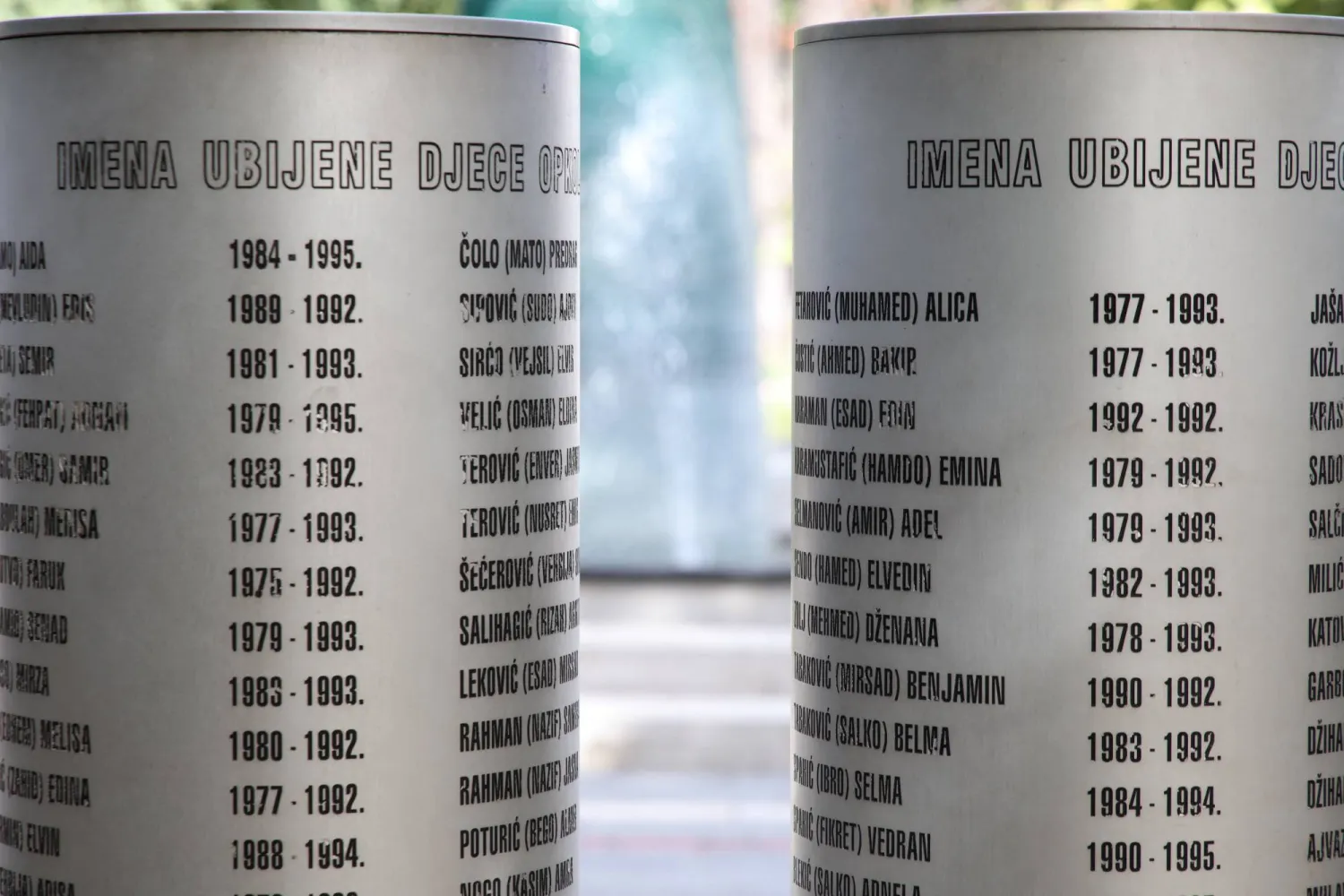
 A memorial with the names of 1,601 children killed during the 1992-1995 siege of Sarajevo, following the death of Ratko Mladic, a former Serbian general convicted of genocide, in Sarajevo, Bosnia and Herzegovina, August 27, 2026. (Reuters)
A memorial with the names of 1,601 children killed during the 1992-1995 siege of Sarajevo, following the death of Ratko Mladic, a former Serbian general convicted of genocide, in Sarajevo, Bosnia and Herzegovina, August 27, 2026. (Reuters)
TT

Serbia’s President Criticizes UN Court for Not Releasing War Criminal Mladic to Die at Home

 A memorial with the names of 1,601 children killed during the 1992-1995 siege of Sarajevo, following the death of Ratko Mladic, a former Serbian general convicted of genocide, in Sarajevo, Bosnia and Herzegovina, August 27, 2026. (Reuters)
A memorial with the names of 1,601 children killed during the 1992-1995 siege of Sarajevo, following the death of Ratko Mladic, a former Serbian general convicted of genocide, in Sarajevo, Bosnia and Herzegovina, August 27, 2026. (Reuters)

Serbia's President Aleksandar Vucic on Friday accused a war crimes UN court in The Hague of “uncivilized behavior” for refusing to grant an early release for the former Bosnian Serb army commander Ratko Mladic, who died Thursday at the age of 84 while serving a life sentence for his crimes. 

Mladic’s family and the Serbian government had requested several times that Mladic be released, citing his age and ailing health. He died a week after the UN rejected his latest request for release on humanitarian grounds. 

“That was uncivilized behavior, unprecedented and without excuse,” Vucic said. “We can now see that they wanted Mladic to die behind bars.” 

The UN tribunal for war crimes committed during the wars in the former Yugoslavia in the 1990s sentenced Mladic to life in prison in 2017 in what was considered a key step toward bringing justice to the victims. He had been in custody since 2011. 

The ruthless warlord was one of the most notorious figures of the war conflict that left more than 100,000 people dead and over 1 million homeless. More than three decades after the wars, former Balkan foes remain divided over his role. 

In an Aug. 20 ruling, the president of the UN court that deals with the legacies of now-closed war crimes tribunals, Uruguayan Judge Graciela Gatti Santana, cited the “comprehensive and compassionate medical care” Mladic was receiving in custody “as well as the exceptional visitation regime allowing meaningful family contact” as reasons for turning down the request. 

Bosnian Serbs hold vigils, while victims' families see justice  

Bosnian Serbs held vigils and lit candles Thursday evening for Mladic, whom they consider a hero despite his conviction. 

“He could not have been a better man. Everything else is just a bunch of lies. He would not touch anyone, child, no one. It's all lies,” said Stojanka Visnjevac, a resident of Kalinovik, Mladic's small hometown. 

But the families of the victims of crimes Mladic orchestrated said his death means at least some justice for their loved ones. 

Fazila Efendic, who lost several members of her family in the 1995 massacre of more than 8,000 Bosnian Muslims in Srebrenica, which is Europe's first acknowledged genocide since World War II, said it is important that Mladic died in prison. 

“We, the victims, are satisfied, when we know that he was convicted to life in prison,” she said. “For us, it is important that he is convicted and that he served his sentence until he died.” 

A UN “safe haven” for Muslims in Srebrenica ended up being overrun by Serbs who forced men and boys to strip, killed them and bulldozed their bodies into mass graves. Serbs under Mladic’s control also laid siege to the Bosnian capital, Sarajevo, and other cities and villages, established concentration camps for detained non-Serb civilians and enemy soldiers, and systematically killed prisoners. 

Mladic could be buried in Serbia  

Vucic said that Belgrade has no information on when Mladic’s body could be released. 

Vucic said Mladic’s family will decide where he would be buried. “If the family expresses a wish that he be buried in the territory of Serbia, we will help so it can be done in a dignified way,” Vucic told reporters.  

He did not confirm earlier reports that Mladic would receive a state funeral. The reports sparked outrage throughout the region. 

Serbia's justice minister Nenad Vujic had said Friday that Mladic “will receive all the military and state honors to which he is entitled”. 

The UN court on Thursday opened an inquiry into Mladic's death, and on Friday the judge conducting the inquiry visited the detention center where he was held.  

The court, formally known as the International Residual Mechanism for Criminal Tribunals, did not immediately respond to questions from The Associated Press about Mladic. 


US Military Weighs Use of ‘Mother of All Bombs’ in Potential Future Strikes on Iran

Iranians drive past an anti-US billboard in Vanak Square, Tehran, on October 14, 2026 (EPA).
TT

US Military Weighs Use of ‘Mother of All Bombs’ in Potential Future Strikes on Iran

Iranians drive past an anti-US billboard in Vanak Square, Tehran, on October 14, 2026 (EPA).

The US military has developed strike plans that could include using the GBU-43/B Massive Ordnance Air Blast Bomb, also known as the "mother of ‌all bombs", ‌against Iranian energy ‌infrastructure ⁠and nuclear sites ⁠if President Donald Trump orders renewed combat operations, CNN reported on Thursday citing ⁠US officials familiar ‌with ‌the matter.

The potential ‌deployment of the ‌largest non-nuclear bomb in the US arsenal would mark a significant ‌escalation in the conflict, although officials ⁠familiar ⁠with military planning discussions told CNN questions remain over its effectiveness in achieving Washington's strategic objectives.

Reuters could not immediately verify the report.


Russia’s Lavrov, China’s Wang Discuss Cooperation, Ukraine, Iran at Asia Security Meeting

In this handout photograph taken and released by the Russian Foreign Ministry on October 14, 2026, Russia's Foreign Minister Sergei Lavrov and China's Foreign Minister Wang Yi hold a meeting on the sidelines of the Seventh Summit of the Conference on Interaction and Confidence Building Measures in Asia (CICA) in Baku. (Handout /Russian Foreign Ministry / AFP)
TT

Russia’s Lavrov, China’s Wang Discuss Cooperation, Ukraine, Iran at Asia Security Meeting

In this handout photograph taken and released by the Russian Foreign Ministry on October 14, 2026, Russia's Foreign Minister Sergei Lavrov and China's Foreign Minister Wang Yi hold a meeting on the sidelines of the Seventh Summit of the Conference on Interaction and Confidence Building Measures in Asia (CICA) in Baku. (Handout /Russian Foreign Ministry / AFP)

The Russian ‌and Chinese foreign ministers discussed the state of bilateral cooperation as well as the crises in Ukraine and Iran during an Asia security meeting, the Russian Foreign Ministry said on Wednesday.

Russian President Vladimir Putin and his Chinese counterpart Xi Jinping reaffirmed ‌their strategic ‌alliance at a ‌regional summit ⁠last August and ⁠both praised prospects for closer cooperation.

The statement on Wednesday said Russian Foreign Minister Sergei Lavrov and his Chinese counterpart Wang Yi met in Azerbaijan at ⁠a meeting of the ‌Conference on ‌Interaction and Confidence Building Measures in Asia.

It ‌said the two ministers "praised the ‌development dynamics of comprehensive partnership and strategic cooperation" and "synchronized watches on bilateral political dialogue".

It said discussions ‌also focused on "relations with the United States and the situation ⁠around ⁠the Ukrainian and Iranian crises".

Both Russia and China have called for an end to the Iran conflict, saying it could expand and threaten stability throughout the region.

China has affirmed its "no limits" partnership with Russia throughout the 4-1/2-year-long war in Ukraine, while calling for diplomatic efforts to end the conflict.


Netanyahu Says He Is Not Seeking to Attack Iran Again Before Israel Election

Israeli Prime Minister Benjamin Netanyahu (C) attends a ceremony marking the opening of Colombia's new embassy in Jerusalem, at the Ministry of Foreign Affairs in Jerusalem, Israel, 14 October 2026. (EPA)
TT

Netanyahu Says He Is Not Seeking to Attack Iran Again Before Israel Election

Israeli Prime Minister Benjamin Netanyahu (C) attends a ceremony marking the opening of Colombia's new embassy in Jerusalem, at the Ministry of Foreign Affairs in Jerusalem, Israel, 14 October 2026. (EPA)

Israeli Prime Minister Benjamin Netanyahu said on Wednesday that he was not in favor of a preemptive strike against Iran before Israel's October 27 election but also warned Tehran and its proxies against striking Israel.

"It is not convenient for us, it's no good," Netanyahu said in an interview on Israel's Army Radio, when asked about the possibility of a preemptive strike and allegations by his political rivals that he was seeking a military confrontation ahead of the election.

"Even if Iran fires missiles at us they will blame me," Netanyahu ‌said, though ‌he also repeated his previous warnings to Iran, saying ‌Israel ⁠would respond forcefully ⁠if attacked.

He would not elaborate on the possibility of a preemptive strike after the election or about his recent discussions with Washington about Iran.

The United States and Iran have been at war since February 28 when the US and Israel attacked Iran and Tehran responded with its own strikes on Israel and Gulf states.

Israel and Iran have not traded ⁠fire since June.

Netanyahu said that Iran's proxies were looking to launch attacks ‌on Israel before the election.

Defense Minister Israel Katz, speaking from the self-declared security zone Israeli forces are ⁠occupying in southern Lebanon, ⁠warned Iran-backed Lebanese group Hezbollah against attacking Israel.

"Hezbollah will suffer a severe blow and lose additional territories in southern Lebanon within the Nabatieh and Litani regions, which will become part of Israel's permanent security zone. The army is prepared to carry out the maneuver," Katz said.

Katz said that a million Shiites would be displaced and that Hezbollah's stronghold in Beirut would not be spared.

Israel launched air strikes and a ground invasion in southern Lebanon this year in parallel with the war in Iran, after Hezbollah fired into Israel in revenge for the attacks against Tehran.

Hundreds of thousands of people from Lebanon's Shiite community, from which Hezbollah draws its support, were uprooted by the fighting.
