
Iran Urges Other Nations Not to Join New US Sanctions, Mediators Focus on Reopening Strait

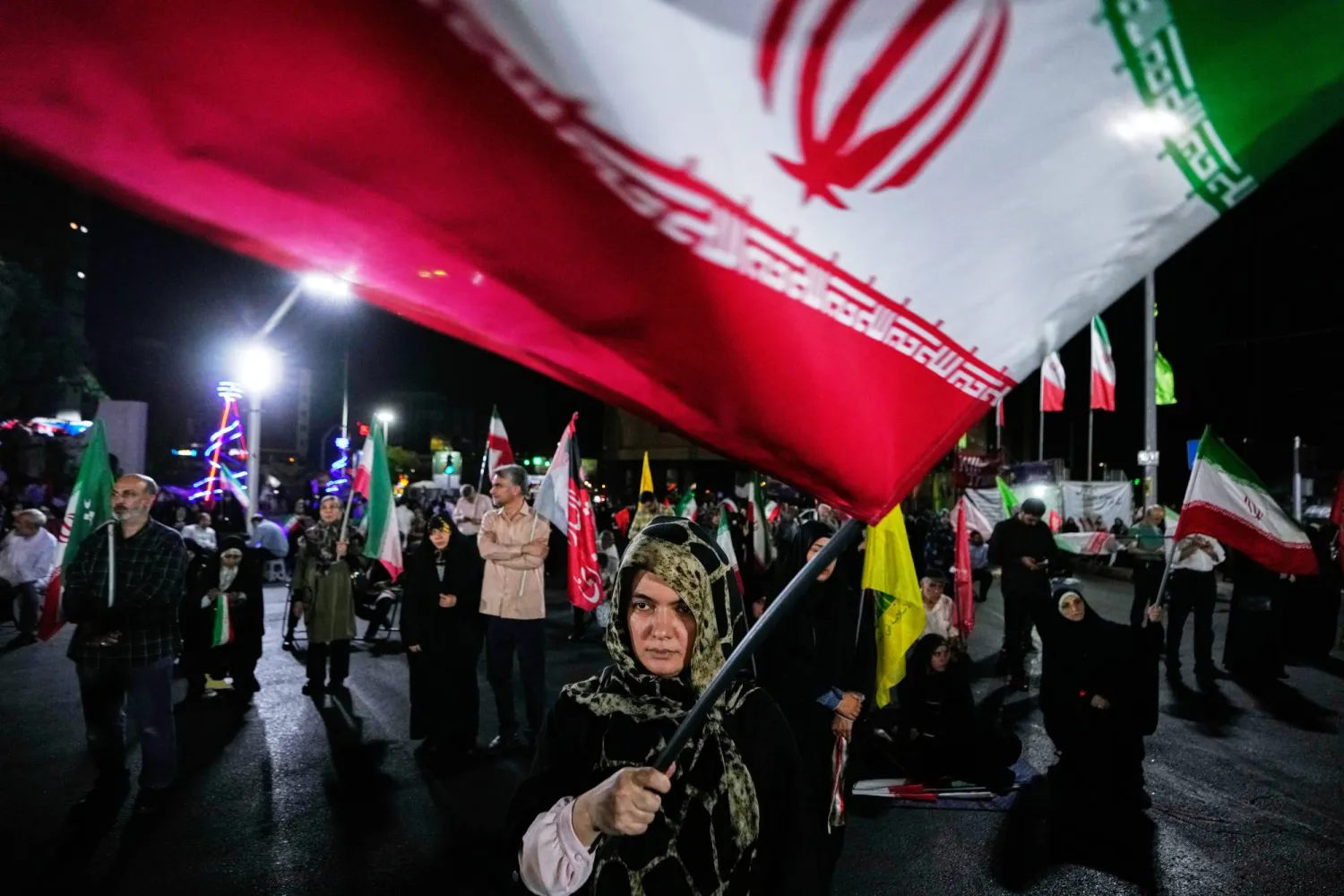
 A pro-government demonstrator waves an Iranian flag during a gathering in a square in Tehran, Wednesday, Aug. 26, 2026. (AP)
A pro-government demonstrator waves an Iranian flag during a gathering in a square in Tehran, Wednesday, Aug. 26, 2026. (AP)
TT

Iran Urges Other Nations Not to Join New US Sanctions, Mediators Focus on Reopening Strait

 A pro-government demonstrator waves an Iranian flag during a gathering in a square in Tehran, Wednesday, Aug. 26, 2026. (AP)
A pro-government demonstrator waves an Iranian flag during a gathering in a square in Tehran, Wednesday, Aug. 26, 2026. (AP)

Iran condemned the United States' new economic sanctions on Friday as "state terrorism" and said other countries were legally obliged not to implement them, while the US Treasury Department announced additional targeted Iran-related measures.  

The Iranian foreign ministry's statement came as mediators stepped up efforts to reopen the Strait of Hormuz, which handled 20% of world oil supplies before the war began six months ago and whose status remains the biggest obstacle to a peace deal.  

President Donald Trump's administration on Monday warned countries to cut their business ties with Iran or face secondary sanctions as part of what it billed as an "economic D-Day," though the Treasury Department stopped short of actually imposing penalties.  

Trump reiterated on Thursday that the US was not talking with Iran, while the White House said Washington's economic campaign would continue until Tehran decided to "come to the table in a meaningful way".  

Iran’s Foreign Ministry said in a statement on Friday ‌that all countries were ‌obligated under international law to refrain from implementing US sanctions against Tehran, adding that participation in them ‌amounted ⁠to complicity in ⁠imposing one state’s unlawful will on independent states.  

It branded the new US measures a "crime against humanity" that put the health and livelihood of millions of civilians at serious risk, and called on other nations and United Nations bodies to uphold the rule of law. 

Treasury officials separately issued sanctions targeting one entity based in Hong Kong and one person linked to Iran's Bank Melli, according to a notice posted ⁠on the department's website. 

With the US focused on its economic pressure campaign, others have sought to revive ‌diplomatic efforts to end the war. 

Qatari Prime Minister Sheikh Mohammed bin Abdulrahman Al Thani said ‌he had stressed during talks with Iranian leaders in Tehran on Thursday the importance of returning to the pre-war status of open shipping through the ‌Strait of Hormuz. 

'PRESSURE DOESN'T WORK,' IRAN TELLS US 

Iranian Foreign Minister Abbas Araghchi on Friday described the talks with Sheikh Mohammed as "creative", and ‌he renewed his appeal to the US to stop putting military and economic pressure on his country and to resume negotiations. 

"Putting diplomacy back on track isn't impossible. It hinges on US understanding of one simple fact: pressure doesn't work," Araghchi said on X. 

Qatar and Pakistan helped broker a memorandum of understanding in June that led to a ceasefire but that quickly unraveled due to disagreements between Iran and the US over the Strait of Hormuz. 

IRANIAN LEVERAGE 

After the ‌US and Israel launched the war on February 28, Iran threatened to strike any vessel transiting the strait without its authorization, driving down traffic and sending up the price of oil, providing Tehran ⁠with leverage in the bargain. 

The US ⁠insists that the strait remain an open international waterway. 

Mohsen Rezaei, secretary of Iran's Supreme National Security Council, said on Thursday Iran was preparing a list of conditions for reopening the strait. 

In the past Iran's conditions have included an end to the US blockade on Iranian ports, compensation and removal of sanctions. It remained unclear whether Iran intended to amend those demands in a way that might be acceptable to Washington. 

CLEARING SEA MINES 

US military commanders say American forces have cleared sea mines from the strait that had been laid months ago by Iran's Revolutionary Guard Corps. 

"Bottom line: today, international shipping lanes are open and momentum is building," Admiral Brad Cooper, commander of the US military's Central Command, said in a video message posted on social media. 

Trump has repeatedly said the strait was open, but many vessels have opted against sailing through it because of Iranian threats, and ship tracking services have estimated activity at roughly 5% to 15% of normal volumes.  

Preliminary shipping data released on Friday showed that only seven commodity vessels had transited the Strait of Hormuz on Thursday, down from 17 a day earlier and below the 10-day average of 15. 

However, oil prices fell on Friday and were on track for a weekly drop, amid what analysts said were signs that more oil was flowing through the strait despite the diplomatic stalemate and that producers were increasingly adapting to the new realities in the Gulf region. 


Netanyahu Party in Uproar as Far-Right Refuses Pleas to Unite

 Israeli National Security Minister Itamar Ben-Gvir whispers into the ear of Prime Minister Benjamin Netanyahu during the last Knesset session in Jerusalem before its dissolution, on July 16, 2026. (Reuters)
Israeli National Security Minister Itamar Ben-Gvir whispers into the ear of Prime Minister Benjamin Netanyahu during the last Knesset session in Jerusalem before its dissolution, on July 16, 2026. (Reuters)
TT

Netanyahu Party in Uproar as Far-Right Refuses Pleas to Unite

 Israeli National Security Minister Itamar Ben-Gvir whispers into the ear of Prime Minister Benjamin Netanyahu during the last Knesset session in Jerusalem before its dissolution, on July 16, 2026. (Reuters)
Israeli National Security Minister Itamar Ben-Gvir whispers into the ear of Prime Minister Benjamin Netanyahu during the last Knesset session in Jerusalem before its dissolution, on July 16, 2026. (Reuters)

Israeli Prime Minister Benjamin Netanyahu's Likud party on Friday upbraided a far-right cabinet member for refusing to run on a joint slate with another ultranationalist, warning a split vote risked tanking their coalition in upcoming elections.

National Security Minister Itamar Ben-Gvir, who recently drew international condemnation for saying Israel should kill "30 to 40" Palestinians nightly in Gaza, has rejected Netanyahu's pleas to join forces with Finance Minister Bezalel Smotrich.

"What does Ben-Gvir want? A broad national government led by Prime Minister Netanyahu... or because of personal considerations, to burn right-wing votes in order to put a left-wing government in power?" the Likud's official account wrote on X.

Netanyahu's calls for unity among his hard-right allies ahead of the October 27 vote come amid a surge in the polls for a new far-right party outside his coalition, founded by former general Ofer Winter.

Analysts say Winter's rising star could siphon votes from Smotrich's base, potentially preventing his Religious Zionism party from clearing the electoral threshold of 3.25 percent unless it joins a list with another party.

Winter, himself from the religious right, has been a vocal critic of the governing coalition, which relies on ultra-Orthodox parties, for allowing men of that community to avoid military service.

In a video posted on X on Thursday night, Netanyahu said Smotrich and Ben-Gvir "must unite. Every time we ran united, we won. When we ran separately, we lost."

"In 1992, the Right had more votes than the Left, like today, but because we were running separately, we got the disaster of Oslo, Arafat, Hamas and recurring catastrophes," he said, referring to the peace process launched with the 1993 Oslo Accords between slain center-left Israeli premier Yitzhak Rabin and late Palestinian leader Yasser Arafat.

Smotrich appeared receptive to the proposal. "It's time for unity and responsibility in the national camp," he wrote on X Thursday evening.

On Friday morning, Netanyahu invited Ben-Gvir and Smotrich to a meeting on Sunday. "We must not waste a single vote; we must unite to save the right-wing bloc!" he wrote on X.

But Ben-Gvir accused Netanyahu of seeking to weaken his right-wing populist Jewish Power party, which consistently polls at around seven to eight parliamentary seats -- comfortably above the threshold.

"According to all polls, a joint run between me and Smotrich would set Jewish Power back by three to four parliament seats," Ben-Gvir wrote on X.

Both ultranationalist parties, once shunned by mainstream politicians, have been keen to maintain independence, allowing them to be kingmakers and to promote uncompromising positions rather than follow the lead of the historically secular Likud.

Ben-Gvir suggested Netanyahu instead push for a joint slate between Winter and Smotrich.

Smotrich and Ben-Gvir have run together twice before. Their joint list won six seats in 2021, then doubled its tally to 14 in the 2022 election that produced the current parliament, before splitting into Smotrich's Religious Zionism and Ben-Gvir's Jewish Power, with seven seats each.


Senior Ukrainian Official Expects 'Technical Talks' on Russia's War Soon

Parts of a shot-down kamikaze drone at a site of a Russian strike, amid Russia’s attack on Ukraine, in the town of Vyshneve in Kyiv region, Ukraine, August 28, 2026. (Reuters)
TT

Senior Ukrainian Official Expects 'Technical Talks' on Russia's War Soon

Parts of a shot-down kamikaze drone at a site of a Russian strike, amid Russia’s attack on Ukraine, in the town of Vyshneve in Kyiv region, Ukraine, August 28, 2026. (Reuters)

Ukraine's top presidential adviser said on Friday that technical talks on Russia's war would likely take place in the near future but added that he did not expect any swift agreement.

"I think everyone will see the negotiations happening very soon. But this will mainly concern the technical side of things and preparations for something big, which I hope we will eventually get to," Kyrylo Budanov said in an interview for YouTube project "Moseichuk+".

US-backed peace talks have so far led to no tangible results to end a war now in its fifth year. The last round of trilateral negotiations took place in February.

Asked if fighting would drag on through the winter, Budanov said it was "unrealistic" to expect the war to end now.

In recent months, both sides have significantly stepped up attacks on logistics, port infrastructure and energy facilities. Russia is also expected to renew its relentless campaign against Ukraine's power grid as winter approaches.

Ukraine and Russia need to reach a point where they are ready to simultaneously take a step toward each other, said Budanov, who is his country's representative at the talks, adding that Kyiv was open to this.

"And as of now, the Russian Federation — and I'm telling you this as someone who is deeply involved in this process — is saying outright, 'we might want to but no'."

Russia's key demand is Ukraine's withdrawal from the eastern Donbas area, which Russian troops have not managed to fully occupy during their more than four-year full-scale invasion. Kyiv says it will not cede territory it still controls.


EU Pledges Two Million Euros in Nepal Flood Aid

A general view shows houses lying deluged in sludge after flash floods at Trishuli in Nepal's Nuwakot district on August 27, 2026. (AFP)
TT

EU Pledges Two Million Euros in Nepal Flood Aid

A general view shows houses lying deluged in sludge after flash floods at Trishuli in Nepal's Nuwakot district on August 27, 2026. (AFP)

The European Union on Friday promised two million euros ($2.3 mn) in aid for Nepal after devastating floods on the country's border with Tibet swept away entire villages, killing hundreds of people, AFP reported.

European Commission chief Ursula von der Leyen wrote on X that the "immediate humanitarian aid" would help "deliver life-saving assistance to families and communities hit hardest."