


Rescuers Claw Through Mud as Missing Toll from Nepal, China Flood Nears 3,000

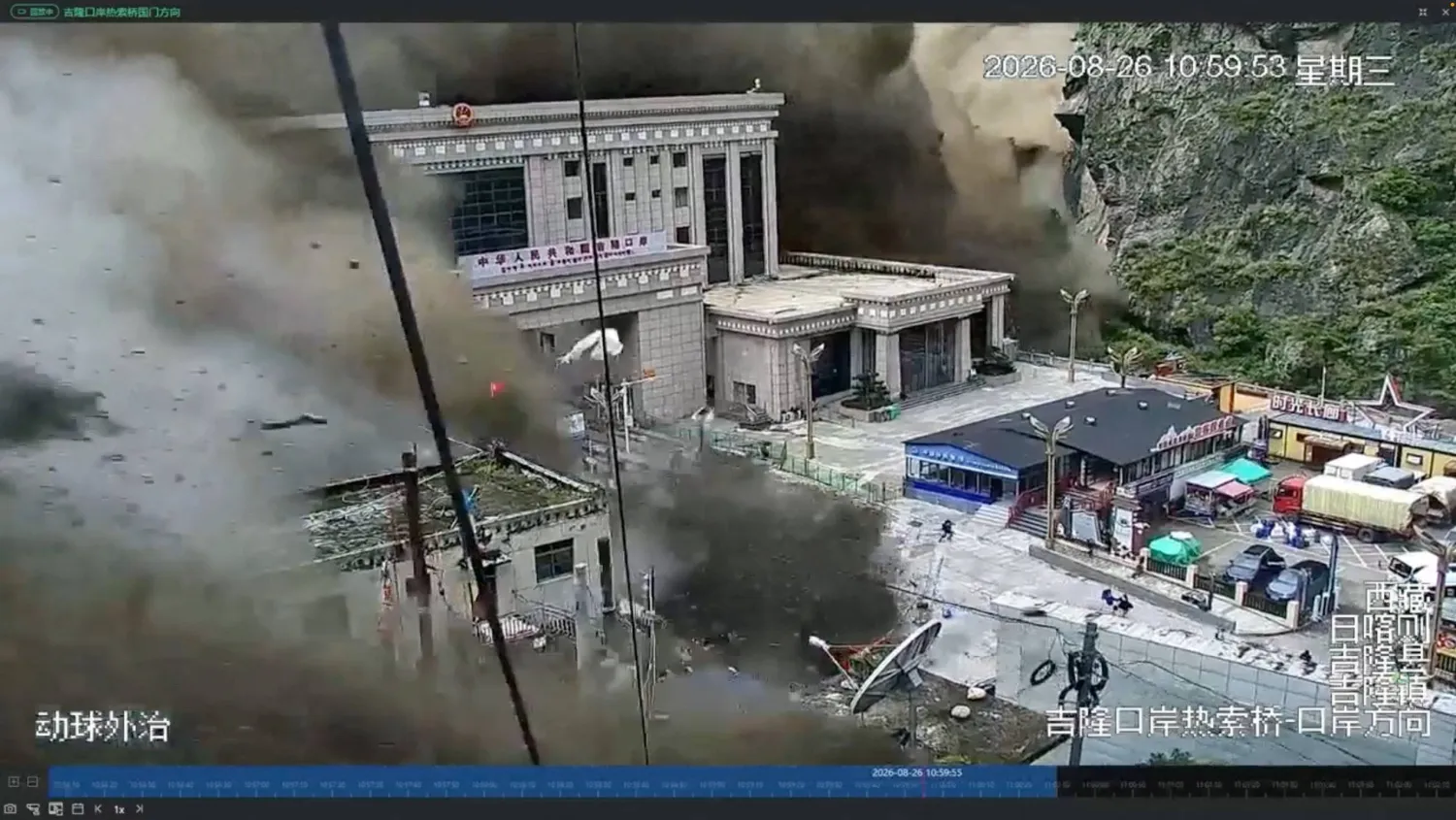
A CCTV footage shows people running away as wall of mud and water destroys buildings in a valley at Nepal-China border, in Gyirong, Tibet region, China August 26, 2026, in this screengrab obtained from a social media video. SOCIAL MEDIA/via REUTERS
TT

Rescuers Claw Through Mud as Missing Toll from Nepal, China Flood Nears 3,000

A CCTV footage shows people running away as wall of mud and water destroys buildings in a valley at Nepal-China border, in Gyirong, Tibet region, China August 26, 2026, in this screengrab obtained from a social media video. SOCIAL MEDIA/via REUTERS

Rescuers in Nepal and China were battling on Saturday to locate thousands of people missing days after a deadly, tsunami-like wall of water and debris swept through the Himalayan region, engulfing entire villages. 

Figures from both countries put the number of missing close to 3,000, with 682 bodies recovered -- and reports of some dead possibly swept downstream as far away as India. 

Rescue worker Kawan Koirala, from the Nepal Scout Disaster Response Team, said they were struggling in thick, leg-sucking mud. 

"People want their family member's body back, either dead or alive, but we cannot find them... you can see the mud," he told AFP, exhausted after an 18-hour shift. 

"It is very traumatic for me too. It is my first time seeing these types of things. Everywhere is mud. We faced flood in Nepal before, but not like this." 

The US Geological Survey said the disaster on the Tibet-Nepal border on Wednesday was caused by a glacial collapse that created a torrent of debris downstream. 

While the exact cause of the collapse is unclear, climate change is causing glaciers to melt worldwide, increasing the risks of such disasters. 

- 'Nothing left' - 

Survivors face an agonizing wait to learn the fate of missing relatives, and the prospect of rebuilding their lives from nothing. 

"All the settlements near the river were swept away," Buddhi Ram Dangol told AFP in Nepal's Nuwakot district. "There is nothing left." 

At Bidur's army base, a key rescue hub in the same district, relatives crowded around lists of rescued people pasted on a wall. 

"I have come here looking for my son," said Kalka Sharda, scanning the list in desperation. "He was a laborer at the hydropower plant, but I can't find his name, and the authorities are not saying anything." 

In an area home to vast energy infrastructure projects, Nepal's disaster authority listed 933 hydropower workers among the missing, along with 517 foreigners, including trekkers and Hindu pilgrims to Tibet's Mount Kailash. 

- 'Enormous' trauma - 

The trauma of Wednesday's catastrophe has been "enormous", and as many as 93,000 people may have been affected, the Red Cross said, with the death toll expected to rise. 

Nepal's reconstruction bill could run into "billions of dollars", Foreign Minister Shisir Khanal said Saturday. 

"The urgency is on rescue and saving lives as much as we can," he said, appealing for specialized assistance, including heavy-lift drones and technology to help locate people who are trapped. 

He also called for forensic testing kits to identify bodies and freezer units to store them, saying bodies that have been in water could decompose at a faster rate. 

"Our own healthcare capacity is very limited to put these bodies in a frozen state for a long time," he said. 

Emergency teams worked flat-out to find survivors as widespread devastation left communities short of food and water. 

Fears of further flooding have compounded the search for the missing. 

The deluge of ice and mud caused huge lakes, and one of these formations has become a risk of further floods. 

In Tibet, where Chinese authorities are the only source of information, Beijing had paused its rescue operation at the hardest-hit area of Gyirong over the risk of renewed flooding. 

On the Nepali side, soldiers were trying desperately to drill through to 100 people trapped in tunnels at multiple hydropower projects on Saturday. 

The prime minister's office said teams had begun "clearing mud and debris" to open the entrance, while a specialized Indian tunnel rescue unit had arrived to help, with a Chinese team on its way. 

Nepal's expert mountain rescue teams -- used to aiding climbers on the world's highest peaks, including Everest -- are also joining the search. 

"We do similar work on the mountains, with rescue operations for people trapped in risky places so I believe our skills will be useful," Tul Singh Gurung, president of Nepal National Mountain Guide Association, told AFP. 

Workers rescued from other dam projects along the Trishuli valley described a disaster that unfolded with terrifying speed. 

- 'I don't think there is any hope left' - 

Nepal reported a death toll of 675 people on Saturday. 

There are 2,426 people, including hundreds of foreigners, who are out of contact in the country. 

Across the border in Tibet, which is largely inaccessible to foreign journalists, seven people died and 554 remain missing, Xinhua state news agency said on Saturday. 

Authorities also said they had evacuated 555 stranded tourists and 499 Chinese residents from Tibet. 

In India, officials said they had recovered seven bodies from rivers flowing from Nepal, believed to be flood victims. 

Hope was fading for some still waiting desperately for news. 

Kalka Sharda, in Bidur, was searching lists of rescued for his 18-year-old son Vinod Sharda, a hydropower plant laborer. 

"I don't think there is any hope left," he said. 

"Because, if he was alive, he would have found a way to get in touch." 


Nepal Warns of Climate Threat After Deadly Floods

A disaster rescue personnel looks on at the site of damaged buildings in the aftermath of flash floods at Trishuli Bazar in Nepal's Nuwakot district on August 29, 2026. (AFP)
TT

Nepal Warns of Climate Threat After Deadly Floods

A disaster rescue personnel looks on at the site of damaged buildings in the aftermath of flash floods at Trishuli Bazar in Nepal's Nuwakot district on August 29, 2026. (AFP)

Nepal's foreign minister warned on Saturday of the growing threat from climate change in the Himalayas, as China offered water and satellite data after devastating floods on their shared border killed hundreds.

The US Geological Survey said the disaster on Wednesday near the high-altitude China-Nepal border was caused by a glacial collapse that sent a torrent of debris downstream, with nearly 3,000 people missing and 682 confirmed dead.

While the exact cause of the collapse is unclear, climate change is causing glaciers to melt worldwide, increasing the risks of such disasters.

Foreign Minister Shisir Khanal said he had spoken by phone with his Chinese counterpart Wang Yi, agreeing to increase the sharing of "real-time hydrological data", according to a statement.

Wang, in a Chinese foreign ministry statement, said Beijing had "shared crucial information with Nepal, including disaster area imagery, satellite and hydrological data, as well as early warnings about upstream barrier lakes".

Wang added that "China and Nepal are bound by mountains and rivers, sharing a common destiny".

Khanal had earlier told reporters on Saturday that Nepal needed greater research to "understand the changing dynamics of the Himalayan ecosystem" and the risks they pose to the landlocked country, encircled by India and China.

That includes not only risks "to Nepal and the downstream community, but also to our northern neighbor, to China, as well," Khanal said.

Himalayan glaciers, which provide critical water to nearly two billion people, are melting faster as the planet heats, exposing communities to unpredictable, costly disasters.

Khanal said climate change required international action.

"We always highlight that Nepal contributes less than or just about 0.01 percent of greenhouse gases but we, the people of Nepal, are one of the major victims of the changing climate and its impact," he added.

"So we request the global community also to come together to preserve the Himalayan ecosystem."

Melting glaciers and thawing permafrost can also destabilize mountain slopes, increasing the risk of landslides and other hazards.


Türkiye Summons Ukraine Ambassador Over Black Sea Attacks

Smoke rises from a civilian vessel on fire, amid Russia's attack on Ukraine, in Odesa, Ukraine July 19, 2026. (Reuters)
TT

Türkiye Summons Ukraine Ambassador Over Black Sea Attacks

Smoke rises from a civilian vessel on fire, amid Russia's attack on Ukraine, in Odesa, Ukraine July 19, 2026. (Reuters)

Türkiye summoned Ukraine's ambassador over attacks this week in the Black Sea against a Turkish vessel, and against a second ship that came to tow the first, the country's foreign ministry said Saturday.

The attacks happened on Wednesday and Thursday, the ministry told AFP.

"During the meeting, Türkiye warned about the absolute need to ensure the safety of people, of assets, of navigation and of the environment in the Black Sea," the ministry said in a statement.

It said the Turkish container ship Lider Bordo Mavi was hit on Wednesday while it was off the Russian coast on the Black Sea. The next day, the ship Lider Kocatepe sent to tow the cargo vessel was also targeted, the ministry said.

The ministry did not say whether there were any casualties in the attacks.

According to local Turkish media, the container ship was towed to the Turkish port of Samsun.

Ankara has been calling for weeks on Ukraine and Russia to suspend their attacks on civilian vessels in the Black Sea. Each of the warring countries has been seeking to damage the other's sources of export revenues as part of their conflict, which Russia started in 2022 with its full-scale invasion of Ukraine.

Turkish commercial ships are active in the Black Sea, sailing under various countries' flags, and several have been hit by drones suspected to be launched by Ukraine.

Türkiye, a NATO member country that maintains relations with both Kyiv and Moscow, has not joined Western sanctions levelled against Russia.

On August 8, Turkish Foreign Minister Hakan Fidan called for a "moratorium" on Black Sea attacks.

"The conflict has spread across the whole Black Sea," he said at the time, complaining that "they are attacking all commercial shipping without distinction".


French Far-Right Accuses Left of Threatening ‘Civil Peace’ if Le Pen Wins

French far-right leader and member of parliament Marine Le Pen, President of the French far-right National Rally (Rassemblement National - RN) party parliamentary group, attends a debate with other candidates for the 2027 French presidential election during the MEDEF summer forum "La Rencontre des Entrepreneurs de France, La REF" in Paris, France, August 27, 2026. (Reuters)
TT

French Far-Right Accuses Left of Threatening ‘Civil Peace’ if Le Pen Wins

French far-right leader and member of parliament Marine Le Pen, President of the French far-right National Rally (Rassemblement National - RN) party parliamentary group, attends a debate with other candidates for the 2027 French presidential election during the MEDEF summer forum "La Rencontre des Entrepreneurs de France, La REF" in Paris, France, August 27, 2026. (Reuters)

The French far-right on Saturday accused the left of seeking to "undermine civil peace" should Marine Le Pen win the presidential election next spring, underscoring the increasingly confrontational tone of the campaign.

With less than eight months to go before France's presidential election, far-right leader Le Pen, 58, remains the front-runner in the polls.

Analysts say that the appeal of political extremes is growing in France, and recent surveys show that hard-left presidential candidate Jean-Luc Melenchon, 75, may have the best chance of reaching the run-off against Le Pen.

Speaking at an agricultural fair in the northeastern town of Chalons-en-Champagne, Jordan Bardella, president of the National Rally (RN) party and Le Pen's prospective prime minister in the event of her victory, said he was concerned by calls from the left for "civil disobedience" if the RN comes to power.

Bardella, 30, said they amounted to "an admission of weakness from the left, which hates democracy and is calling into question the fundamental principles of the rule of law and the electoral process."

"The attitude of France Unbowed at the start of this campaign is deeply worrying," said Bardella.

"They are already seeking to undermine civil peace in our country."

Mathilde Panot, leader of the LFI parliamentary group in parliament's lower house, and Greens leader Marine Tondelier have recently said they would support "civil disobedience" in the event of an RN victory.

Some observers say the election campaign is increasingly at risk of becoming a contest dominated by populist anti-establishment forces, raising concern among investors about the prospect of a presidential runoff between the far right and the hard left.

Bardella said he was concerned about Melenchon's "true intentions."

During a first presidential debate on Thursday, Melenchon vowed to "disobey" European decisions that contradict the wishes of French voters and pressed ahead with his proposals to cancel a chunk of France's public debt.

"France Unbowed and Monsieur Melenchon do not want to win this presidential election," said Bardella.

"They do not want to protect institutions, they want to destroy them."
