


Venezuela Says Retains ‘Sovereignty’ in US Oil Deal

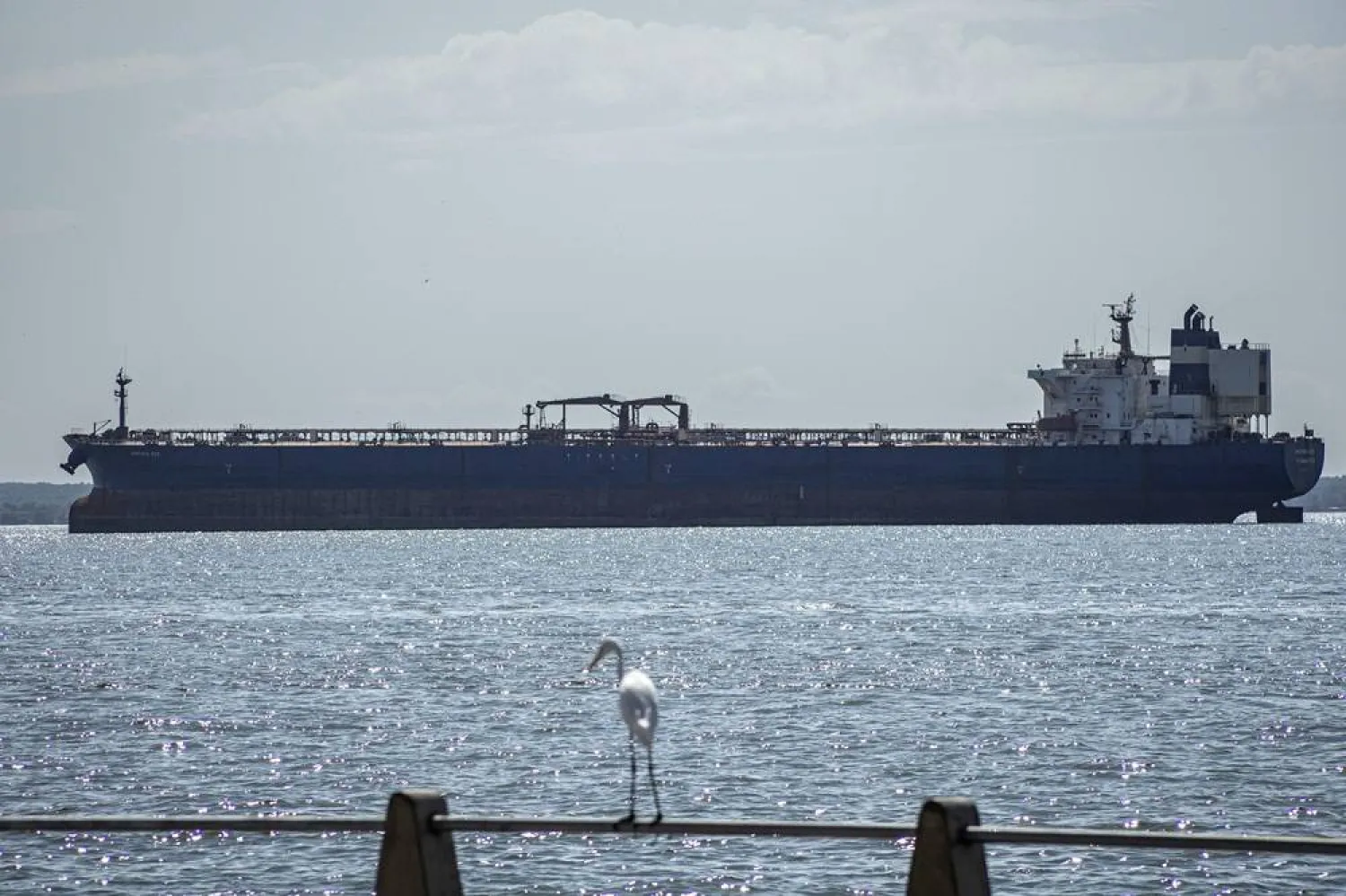
An oil tanker sails off the coast of Maracaibo, Venezuela, 29 August 2026. (EPA)
TT

Venezuela Says Retains ‘Sovereignty’ in US Oil Deal

An oil tanker sails off the coast of Maracaibo, Venezuela, 29 August 2026. (EPA)

Interim leader Delcy Rodriguez assured the public Saturday that Venezuela retains control of its oil under a new agreement that allows the United States significant access to it.

The United States will have majority control of 65 billion barrels of Venezuela's proven reserves in what President Donald Trump described Friday as "the biggest oil deal in world history."

"One thing must be absolutely clear: Venezuela retains ownership and sovereignty over its resources," Rodriguez said in a speech on state television.

The agreement with the United States aims to turn "cold, inert" resources underground to "a source of social and economic well-being for the people of Venezuela," she said.

Caracas says the deal involves $100 billion in private investment aimed at revitalizing the industry in a country with the world's largest proven oil reserves.

But a lack of transparency is raising concerns among Venezuelans, including supporters of the government. A flood of social media comments decried loss of sovereignty, meager benefits and political costs.

"We don't know who this will benefit -- whether it's Venezuela or (the United States)," said Jesus Salazar, a 68-year-old security guard.

"I have my doubts, but we'll have to wait and see what happens."

Venezuela's government has operated under intense pressure from the Trump administration since American forces ousted and captured long-time ruler Nicolas Maduro in January.

Washington allowed Rodriguez, his vice president, to stay on as interim leader so long as she toes Washington's line.

Venezuela's ruling party said Saturday it supports economic measures that "prioritize national interests and make it possible to overcome the impact of more than a decade of economic sanctions, unilateral coercive measures, and unjust blockades."

The party consistently blames US sanctions for the collapse of Venezuela's economy.

- Petrol and poverty -

Rodriguez has pushed through reforms in Venezuela's mining and petroleum industries, opening once tightly controlled sectors to private capital and foreign investment.

Washington, for its part, has eased sanctions imposed on Venezuela's oil sector under the Maduro government.

Oil production rose by 29.8 percent between January and July, reaching 1.2 million barrels per day -- still well below the three million barrels per day produced a quarter of a century ago.

The US deal aims to restore production to those levels, but analysts agree it would take time.

"The increase in production won't be seen for at least three or four years," said engineer Oswaldo Felizzola, a professor at the Institute of Higher Studies in Administration (IESA) in Caracas.

He welcomed the United States acting as a "guarantor" for investments in Venezuela, which has failed to attract significant capital for more than a decade.

"Without this, these fields would not be developed over the next 10 or 15 years," because state-owned Petroleos de Venezuela (PDVSA) "does not have the financial resources to do so."

An initiative of this magnitude could accelerate long-awaited economic recovery in Venezuela, a country still reeling from the brutal 80 percent contraction between 2014 and 2021 that plunged millions of Venezuelans into poverty.

Many survive on a monthly minimum wage equivalent to $0.16, plus government subsidies that can reach $240 per month -- still far short of the estimated $730 needed to buy basic food necessities for a family of five.

- Doubt and optimism -

Carlos Baco, a 74-year-old government employee, hopes oil revenues will start flowing under the new deal, but said he hasn't felt the effects of the increase in oil production over the past few months.

"Consumer goods and food are more expensive... the dollar is rising and prices are going up," he said. "It's impossible here."

Rodriguez has promised more than $204 billion in tax revenue from the deal, without providing details.

For analyst Elias Ferrer of the Orinoco think tank, the investment is good news, even without specifics.

"It's undoubtedly better than before. Before, this oil wasn't being extracted; if no one extracts it, no one pays royalties, and no one profits from it," he said.

"If everything is done correctly... this will be a great opportunity for Venezuela to see its oil sector revived," said attorney Dolores Dobarro, Venezuela's former deputy minister of energy.



Analysts North Korea Appears to Have Tested Upgraded Hypersonic Weapon

This picture taken on September 21, 2026 and released by North Korea's official Korean Central News Agency (KCNA) on September 22, 2026, shows North Korean leader Kim Jong Un speaking at the 3rd Workshop for Officials in the Propaganda Sector of the Workers' Party of Korea in Pyongyang. (Photo by KCNA / KCNA VIA KNS / AFP)
TT

Analysts North Korea Appears to Have Tested Upgraded Hypersonic Weapon

This picture taken on September 21, 2026 and released by North Korea's official Korean Central News Agency (KCNA) on September 22, 2026, shows North Korean leader Kim Jong Un speaking at the 3rd Workshop for Officials in the Propaganda Sector of the Workers' Party of Korea in Pyongyang. (Photo by KCNA / KCNA VIA KNS / AFP)

North Korea appears to have tested a hypersonic weapon that could evade missile defenses and prove hard to track and intercept, analysts told AFP Wednesday.

South Korea and Japan said Pyongyang fired two short-range ballistic missiles off its east coast Sunday, condemning the launches as threats to regional peace and security.

North Korea did not identify the weapon, saying only that its missile bureau had "successfully tested a new type of weapon" in a demonstration of "ultra-modern defense technology.”

Analysts said the weapon appeared to be an upgraded version of North Korea's Hwasongpho-11Ma-1 hypersonic short-range ballistic missile.

With a range of 450 to 600 kilometers (around 280-370 miles), the hypersonic missile is "designed to strike key military facilities across the Korean peninsula within an extremely short period of time,” Yang Moo-jin, former president of the University of North Korean Studies in Seoul, told AFP.

Images released by Pyongyang's state media showed leader Kim Jong Un and his daughter Ju Ae watching a screen displaying what appeared to be the missile's flight path, labelled "Hwasongpho-11Ma-1 flight trajectory.”

The North Korean leader warned this week that the weapon's advances would give adversaries "an incurable headache and a very cruel and unavoidable blow,” according to the official Korean Central News Agency.

Despite long-running UN sanctions, North Korea has enshrined its status as a nuclear-armed state in law, with its leaders repeatedly declaring its atomic arsenal permanent and irreversible.

North Korea has also secured critical backing from Russia alongside its traditional ally China, leaving fewer incentives for it to engage in renewed diplomacy with Washington.

"North Korea may be talking up its own capabilities, but it has clearly reached the point where it can launch weapons of this caliber," Ahn Chan-il, a researcher originally from North Korea, told AFP.

"I believe these tests are less about upgrading its own military capabilities than testing weapons produced by its defense industry to meet Russia's wartime demand."

Since Russia launched its invasion of Ukraine in 2022, North Korea has become a key ally of the Kremlin, sending troops to support Moscow's war effort in return for economic benefits and military technology, analysts say.

Hong Sung-pyo, senior researcher at the Seoul-based Korea Institute for Military Affairs, said that if used against South Korea, the hypersonic weapon would pose a serious threat.

"But a single successful test is not enough to prove its capabilities. If deployed operationally, however, it would be extremely difficult to defend against," he told AFP.

"Because it maneuvers as it descends during the terminal phase of flight, it is harder to track and intercept than a conventional ballistic missile -- particularly at hypersonic speeds."


Tigray Rebel Forces Seize Ethiopia Regional Airport

(FILES) The charred remaining of a T-72 tank lay on the road that connects Shiraro to Shire on October 12, 2024.  (Photo by Michele Spatari / AFP)
(FILES) The charred remaining of a T-72 tank lay on the road that connects Shiraro to Shire on October 12, 2024. (Photo by Michele Spatari / AFP)
TT

Tigray Rebel Forces Seize Ethiopia Regional Airport

(FILES) The charred remaining of a T-72 tank lay on the road that connects Shiraro to Shire on October 12, 2024.  (Photo by Michele Spatari / AFP)
(FILES) The charred remaining of a T-72 tank lay on the road that connects Shiraro to Shire on October 12, 2024. (Photo by Michele Spatari / AFP)

Tigrayan rebel forces in northern Ethiopia have seized control of the airport in the regional capital, security and local sources told AFP on Wednesday, at a time of rising tensions with the federal government.

The Tigray People's Liberation Front (TPLF), which controls the region, fought a devastating civil war with the federal government in 2020-2022 that killed some 600,000 people, according to African Union estimates.

Sporadic clashes in recent months have raised fears of a return to war.

"While we were on our way to the airport for work, our supervisor called the driver and told him that the airport had been taken over by Tigray forces. Since there were no flights, he told us to return home," an employee at Alula Aba Nega Airport in the Tigrayan capital Mekelle told AFP.

The information was confirmed by a foreign security source based in Ethiopia.

A small number of federal police guard the airport, and their condition was unknown.

Flight Radar, an air traffic tracker, showed that Wednesday morning's flight between Mekelle and the federal capital, Addis Ababa, had been cancelled.

"Ethiopian Airlines has temporarily suspended flights to Mekele, Axum, and Shire effective today, due to the current situation in the Tigray region," the national carrier said in a statement.

On Sunday, the TPLF was announced as a member of a new alliance of anti-government armed groups from across the country.

Ethiopia faces a myriad of insurgencies, including in its most populous regions, Oromia and Amhara.

The TPLF ruled the whole of Ethiopia from 1991 to 2018 before being sidelined with the rise of Prime Minister Abiy Ahmed, eventually triggering the civil war.

The Pretoria Peace Agreement ended the war and maintained an uneasy calm until late 2025, when clashes resumed.

The federal government has since launched multiple drone strikes in Tigray and massed troops at the regional border.

Rights groups have accused the TPLF of a campaign of forced recruitment this year as it prepares for renewed conflict.

The region has not recovered from the last war, with around one million people still displaced and many aspects of the peace agreement still unfulfilled.

Ethiopian authorities have accused the TPLF of allying with neighboring Eritrea, as well as Ethiopian armed groups.

The federal government has a significant military advantage, having ramped up production of military drones since the last conflict.


UK to Launch New Military Space Squadron to Protect Satellites

Britain's Defence Secretary Wes Streeting (L) attends a 'Service of Thanksgiving and Rededication' to mark the 86th anniversary of Battle of Britain, at Westminster Abbey in central London on September 20, 2026. (Photo by Peter Nicholls / POOL / AFP)
TT

UK to Launch New Military Space Squadron to Protect Satellites

Britain's Defence Secretary Wes Streeting (L) attends a 'Service of Thanksgiving and Rededication' to mark the 86th anniversary of Battle of Britain, at Westminster Abbey in central London on September 20, 2026. (Photo by Peter Nicholls / POOL / AFP)

Britain announced Wednesday that it will launch a new military space squadron charged with defending the country's satellites, in the latest move as various countries rush for military space capabilities.

The new Royal Air Force (RAF) squadron will protect critical satellites used in communications and to warn of incoming missile attacks, the Ministry of Defence (MoD) said.

It described the unit -- to be known as No III Space Effects Squadron -- as the country's first dedicated to "disrupting, degrading, and denying enemy activity targeting British interests in space.”

The MoD noted the UK launched two squadrons in 2023 that "watch and warn" of space threats while the new unit will "act against those threats, using advanced technology, including electronic warfare,” AFP reported.

Air Chief Marshal Harv Smyth will formally unveil the squadron on Wednesday at a two-day UK Space Power Conference starting in London, where Defense Secretary Wes Streeting will also warn Britain must "keep pace in the new space race.”

The announcement comes just over a week after the United States confirmed for the first time that it has arms deployed in orbit above the Earth.

That prompted China to warn against turning outer space into a "battlefield" and Russia to caution it must be "free from any weapon” amid fears of an arms race in space.

The developments are being driven by rapid technological advancements but lack a comprehensive legal framework.

Last year, the head of UK Space Command Major General Paul Tedman warned he was "really worried" by Russia attempting to jam British military satellites on a regular basis.

He noted at the time that the UK was operating six dedicated military satellites for communications and surveillance, which were equipped with counter-jamming technology.