


Some Migrants Ready to Pack Bags Fearing Far-Right Win in East German State

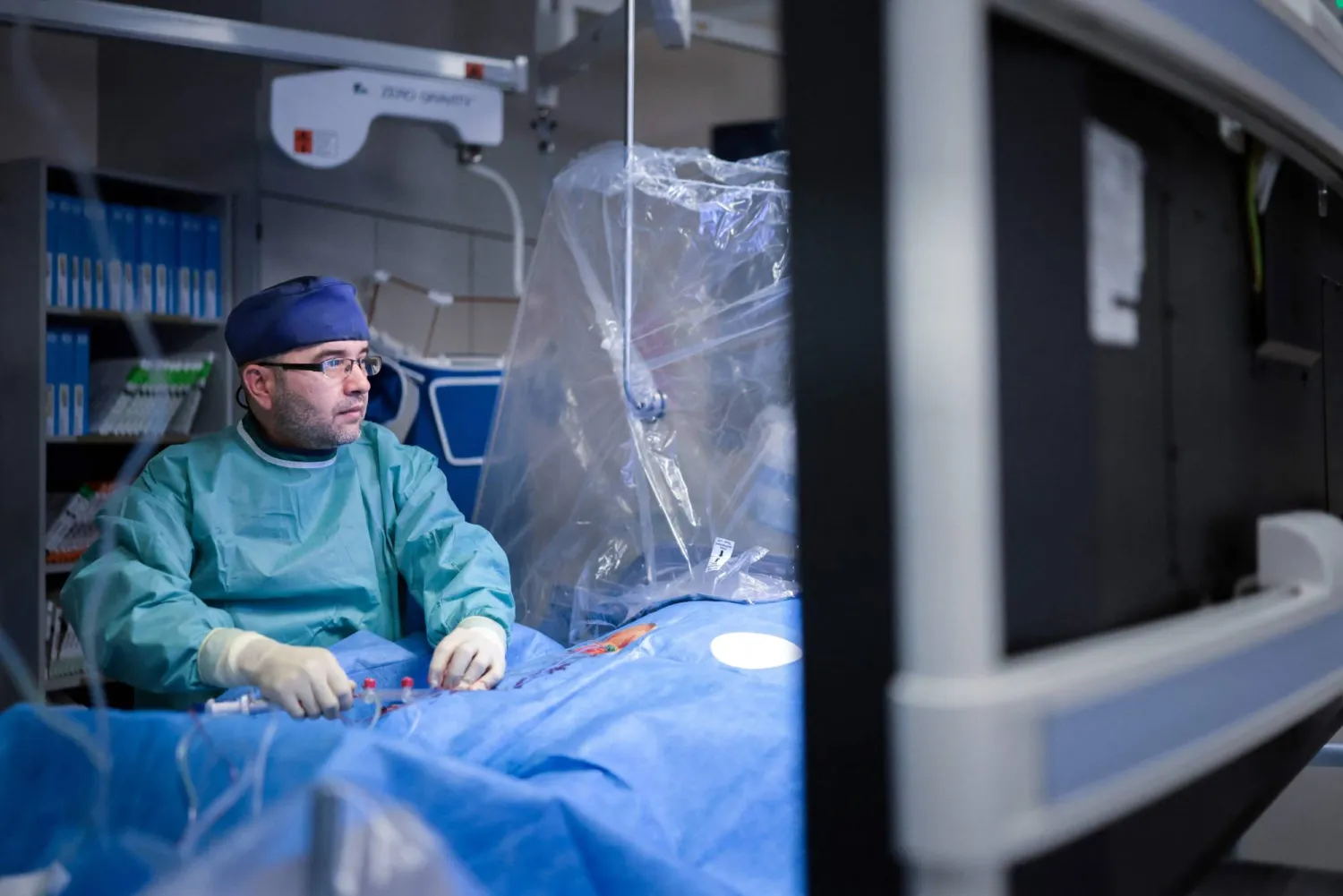
Cardiologist Ayman Alyoussef, who came to Germany from Syria in 2014, is treating a patient in the operating room of the cardiac catheterization lab at Harzklinikum Dorothea Christian Erxleben, in Quedlinburg, eastern Germany, on August 27, 2026. (AFP)
TT

Some Migrants Ready to Pack Bags Fearing Far-Right Win in East German State

Cardiologist Ayman Alyoussef, who came to Germany from Syria in 2014, is treating a patient in the operating room of the cardiac catheterization lab at Harzklinikum Dorothea Christian Erxleben, in Quedlinburg, eastern Germany, on August 27, 2026. (AFP)

As a far-right regional election victory looms in an ex-communist eastern German state, many migrants are readying to pack their bags, fearful of the AfD party's threatened "deportation and remigration offensive".

A week from now, the anti-immigration, Islamophobic and Russia-friendly Alternative for Germany party is expected to score a historic win in the small state of Saxony-Anhalt, with hopes of taking its first-ever governing majority.

It is an ominous scenario for Syria-born cardiologist Ayman Alyoussef, head physician in a clinic in the picturesque town of Quedlinburg, who voiced a common sentiment: "I fear that hatred of foreigners will spread."

Alyoussef, who arrived in the country in 2014 and is now a German citizen, said he has been welcomed by patients and colleagues but sometimes faces hostility on the streets, as do his wife and daughter who wear Muslim headscarves.

"There are patients who arrive at 3:00 am with a heart attack. I am able to get them through an acute crisis," Alyoussef told AFP. "Afterwards, they are very grateful when they realize that a foreigner helped them.

"But out on the street, they don't know that I am a cardiologist. They think I am just a foreigner receiving assistance from the city. That is why they say they don't want someone like me here. That is the problem."

Many foreign-born residents share such experiences and fears.

Last week, some 150 migrant-run restaurants, kiosks and barber shops in the state capital Magdeburg temporarily closed their doors to protest what they warned is an increasingly xenophobic climate.

Support group the Refugee Council said many migrants had already reported "experiences of racism and social exclusion" and that talk of mass deportations had sparked growing "fear and uncertainty".

- 'Up in flames' -

It is a feeling shared by Afghan migrant Rezwaan Talash, 24, who arrived in Germany six years ago and works in a Magdeburg computer repair shop.

"Whether I'll still have my life the way it is now, that's a question and a fear that's always on my mind," he told AFP.

Talash, who also volunteers in a migrant support group, said that "from our association, quite a few people from Saxony-Anhalt have recently moved away because it could be unsafe here for us after the elections.

"We don't want everything we've worked to achieve here so far -- starting a calm, good life here -- to suddenly go up in flames."

AfD top candidate Ulrich Siegmund, who wants to become state premier, has vowed to deport all foreigners without legal status "from minute one" in office.

Speaking to AFP on Saturday at a campaign event, Siegmund insisted that his party wants to deport "people who are here illegally, who are required to leave the country", while "regular immigration based on strict criteria ... would not be a problem".

Whatever happens after Sunday's election, the heated campaign rhetoric has already deepened "societal divisions", said Mamad Mohamad, a candidate for the left-leaning Greens party who was recently handing out flyers outside an Islamic cultural center in the city of Halle.

"There are people who want to talk to us and have questions, but there are also people who walk by and hurl insults or shout at us," he told AFP.

Mohamad, a Yazidi Kurd who arrived in Germany from Syria in 1996 as a 16-year-old, said he and his fellow campaigners "always have to keep an eye on where we are, who we are talking to, and ensure we are never alone.

"We always go out in groups of three or four when campaigning in the city."

- Demographic crisis -

Economists warn that the AfD's anti-migrant campaign, aside from the human toll, would spell an economic own-goal for the small state, which has already lost nearly a quarter of its population since Germany's reunification in 1990.

"Today, for every two people leaving the workforce, only one enters it -- a gap that cannot be filled by the residents of Saxony-Anhalt and neighboring regions alone," says conservative CDU candidate Sven Schulze.

The AfD has proposed to counter the demographic crisis with "baby bonuses" for German parents and by seeking to lure back Germans living abroad, but employers say they are already struggling to find qualified staff.

"Saxony-Anhalt definitely has problems finding young talent," said Talash's boss in the IT store, Matthias Herberg. "Many people leave the state. Many school leavers don't have ideal qualifications.

"Well-qualified people with a migration background could absolutely fill these gaps."

Pushing out migrants would especially hit the state's health sector, where thousands of doctors and nurses are foreign-born.

"Without our highly qualified colleagues of foreign origin, we wouldn't be able to function," said Quedlinburg clinic director Matthias Voth. "I would have to close the hospital."

Alyoussef said he wanted to stay but was keeping his options open.

"I have a German passport, and my family too," he said. "I can work anywhere -- not just here in Saxony-Anhalt or in other states, but in other countries as well.

"If I get the feeling that hatred is being spread here, then that's it, I'm done."


Russia Says Preparing ‘Massive Strikes’ on Ukraine’s Energy Sector

A view of the destruction after a Russian attack struck a warehouse, followed by an explosion, in the village of Myla, Kyiv region, Ukraine, Saturday, Aug. 29, 2026. (AP)
TT

Russia Says Preparing ‘Massive Strikes’ on Ukraine’s Energy Sector

A view of the destruction after a Russian attack struck a warehouse, followed by an explosion, in the village of Myla, Kyiv region, Ukraine, Saturday, Aug. 29, 2026. (AP)

Russia's defense ministry on Sunday said it was gearing up for large-scale attacks on Ukraine's energy infrastructure in a tit-for-tat response to strikes by Kyiv.

"Russian forces have begun preparations for massive strikes against facilities in Ukraine's energy sector in response to the ongoing attacks by the Kyiv regime on civilian infrastructure and on Russia's oil and energy complex," it said on Telegram.

Last winter, Moscow repeatedly hit Ukrainian power plants, devastating the country's energy sector and plunging millions of people into cold and darkness in sub-zero temperatures.

Both sides have for several months escalated long-range strikes, targeting infrastructure such as warehouses, businesses, oil and port facilities, as well as ships, increasing civilian casualties.

On Sunday, the Russian army claimed to have struck a plant in Kyiv producing asbestos and cement whose warehouses, it said, were used to store explosives, as well as a manufacturer of drones and munitions.

On Saturday, a Russian strike on an ammunition depot in the suburbs of the Ukrainian capital triggered a huge explosion and killed at least 37 people.

Ukraine for its part attacked an oil refinery with drones in northwestern Russia, causing a fire, according to the local authorities.


Trump Cannot Deport Students for Criticizing Israel, Judge Rules

Students walk through the Stanford University campus, March 14, 2019, in Santa Clara, Calif. (AP)
TT

Trump Cannot Deport Students for Criticizing Israel, Judge Rules

Students walk through the Stanford University campus, March 14, 2019, in Santa Clara, Calif. (AP)

Citing the importance of the First Amendment, a federal judge in California says the US government is unconstitutionally silencing critics of Israel's war in Gaza and others as part of the Trump administration’s quest to deport noncitizens who it says disrupted college campuses while expressing their views.

Judge Noël Wise, in a ruling Friday, delivered a victory for The Stanford Daily, the student newspaper at Stanford University, which has said some international students were afraid to speak out because of the deportation threat.

“Freedom of speech is illusory if we are only ‘free’ to express complementary views about the government and its leaders,” the judge wrote.

The decision largely piggybacks on findings from nearly a year ago by a US district judge in Boston, who ruled that the Trump administration violated the Constitution when it targeted people who are not citizens for deportation solely for supporting Palestinians and criticizing Israel.

Wise wrote that the freedoms of speech and the press are “foundational to America’s enduring democracy.” The judge cited free-speech and vagueness flaws that violate the First Amendment and Fifth Amendment as she struck down portions of the provisions that the federal government follows regarding deportations.

Wise cited retaliation in March 2025 by US immigration authorities against people who engaged in speech supporting the Palestinians and against Israel's actions, which a growing number of experts, including those commissioned by a UN body, have said amount to genocide. The judge also cited retaliation against people who were critical of Charlie Kirk after the Turning Point USA co-founder was assassinated last September.

“Tomorrow, or perhaps even today, targets may include anyone in the United States who exercises their freedom of speech to simply express opinions the government does not like,” the judge in San Jose said.

“This downward spiral is antithetical to our Constitution that recognizes our right to speak freely,” she added. “Here you can simultaneously hate the content of a person’s speech and love the country that cherishes the freedom to allow it. Zealous protection of our Constitutional right to free speech is a provocative demonstration of our country’s powerful lack of fear.”

The Justice Department did not respond Saturday to a message seeking comment on the decision.

George Porteous, the editor-in-chief of The Stanford Daily, responded to the ruling by saying on X: “The reporters in our newsroom shouldn’t have to fear that writing a story will result in their deportation. Today’s victory means they won’t have to.”

Conor Fitzpatrick, an attorney with the Foundation for Individual Rights and Expression, which brought the lawsuit, praised the ruling.

“In America, free speech doesn’t just belong to the people who say things the government agrees with,” Fitzpatrick said in a release.

In her decision, Wise said it was clear that the government's tactics has had an effect on college campuses.

“The government has offered a chilling message regarding protected speech — speak out against Israel or in support of Palestinians and we will revoke your visa and deport you. Behave. Noncitizen students heard the warning and heeded. And, as the idiom goes, the silence is deafening,” the judge wrote.

At The Stanford Daily, lawfully present noncitizens at the paper have quit, withheld articles, refused assignments, requested articles be taken down, and asked for anonymity due to fear of adverse immigration consequences, Wise noted.

She said noncitizens have the same First Amendment rights as citizens and yet were left to guess what the US foreign policy was at any given moment and on any given subject.

“This is an incomprehensible standard,” she said. “While the Court understands that the government has been granted considerable discretion on foreign policy and immigration matters, that discretion must nevertheless still ensure that ordinary people can understand what the law permits and prohibits.”

Wise added: “Our Constitutional right to freedom of speech guarantees people the right to express — through their words, actions, or assembly — opinions that may be repugnant, views that run counter to prevailing political norms, or beliefs that otherwise challenge the country’s domestic or foreign policy, military engagement, or war.”


No Dutch Investigation into Mladic’s Death, Says Tribunal

The flag of Bosnia and Herzegovina among graves at the memorial cemetery where the victims of the Srebrenica genocide are buried, following the death of Bosnian Serb Ratko Mladic, former general convicted of Bosnia genocide, in Potocari, Bosnia and Herzegovina, August 28, 2026. (Reuters)
TT

No Dutch Investigation into Mladic’s Death, Says Tribunal

The flag of Bosnia and Herzegovina among graves at the memorial cemetery where the victims of the Srebrenica genocide are buried, following the death of Bosnian Serb Ratko Mladic, former general convicted of Bosnia genocide, in Potocari, Bosnia and Herzegovina, August 28, 2026. (Reuters)

A UN court said Saturday evening that Dutch authorities would not be conducting a criminal investigation into the death of Ratko Mladic, the convicted Bosnian Serb war criminal.

Mladic, serving life in prison in The Hague for genocide and war crimes committed during the 1992-1995 Bosnian war, died in hospital on Thursday, having suffered several strokes in recent months.

His age has always been a matter of dispute. He claimed to have been born in March 1943, but the tribunal listed his birth year as 1942 -- local media widely reported that he'd died at the age of 84.

The International Residual Mechanism for Criminal Tribunals Mechanism said the Dutch authorities had carried out the procedures required by national law.

On Friday, they had decided "that no criminal investigation would be opened and that they would not be conducting an autopsy", the statement added.

The Mechanism said it had also appointed a judge, Iain Bonomy, to conduct a separate investigation into Mladic's death. That inquiry was still ongoing and details, for the moment, were confidential, it added.

On Monday, days before Mladic's death, the Serbian authorities had called for his release on health grounds for treatment in Serbia.

In May, the Mechanism had already rejected a request from his family for Mladic's release.

Mladic, who was arrested in Serbia in 2011, had the verdict against him confirmed on appeal in 2021.

One of the crimes ascribed to him was the July 1995 massacre of approximately 8,000 Bosnian men and boys in the eastern Srebrenica region -- the worst such atrocity in Europe since WWII.

The Mechanism's role is to carry out the residual duties of the UN tribunals based in The Hague, including the International Criminal Tribunal for the former Yugoslavia, which convicted Mladic.
