


Trump Cannot Deport Students for Criticizing Israel, Judge Rules

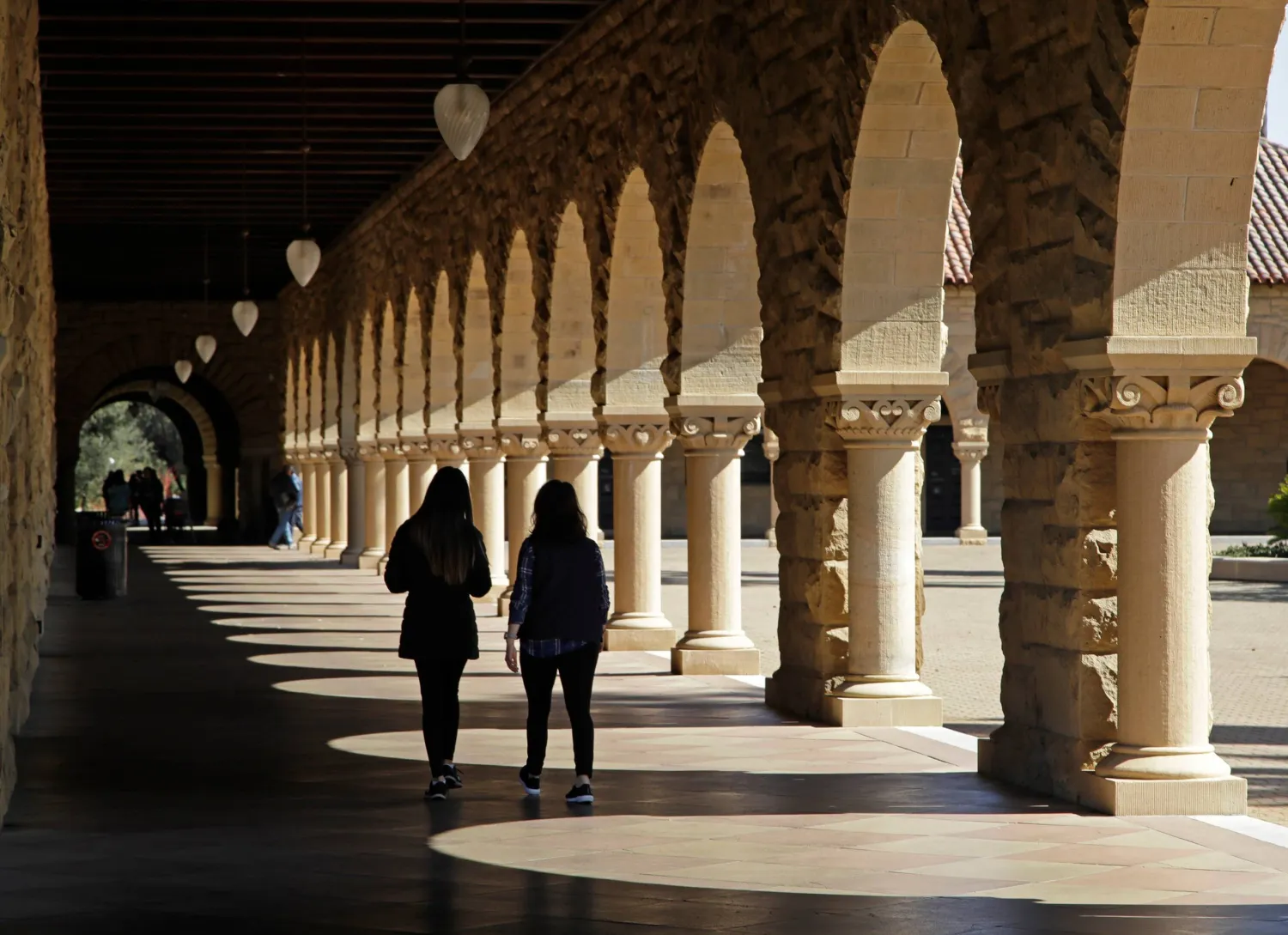
Students walk through the Stanford University campus, March 14, 2019, in Santa Clara, Calif. (AP)
TT

Trump Cannot Deport Students for Criticizing Israel, Judge Rules

Students walk through the Stanford University campus, March 14, 2019, in Santa Clara, Calif. (AP)

Citing the importance of the First Amendment, a federal judge in California says the US government is unconstitutionally silencing critics of Israel's war in Gaza and others as part of the Trump administration’s quest to deport noncitizens who it says disrupted college campuses while expressing their views.

Judge Noël Wise, in a ruling Friday, delivered a victory for The Stanford Daily, the student newspaper at Stanford University, which has said some international students were afraid to speak out because of the deportation threat.

“Freedom of speech is illusory if we are only ‘free’ to express complementary views about the government and its leaders,” the judge wrote.

The decision largely piggybacks on findings from nearly a year ago by a US district judge in Boston, who ruled that the Trump administration violated the Constitution when it targeted people who are not citizens for deportation solely for supporting Palestinians and criticizing Israel.

Wise wrote that the freedoms of speech and the press are “foundational to America’s enduring democracy.” The judge cited free-speech and vagueness flaws that violate the First Amendment and Fifth Amendment as she struck down portions of the provisions that the federal government follows regarding deportations.

Wise cited retaliation in March 2025 by US immigration authorities against people who engaged in speech supporting the Palestinians and against Israel's actions, which a growing number of experts, including those commissioned by a UN body, have said amount to genocide. The judge also cited retaliation against people who were critical of Charlie Kirk after the Turning Point USA co-founder was assassinated last September.

“Tomorrow, or perhaps even today, targets may include anyone in the United States who exercises their freedom of speech to simply express opinions the government does not like,” the judge in San Jose said.

“This downward spiral is antithetical to our Constitution that recognizes our right to speak freely,” she added. “Here you can simultaneously hate the content of a person’s speech and love the country that cherishes the freedom to allow it. Zealous protection of our Constitutional right to free speech is a provocative demonstration of our country’s powerful lack of fear.”

The Justice Department did not respond Saturday to a message seeking comment on the decision.

George Porteous, the editor-in-chief of The Stanford Daily, responded to the ruling by saying on X: “The reporters in our newsroom shouldn’t have to fear that writing a story will result in their deportation. Today’s victory means they won’t have to.”

Conor Fitzpatrick, an attorney with the Foundation for Individual Rights and Expression, which brought the lawsuit, praised the ruling.

“In America, free speech doesn’t just belong to the people who say things the government agrees with,” Fitzpatrick said in a release.

In her decision, Wise said it was clear that the government's tactics has had an effect on college campuses.

“The government has offered a chilling message regarding protected speech — speak out against Israel or in support of Palestinians and we will revoke your visa and deport you. Behave. Noncitizen students heard the warning and heeded. And, as the idiom goes, the silence is deafening,” the judge wrote.

At The Stanford Daily, lawfully present noncitizens at the paper have quit, withheld articles, refused assignments, requested articles be taken down, and asked for anonymity due to fear of adverse immigration consequences, Wise noted.

She said noncitizens have the same First Amendment rights as citizens and yet were left to guess what the US foreign policy was at any given moment and on any given subject.

“This is an incomprehensible standard,” she said. “While the Court understands that the government has been granted considerable discretion on foreign policy and immigration matters, that discretion must nevertheless still ensure that ordinary people can understand what the law permits and prohibits.”

Wise added: “Our Constitutional right to freedom of speech guarantees people the right to express — through their words, actions, or assembly — opinions that may be repugnant, views that run counter to prevailing political norms, or beliefs that otherwise challenge the country’s domestic or foreign policy, military engagement, or war.”



Iran Supreme Leader Calls for Unity Among Muslim Countries

Motorbikes drive past a billboard depicting Iran's late Supreme Leader Ali Khamenei, center, handing the country's flag to his son and successor, Mojtaba Khamenei, right, as the late revolutionary founder Khomeini stands at left, in a square in downtown Tehran, Iran, March 10, 2026. (AP)
TT

Iran Supreme Leader Calls for Unity Among Muslim Countries

Motorbikes drive past a billboard depicting Iran's late Supreme Leader Ali Khamenei, center, handing the country's flag to his son and successor, Mojtaba Khamenei, right, as the late revolutionary founder Khomeini stands at left, in a square in downtown Tehran, Iran, March 10, 2026. (AP)

Iran's supreme leader Mojtaba Khamenei on Sunday called on Muslim countries in the region to unite against the United States and Israel, in a written message issued six months on from the start of the Middle East war.

Khamenei, in power since shortly after his father Ali Khamenei was killed at the start of the war on February 28, has yet to be seen in public since his appointment, and authorities have not released any video or audio of him.

"The solution to the problems of the Islamic nations is unity of words, friendship, and cooperation on the path of goodness," he said Sunday.

"Anyone, in any position, who does anything that leads to division among Muslims and creates conflict in the Muslim community, knowingly or unknowingly, intentionally or unintentionally, has served the purpose of the enemies of Islam," he added, according to his official website.

During the war, Iran struck countries across the Middle East, claiming it was targeting US military bases, while the attacks struck civilian and energy facilities.

Relations with those nations have since soured.

Khamenei, who has the final say on major state policies, also called on Iranian officials and citizens to put aside differences and come together against Israel and the United States.

"Again, this servant's advice to the Iranian people is to not allow any differences to arise among themselves in any way," he said, echoing remarks made in another statement on Friday.

"I firmly declare that doing anything detrimental to social cohesion is prohibited," he had said in Friday's message.

He also called Friday for the gradual de-dollarization of the Iranian economy and for boosting economic production to support growth following months of a US naval blockade and years of crippling sanctions that have hit livelihoods.


Pakistan Suspends Eight Officials After Deadly Infant Ward Fire

A woman walks out from the Mother and Child Health ward at the Pakistan Institute of Medical Sciences (PIMS) Hospital in Islamabad on August 27, 2026. (AFP)
TT

Pakistan Suspends Eight Officials After Deadly Infant Ward Fire

A woman walks out from the Mother and Child Health ward at the Pakistan Institute of Medical Sciences (PIMS) Hospital in Islamabad on August 27, 2026. (AFP)

Pakistan's prime minister said eight officials were suspended and called for criminal proceedings against them, after 14 infants were killed in a fire in the maternity ward of a hospital in the country's capital.

A preliminary report conducted by a four-person committee formed by Prime Minister Shehbaz Sharif found the deadly blaze had engulfed the unit "within approximately two minutes" just after 6:30am (0130 GMT) on Wednesday, with a nurse only able to save one of the 15 infants in the hospital's care.

Among those suspended were hospital staff including its executive director and the head of the neonatal department, as well as the director-general of Islamabad's emergency services.

Sharif said late Saturday "those responsible for criminal negligence do not deserve any concession" and that they will be "brought to justice".

He also approved taking action against the company responsible for the hospital's security, without naming them.

Emergency services were called within six minutes of the fire breaking out, with the first rescue services arriving at the scene 15 minutes later, the report said.

Parents and other witnesses told AFP the response had been slow and guards had reportedly prevented people from leaving the building.

The hospital did not have detailed operating procedures or fire and emergency training, according to the preliminary report.

Two nurses, a woman security guard and another officer were in the ward when the fire started, but there were no supervising staff, the report stated.

Earlier Health Minister Mustafa Kamal said that a spark from an air conditioner is believed to have caused the fire. The report clarified an ignition source is yet to be determined as the investigation continues.

Health Secretary Aslam Ghori, the country's top civil servant for the department, was sacked on Wednesday following the devastating incident.

Fires in large buildings are frequent in Pakistan, often due to poor safety laws and building codes as well as lax enforcement.

In January, more than 65 people were killed in a shopping center fire in the port city of Karachi.

At least 11 people were killed in another shopping mall fire in Karachi in 2023.

In 2012, at least 250 laborers died at a garment factory in Karachi.


Russia Says Preparing ‘Massive Strikes’ on Ukraine’s Energy Sector

A view of the destruction after a Russian attack struck a warehouse, followed by an explosion, in the village of Myla, Kyiv region, Ukraine, Saturday, Aug. 29, 2026. (AP)
TT

Russia Says Preparing ‘Massive Strikes’ on Ukraine’s Energy Sector

A view of the destruction after a Russian attack struck a warehouse, followed by an explosion, in the village of Myla, Kyiv region, Ukraine, Saturday, Aug. 29, 2026. (AP)

Russia's defense ministry on Sunday said it was gearing up for large-scale attacks on Ukraine's energy infrastructure in a tit-for-tat response to strikes by Kyiv.

"Russian forces have begun preparations for massive strikes against facilities in Ukraine's energy sector in response to the ongoing attacks by the Kyiv regime on civilian infrastructure and on Russia's oil and energy complex," it said on Telegram.

Last winter, Moscow repeatedly hit Ukrainian power plants, devastating the country's energy sector and plunging millions of people into cold and darkness in sub-zero temperatures.

Both sides have for several months escalated long-range strikes, targeting infrastructure such as warehouses, businesses, oil and port facilities, as well as ships, increasing civilian casualties.

On Sunday, the Russian army claimed to have struck a plant in Kyiv producing asbestos and cement whose warehouses, it said, were used to store explosives, as well as a manufacturer of drones and munitions.

On Saturday, a Russian strike on an ammunition depot in the suburbs of the Ukrainian capital triggered a huge explosion and killed at least 37 people.

Ukraine for its part attacked an oil refinery with drones in northwestern Russia, causing a fire, according to the local authorities.