Germany Blames Russia for Airport Drone Incident, Hits Back with Sanctions

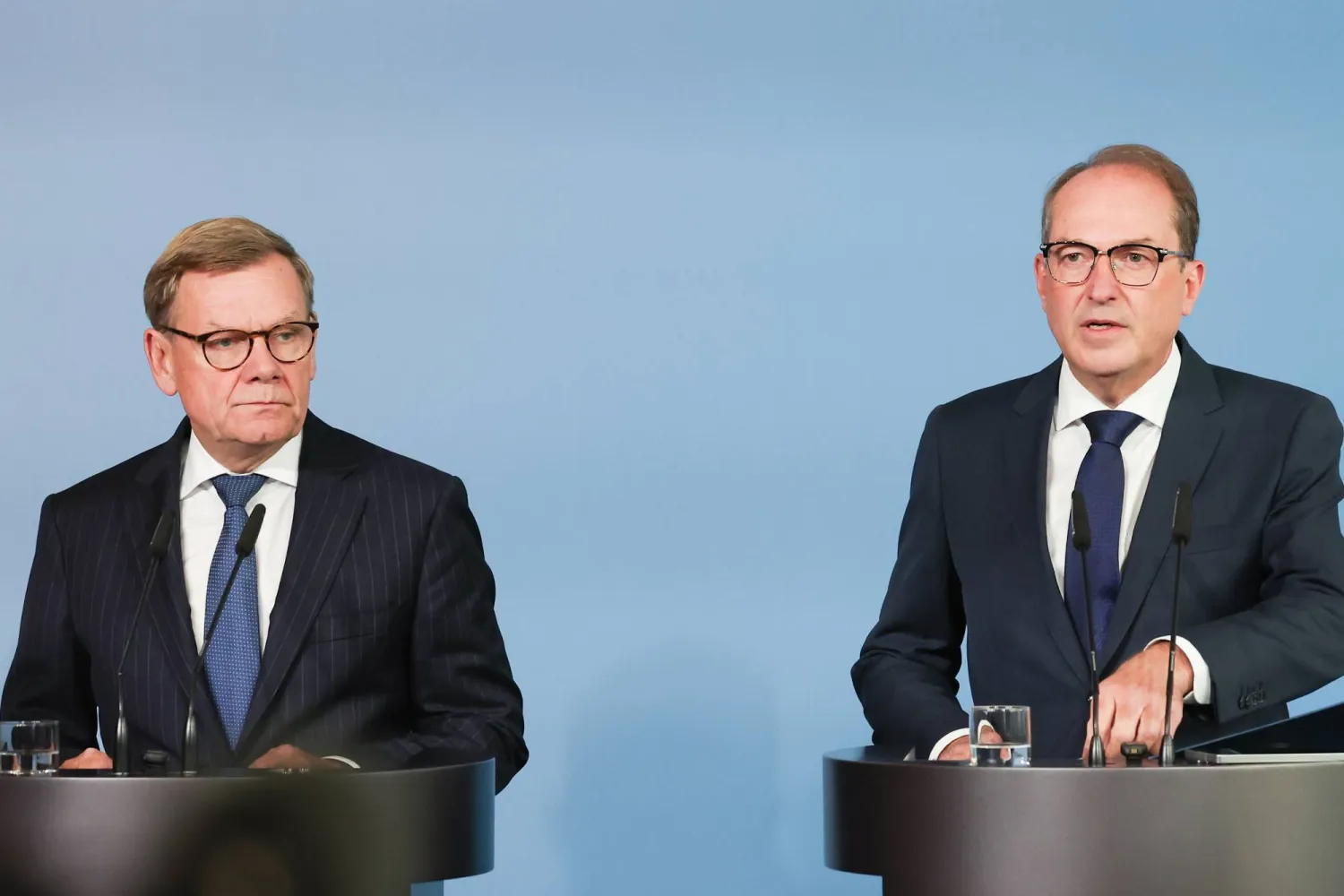
German Interior Minister Alexander Dobrindt R) and German Foreign Minister Johann Wadephul attend a press conference on the drone incident at Leipzig Airport in Berlin, Germany 01 September 2026. (EPA)
TT

Germany Blames Russia for Airport Drone Incident, Hits Back with Sanctions

German Interior Minister Alexander Dobrindt R) and German Foreign Minister Johann Wadephul attend a press conference on the drone incident at Leipzig Airport in Berlin, Germany 01 September 2026. (EPA)

Germany on Tuesday blamed Russia for an attempted "hybrid attack" involving an explosive-laden drone at a strategic airport last month and announced diplomatic counter-measures.

The European Union expressed "full solidarity" with Germany, NATO assured that it would defend its members and countries including Britain, Estonia and Poland offered strong backing.

Germany will close Russia's consulate in the former capital Bonn later this month, and cancel the contract for the Russian House, a cultural center in Berlin, said Foreign Minister Johann Wadephul.

"We are tightening entry controls for Russian nationals" and Germany would propose the listings of more Russian individuals for European Union sanctions, he added, as the Russian ambassador to Berlin was being summoned.

Germany's top diplomat also vowed that "we are increasing pressure on the Russian shadow fleet" -- a term for the old oil tankers and other cargo ships with opaque ownership Russia uses to get around Western sanctions.

Interior Minister Alexander Dobrindt said that after assessing the drone technology used and other intelligence, "the government concludes that Russia is responsible for the hybrid attack in Leipzig on August 4".

He blamed "low-level agents" for the operation and said "the drone configuration -- various components, explosives and ignition systems -- are known to us from other hybrid operations by Russia and its war against Ukraine".

"We do not view the Leipzig incident in isolation, but rather see it in the context of other hybrid actions," he said. "We assume that Germany is the target of further hybrid attacks by Russia."

"We are not at war, but we are a daily target of hybrid warfare."

European Union chief Ursula von der Leyen said the bloc stands in "full solidarity" with Germany, while NATO chief Mark Rutte said the alliance "will continue to strengthen our ability to deter and defend all Allies against any threat."

Germany, which supports Ukraine in its fight against Russia, has for months reported suspicious drone sightings over military and industrial sites, but the Leipzig incident raised the alarm as a drone found there carried explosives.

Police used a robot to defuse the device near a Ukrainian cargo plane. Another drone was reportedly found weeks later near the airport, also with traces of an explosive substance.

The airport in eastern Germany plays a key role in the transport of military goods, including by the German military and NATO allies, and also serves as a base for Ukraine's Antonov Airlines.

- 'Hub for espionage' -

Chancellor Friedrich Merz said last week that Germany has "found itself in the crosshairs of hybrid attackers" and warned that the perpetrators would "pay for them", without naming a target.

There had been much discussion of whether Germany should shut down Berlin's Russian House, which security services believe is both a center to spread propaganda and an intelligence hub.

The Russian House of Science and Culture, a seven-storey building opened in 1984 in what was then East Berlin, is located near the Russian embassy.

Conservative MP and security policy expert Roderich Kiesewetter recently told Welt TV that the facility is assumed to be a hub for espionage.

He said more than 100 people lived there "with no one knowing who they are" and that the building's power consumption is unusually high.

It was "presumably filled with technical surveillance equipment", he said, and used by "people who are not well-disposed toward Germany".

In recent weeks, the German government had explained it was so far keeping the Russian House open by pointing to its bilateral contractual link to the Goethe Institute in Moscow.

Kiesewetter had dismissed concerns about Russian countermeasures.

"Are we not closing it because we believe the Goethe Institutes in Russia would then be closed in retaliation?" he asked. "Then they'll just get closed."


Military Helicopter Crashes in Southern Türkiye, Killing 4

Rescuers and security officers examine the wreckage of an ambulance helicopter after it collided with a hospital building and crashed into the ground, in Mugla, Türkiye, December 22, 2024. REUTERS/Kenan Gurbuz Purchase
TT

Military Helicopter Crashes in Southern Türkiye, Killing 4

Rescuers and security officers examine the wreckage of an ambulance helicopter after it collided with a hospital building and crashed into the ground, in Mugla, Türkiye, December 22, 2024. REUTERS/Kenan Gurbuz Purchase

A military helicopter crashed in southern Türkiye on Thursday, killing four personnel, the Turkish Defense Ministry said.

The aircraft crashed for unknown reasons in Samankoy, a neighborhood on the southern outskirts of the provincial capital Malatya in the early evening.

“As a result of an accident involving our S-70 helicopter in Malatya, for a reason not yet determined, 4 of our heroic comrades-in-arms aboard the helicopter were martyred,” the ministry said in a social media post.

“We pray that God will have mercy on our martyrs and offer our condolences and prayers for strength to their grieving families, our Turkish Armed Forces, and our noble nation.”

According to The Associated Press, TV images showed the wreckage of the helicopter burning near a cluster of buildings in an otherwise open area of land. The Demiroren News Agency reported that flames had spread to a nearby house but reported no casualties on the ground.

Police, firefighters and medical teams were dispatched to the crash.


Trump Says US Does Not Need Iran Deal

US President Donald Trump and Vice President JD Vance look on during a Veterans Day ceremony at Arlington National Cemetery in Arlington, Virginia, US, November 11, 2026. REUTERS/Kylie Cooper
TT

Trump Says US Does Not Need Iran Deal

US President Donald Trump and Vice President JD Vance look on during a Veterans Day ceremony at Arlington National Cemetery in Arlington, Virginia, US, November 11, 2026. REUTERS/Kylie Cooper

President Donald Trump said on Thursday the US does not need a deal with Iran and directed Vice President JD Vance, who has played a role in efforts to resolve the war, to focus "his complete and total attention" on alleged crime and corruption in Democratic-run cities and states.

Trump's directive came a day after the Wall Street Journal reported that Vance was considering face-to-face peace talks with a hard-line Iranian security official and a week after the vice president blamed the costly war with Iran for Republicans' midterm elections drubbing.

Trump's comments marked a shift in tone after he had suggested ⁠in recent weeks ⁠that Iran would be more willing to strike a deal in the eight-month conflict after the US elections.

"We don’t need a deal with Iran. Those days have long since passed. We’ve got their money, Hundreds of Billions of Dollars, and we’ve got their Strait!" Trump wrote on social media, referring to the Strait of Hormuz, the critical ⁠shipping route near Iran where the US military has been working to secure safe passage for international shipping.

Trump said he asked Vance to focus instead on a domestic issue the president previously put in his portfolio: leading an effort targeting alleged fraud in Democratic-run cities and states throughout the US.

"Our Budget could be quickly BALANCED with the correction of this large-scale criminal activity. CORRUPTION is in the Democrat Leadership’s blood!" Trump wrote on Thursday.

Vance's office did not immediately respond to a request for comment.

The Wall Street Journal reported on Wednesday that ⁠Vance was considering ⁠meeting with a senior Iranian security official, a move that would have put Vance at the center of peace negotiations. Reuters has not confirmed the potential talks.

Vance, who is viewed as a leading contender for the 2028 Republican presidential nomination, distanced himself from the war last week after Republicans' midterm election rout by Democrats.

The vice president blamed the costs of the Iran war in part for the party's losses. He also said an earlier recommendation to end the war was "sound advice."

Trump responded to Vance's position by defending the war as necessary to stop Iran from obtaining a nuclear weapon.


Iran: Four Tankers Struck by Explosions in Strait of Hormuz

Iran: Four Tankers Struck by Explosions in Strait of Hormuz
TT

Iran: Four Tankers Struck by Explosions in Strait of Hormuz

Iran: Four Tankers Struck by Explosions in Strait of Hormuz

Four oil tankers were hit by explosions in the Strait of Hormuz, Iran's military said on Thursday, adding that the vessels had ignored warnings and entered what it considers restricted areas of the strategic waterway.

Tankers are still facing attacks across the strait, despite a rebound in traffic and expectations of a de-escalation in the war between the United States and Iran that have been reflected in falling oil prices.

Iran's Revolutionary Guards Navy said two supertankers were disabled by explosions on Wednesday after they ignored ⁠warnings against using what ⁠it said was an "unauthorized route".

Reuters could not immediately verify the Iranian account.

The two vessels "exploded after hitting naval mines", Iranian state media reported, broadcasting what it said was video footage of the incidents.

Iran's army later said two other tankers had hit mines on Thursday afternoon while sailing through the eastern Strait of Hormuz after ignoring ⁠warnings and disabling their radar systems, state TV reported. The tankers entered a restricted area and subsequently caught fire, it reported.

Earlier in the US-Israeli war with Iran, which began in February, the IRGC Navy announced its attacks on tankers. More recently, however, it has instead reported that vessels have caught fire after hitting naval mines while traversing the southern part of the strait, which it has declared an unauthorized route.

In several of those cases, the United Kingdom Maritime Trade Operations agency (UKMTO) has said vessels had been struck by unknown projectiles.

The ⁠UKMTO said ⁠in reports on Thursday that a vessel was hit by an unidentified projectile about 14 nautical miles northwest of the UAE emirate of Ras Al-Khaimah on Wednesday while exiting the strait, causing a fire in its engine room.
Firefighting efforts were under way and all crew had been evacuated, it added.

At least 10 ships were hit in the first 10 days of November, after 37 attacks in October, which was the highest monthly tally since the conflict began in late February, according to data from the Washington Institute for Near East Policy.