



IAEA: Status of Iran’s Nuclear Program Is Unclear

IAEA Director General Rafael Grossi (AP) 
TT

IAEA: Status of Iran’s Nuclear Program Is Unclear

IAEA Director General Rafael Grossi (AP) 

The status of a key part of Iran's nuclear program remains unknown while international inspectors have yet to gain access to nuclear facilities, the International Atomic Energy Agency reported on Tuesday, as the country’s six-month conflict with the United States shows no signs of resolution.

IAEA monitors cannot verify the location or status of Iran’s stockpile of near-bomb grade uranium, according to the 11-page restricted report that was sent to member states and cited by Bloomberg and Reuters.

“The agency’s lack of information about this nuclear material and access to facilities to verify it is a matter of proliferation concern,” IAEA Director General Rafael Grossi wrote in the report.

He added that Iran needs to allow inspectors back in “with the utmost urgency.”

The IAEA report on Iran followed Grossi's visit to Washington. It also came as the US launched a new wave of strikes against targets in Iran, increasing tensions as both countries compete for control of the Strait of Hormuz waterway.

Grossi repeated his demands for Iran to allow inspectors to resume their work and called for a negotiated resolution to the US-Iran conflict.

Stockpiles Cannot Be Verified

The report on Iran showed there had again been no progress. Inspectors have yet to return to nuclear sites the United States and Israel bombed in June 2025.

Until those attacks, the IAEA estimates Iran had 440.9 kg of uranium enriched to up to 60% purity, a short step from the roughly 90% of weapons-grade uranium. That is enough material, if enriched further, for 10 nuclear weapons, according to an IAEA yardstick, and Iran also had material enriched to lower levels.

Before the June 2025 strikes, the IAEA reported that Iran held approximately 8,599.6 kilograms of low-enriched uranium alongside over 440 kilograms of highly enriched uranium, according to Bloomberg.

How much of that remains is unclear.

“It is more than a year since the Agency lost continuity of knowledge in relation to the previously declared inventories of LEU (low-enriched uranium) and HEU (highly enriched ⁠uranium) enriched up to 60% U-235 at the declared nuclear facilities affected by the attacks of June 2025,” the report said.

“The Agency's lack of information about this nuclear material and access to facilities to verify it is a matter of proliferation concern ... and needs to be addressed with the utmost urgency,” it added.

IAEA inspections of Iran dropped by more than half last year after the country imposed new restrictions following a 12-day conflict in which Israel and the US attacked its nuclear sites.

Inspectors will be allowed to visit Iran's Bushehr nuclear power plant in mid-September, the IAEA reported.

A War that Disrupted the Nuclear Path

Uncertainty around Iran’s nuclear program has exasperated with the war that began on February 28, when the United States and Israel launched attacks on Iran.

Since then, Washington and Tehran witnessed several months of fighting and attempts to negotiate, before reaching a tentative understanding in June. The accord was supposed to allow the agency access to Iran’s nuclear sites and begin a new set of talks on Iran’s nuclear program, but that agreement quickly collapsed.

US President Donald Trump insists that military action is necessary to ensure Iran never acquires a nuclear weapon.

Iran has always denied seeking a nuclear weapon but has never satisfactorily explained to the agency why it has enriched uranium to 60%.

The IAEA report comes before a meeting next week of the agency’s board of governors in Vienna to consider a new resolution censuring Iran.


Iran Guards Say Attacked US Naval Drone

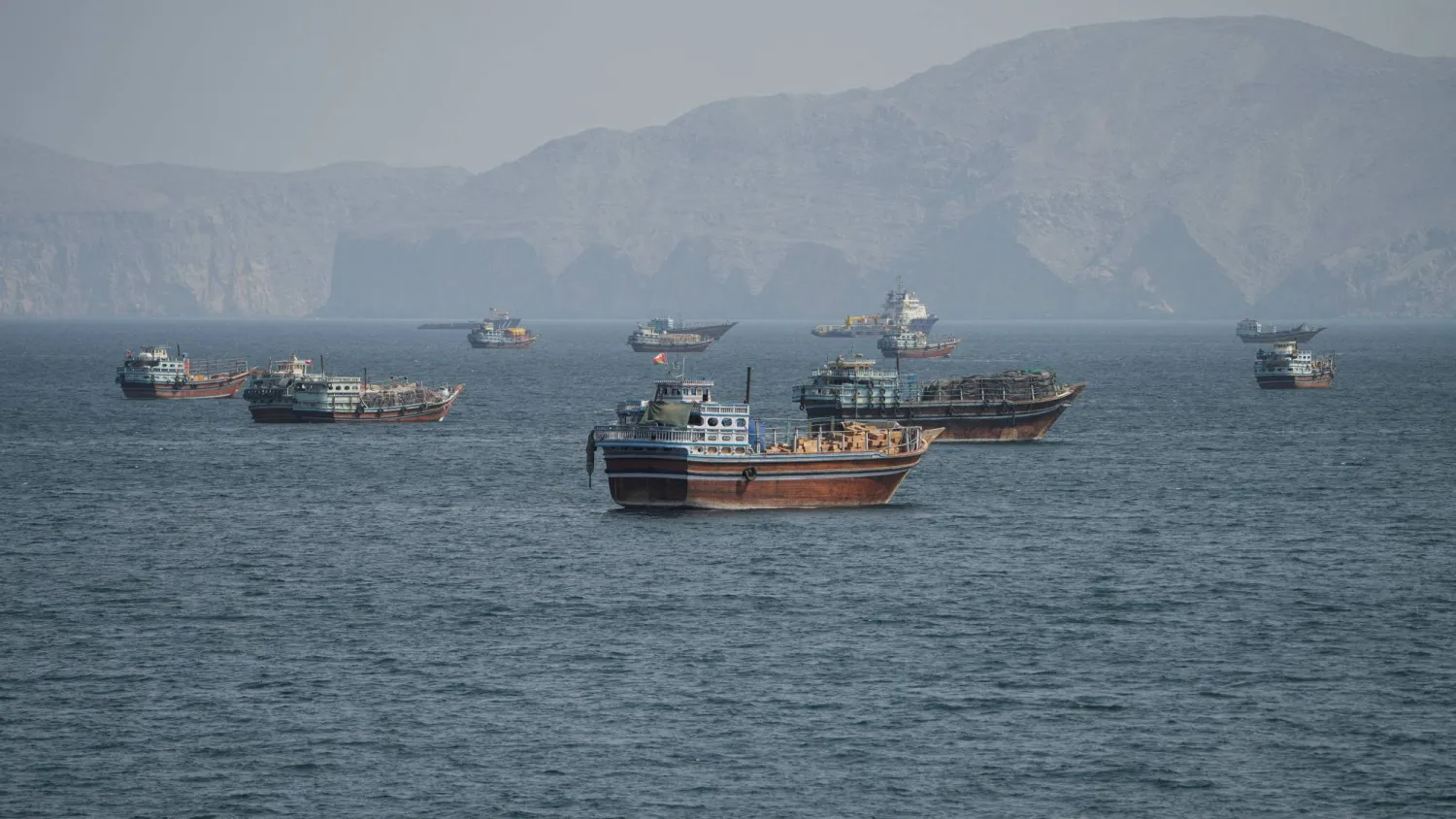
Vessels in the Strait of Hormuz are visible near the beach of Bandar Abbas, Iran, August 25, 2026. Majid Asgaripour/WANA (West Asia News Agency) via REUTERS
TT

Iran Guards Say Attacked US Naval Drone

Vessels in the Strait of Hormuz are visible near the beach of Bandar Abbas, Iran, August 25, 2026. Majid Asgaripour/WANA (West Asia News Agency) via REUTERS

Iran's Revolutionary Guards said on Sunday that they had attacked a US naval drone that was trying to enter the Strait of Hormuz, hours after Tehran and Washington traded strikes.
"The heroic Naval Forces of the Islamic Revolutionary Guard Corps attacked an American military unmanned surface vessel (remotely operated vessel) that was attempting to enter the protected area of the Strait of Hormuz," the Guards said in a statement carried by Iranian state television IRIB.


NATO Will Not Tolerate Hybrid Actions Against Members, US Envoy Says

The US flag is lowered to half staff to honor country music legend Dolly Parton following her passing, at the North Atlantic Treaty Organization (NATO) headquarters, in Brussels, Belgium, 27 August 2026. (EPA)
TT

NATO Will Not Tolerate Hybrid Actions Against Members, US Envoy Says

The US flag is lowered to half staff to honor country music legend Dolly Parton following her passing, at the North Atlantic Treaty Organization (NATO) headquarters, in Brussels, Belgium, 27 August 2026. (EPA)

NATO members should not tolerate deliberate actions of hybrid war, and the United States will stand by countries as they deal with these incidents, Matthew Whitaker, the US ambassador to NATO, said on Saturday.

Whitaker said last month's attempted drone attack at Germany's Leipzig/Halle Airport, which Berlin ‌has blamed ‌on Russia, was more worrying ‌than ⁠other recent incidents ⁠NATO members have faced due to Russian drones targeting Ukraine that strayed off course.

"Then you have what I would call the more concerning hybrid actions like we saw ⁠in Leipzig, like we ‌have seen ‌in Poland," Whitaker said speaking on the sidelines ‌of a business conference in Italy.

NATO ‌members must be prepared, vigilant and also deliver a strong message when they are challenged by these events, ‌he said.

"If we can identify who's doing it — which Germany ⁠did — ⁠we make sure we express strongly that is unacceptable and we will not tolerate it," Whitaker said.

Critical infrastructure, including energy assets, could be targeted and should be monitored by national authorities, he added.

The response to these challenges is primarily national, but the United States supports countries when they are dealing with these acts, he said.


Thousands March for Democracy Ahead of Eastern German Vote

People attend a demonstration as part of a democracy festival, a day before the Saxony-Anhalt state election, in Magdeburg, Germany, September 5, 2026. (Reuters)
TT

Thousands March for Democracy Ahead of Eastern German Vote

People attend a demonstration as part of a democracy festival, a day before the Saxony-Anhalt state election, in Magdeburg, Germany, September 5, 2026. (Reuters)

Thousands of people joined a march for "democracy" in eastern Germany on Saturday, a day ahead of a regional election expected to result in a historic win for the far right.

The march in Magdeburg, capital of the Saxony-Anhalt region, drew demonstrators holding up placards proclaiming "more love, less hate", "a better life without Nazis", and "the potato is also of foreign origin".

The march was organized by a coalition of groups dubbed "Saxony-Anhalt: Open to the World".

The far right, anti-migrant, pro-Russian and pro-Donald Trump Alternative for Germany (AfD) party is leading in the polls for the Saxony-Anhalt election, and is expected to top the vote in the small state of 2.1 million inhabitants.

It would be the first regional election win for the AfD, marking an unprecedented breakthrough for the far right in Germany in the postwar era.

However, the party is not assured of managing an absolute majority that would allow it to govern alone.

So far, all other parties have ruled out governing with the AfD, with the exception of the pro-Russian left-wing party BSW, whose members are divided on the issue.