


Rights Groups Urge US Lawmakers to Drop Provision to Deepen Defense Ties with Israel

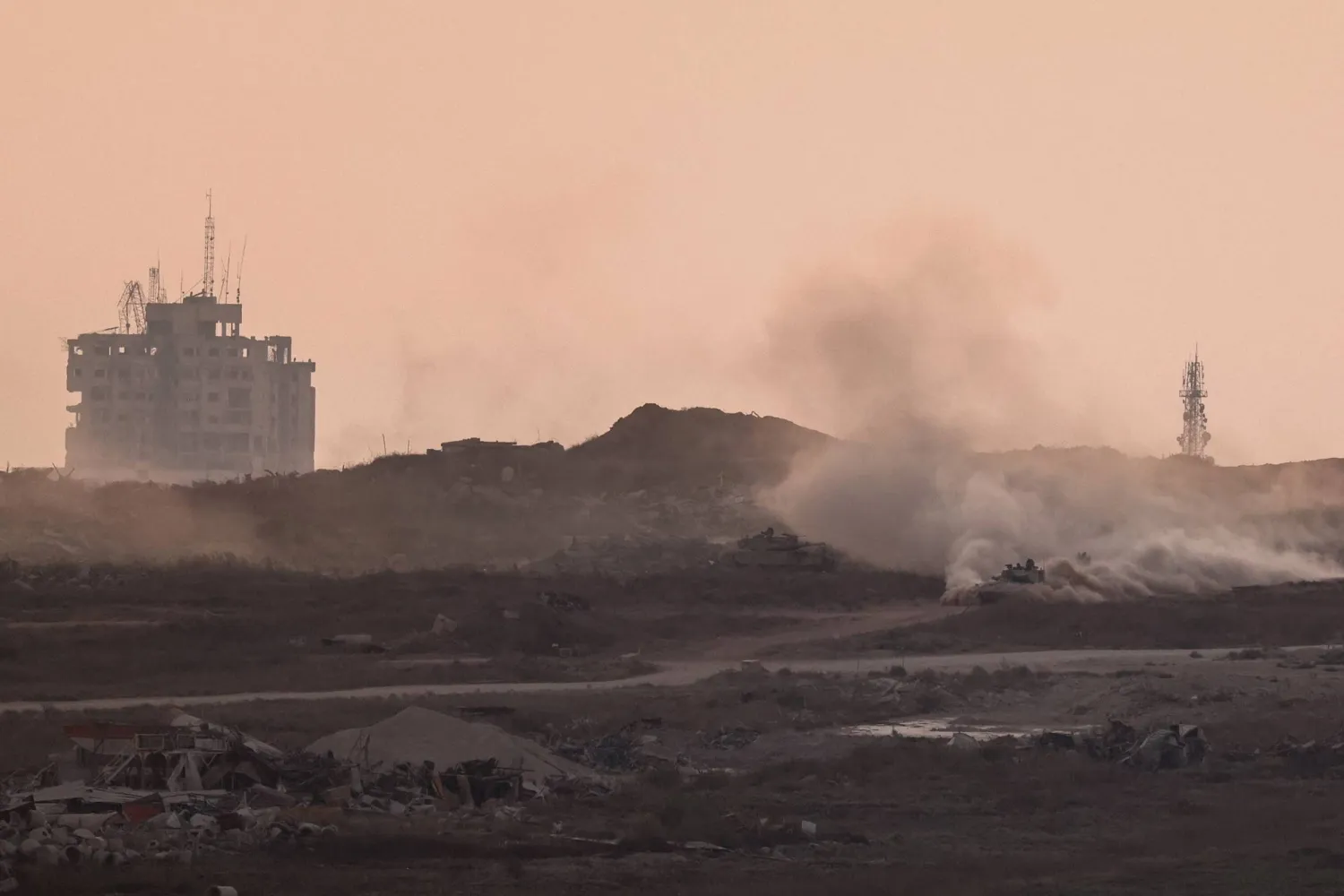
An Israeli tank maneuvers in Gaza, as seen from the as seen from the Israeli side of the border, September 1, 2026. (Reuters)
TT

Rights Groups Urge US Lawmakers to Drop Provision to Deepen Defense Ties with Israel

An Israeli tank maneuvers in Gaza, as seen from the as seen from the Israeli side of the border, September 1, 2026. (Reuters)

Dozens of civil rights and advocacy groups are urging Congress to scrap a defense bill provision that would deepen US-Israeli military technology ties, according to a letter seen by Reuters, at a time of growing US skepticism toward the longtime ally.

The provision would deepen cooperation between the US and Israeli defense sectors by accelerating joint military technology development and other partnerships. The bill passed the House of Representatives in July and awaits Senate action.

The provision of the 2027 National Defense Authorization Act, known as Section 219, seeks to set up frameworks for joint ventures, licensing agreements and US-based co-production partnerships with the Israeli industry.

In Thursday's letter addressed to leaders of the House and Senate Armed Services Committees, 56 groups said deeper integration with Israel's defense sector would be "exceptionally dangerous" and urged lawmakers to remove the provision.

The groups include ‌Amnesty International USA ‌and the civil rights network National Lawyers Guild as well as Arab and ‌Jewish advocacy ⁠groups.

"At a time ⁠in which American interests are increasingly diverging from those of Israel, and American public opinion is turning increasingly against unconditional support to Israel, creating new points of influence for Israel in the US defense-technology ecosystem is exceptionally dangerous," said the letter, which has not been previously reported.

Israel is one of Washington's closest allies in the region, and the two countries cooperate extensively on defense and intelligence issues. Supporters say deeper ties could help speed military innovation and technology development.

A spokesperson from the Israeli Embassy in Washington did not immediately respond to a request for comment on this story.

But Israeli Prime ⁠Minister Benjamin Netanyahu said in a May interview with CBS that he hoped ‌to wean Israel off US military support within a decade. In a ‌June letter to a US congressman he wrote that the time has come for Israel "to move from aid recipient to partner."

US ‌PUBLIC SUPPORT FOR ISRAEL DECLINES

US public support for Israel has fallen since the Gaza war began in ‌2023, particularly among Democrats. A June Quinnipiac University poll found 48% of voters and 66% of Democrats believe the United States is too supportive of Israel, up from 16% and 20% when the question was first asked in 2017.

Support for Israel among Democratic voters has plummeted, candidates critical of Israel are winning Democratic primaries and even moderate lawmakers are increasingly willing to challenge decades of ‌US support for Israel.

The Hamas group, in an October 7, 2023, attack on Israel, killed nearly 1,200 Israelis and foreign nationals and took hundreds ⁠hostage. More than 73,000 Palestinians ⁠have since been killed in Israel's subsequent assault on Gaza, according to Gaza health officials.

The letter criticizes Israel for its potential violations of international humanitarian law in its war in Gaza and rising settler violence against Palestinians in the Israeli-occupied West Bank. It says such developments should prevent any discussion of deepening military ties.

A memorandum of understanding that provides $3.8 billion annual US military aid to Israel is approaching its expiration date in 2028 and conversations are under way on how Washington's assistance to Israel would evolve beyond that date.

Some members of Congress have already tried to strip the provision from the fiscal 2027 NDAA. Republican Representative Thomas Massie of Kentucky and Democratic Representative Ro Khanna of California introduced an amendment to block it, but it did not make it into the House version of the bill.

Once the House and Senate write their versions of the NDAA, members of the two chambers work out a compromise version of the bill, which must pass both chambers - typically near the end of the calendar year - before it can be sent to the White House for President Donald Trump to sign into law or veto.



War Criminal Mladic’s Body Returns to Serbia with Military Honors

A convoy of vehicles, escorted by police, carrying the coffin of deceased Bosnian Serb General Ratko Mladic leaves Belgrade Airport, in Belgrade, Serbia, 03 September 2026. (EPA)
TT

War Criminal Mladic’s Body Returns to Serbia with Military Honors

A convoy of vehicles, escorted by police, carrying the coffin of deceased Bosnian Serb General Ratko Mladic leaves Belgrade Airport, in Belgrade, Serbia, 03 September 2026. (EPA)

Bosnian Serb war criminal Ratko Mladic's body arrived in Serbia Thursday, where it was received with military honors.

The casket, draped in the Serbian flag, was carried from the plane by six soldiers after arriving from The Hague, accompanied by Mladic's son Darko and Serbia's Justice Minister Nenad Vujic.

The body was then driven from the airport under police escort, reportedly to a Belgrade military hospital.

Mladic died last week while serving a life sentence for genocide, war crimes and crimes against humanity during the 1992-1995 Bosnian war.

Pro-government media broadcast images of dozens of people, mostly young men, gathered on footbridges over the motorway, displaying banners honoring Mladic and lighting flares as the convoy passed.

The same outlets reported details of the funeral, including a public service at a church scheduled for Monday, but no details have been officially confirmed.

Serbian President Aleksandar Vucic said earlier Thursday that the state would provide "every kind of logistical and transport support" and he expected tens of thousands to gather for the funeral.

The court ordered a full inquiry into the circumstances surrounding Mladic's death, which had to be completed before his family could take possession of the body.

- EU concern -

EU Enlargement Commissioner Marta Kos on Monday criticized plans to bury Mladic with state honors.

"Regarding Ratko Mladic, the glorification of war criminals is contrary to fundamental European values and has no place in the European Union or in countries that aspire to become members," Kos said in Slovenia.

Mladic, who had suffered several strokes in recent months, was convicted of atrocities committed during Bosnia's war, which killed around 100,000 people and forced 2.2 million from their homes.

His role in the killings earned him the nickname the "Butcher of Bosnia", particularly for his role in the Srebrenica massacre, Europe's worst atrocity since World War II.

Mladic was the military face of a brutal leadership alongside former Bosnian Serb political leader Radovan Karadzic and ex-Yugoslav president Slobodan Milosevic.

After receiving the body, the military hospital said it would carry out a post-mortem examination "at the request of Mladic's family and the justice minister".

Dr. Ivan Lekovic, deputy head of the hospital, said: "All findings, including the post-mortem results and those of all analyses and examinations, will be provided to the family and the relevant institutions as soon as possible."

Serbia's Justice Minister Nenad Vujic said last week that Mladic "will receive all the military and state honors to which he is entitled".

Vucic said only that the funeral would be "dignified and in accordance with the family's wishes".


US Pressure on Iran Starting to Tell, as Sanctions and Blockade Bite

A woman crosses as motorists drive past an anti-US billboard at Enghelab Square in Tehran on September 2, 2026. (AFP)
TT

US Pressure on Iran Starting to Tell, as Sanctions and Blockade Bite

A woman crosses as motorists drive past an anti-US billboard at Enghelab Square in Tehran on September 2, 2026. (AFP)

A US campaign to throttle Iran's economy by blockading its oil exports and stopping sanctions evasion is growing increasingly difficult to withstand, three senior Iranian sources said.

Washington has in recent weeks sought to ratchet up the economic pressure on Tehran, in an effort to extract concessions in any future negotiation that six months of conflict have so far failed to secure.

Although Iran's clerical rulers managed to bypass sanctions for decades, the latest US moves have left them in a far more sensitive position, with few remaining channels to secure foreign currency or buy goods, the sources said.

In particular, the effort to stop Iran accessing international financing networks in other countries it has long used to keep its economy functioning poses a real and urgent threat, the sources said.

Any sign the economic campaign may break a months-long deadlock in the conflict will likely cheer US planners, though Iran has also warned it could respond to the pressure with military escalation, raising the stakes at a key moment.

PETROL STOCKS LOW AS CURRENCY COLLAPSES

The war has erupted back into open fighting this week, with US attacks along Iran's Gulf coast prompting retaliatory Iranian strikes at Arab states.

Neither side ‌has signaled yet it ‌is ready to make the concessions demanded by the other, leaving the war in a costly stalemate - though ‌one that ⁠may be shifting.

While ⁠more energy is flowing to international markets through the Strait of Hormuz despite Iranian efforts to continue disrupting the seaway, the US blockade of Iranian oil exports has entirely cut off Tehran's main source of revenue.

Adding to Iran's problems, the economy was already deep in crisis before the conflict, with a cratering currency and spiraling inflation, while months of bombing have run up a massive bill to rebuild damaged industry and infrastructure.

Meanwhile, the country's financial squeeze is itself biting into Tehran's efforts to get around the sanctions regime, leaving less cash to pay the high premiums required to skirt sanctions illicitly, the sources said.

The rial has fallen to record lows over recent days and one senior source said Iran only has another two months' supply of gasoline, which has to be imported despite domestic oil production because of limited refining capacity.

Iran's ⁠rulers are keenly aware of the potential risks of an economic meltdown and the possibility of it reigniting ‌the nationwide mass protests it put down in January by killing thousands of demonstrators.

"They are under very, ‌very severe economic pressure. They're losing control of the Straits. It's really a question of if they choose to negotiate and I think they'll have to," said Ali Ansari, modern ‌history professor at St Andrews University in Scotland.

The war is also entering a new phase, with each side trying to influence each other's politics.

Iran ‌hopes the threat of inflation will deter the US administration before midterm elections in November, while Washington aims to push Iranians to revolt, a senior Iranian official said.

BLOCKADE AND SECONDARY SANCTIONS SQUEEZING TEHRAN

The latest US measures expanded secondary sanctions that target countries doing business with Iran in a bid to stop it clearing dollar transactions needed for both oil sales and to finance crucial imports of goods and raw materials.

That effort is making Iran's existing sanctions evasion networks - front companies, unregistered tankers and smuggling - too expensive to use, the ‌three senior sources said.

Iranian crude loadings have fallen this month to about 260,000 barrels a day, from about 1.7 million a year earlier, according to data from commodity analytics firm Kpler, with only a trickle still moving ⁠off terminals for distribution by truck, train ⁠or smaller boats over the Caspian Sea.

Tehran says it still has tens of millions of barrels stored in tankers outside the blockade zone that it can sell, but the new sanctions mean intermediaries are stepping back or demanding more money, one of the officials said.

Total trade has fallen between 25% and 35%, with imports hit harder than exports, President Masoud Pezeshkian has said, one of several top officials warning in recent weeks about Iran's rapidly deteriorating situation.

US pressure and Iran's own attacks have meanwhile disrupted one of the main conduits for Iranian trade - the United Arab Emirates, which said on August 19 that all commercial exchange and financial dealings with Tehran were halted until further notice.

“If those channels stay closed, a supplier wants cash, a deal is routed through another country and a shipment arrives later and dearer,” said an Iranian trader in Tehran who deals in imported goods.

The currency has collapsed in value from around 1 million rials to the dollar a year ago to over 2.2 million rials now.

The internal impact is very painful. Official figures put 12-month average inflation at 69.9% with food, beverages and tobacco prices rising at nearly twice that rate.

Official unemployment rose to 9.1% in the spring, while the number of those in work fell by about 450,000 from a year earlier amid a wider fall in labor force participation.

Even for those still in work, the average monthly salary of around $125 a month comes nowhere near meeting basic household spending requirements that come to around $450 a month according to official data.

"We are getting poorer every day," said Mahnaz, a 34-year-old private-sector employee in Tehran who asked that her family name not be used.


US to Seek Back Payment from Europe for Ukraine Aid, Trump Says

Firefighters walk among debris at a destroyed pharmaceutical warehouse after Russian drone attacks on the outskirts of Kyiv, Ukraine, Thursday, Sept. 3, 2026. (AP)
TT

US to Seek Back Payment from Europe for Ukraine Aid, Trump Says

Firefighters walk among debris at a destroyed pharmaceutical warehouse after Russian drone attacks on the outskirts of Kyiv, Ukraine, Thursday, Sept. 3, 2026. (AP)

US President Donald Trump on Thursday said he would ask European nations to pay back the United States for military aid and munitions previously sent to Ukraine and appeared to signal a halt in sales to allied nations.

In a ‌social media post, ‌Trump also slammed ‌reports ⁠of heavily depleted US ⁠munition stockpiles amid the separate war in Iran, while adding that the United States was stockpiling munitions.

"We are taking them for ourselves, the ⁠USA, rather than selling them ‌to ‌others, but the sales to Allies ‌will soon again, begin," Trump ‌wrote.

"Hundreds of Billions of Dollars was given to Ukraine and NATO, free of charge, that Europe ‌would have paid for — If they were only asked, ⁠but ⁠we will be asking for that money, though somewhat belatedly!" he added.

Reuters reported last month that the US Army has used up much of its stockpile of highly accurate long-range missiles during the Iran war, raising concerns about the military's readiness for future conflicts.