Iran Raises Price of Petrol as US Applies Economic Pressure

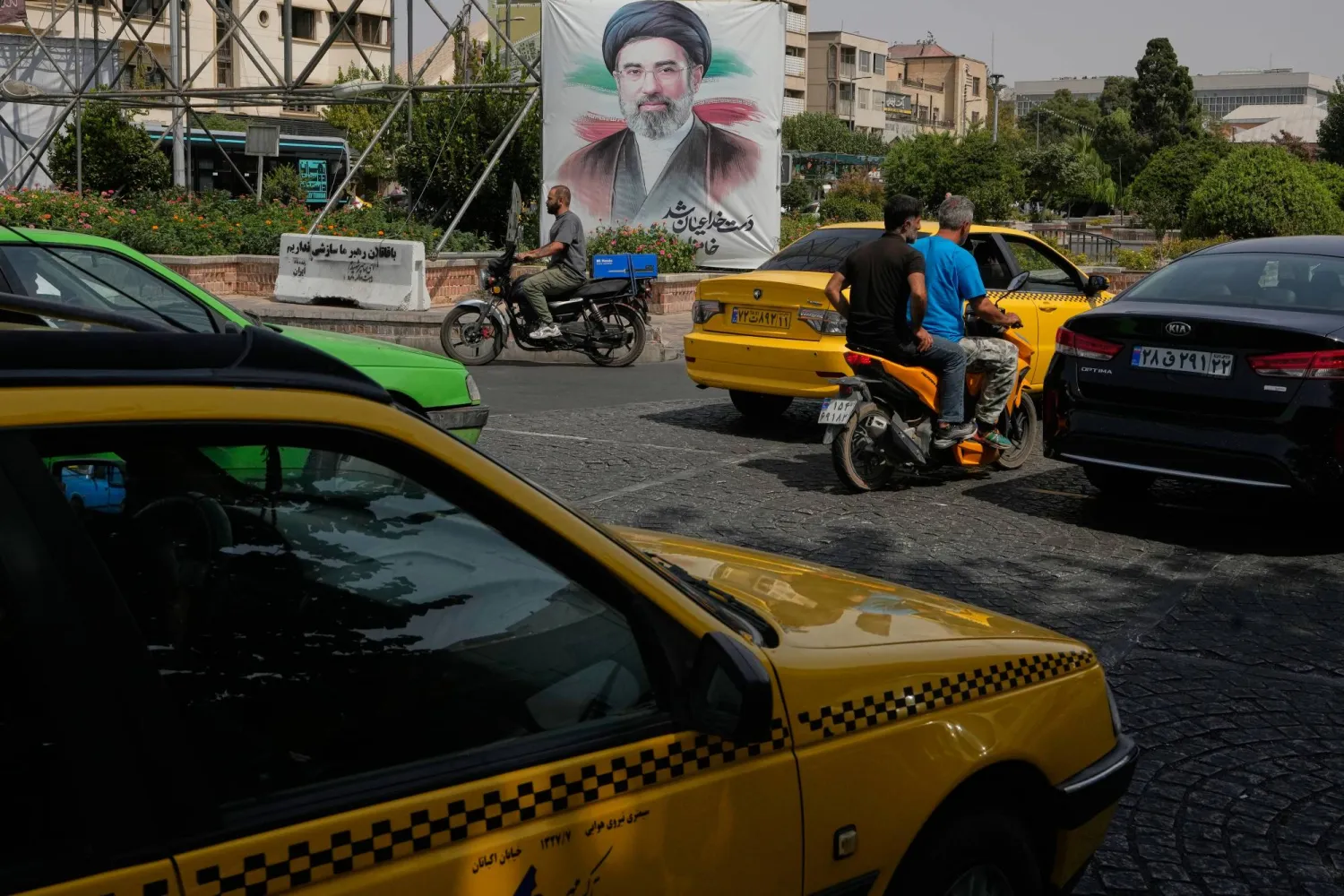
 Vehicles pass a banner showing a portrait of the Iranian Supreme Leader Mojtaba Khamenei, in downtown Tehran, Iran, Monday, Aug. 31, 2026. (AP)
Vehicles pass a banner showing a portrait of the Iranian Supreme Leader Mojtaba Khamenei, in downtown Tehran, Iran, Monday, Aug. 31, 2026. (AP)
TT

Iran Raises Price of Petrol as US Applies Economic Pressure

 Vehicles pass a banner showing a portrait of the Iranian Supreme Leader Mojtaba Khamenei, in downtown Tehran, Iran, Monday, Aug. 31, 2026. (AP)
Vehicles pass a banner showing a portrait of the Iranian Supreme Leader Mojtaba Khamenei, in downtown Tehran, Iran, Monday, Aug. 31, 2026. (AP)

Iranian authorities on Sunday announced they were raising the price of petrol for heavier consumers, as the United States steps up sanctions seeking to isolate the country's economy.

Iran's quota system prices petrol in three tiers -- 1,500 tomans per liter for a consumer's first 60 liters in a given month, 3,000 tomans per liter for their next 50, and 5,000 tomans per liter after that. The toman is an informal unit equivalent to 10 Iranian rials.

On Sunday, government spokeswoman Fatemeh Mohajerani said the price for the third tier would double to 10,000 tomans (about 4.5 US cents).

"The rate will increase to 10,000 toman rials from the morning of September 8," Mohajerani said in remarks carried by state media.

"Different numbers were mentioned in expert meetings, but because the president had promised the people, the rate of 10,000 tomans was set," she added.

She later clarified that the price of the first and second tiers would not be changed.

Iran, a major oil producer with some of the world's cheapest fuel, has for years heavily subsidized petrol, making any changes to pricing politically sensitive.

The development comes as the Iranian currency was trading on the black market Sunday at more than 2.2 million rials to the US dollar, according to websites that track the rate.

Before the start of the Middle East war on February 28, the rial traded at around 1.7 million to the dollar, and in late April it hit what was then a record low of 1.8 million.

Late last month, US Treasury Secretary Scott Bessent laid out plans for the "economic asphyxiation" of Iran, hoping to use financial pressure to hasten the end of the war.

The new measures build on a sanctions regime by the US and allies that has been in place since 2018, when President Donald Trump withdrew from an international deal struck with Tehran on its nuclear program.

The United States has also put Iran's ports under a naval blockade, attempting to reduce its oil exports to zero.


Iran Says Received US Response to Its Proposal to End War

Vessels in the Strait of Hormuz near the beach of Bandar Abbas, Iran, September 28, 2026. Amirhosein Khorgooi/ISNA/via WANA (West Asia News Agency) via REUTERS
TT

Iran Says Received US Response to Its Proposal to End War

Vessels in the Strait of Hormuz near the beach of Bandar Abbas, Iran, September 28, 2026. Amirhosein Khorgooi/ISNA/via WANA (West Asia News Agency) via REUTERS

Iranian authorities said on Wednesday they received the official US response to their proposal to end the Middle East war, state media reported, days after US President Donald Trump rejected the plan. 

"At today's cabinet meeting, the American side's proposal was presented to President Masoud Pezeshkian by Foreign Minister Abbas Araghchi," government spokeswoman Fatemeh Mohajerani told the official IRNA news agency, without specifying the content of the reply. 

After seven months of conflict, indirect talks between the United States and Iran resumed last week on the sidelines of the UN General Assembly, said AFP. 

Iran said it has put forward seven conditions for ending hostilities and reopening the strategic Strait of Hormuz, a vital route for oil and gas exports. 

The strait lies at the heart of the conflict between the United States and Iran, which began with US-Israeli strikes on Iran in late February. 

Tehran imposed a blockade on Hormuz after the war started, prompting Washington to respond with its own blockade on Iranian ports. 

While not all conditions have been made public, Iran is notably demanding a ceasefire across the Middle East, including in Lebanon, where its ally Hezbollah has been battling Israeli forces. 

It is also demanding the unfreezing of Iranian assets abroad, the lifting of sanctions on its oil sector and an end to the US naval blockade. 

Trump rejected the proposal when speaking to the press on Saturday, but Tehran had been awaiting an official response via Qatari mediators. 

Fighting has subsided in recent weeks, though Tehran has continued to target ships in the strait. 

Iran's Revolutionary Guards, the ideological arm of the country's military, said on Wednesday that they have been striking small vessels that try to pass through the strait. 

"We have been striking ships for quite some time now -- specifically the small vessels I mentioned that attempt to pass. We block their passage, yet the US has not retaliated for a while," Guards spokesperson Hossein Mohebi told state TV. 

The US, meanwhile, has stepped up its economic warfare against Iran, imposing sanctions on Iranian airlines and vowing to take a hard stance against foreign companies that provide them with assistance. 


US Supreme Court Lifts Limits on Third-country Deportations

The United States has deported thousands of migrants to so-called third-countries, including Liberia, as part of US President Donald Trump's immigration crackdown. Matthew Jacobs / AFP
TT

US Supreme Court Lifts Limits on Third-country Deportations

The United States has deported thousands of migrants to so-called third-countries, including Liberia, as part of US President Donald Trump's immigration crackdown. Matthew Jacobs / AFP

The US Supreme Court on Tuesday lifted restrictions on the deportations of immigrants to countries that are not their own, while agreeing to hear the issue on its merits in December.

The conservative-dominated high court granted an emergency request by the Trump administration to suspend a lower court ruling that restricted, but did not outright ban, so-called "third-country removals."

The lower court had said people targeted with deportation must be given effective notice ahead of time about where they are being sent to allow them to raise concerns about potential persecution, said AFP.

The three liberal justices on the nine-member bench said they would not have granted the administration's request.

President Donald Trump campaigned on promises to expel millions of undocumented migrants from the United States and has taken several actions aimed at speeding up deportations since returning to the White House in 2025.

The Trump administration has defended third-country deportations as necessary since the home nations of some of those who are targeted for removal sometimes refuse to accept them.

In a brief to the Supreme Court, opponents of lifting the restrictions argued that the lower court ruling did not fully block all third-country deportations, "it simply requires them to do so lawfully."

Trump's solicitor general, John Sauer, meanwhile told the court that the rapid deportation to third countries was "an essential tool to remove certain aliens, including some of the worst criminal aliens."

The lower court ruling "created substantial logistical problems" with removals, he said.

- 'Indefensible' -

An AFP investigation found that the US has offered multimillion-dollar deals and threatened visa restrictions in a bid to get "third countries," especially in Africa, to take such deportees.

Once in these countries -- and outside US jurisdiction -- deportees have been subject to abuse by local guards, indefinite detention, or quickly re-deported to their home countries.

According to an investigation published last week, the United States has deported more than 25,000 people under secretive agreements with 35 countries to take migrants with no ties to those nations.

The investigation by Forbidden Stories found the administration has earmarked $410 million to be paid directly to the receiving countries, or to United Nations agencies to facilitate the returns.

The vast majority of the deportees -- around 20,000 -- were sent to Mexico, but the rest were dispersed to 27 other countries across Latin America, Africa, and the Pacific, and agreements have been finalized with seven more.

Congress has made it US policy not to deport people to countries where their lives would be in danger or they could be subject to torture.

After the high court's ruling, some Democratic lawmakers were calling for more formalized steps to prevent such deportations and uphold due process.

"Congress must step in. No one should be shipped off to a country that is not their own without basic due process and a meaningful opportunity to raise legitimate fears for their safety," House Democrat Lois Frankel said on X.

Rob Menendez, another congressional Democrat, called the Supreme Court's decision "indefensible."

"Taxpayers shouldn't fund tearing people from the only home they've ever known, nor should our legal system fast-track these unilateral deportations."


US Withdraws from European Anti-Corruption Panel

FILE PHOTO: A general view of a US State Department sign outside the US State Department building in Washington, DC, US, July 11, 2025. REUTERS/Annabelle Gordon/File Photo
TT

US Withdraws from European Anti-Corruption Panel

FILE PHOTO: A general view of a US State Department sign outside the US State Department building in Washington, DC, US, July 11, 2025. REUTERS/Annabelle Gordon/File Photo

The Trump administration has withdrawn the United States from a top European anti-corruption watchdog as it forges ahead with plans to disengage from international and multilateral organizations that it accuses of exceeding their mandates, being inefficient or not adapting to US policies.

The Council of Europe said Tuesday that the US formally notified it a day earlier that it would leave the Group of States against Corruption, or GRECO. Only two other countries have left GRECO before — Russia and Belarus.

The State Department confirmed the move, saying that US participation, which requires an annual monetary contribution, “does not provide tangible benefits to US national security.”

“The era of writing blank checks to international bureaucracies is over,” it said. “The department is instead prioritizing higher-impact tools to combat corruption, such as visa restrictions, sanctions, and targeted foreign assistance to strengthen foreign criminal investigations into corruption directly threatening US security and prosperity.”

The Strasbourg-based Council of Europe said the US had been “a valuable contributor” to GRECO "and to the exchange of experience and good practice in preventing and combating corruption.”

“GRECO remains open to resuming cooperation with the United States in the future in support of shared efforts to prevent corruption, strengthen integrity and uphold the rule of law,” it said in a statement.

The decision was announced a week after the Organization for Security and Cooperation in Europe said the US had declined to invite its members to observe November’s congressional midterm elections, a sharp break from past practice.

The US has already withdrawn from a number of European-based UN and multilateral agencies, including the World Health Organization and the UN Human Rights Council, and is weighing further such steps.

The US withdrew in January from another Council of Europe panel — the Venice Commission, which is an advisory body on constitutional law.

GRECO was created in 1999 by the Council of Europe to monitor compliance with the organization’s anti-corruption standards. Membership is not limited to European Union members, and the United States joined a year after its founding.