


Far-Right Triumph in Eastern Germany Leaves Migrants Questioning Their Future

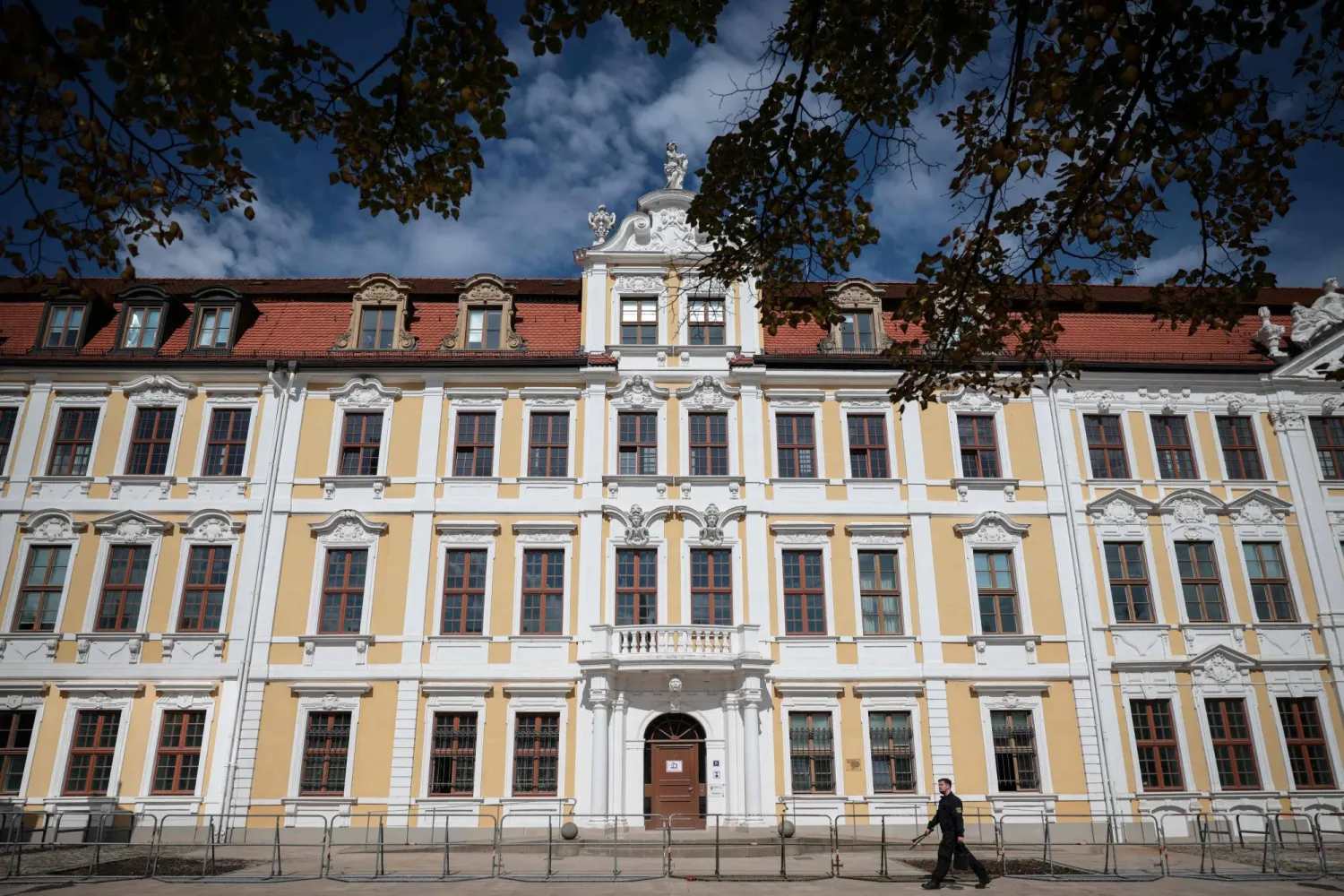
A general view taken on September 7, 2026 in Magdeburg, eastern Germany, shows Saxony-Anhalt's State Parliament, the day after the state election. (AFP)
TT

Far-Right Triumph in Eastern Germany Leaves Migrants Questioning Their Future

A general view taken on September 7, 2026 in Magdeburg, eastern Germany, shows Saxony-Anhalt's State Parliament, the day after the state election. (AFP)

Mamad Mohamad watched with mixed emotions as the far-right Alternative for Germany (AfD) swept to a historic victory on Sunday evening in the eastern state of Saxony-Anhalt.

A member of the Greens, the 46-year-old is set to become one of the first lawmakers with an immigrant background to enter the state parliament, alongside Mustafa Groener of the Left (Die Linke) party.

For Mohamad, who arrived in Germany from Syria as a 16-year-old Yazidi Kurd in 1996, it was a milestone that should have been a moment of celebration. Instead, he described it as a "poisoned victory".

"My heart was split," Mohamad said, recalling the first projections that showed the AfD outperforming expectations ‌while Chancellor Friedrich Merz's ‌governing conservatives slumped to a historic low.

'CULTURALLY ALIEN'

The AfD has long ‌campaigned ⁠for tighter immigration ⁠and asylum policies, arguing that Germany has lost control of its borders and that migration is putting heavy pressure on public services, security and social cohesion.

According to its election manifesto, an AfD-led Saxony-Anhalt would launch a state-level campaign to deport rejected asylum seekers.

The party also proposes encouraging businesses to adopt artificial intelligence and automation rather than rely on skilled migration from what it describes as "culturally alien" backgrounds.

The AfD rejects accusations that its rhetoric contributes to a hostile climate for migrants, insisting it opposes only illegal and uncontrolled ⁠migration.

"Everyone is warmly welcome who contributes positively to our society, who ‌wants to work here, who is qualified, who pays taxes, ‌and who abides by the law," AfD co-leader Alice Weidel said on Monday.

PACKED BAGS

The mood in Mohamad's ‌family was somber on Monday.

His daughter, he said, was reluctant to attend school, one of ‌several criticized by the AfD over projects that examine threats to democracy.

Though anxiety is running high in many immigrant communities, the result has prompted unease rather than surprise, said Undra Dressler, managing director of the State Network of Migrant Organizations in Saxony-Anhalt.

People with migrant backgrounds have long faced discrimination and structural barriers in access ‌to work, education, healthcare and public services, Dressler said.

"All of this is our reality," she told Reuters.

Sunday's result nevertheless marks a turning ⁠point, she said. "There are ⁠many people in our communities who say: 'We've already packed our bags and have concrete plans, and we'll be leaving soon,' or, in some cases, have already left."

Pascal Begrich, managing director of democracy advocacy group Miteinander, said he did not expect a large-scale exodus, partly because of economic realities, but agreed that many migrants but also employers were reassessing their future in Saxony-Anhalt.

"There are companies asking themselves whether they really want to locate here and whether they can ensure their workers will be safe," Begrich told Reuters.

CONSTITUTIONAL LIMITS

Mohamad said he feared the political shift could make it harder to attract newcomers to a state already grappling with demographic decline.

"Skilled workers and families will look elsewhere," he said.

Despite concerns about the state's political direction, both Dressler and Begrich stressed that any future government would remain bound by Germany's constitutional order and protections for minorities.

"Every government is bound by this," Dressler said. "And the 15 other federal states have a duty to monitor this and, if necessary, to intervene."




Russia Attacks Ukrainian Energy Grid, Forcing Power Cuts as Winter Looms

 Rescue workers put out a fire at a residential house destroyed in a Russian missile strike on Vyshhorod, Kyiv region, Ukraine, Wednesday, Sept. 30, 2026. (AP)
Rescue workers put out a fire at a residential house destroyed in a Russian missile strike on Vyshhorod, Kyiv region, Ukraine, Wednesday, Sept. 30, 2026. (AP)
TT

Russia Attacks Ukrainian Energy Grid, Forcing Power Cuts as Winter Looms

 Rescue workers put out a fire at a residential house destroyed in a Russian missile strike on Vyshhorod, Kyiv region, Ukraine, Wednesday, Sept. 30, 2026. (AP)
Rescue workers put out a fire at a residential house destroyed in a Russian missile strike on Vyshhorod, Kyiv region, Ukraine, Wednesday, Sept. 30, 2026. (AP)

Russia unleashed a widely anticipated air campaign against Ukraine's energy grid on Wednesday, hitting power facilities and infrastructure around Kyiv and other regions in the heaviest combined attack on energy sites in months.

The strikes, in which Ukrainian officials said seven people were killed, followed days of intensifying drone barrages primarily on the capital, a prelude to what many Ukrainians expect to be a winter of attacks intended to plunge cities into cold and darkness when Ukraine is short of air defenses.

Ukraine's state power grid operator Ukrenergo said it had imposed emergency power cuts as a result of the attack in Kyiv and three surrounding regions — the first time such a measure had been imposed in the capital since the spring.

Russian attacks last winter, which brought record-low temperatures, ravaged power and heating systems, ‌forcing Ukrainians to adapt ‌to dire circumstances.

CAPITAL SHROUDED IN SMOKE

Some of the capital's trams and trolley buses ground to ‌a halt ⁠due to the ⁠outages as people headed home from work. Kyiv's water utility said pressure in the water system was reduced.

"Russia has escalated to massive strikes on energy infrastructure," Prime Minister Sergii Koretskyi said on X after the attacks overnight.

"Since summer, there's barely been a day without an attack on our energy infrastructure. But a combined strike of this scale hasn't happened since the end of last heating season."

Kyiv residents awoke on Wednesday to a city shrouded in fog from the smoke of attacks, which authorities said damaged a key power plant and other energy facilities around the capital.

Ukraine's air force said its air defenses had intercepted 254 of 285 Russian drones deployed until early evening.

It said 174 drones were high-flying ⁠and faster jet-propelled models, which are harder to intercept. Russian forces had also launched a ballistic ‌missile attack.

A child was among the seven dead across Ukraine, President Volodymyr Zelenskiy said, ‌with critical infrastructure coming under attack in five regions. Further damage was reported in another five regions, he added.

Zelenskiy visited a military command post near ‌the town of Lyman near the eastern frontline and praised what he said were gains against Russian forces during a counteroffensive.

He ‌said Ukrainian forces had recaptured 176 sq. km. (29.3 sq. miles) of territory since the start of the operation.

Russia said its forces had struck power plants in the Kyiv region, an industrial complex in Odesa region, and port infrastructure in Ismail in the southwest.

Kyiv Mayor Vitali Klitschko said debris had been found at a Western embassy, but offered no further details. The overnight attack triggered a more than 12-hour air-raid alert.

Drone strikes continued in Kyiv into ‌the early evening.

Near-constant daytime sirens and explosions have become a fixture of daily life in Kyiv, where drone attacks have killed around a dozen people over the past week alone.

PM ⁠ORDERS POWER BACKUP CHECKS

Ukrainian Foreign Minister ⁠Andrii Sybiha described Wednesday's attack by Russia as a "deliberate" distraction from its grinding battlefield offensive in eastern Ukraine, which has slowed since last year.

"Moscow is increasing the pressure on Ukrainian civilians as winter approaches, trying once again to turn cold, darkness, and disruption of normal life into weapons," he said on X.

Forecasters say they expect freezing temperatures at night in Kyiv in the coming days.

Russia, which began its full-scale invasion in February 2022, denies targeting civilians although it has pounded cities and towns across Ukraine.

Koretskyi, the prime minister, said he had instructed local authorities to check the readiness of backup power systems at critical facilities and speed up installations.

Authorities in recent weeks and months have been building protective facilities and aiming to diversify energy generation before Russia's expected winter campaign.

However, Ukrainian human rights ombudsman Dmytro Lubinets said there was a critical shortage of urban shelters, describing the civil-defense system as having "completely failed".

DRONES CROSS INTO MOLDOVA

In Moldova, on Ukraine's western border, the defense ministry said three drones had crossed into its airspace over the course of the day.

NATO members Romania and Poland both scrambled military jets, the countries said, and flights at the Polish airports of Lublin and Rzeszow were suspended for a time.

Ukraine has also stepped up attacks on Russia, striking oil refineries and online retailers to undermine its war effort.


Pentagon Creates ‘Autowarcom’ to Expand AI and Drone Capabilities

 Secretary of Defense Pete Hegseth gives a State of the Force address at Marine Corps Base Quantico, Wednesday, Sept. 30, 2026 in Quantico, Va. (Alex Wong/Pool Photo via AP)
Secretary of Defense Pete Hegseth gives a State of the Force address at Marine Corps Base Quantico, Wednesday, Sept. 30, 2026 in Quantico, Va. (Alex Wong/Pool Photo via AP)
TT

Pentagon Creates ‘Autowarcom’ to Expand AI and Drone Capabilities

 Secretary of Defense Pete Hegseth gives a State of the Force address at Marine Corps Base Quantico, Wednesday, Sept. 30, 2026 in Quantico, Va. (Alex Wong/Pool Photo via AP)
Secretary of Defense Pete Hegseth gives a State of the Force address at Marine Corps Base Quantico, Wednesday, Sept. 30, 2026 in Quantico, Va. (Alex Wong/Pool Photo via AP)

US Defense Secretary Pete Hegseth on Wednesday announced the creation of a new military command that would be dedicated to building and providing autonomous and robotic capabilities across the US military.

The command, which Hegseth said would be called "Autonomous Warfare Command," highlights the rapidly changing nature of warfare and the need to make progress on systems like drones and the use of artificial intelligence.

Creating a new command is not common — the last one was US Space Command in 2019 — and the move reflects the Pentagon's push to shift from costly ‌conventional weapons platforms ‌to cheaper, AI-driven autonomous systems that have proved decisive in ‌recent ⁠conflicts.

Speaking in front ⁠of hundreds of junior officers and enlisted personnel at Quantico, Virginia, in a speech peppered with attacks on the media, Hegseth said the command would be led by a four-star officer.

"The pace of war is changing faster than the process to support it," Hegseth said in a speech called the "State of the Force," in which he announced other changes, including the creation of the office of religious affairs.

"Cheap compute, superintelligence, and ⁠advanced commercial manufacturing have enabled the proliferation of low-cost, high-precision strike," ‌Hegseth added.

The US military currently has 11 combatant ‌commands, which are responsible for different parts of the world and specific tasks.

EXPERTS WARN OF ‌AI RISKS

Experts have expressed fears over the potential for unchecked AI development and ‌technology rivalries that could further heighten risks across the global security environment.

Both China and the US — the two major drivers of cutting-edge AI development and its global adoption — have been at loggerheads over AI policies and industry practices. Security experts from both countries have called for ‌guardrails and consensus-building regarding AI in military systems, including nuclear weapons.

The United States has long relied on its vast military budget ⁠to field some ⁠of the world's most expensive weapons systems. But there is an increasing realization within the Pentagon that this is not sustainable.

"Today we need both quality and quantity," Hegseth said.

WAR IN UKRAINE ILLUSTRATES DRONE WARFARE

The technology of war has evolved rapidly in recent years, a shift starkly illustrated by Russia's war in Ukraine.

What began as a conflict dominated by tanks and artillery has increasingly become a drone war.

Outgunned in conventional armor and aircraft, Ukraine turned to inexpensive unmanned systems for reconnaissance and attack. Drones are estimated to account for about 70% of Russian casualties, enabling strikes to be carried out remotely and reducing the risk to pilots and aircrews.

The Pentagon has in recent years made some progress, including the creation of a task force — Joint Interagency Task Force 401 — that is focused on countering drones.


Iran Hangs 2 Men on Charges of Violence During Protests

People shop at Tajrish Bazaar in northern Tehran, Iran, 30 September 2026. Iran is facing an economic crisis as the conflict between the US and Iran continues. (EPA)
TT

Iran Hangs 2 Men on Charges of Violence During Protests

People shop at Tajrish Bazaar in northern Tehran, Iran, 30 September 2026. Iran is facing an economic crisis as the conflict between the US and Iran continues. (EPA)

Iran executed two men Wednesday over what it said was their role in violence during nationwide anti-government protests in January, state media reported.

IRNA, citing the judiciary, said the men took part in unrest in the northeastern city of Mashhad that left four security officers dead.

The judiciary said the men confessed to the violence, including setting fires and damaging public property. It also said one confessed to stabbing a member of Iran's paramilitary force.

Iran’s Supreme Court upheld the sentences before they were carried out Wednesday morning.

The unrest began Dec. 28 amid anger over Iran’s collapsing currency and worsening economy and quickly spread across the country. Iranian authorities responded with a deadly crackdown.

Dozens of Iranians have since been executed in connection with the protests, according to state media in Iran.

Executions aren't uncommon in Iran, where rights groups say the accused are often tried in secretive courts based on forced confessions extracted through torture.