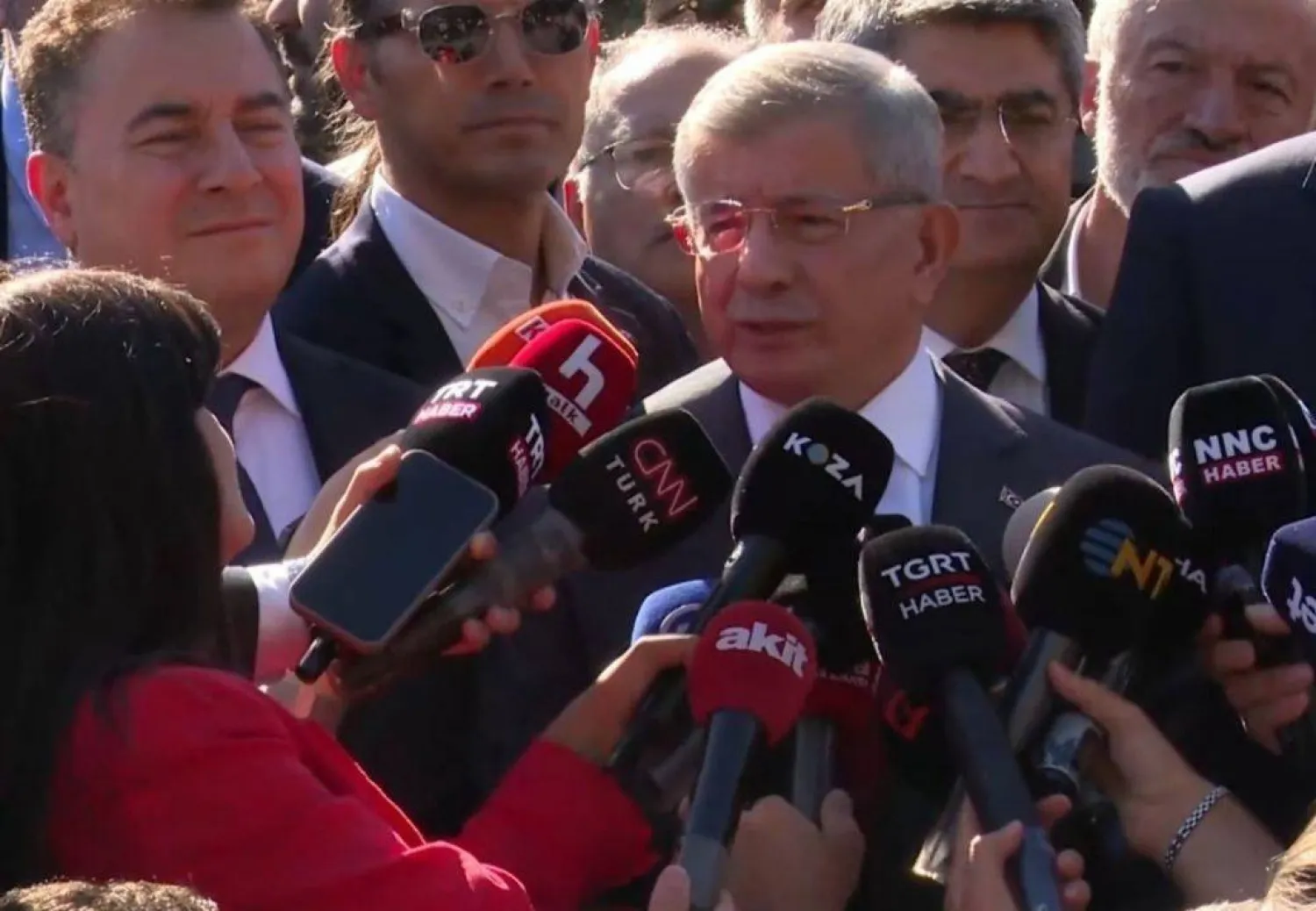
In Historic Precedent, Turkish Former PM Davutoglu Questioned over ‘Insulting the President’

Turkish former Prime Minister and Minister of Foreign Affairs Ahmet Davutoglu speaks to the press on Monday. (Turkish media)
TT

In Historic Precedent, Turkish Former PM Davutoglu Questioned over ‘Insulting the President’

Turkish former Prime Minister and Minister of Foreign Affairs Ahmet Davutoglu speaks to the press on Monday. (Turkish media)

Turkish former Prime Minister and Minister of Foreign Affairs Ahmet Davutoglu has given his testimony before the Ankara Chief Public Prosecutor’s Office as part of an investigation against him on charges of insulting President Recep Tayyip Erdogan, marking a precedent in Türkiye's history.

In a brief statement following his roughly one-hour testimony, Davutoglu said: "This is an unprecedented event in the history of the Republic of Türkiye; for the first time in the Republic's history, a prime minister is summoned to the prosecutor's office as a suspect merely for expressing his opinion and making criticism."

Davutoglu expressed his gratitude to the party leaders who came to support him during his testimony. Those who arrived at the Chief Public Prosecutor’s Office to show their solidarity included Ali Babacan, the former Deputy Prime Minister, Minister of Economy, and Minister of Foreign Affairs, who currently serves as the leader of the Democracy and Progress Party; Mehmet Emin Ekmen, the deputy leader of the party; and Mahmut Arikan, the leader of the Felicity Party.

Davutoglu refused to answer any questions from journalists "to protect Türkiye’s image”.

"I respect the judiciary; therefore, I provided the testimony required of me," he added.

The Ankara Chief Public Prosecutor’s Office opened an investigation last Thursday against Davutoglu on charges of insulting Erdogan. The investigation stems from a video published on social media platforms dating back to 2021, which showed Davutoglu speaking with a group of citizens in a village near the city of Bingol in eastern Türkiye.

Davutoglu criticized Erdogan without mentioning him by name, saying: "Unlike the ministers who came after me, I did not earn a single penny illegally. I told them not to reach out their hands and not to make illicit gains, but they did. They amassed billions upon billions, plundered illicit gains, and enriched their entourage and those around them."

"He (Erdogan) appointed his son-in-law (Berat Albayrak, the former Minister of Energy and Natural Resources, and Minister of Treasury and Finance) as a minister, enriched his relatives, and handed Türkiye over to five contractors," he alleged.

The Chief Public Prosecutor’s Office stated in a response that the prosecution initiated an immediate, automatic investigation against Davutoglu under the Turkish Penal Code, due to statements deemed offensive to the President of the Republic that were circulated on social media platforms.

If convicted, he faces between one and four years in jail.

Davutoglu, a prominent political science academic who was nicknamed "The Professor" within the circles of the ruling Justice and Development Party (AKP), served as an advisor to former President Abdullah Gul, and later to Erdogan during his premiership, before becoming Minister of Foreign Affairs.

He assumed the party’s leadership, succeeding Erdogan after the latter was elected president in 2014. In 2016, he announced his resignation from the party leadership due to disagreements with Erdogan over his approach to managing both the party and the country.

In 2019, he resigned from the party after differences with Erdogan deepened. He subsequently founded the Future Party.

On July 30, Davutoglu unexpectedly announced his decision to dissolve the party and withdraw from political activity. Citing the "corruption of the political climate in Türkiye," he noted that "the decision is not a surrender or an abandonment of politics, but rather came to establish an ethical distance from politics."


Netanyahu’s Somalia Map Revives Fears of Partition

From the Somali capital, Mogadishu (Reuters)
TT

Netanyahu’s Somalia Map Revives Fears of Partition

From the Somali capital, Mogadishu (Reuters)

A map unveiled by Israeli Prime Minister Benjamin Netanyahu has sparked outrage in Somalia, which accused him of undermining its sovereignty and territorial integrity by depicting Puntland and Somaliland as separate states.

The map has reignited fears of partition in a country already grappling with deep divisions. Puntland remains at odds with the federal government, while Israel recognized the breakaway region of Somaliland several months ago.

Somalia rejects the map

Somalia's federal government "categorically rejected" what it called a "misleading map" displayed during Netanyahu's news conference on Sunday, saying it portrayed the country as fragmented.

It condemned the move as "a flagrant violation of Somalia's sovereignty, territorial integrity and internationally recognized borders."

In a statement issued by the Information Ministry on Wednesday evening, the government reaffirmed its unwavering commitment to national sovereignty and the unity of its territory and people.

It stressed that Somaliland and Puntland remain "integral and inseparable parts of the unified, sovereign Somali state."

The government warned that any attempt by foreign officials or outside parties to redraw Somalia's political map, misrepresent its borders or undermine its territorial unity would constitute a direct violation of international law and diplomatic norms.

It urged the international community and its partners to respect Somalia's independence and territorial integrity, pledging to uphold its constitutional duty to defend the country's sovereignty and national unity.

Netanyahu displayed the map, titled "Geopolitical Alliances in the Middle East," during an Israeli national security briefing on Oct. 18. It placed Puntland and Somaliland in geopolitical categories linked to Israel.

For Mogadishu, the controversy goes beyond the map itself.

Abdulwali Jama Barre, an African affairs expert and co-founder of the Somali Academy of Leadership and Global Affairs, said the government's response underscored its determination to preserve Somalia's unity and reject any treatment of its regions as independent states.

But Barre drew a distinction between the map's depiction and formal recognition of independence.

"Showing Somali territories under separate geopolitical classifications does not, in itself, mean the map formally declared them independent states," he told Asharq Al-Awsat.

"However, the Somali government viewed the depiction as fragmenting the country's political map and undermining its internationally recognized borders."

Barre said the dispute carried particular weight given Somaliland's contested political status, its ties with Israel and fears in Mogadishu that foreign involvement could weaken Somalia's unity.

The deeper concern, he said, is that foreign powers could increasingly treat Somali regions as entities separate from the federal state.

That risk would grow if symbolic gestures were followed by concrete steps or new formal arrangements amid the country's existing political disputes, he added.

Deep divisions

Somaliland's strategic location adds another dimension to the dispute.

The breakaway region stretches along 740 kilometers of the Gulf of Aden coastline, occupying a key position at the junction of the Indian Ocean and the Red Sea in the Horn of Africa. It is also home to the strategically important Port of Berbera.

Since breaking away from Somalia in 1991, Somaliland had failed to secure international recognition until Israel recognized it, a decision Mogadishu firmly rejects, with Arab countries backing its position.

The map controversy comes as tensions between Somalia's federal government and Puntland remain unresolved.

In May, Puntland President Said Abdullahi Deni declared that he no longer recognized Hassan Sheikh Mohamud as Somalia's legitimate president, accusing him of illegally abusing his presidential powers.

Deni called for an urgent gathering of Somalia's political parties to agree on an inclusive electoral process.

The dispute is part of a broader rift between Puntland and Mogadishu. Over the past year, the regional administration has repeatedly challenged Mohamud's positions and refused dialogue with him.

Deni has also joined the opposition Somali Future Council, which is demanding the government's departure.

At the time, Somalia's federal Interior Minister Ali Yusuf Ali, known as Hosh, sharply criticized Deni, calling him "an obstacle to the state, the country's unity and its development."

Barre warned that such internal divisions must be addressed through constitutional and political dialogue to prevent disputes between Mogadishu and regional administrations, particularly Puntland, from becoming an arena for foreign competition.

He urged Mogadishu to pursue diplomatic action on several fronts, beginning with a formal protest to Israel and a request for clarification about the map and the circumstances in which it was presented.

Somalia should also raise the matter with the United Nations, African Union, Arab League and Organization of Islamic Cooperation, seeking assurances of respect for its sovereignty and territorial integrity, he said.

At home, Barre stressed the need for renewed dialogue between the federal government and regional administrations, especially Puntland, to resolve their differences within an agreed constitutional framework.


Trump: Iran is Trying to Drive Up Oil Prices Before Midterm Elections

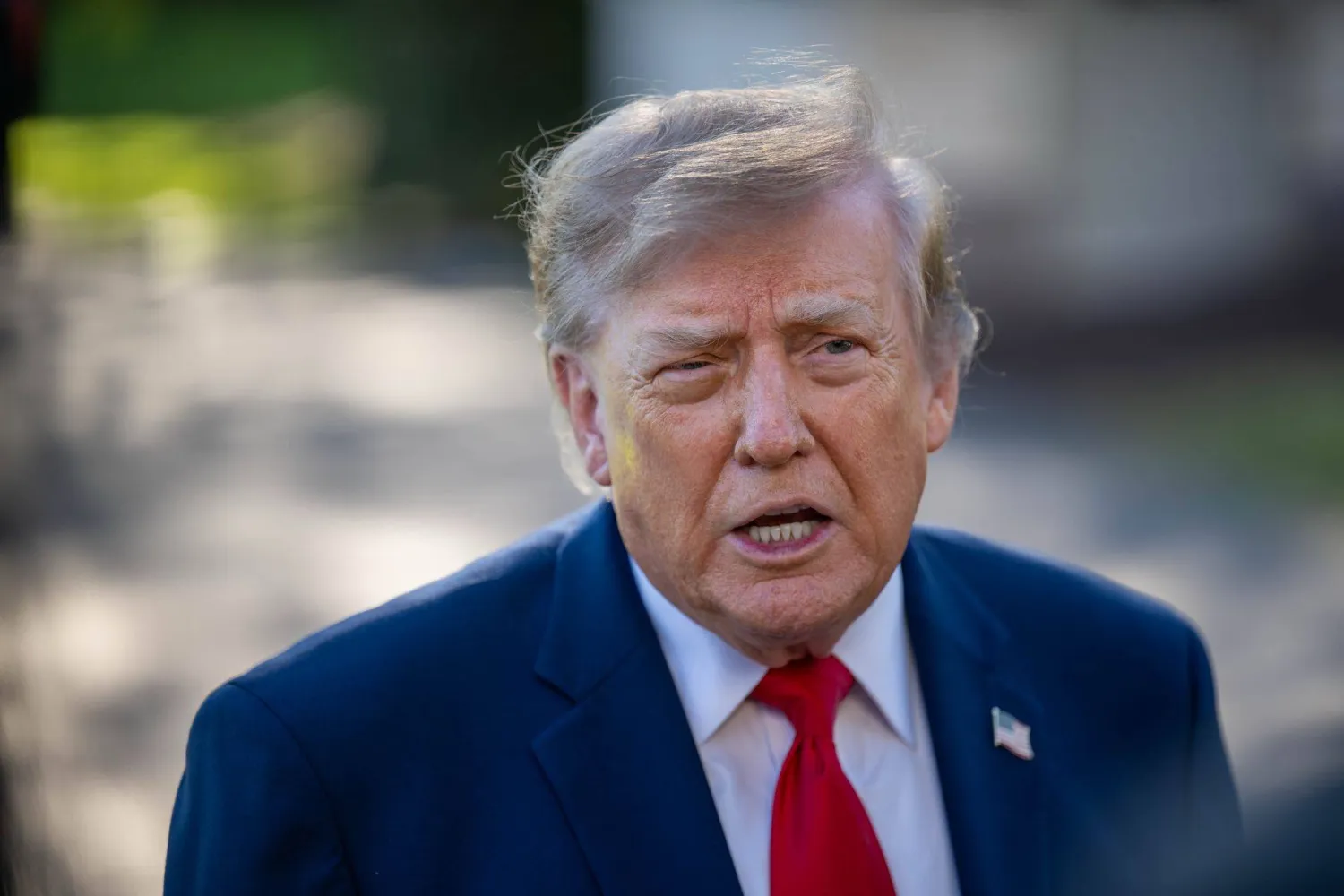
21 October 2026, US, Washington: US President Donald Trump speaks to the press at the White House before departing for South Carolina. Photo: Matt Kaminsky/ZUMA Press Wire/dpa
TT

Trump: Iran is Trying to Drive Up Oil Prices Before Midterm Elections

21 October 2026, US, Washington: US President Donald Trump speaks to the press at the White House before departing for South Carolina. Photo: Matt Kaminsky/ZUMA Press Wire/dpa

US President Donald Trump said on Thursday that Iran was doing all it could ⁠to drive up ⁠the price of oil before ⁠the US midterm elections.

"They are even making up fake hits, mines, and everything else," he said ⁠in ⁠a Truth Social post.

Iran's state television reported on Thursday that seven oil tankers were either struck by attacks or hit naval mines in the Strait of Hormuz overnight, possibly the largest single-day number of vessels damaged in the waterway since the Iran war started on Feb. 28.

Quoting a statement by the Revolutionary Guard's navy, the Iranian report said four of the tankers were transferring oil when they were targeted and caught fire. Three more were damaged and immobilized after hitting naval mines. The report didn't provide details about possible casualties or the tankers' flags.

Oil prices climbed about 2% to a five-month high on Thursday.

Brent futures rose $2.42, or 2.2%, to $111.24 a barrel at 10:45 a.m. EDT (1445 GMT), while US West Texas Intermediate (WTI) crude rose $1.14, or 1.2%, to $98.29.

That drove Brent into technically overbought territory for a third time in a week and set for its highest close since May 18.


French Justice Minister: 217 People Jailed Over Riots

France's Justice Minister Gerald Darmanin leaves after attending the weekly cabinet meeting at the Elysee Palace in Paris on October 22, 2026. (Photo by Ludovic MARIN / AFP)
TT

French Justice Minister: 217 People Jailed Over Riots

France's Justice Minister Gerald Darmanin leaves after attending the weekly cabinet meeting at the Elysee Palace in Paris on October 22, 2026. (Photo by Ludovic MARIN / AFP)

French courts have jailed 217 people after convicting them in fast-track trials linked to last weekend's rioting, the justice minister said Thursday, hailing the judiciary's "extremely firm" response.

Speaking outside the Fleury-Merogis prison on the outskirts of Paris, Gerald Darmanin said 2,700 people had been detained since Saturday.

More than 1,000 of them had appeared in court, he said, of whom "217 people have been imprisoned... and this figure is continuing to rise a lot."

Darmanin told reporters that of the 217 sent to jail "half had no criminal record", adding that "in general these are men aged between 18 to 25."

"This shows that prosecutors and judges are imprisoning people who, until now, were not known to the judiciary and are first offenders. It shows that the decisions of the judiciary are being applied in an extremely firm way," AFP quoted him as saying.

Darmanin has vowed to oversee expedited trials to rapidly clear the backlog of cases and to serve as a deterrent. New protests over grievances including the rising cost of living are planned this weekend.

But he has faced criticism from some lawyers who have accused the judiciary of lurching into repression.

France, like many European countries, faces problems with prison overcrowding but Darmanin said the solution was not "to imprison fewer people, but to create more space in prison."

As of September 1, there were 90,020 inmates in French prisons, well above the capacity of 63,348 places and a new record, according to ministry statistics.