


Vance Assails Democratic ‘Hatred’ in Fiery US Midterm Pitch

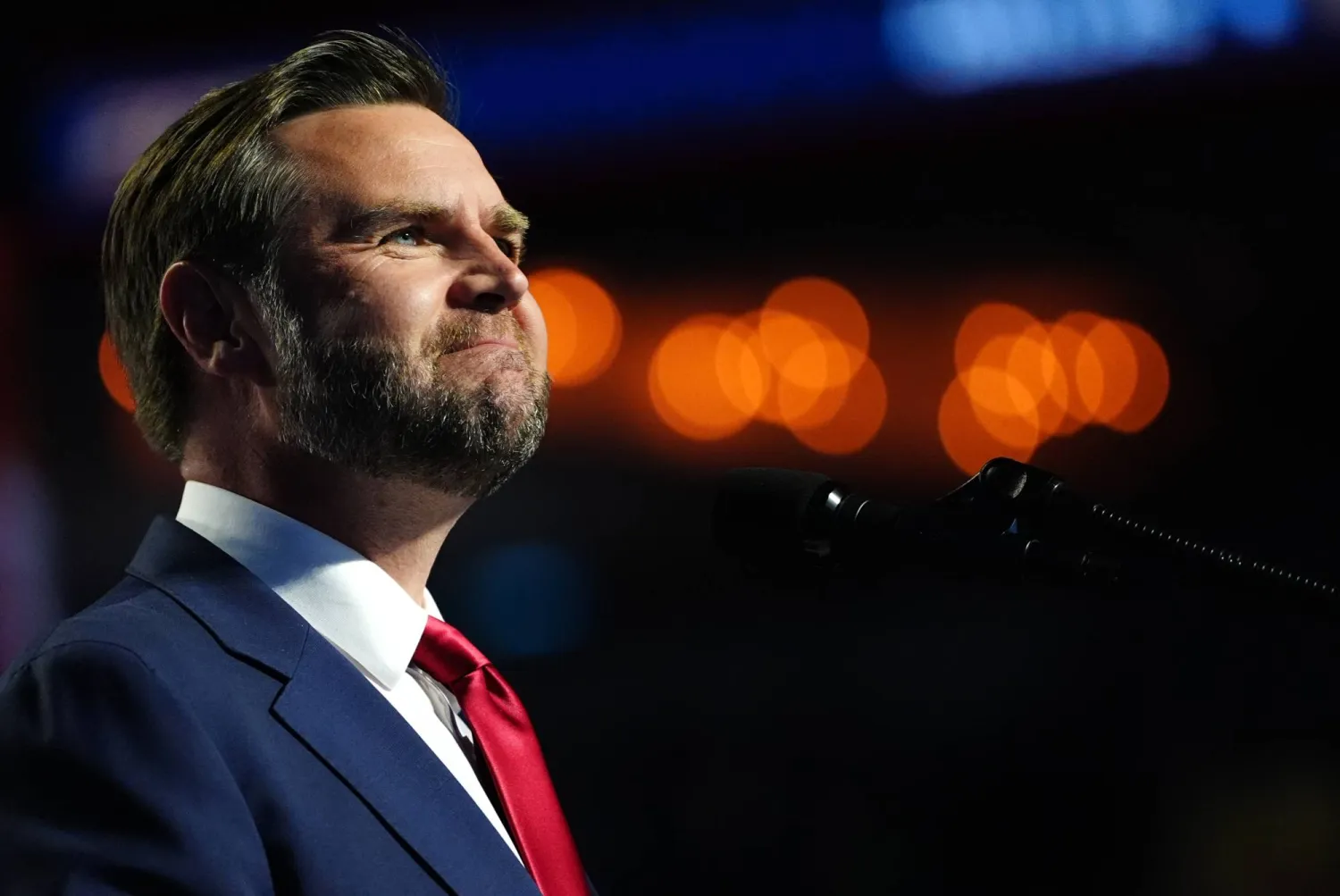
 Vice President JD Vance speaks at the Republican convention, Thursday, Sept. 10, 2026, in Dallas. (AP)
Vice President JD Vance speaks at the Republican convention, Thursday, Sept. 10, 2026, in Dallas. (AP)
TT

Vance Assails Democratic ‘Hatred’ in Fiery US Midterm Pitch

 Vice President JD Vance speaks at the Republican convention, Thursday, Sept. 10, 2026, in Dallas. (AP)
Vice President JD Vance speaks at the Republican convention, Thursday, Sept. 10, 2026, in Dallas. (AP)

US Vice President JD Vance called Democrats the "party of hatred" Thursday and urged voters to send them packing in November's midterms, in a prime-time convention speech that showcased him as a possible heir to Donald Trump in 2028.

The 42-year-old vice president was greeted by a huge roar and chants of "JD! JD!" as he took the stage at the American Airlines Center in Dallas.

"This fall, the Democrats are running candidates who will tell your children what they're allowed to say, how they're allowed to live, and, importantly, who they ought to hate," Vance said.

"The Democrats are the party of hatred. They're the party that despises America and the people who built it. They're the party that can find sympathy for the terrorists who perpetrated 9/11," he added

Trump returned to the stage after Vance and immediately praised his vice president.

"I want to thank our great vice president. What a job he did tonight!" Trump said. "You know, the Democrats are getting nervous."

The president promised to be brief before introducing a convention-closing music set, saying: "I'm getting a little tired of politics now."

But he reprised familiar rally lines, attacking "radical left" Democrats and again making himself the centerpiece of the Republican midterm campaign.

"I'm not on the ticket. You've got to pretend I'm on the ticket," Trump told supporters.

Republicans head into November under heavy electoral pressure.

US election tracking site Decision Desk HQ projects Democrats will win the House 229-206 and has the Senate on a knife-edge at 50-50. Trump's approval rating has languished in the low-to-mid 30s amid stubborn inflation and an unpopular war with Iran.

Trump also repeated his extraordinary promise from Wednesday to pay every American adult a $5,000 "Trump dividend" if Republicans retain both chambers of Congress.

- Family and future -

Vance, meanwhile, sought to sharpen a convention-long portrayal of Democrats as extremists, arguing that disagreements within the Republican coalition were minor compared with what he called the rhetoric of the "far left."

"I'm not asking you to agree with every policy of our administration," Vance told the crowd.

"I'm asking you to recognize the contrast with the radicals, and the achievements of the last 18 months."

Family and fatherhood were recurring themes as Vance sought to contrast what he described as traditional values with the political left, adding "we got to send their asses packing in November."

He also paid tribute to conservative youth activist Charlie Kirk on the first anniversary of his killing, addressing Kirk's young children directly.

"History will record that your father was a great man," Vance said.

Vance turned to his political opponents, accusing them of attacking the traditional family.

"To the radicals who wish to abolish my family and the thousands and millions of other families all across our country, we have a simple message for them: stay the hell away from our kids," he said.

- High-stakes gamble -

Vance is widely regarded as an early front-runner for the 2028 Republican presidential nomination, although he has said he will not make a decision until after the midterms.

His appearance immediately before Trump's closing remarks gave him one of the convention's most prominent speaking slots as Republicans begin to consider their post-Trump future.

Speaking to reporters on the tarmac before departing Texas, Trump praised Vance.

"I think he did very well tonight, and he's a very talented guy. He's a great -- been a great vice president. I think he did a very good job," Trump said.

The central Republican gamble remains whether Trump can mobilize voters personally loyal to him even when he is not actually running, without further alienating independents who have soured on his presidency.

Vance's appearance added the longer-term question of whether one of Trump's potential successors can eventually inherit the political coalition he built.

Ed Williams, a 59-year-old engineer from Dallas, told AFP Vance had come across as "very charismatic," and hit the issues important to "the America that I want."

"I'm considering Vance very strongly for my presidential pick in 2028," he said, as jubilant Republicans streamed out of the convention hall and into a steamy Dallas night.



China, Iran Among Countries That Have Used AI to Aid Spying, Anthropic Says

The Anthropic logo in this illustration taken June 5, 2026. (Reuters)
TT

China, Iran Among Countries That Have Used AI to Aid Spying, Anthropic Says

The Anthropic logo in this illustration taken June 5, 2026. (Reuters)

Anthropic said Thursday it shut down multiple cases of state-sponsored surveillance operations that used its artificial intelligence (AI) models, and warned that governments and state-aligned actors are increasingly using AI to spy on ethnic minorities and dissidents.

The incidents were found and disrupted between January and July, and they originated in China, Iran and west Africa, Anthropic said in a report about misuse of its models.

These surveillance campaigns "targeted the same diaspora and dissident communities these regimes have historically targeted. These include pro-democracy figures in Hong Kong, Tibetan and Falun Gong communities across Asia, and Iranian minority communities and opponents of the Iranian regime abroad," the report said.

In one case, Iranian actors developed a way to identify people through their social media accounts; in another, a contractor working for Malian national security authorities used Claude "to design the underlying software that enabled the intelligence gathering."

"AI is now being used in place of an engineering workforce," the report said.

Anthropic also disrupted efforts by users to design weapons, conduct questionable biological research, and create dating scams.

The San Francisco-based AI lab also accused Chinese developers of deceptively using Claude to produce responses to user queries while simultaneously "distilling" that data to improve their own models.

Distilling is an industry term that refers to a process where one AI model is used to train another one.

Chinese developers have previously been accused of using that technique without permission, essentially stealing resources from American labs such as Anthropic and OpenAI.

Now Anthropic alleges that China's Moonshot and DeepSeek have also secretly used Claude to generate answers given to its users.

"In one instance, over a ten-day period, Moonshot relayed almost 300,000 customer requests to Anthropic" through a "network of 5,380 fraudulent accounts, most of which appeared to be located in Singapore and Japan," the report said.

Some of that data contained sensitive user information, potentially in violation of privacy agreements.

"We do not know if Moonshot notified their customers that their requests were being rerouted to Anthropic and exposed to a third party," the report said.

DeepSeek used similar techniques.

When it comes to the research Anthropic detected and blocked that was related to biological weapons, the intent of the actors was less clear-cut and the AI lab did not identify them.

"The individuals implicated in these case studies are working scientists. We do not assert that they intended harm, and identifying them or their labs could expose them to harm," the report said.

The scientific research in those cases involved work around the mosquito-born chikungunya virus, a "highly-pathogenic" strain of the bird flu, a family of viruses that include smallpox and mpox, venoms and other toxins.


Iran is Reportedly Producing Ballistic Missiles Again in Underground Facilities

FILE PHOTO: A man walks next to a symbolic mockup of an Iranian missile and an Iranian flag at Imam Hussein Square in Tehran, Iran, July 12, 2026. Majid Asgaripour/WANA (West Asia News Agency) via REUTERS
TT

Iran is Reportedly Producing Ballistic Missiles Again in Underground Facilities

FILE PHOTO: A man walks next to a symbolic mockup of an Iranian missile and an Iranian flag at Imam Hussein Square in Tehran, Iran, July 12, 2026. Majid Asgaripour/WANA (West Asia News Agency) via REUTERS

Iran has resumed its production of ballistic missiles using stockpiled components and working in underground facilities, officials from the US and Middle East familiar with the matter said.

Despite heavy attacks on its missile sites and industrial facilities during the initial phase of the war, Iran has been busy assembling liquid-propellant missiles, which have to be fueled just before launch, as well as solid-propellant missiles, which can be stored ready to fire, some of the officials told The Wall Street Journal.

Intelligence points to activity at several underground sites, including the Khojir missile facility in southeastern Iran, those officials said. Iran is also attempting to build new underground assembly points to avoid getting struck again, the daily quoted them as saying.


A banner with a picture of US President Donald Trump next to an Iranian missile system at Azadi Square in Tehran, Iran, July 30, 2026. Majid Asgaripour/WANA (West Asia News Agency) via REUTERS

So far, Iran is mainly assembling the new missiles from existing components in more limited quantities than before the war, the US and regional officials said. The US and Israel damaged a number of industrial facilities needed to produce missile components and missiles themselves, and the naval blockade has complicated imports of parts and ingredients for solid fuel.

The renewed production underscores the difficulty of fully dismantling Tehran’s missile program, a goal of the war the US and Israel launched on Feb. 28.

“When there are no bombings of the facilities, you can replace damaged infrastructure, and you can buy new components from other countries and store them in the facilities,” said Tal Inbar, a senior analyst at the US-based Missile Defense Advocacy Alliance. “You have to be extremely naive to think that Iran is not rebuilding its missile-production capabilities.”

A White House official didn’t directly address the question of whether Tehran had resumed production of ballistic missiles but said that Iran’s nuclear facilities had been obliterated and its military forces severely degraded. “Iran is weaker now than ever before, and President Trump will never allow Iran to have a nuclear weapon,” the official said.

Sean Parnell, the Pentagon’s chief spokesman, said the US had “destroyed up to 90% of Iran’s drone, ballistic missile, and naval industrial base” and “significantly degraded” Iran’s ability to launch missiles and drones.


Next 9/11 Shock Might Be Being Planned Where We’re Not Looking, UK’s MI5 Chief Says

A person takes a photo of the "Tribute in Light" public art installation commemorating the 9/11 2001 terrorist attacks as it shines up from the skyline of lower Manhattan in preparation for the 25th anniversary, in New York City, on September 10, 2026. (AFP)
TT

Next 9/11 Shock Might Be Being Planned Where We’re Not Looking, UK’s MI5 Chief Says

A person takes a photo of the "Tribute in Light" public art installation commemorating the 9/11 2001 terrorist attacks as it shines up from the skyline of lower Manhattan in preparation for the 25th anniversary, in New York City, on September 10, 2026. (AFP)

Intelligence services must not dwell ‌too much on past threats but accept that a new strategic shock along the lines of the 9/11 attacks could already be in preparation where they are not looking, the head of Britain's MI5 spy agency said.

In an opinion piece published on Friday to mark 25 years since al-Qaeda militants crashed hijacked passenger jets into the World Trade Center in New York and the Pentagon, MI5's Director General Ken McCallum said security agencies had to be ready to adapt to current ‌and future challenges.

"We ‌know that the next strategic shock ‌will, ⁠by definition, not resemble ⁠the last one. That is perhaps the most important lesson of all," McCallum wrote in the commentary for the Independent newspaper.

"We must of course always learn from the last attack – but must beware of preparing brilliantly to fight yesterday’s enemy, using yesterday’s methods, against yesterday’s target ... The uncomfortable truth is that the ⁠next strategic shock may already be taking shape ‌somewhere we are not yet ‌looking."

Al-Qaeda, though diminished, remains a threat, as does the aspiration of ‌that group and other militants for mass casualty attacks, McCallum ‌said.

This was recently borne out by a foiled extremist plot to kill hundreds in gun attacks on the Jewish community in the northern English city of Manchester, he added.

But McCallum said MI5 was ‌also facing rising state-backed aggression, ranging from sabotage carried out by criminal proxies to cyberattacks on ⁠power stations.

Unlike ⁠in 2001, many systems and services are in the hands of the private sector and it will require governments, businesses and academia all working together to close vulnerabilities and to respond swiftly in a crisis, he said.

"We cannot wait for the next shock to discover who owns the vulnerability, who has the authority to act, or who was supposed to pick up the phone," he wrote.

"We owe the victims of 9/11 – and those who will otherwise become the victims of tomorrow’s attack – something more than remembrance. We owe them preparation, resilience and the courage to adapt before the next shock arrives."