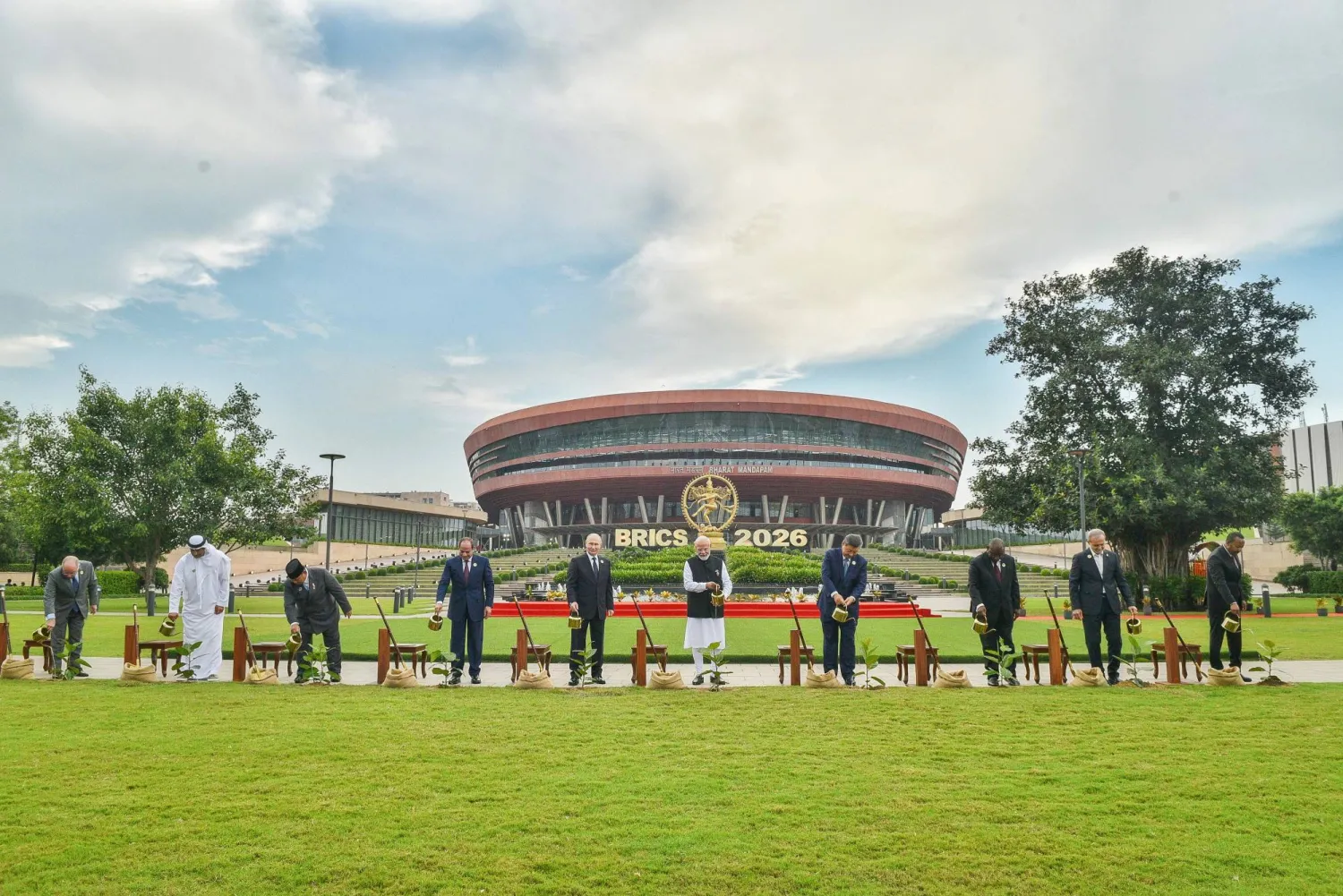
BRICS Nations Call for 'Maximum Restraint' in Middle East War

A handout photo made available by India’s Ministry of External Foreign Affairs shows BRICS leaders planting trees during the 18th BRICS Leaders' Summit in New Delhi, India, 12 September 2026. EPA/INDIAN MINISTRY OF EXTERNAL FOREIGN AFFAIRS/HANDOUT
TT

BRICS Nations Call for 'Maximum Restraint' in Middle East War

A handout photo made available by India’s Ministry of External Foreign Affairs shows BRICS leaders planting trees during the 18th BRICS Leaders' Summit in New Delhi, India, 12 September 2026. EPA/INDIAN MINISTRY OF EXTERNAL FOREIGN AFFAIRS/HANDOUT

Members of the 11-nation BRICS group including China, Russia, Iran and India called for calm in the Middle East at a summit in New Delhi on Saturday.

Chinese President Xi Jinping, who joined Russian, Iranian, Indian and other leaders in India's capital, told the summit that the Middle East war "does not serve the common interests of the international community.”

Leaders issued a statement on Saturday after intense diplomatic efforts by host India, as the bloc seeks to bolster its global influence and address conflict, trade turbulence and energy security.

"We express deep concern over the continued escalation of tensions in Middle East/West Asia," the joint statement said, according to AFP, adding the countries "call for exercising maximum restraint, as well as avoiding actions that could further aggravate the situation.”

BRICS was created in 2009 as a forum for major emerging economies seeking greater influence in institutions dominated by Western powers.

"We have to transform this pyramid of privilege into a platform of partnership," Indian Prime Minister Narendra Modi told Xi, Russian President Vladimir Putin, Iranian President Masoud Pezeshkian and other leaders as he opened the two-day summit.

Modi said BRICS nations "represent 50 percent of the world's population, 40 percent of global GDP and more than 25 percent of global trade.”

But finding balance in the bloc is a tough diplomatic task.

India maintains cordial relations with both Iran and US ally Israel, but is also careful to strike a delicate balance in its ties with Washington.

Iran's Pezeshkian attended the summit shortly after warning that the Middle East does not need the United States to be a "regional policeman,” with the two countries at war and tensions threatening the vital Strait of Hormuz.

India has navigated the energy crisis caused by the US-Iran war in part by turning to Russia, despite Moscow's war in Ukraine and pressure from Washington and other Western capitals.

Modi embraced Putin before talks on Friday. The Russian president, who last visited India in December 2025, is one of New Delhi's most important strategic partners.

Xi's participation is also being closely watched because it is his first visit to neighboring India since 2019, and the biggest step yet in a cautious thaw between the nuclear-armed rivals.

Xi was given a red-carpet welcome, with an honor guard of soldiers and traditional dancers in colorful dresses.

"Although our two countries are different in many respects, they are fully capable of complementing each other's strengths, supporting one another, achieving mutual success and advancing together," Xi said as he met Modi, in a video released from New Delhi.

His visit comes six years after a deadly military clash along the disputed Tibetan border between China and India, with ties gradually improving through restored flights, visas and high-level contacts.

The underlying territorial dispute remains unresolved, and both sides retain heavy military deployments along their roughly 3,500-kilometer high-altitude border.

India's foreign ministry said in a statement after the meeting that "the two leaders expressed commitment to a fair, reasonable, and mutually acceptable resolution of the boundary question.”

Modi "underlined the need for both sides to observe existing agreements and understandings on border related issues," the foreign ministry added.

Deep mistrust remains, with their contested Himalayan frontier, a widening trade deficit and strategic rivalry continuing to complicate ties.

"Both sides should... work hand-in-hand to promote high-quality major financial cooperation, advocate an equal and sustainable global order, and foster an economic globalization that is open and inclusive," Xi said.


Iran President to Visit Moscow Next Week for Talks with Putin

Russian President Vladimir Putin meets with Iranian President Masoud Pezeshkian in Turkmenbashi earlier in October. (Reuters)
TT

Iran President to Visit Moscow Next Week for Talks with Putin

Russian President Vladimir Putin meets with Iranian President Masoud Pezeshkian in Turkmenbashi earlier in October. (Reuters)

Iranian Foreign Minister Abbas Araghchi stated that President Masoud Pezeshkian will travel to Moscow next week to meet his Russian counterpart, Vladimir Putin, as part of ongoing consultations between the two countries regarding bilateral cooperation and regional developments.

Araghchi noted, in a message addressing the recent visit of Russian Foreign Minister Sergei Lavrov to Tehran, that the talks focused on developing political and economic cooperation, implementing joint agreements, and strengthening the comprehensive strategic partnership between Iran and Russia.

The state-run Mehr News Agency quoted Araghchi as saying: "During this visit, we stressed the importance of continuing consultations to protect mutual interests and enhance regional peace and stability. This dialogue and these consultations will continue next week in Moscow in the presence of the presidents of both countries."

Lavrov visited Tehran on Monday, marking his first visit to Iran since the eruption of the war on February 28, where he met with Pezeshkian and Araghchi.

In a joint press conference with Araghchi, he said that Pezeshkian might visit Moscow "in the coming days," without specifying a date.

Lavrov called for a return to the pre-war status quo in the Strait of Hormuz, including the "restoration of freedom of navigation and guarantees against a recurrence of aggression," adding that Russia was ready to search for a way to resolve the crisis.

Russia "has no intention of abandoning the implementation of economic and investment agreements with Iran" despite the "difficult situation," he said, revealing that Russian experts are "gradually returning to the Bushehr nuclear plant".

Trade exchange between Moscow and Tehran grew by 21 percent last year, he added.

Pezeshkian and Putin recently met in Turkmenistan. Putin had informed Pezeshkian in early October of Moscow's readiness to contribute to mediation efforts.


Iran Judiciary Says Chief Holds Rare Meeting with Supreme Leader

 A police officer monitors traffic as he stands under portraits of Iran's supreme leader Mojtaba Khamenei in Tehran on October 21, 2026. (AFP)
A police officer monitors traffic as he stands under portraits of Iran's supreme leader Mojtaba Khamenei in Tehran on October 21, 2026. (AFP)
TT

Iran Judiciary Says Chief Holds Rare Meeting with Supreme Leader

 A police officer monitors traffic as he stands under portraits of Iran's supreme leader Mojtaba Khamenei in Tehran on October 21, 2026. (AFP)
A police officer monitors traffic as he stands under portraits of Iran's supreme leader Mojtaba Khamenei in Tehran on October 21, 2026. (AFP)

Iran's judiciary said on Saturday that its chief held a rare meeting with the country's supreme leader Mojtaba Khamenei, who has yet to appear in public since being appointed.

Mojtaba was chosen in March to succeed his father and longtime ruler Ali Khamenei, who was killed in US-Israeli strikes in central Tehran alongside senior military commanders at the start of the Middle East war, and was said to have been injured in the same attack.

Judiciary chief Gholamhossein Mohseni Ejei and the supreme leader discussed issues including "securing public rights, and effectively combating corruption and its bottlenecks", the judiciary's Mizan Online website reported.

They held talks on "pursuing the recovery of rights and compensation for material and moral damages arising from the crimes of American-Zionist criminals", it said.

The younger Khamenei has only communicated through written messages since his appointment, some of them published in handwriting attributed to him.

No video message from him has been released, and the time and location of his meeting with Ejei were not disclosed, as has been the case with previously reported meetings.

Earlier this week, Iran's chief negotiator Mohammad Bagher Ghalibaf also reportedly met with the supreme leader to discuss "the latest developments" in the war.

President Masoud Pezeshkian was reported to have met Mojtaba Khamenei in May, in what was among the first publicly reported meetings with the new leader.

Ali Abdollahi, then head of the Khatam al-Anbiya command center overseeing Iran's military operations, also met him later.

Abdollahi was subsequently appointed chief of the staff of Iranian armed forces while retaining his previous position.


Trump Votes Early in Florida for US Midterm Elections

 President Donald Trump, left, and first lady Melania Trump listen to a question from a reporter after casting their early-voting ballots for the 2026 midterm elections at the Palm Beach County Library in West Palm Beach, Fla., Saturday, Oct. 24, 2026. (AP)
President Donald Trump, left, and first lady Melania Trump listen to a question from a reporter after casting their early-voting ballots for the 2026 midterm elections at the Palm Beach County Library in West Palm Beach, Fla., Saturday, Oct. 24, 2026. (AP)
TT

Trump Votes Early in Florida for US Midterm Elections

 President Donald Trump, left, and first lady Melania Trump listen to a question from a reporter after casting their early-voting ballots for the 2026 midterm elections at the Palm Beach County Library in West Palm Beach, Fla., Saturday, Oct. 24, 2026. (AP)
President Donald Trump, left, and first lady Melania Trump listen to a question from a reporter after casting their early-voting ballots for the 2026 midterm elections at the Palm Beach County Library in West Palm Beach, Fla., Saturday, Oct. 24, 2026. (AP)

US President Donald Trump on Saturday voted early in his home state of Florida for the November 3 midterm elections, in which his Republican Party is battling to maintain control of Congress.

Trump and his wife, Melania, cast their ballots ahead of an appearance by the president at a campaign rally in the southern US state of Georgia.

Trump said he voted party line, or exclusively for members of his Republican Party.

Asked by reporters after voting about corruption as a major issue for voters, Trump insisted that it was happening in districts and cities controlled by Democrats.

"You ought to look at the real corruption -- it's Democrat corruption," he said.

The Republican billionaire, who has consistently refused to accept his defeat in the 2020 presidential election, baselessly alleging widespread voter fraud, reiterated allegations along those lines Saturday.

"I ran and I won in 2016, and I won in 2020, too, but it didn't work out that way," he said at the Palm Beach County Supervisor of Elections office in West Palm Beach. "It was a rigged election, but I won by millions of votes."

With 10 days to go until the midterms, which traditionally favor the party outside the White House, Trump faces dismal polls suggesting the Republicans will lose control of the House of Representatives and possibly the Senate.

Without a Republican majority in Congress, the 80-year-old president would have little room to push through his legislative agenda during his final two years in office.