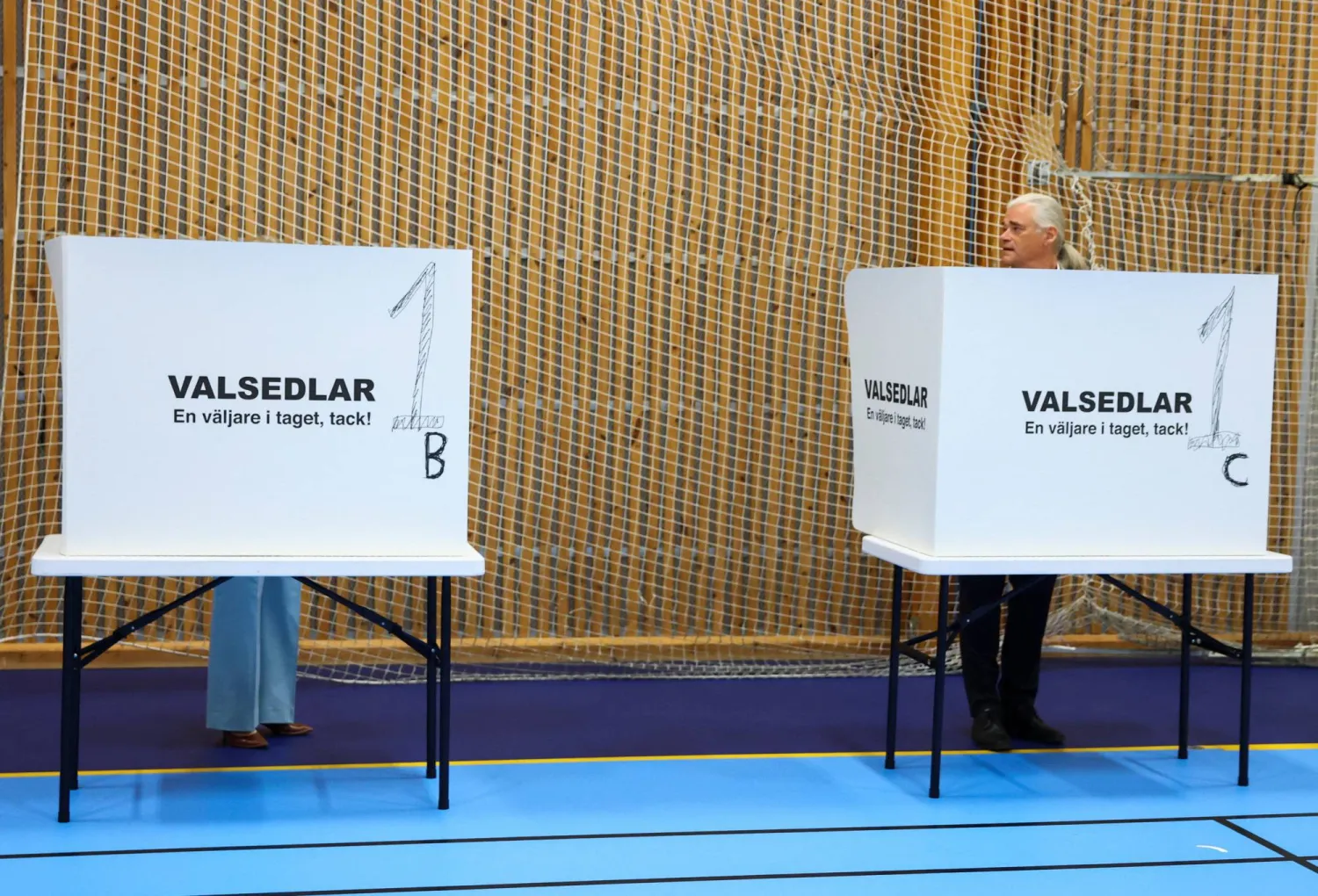
Swedish Voters Go to Polls to Choose a New Parliament as Hard Right Bids for Role in Government

 Opposition leader and Sweden's Social Democratic Party leader, Magdalena Andersson, and her husband, Richard Friberg, vote during the general election in Nacka, near Stockholm, Sweden, September 13, 2026. (Reuters)
Opposition leader and Sweden's Social Democratic Party leader, Magdalena Andersson, and her husband, Richard Friberg, vote during the general election in Nacka, near Stockholm, Sweden, September 13, 2026. (Reuters)
TT

Swedish Voters Go to Polls to Choose a New Parliament as Hard Right Bids for Role in Government

 Opposition leader and Sweden's Social Democratic Party leader, Magdalena Andersson, and her husband, Richard Friberg, vote during the general election in Nacka, near Stockholm, Sweden, September 13, 2026. (Reuters)
Opposition leader and Sweden's Social Democratic Party leader, Magdalena Andersson, and her husband, Richard Friberg, vote during the general election in Nacka, near Stockholm, Sweden, September 13, 2026. (Reuters)

Voters in Sweden will head to the polls on Sunday for an election that will determine whether a conservative leader remains in charge and a hard-right party wins ministerial jobs for the first time, or whether the center-left returns to power.

Prime Minister Ulf Kristersson is seeking a second four-year term at the helm of the European Union nation that is also NATO’s newest member. Meanwhile, his predecessor hopes to win the job back.

Experts say the campaign has been fragmented and incoherent, with policy questions such as how healthcare should be organized drowned out by questions about which parties will be able to put together a government.

“Crime has come down, inflation has come down. So these topics are not really what people discuss,” said Zeth Isaksson, a sociologist in electoral behavior at Stockholm University and a political scientist at the European University Institute in Florence, Italy. “People discuss who is going to be in government, and that’s what the election is about.”

Kristersson has led Sweden since 2022 with a three-party center-right coalition. It relies on outside support from the Sweden Democrats, an anti-immigration party that has far-right roots but has moved toward the political mainstream, for a parliamentary majority. If the right is reelected, it can expect Cabinet posts this time.

He’s up against Magdalena Andersson of the center-left Social Democrats, a party that more often than not has led Swedish governments since World War II. Andersson served as prime minister from 2021 until she lost power at the last election.

There are two major political blocs: one with four parties on the right and another with four parties on the left. So the big question is less about which party wins and more about which side can form a majority. Individual parties need a minimum of 4% of the vote to win parliamentary seats.

The Sweden Democrats, who in 2022 took 20.5% of the vote to become the biggest party on the right, can expect Cabinet seats if power doesn’t change hands.

Kristersson announced in April that his conservative Moderates would allow them into government if the right has a majority — though he would remain prime minister even if the Sweden Democrats are the stronger party.

The Sweden Democrats were founded in the 1980s by people who had been active in right-wing extremist groups, including neo-Nazis. They toned down their rhetoric and expelled openly racist members under Jimmie Åkesson, who has led them since 2005 and overseen their growth from what was once a marginal party.

The Sweden Democrats' role is in focus against a background of gains for the populist right in Europe, including the first-place finish by the far-right Alternative for Germany party in a regional election there Sept. 6.

More than 8 million people in the nation of about 10.6 million are eligible to vote in the election for the 349-seat parliament, the Riksdag, which will elect the next prime minister. The Swedish Election Authority says the first preliminary results will be available around 9 p.m. local time (1900 GMT).


Israel Defense Minister Slams Eisenkot’s Call for Military to Resist PM Pressure

Israeli Prime Minister Benjamin Netanyahu and Defense Minister Israel Katz attend a graduation ceremony of new Israeli army officers at a base near Mitzpe Ramon, Israel, October 21, 2026. (Reuters)
TT

Israel Defense Minister Slams Eisenkot’s Call for Military to Resist PM Pressure

Israeli Prime Minister Benjamin Netanyahu and Defense Minister Israel Katz attend a graduation ceremony of new Israeli army officers at a base near Mitzpe Ramon, Israel, October 21, 2026. (Reuters)

Israel's defense minister on Wednesday denounced opposition candidate Gadi Eisenkot for urging the military to resist post-election pressure from Prime Minister Benjamin Netanyahu, who has threatened new strikes on Iran.

"His call to senior military officials not to obey the directives of the prime minister or me or of other relevant security authorities, on the grounds that 'they have his support', is an anti-democratic statement detached from reality," Israel Katz wrote on X.

Eisenkot, a former military chief, in a speech to supporters after Tuesday's election said that Netanyahu was a caretaker prime minister lacking a mandate and that the military should serve the state rather than the premier.

"Stand firm in the face of any attempt to challenge you. You have my unequivocal backing. Netanyahu, do not dare use Israel's security for your political needs," Eisenkot said.

Netanyahu has repeatedly threatened renewed war on Iran, after bombing campaigns backed by the United States last year and again this year.

Media reports, denied by Netanyahu, said that military chief Lieutenant General Eyal Zamir pushed back immediately before the election on the prime minister's new plans on Iran.

Katz said that Eisenkot's comments were the latest in "a campaign of lies" about tensions between Netanyahu and the military over Iran.


Caretaker Role Could Limit Netanyahu but Not Rule Out War with Iran

Israel's Prime Minister Benjamin Netanyahu addresses his supporters at the election night rally after the first exit polls were announced, in Jerusalem on early October 28, 2026, during Israel's legislative elections. (AFP)
TT

Caretaker Role Could Limit Netanyahu but Not Rule Out War with Iran

Israel's Prime Minister Benjamin Netanyahu addresses his supporters at the election night rally after the first exit polls were announced, in Jerusalem on early October 28, 2026, during Israel's legislative elections. (AFP)

Benjamin Netanyahu is expected to face more constraints as Israel's caretaker prime minister after Tuesday's election, but experts say his government could still retain significant powers including when it comes to waging war on Iran.

Neither Netanyahu’s right-wing coalition nor an opposition bloc led by former military chief Gadi Eisenkot is projected by Israeli media ‌to win ‌a majority in the country’s 120-seat legislature. Eisenkot has ‌acknowledged ⁠the prime minister ⁠was still in office as a caretaker but issued a warning that Netanyahu might use security for political ends.

Netanyahu's office has previously rejected accusations he is using the Iran conflict for political gain. His office did not immediately return a request for comment on Wednesday.

“If you look at the letter of the law, a caretaker government has the ⁠same authority, has the same powers as a regular ‌government,” said Guy Lurie, a research ‌fellow at the Israel Democracy Institute, adding however that a caretaker government “has a duty ‌of restraint” and more limited discretion to act in some areas.

A ‌caretaker government faces limitations when it comes to issues such as appointments, but has leeway to act in matters where there is a public interest, analysts say.

“In general, security issues are the clearest exception to this duty of ‌restraint,” said Or Asher, a researcher at the Tel Aviv-based Tachlith Institute, noting that Israel's supreme court has ⁠previously held ⁠that a caretaker government must avoid far-reaching decisions unless they are justified by a pressing necessity.

“The Supreme Court has historically avoided intervening in decisions to go to war, and parliamentary oversight is at its thinnest in the weeks after the new Knesset convenes and before its committees are formed,” Asher said, adding that “a caretaker prime minister can legally take Israel to war, including against Iran”.

After the final tally is in, Israel’s President Isaac Herzog is expected to consult party leaders and then tap the candidate he believes has the best chance of forming a government, with the nominee then getting up to 42 days to establish a government.


Iran Warns Any Israeli-led Attack Would be 'Devastating' for Global Markets

FILED - 25 September 2026, US, Bronx: FILE PHOTO - Iranian Foreign Minister Abbas Araghchi delivers a statement during a press conference at Security Council encounter at UN Headquarters in New York. Photo: Lev Radin/ZUMA Press Wire/dpa
TT

Iran Warns Any Israeli-led Attack Would be 'Devastating' for Global Markets

FILED - 25 September 2026, US, Bronx: FILE PHOTO - Iranian Foreign Minister Abbas Araghchi delivers a statement during a press conference at Security Council encounter at UN Headquarters in New York. Photo: Lev Radin/ZUMA Press Wire/dpa

Iran's Foreign Minister Abbas Araghchi warned on Wednesday that any Israel-instigated attack would have a "devastating impact" on global markets.

"Devastating impact on int'l markets of any Israel-instigated military misadventure” in the Arabian Gulf region “remains major concern for both gas suppliers and consumers," Araghchi said in a post on X.

His post came as Qatari mediators presented Iran with a new draft deal on Sunday to end the war with the US and Israel, and Tehran is expected to send a response to the draft by the end of the week, an official briefed on the negotiations said on Wednesday.

The new draft being considered by Iran sets a seven-day timeline addressing both Tehran's and Washington's concerns, laying out daily confidence-building ⁠steps that each ⁠side must take, the official said.

The timeline could begin early next week and several countries would act as guarantors of the deal, the official added.

Qatar, along with Pakistan, has led mediation to end the war that the ⁠US and Israel launched in February. The conflict has disrupted global shipping and oil supplies and spilled over across other parts of the Middle East.