


Universities Slam Belgian Refusal to Evacuate Gaza Students

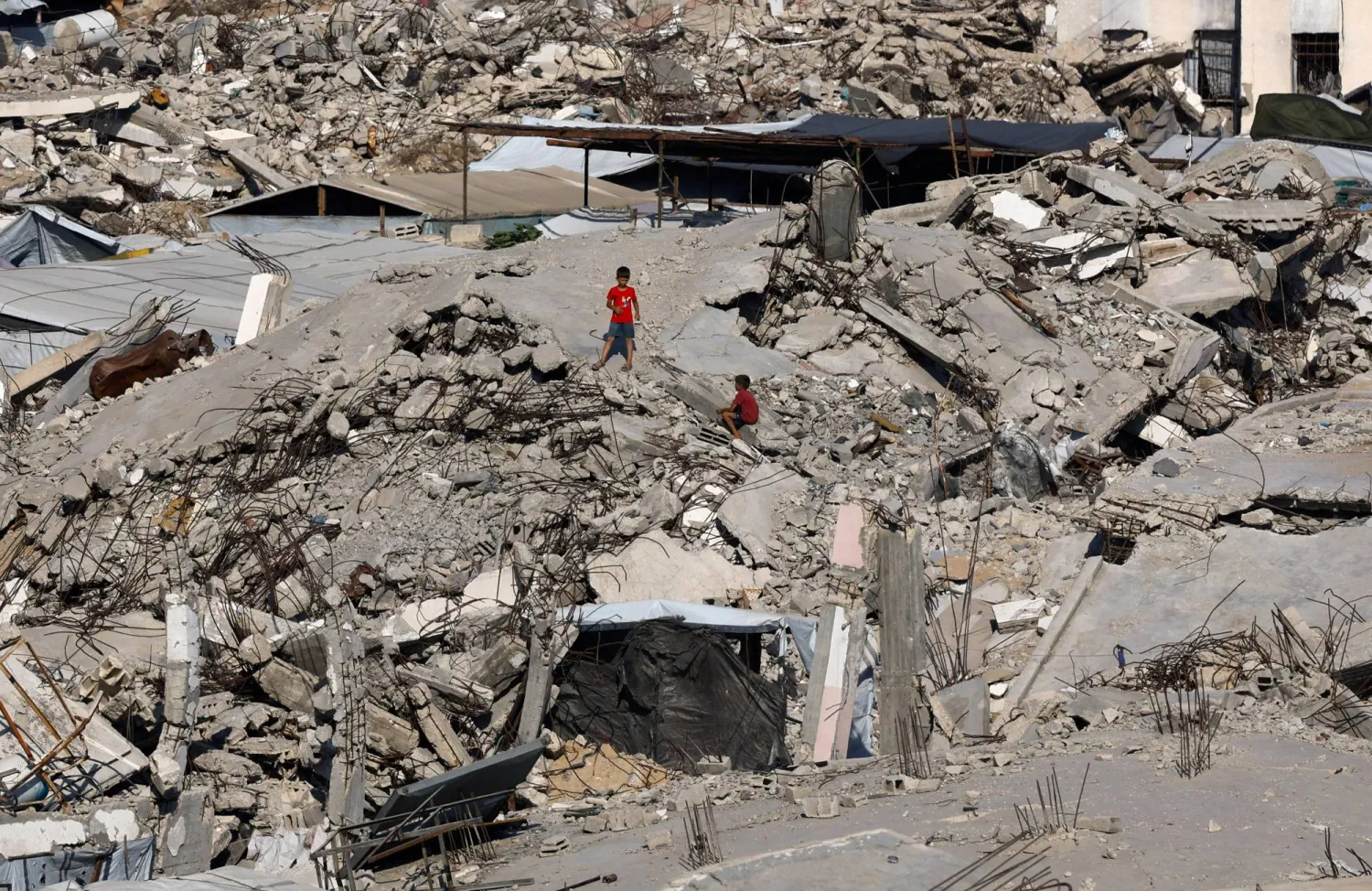
Young Palestinians amid the rubble of buildings destroyed during the war, at Jabalia refugee camp in the northern Gaza Strip, August 5, 2026. (Reuters)
TT

Universities Slam Belgian Refusal to Evacuate Gaza Students

Young Palestinians amid the rubble of buildings destroyed during the war, at Jabalia refugee camp in the northern Gaza Strip, August 5, 2026. (Reuters)

Belgium's top universities condemned on Monday the government's refusal to help 13 students from war-torn Gaza who received scholarships at Belgian universities reach the country.

Brussels set aside plans to evacuate the Palestinian students last week in a case that has split the coalition government.

The rectors of the European country's top 10 universities expressed their "dismay" at the move in a letter, accusing the administration of using the students as "bargaining chips" in a "disgraceful political horse-trading".

Centrist Foreign Minister Maxime Prevot has advocated in favor of evacuating the students but has faced opposition from the Flemish conservatives party of Prime Minister Bart De Wever, according to a government source.

Prevot said one member of the five-party coalition demanded concessions on migration, including the creation of deportation centers, in return for greenlighting the evacuations.

"They must not be treated as bargaining chips or as variables to be adjusted in political debates on migration," the rectors wrote of the Gaza students.

"Their cases must be assessed for what they are: those of students and researchers who have been awarded scholarships on the basis of their academic merit and who have all expressed their intention to return to their home countries to contribute to their reconstruction."

The students are among about 1,500 Palestinians in Gaza currently waiting to reach Belgium, having been granted the right to do so, mainly under family reunification rules, according to several NGOs.

Yet, evacuations from the Palestinian territory at war with Israel are proceeding at a trickle, with activists and now the universities accusing the government of deliberately slowing down the process.

"Discussions in recent weeks also show that the obstacles cited do not stem from insurmountable constraints but rather from a lack of political will," the university chiefs wrote.

The case is not isolated, with Palestinian students hoping to study in Italy, Türkiye, the Netherlands, Germany also reporting delays in recent months.

Palestinian group Hamas launched an attack on Israel on October 7, 2023, which killed 1,221 people, according to official Israeli figures.

Israel's offensive has since claimed at least 73,470 lives in Gaza, according to the Gaza health ministry, which operates under Hamas.



Trump Says Ukraine, Russia Agree Not to Hit Energy Targets

A rescuer works at a site of an apartment building damaged during a Russian air strike, amid Russia's attack on Ukraine, in the frontline city of Kramatorsk, Ukraine September 13, 2026. (Reuters)
TT

Trump Says Ukraine, Russia Agree Not to Hit Energy Targets

A rescuer works at a site of an apartment building damaged during a Russian air strike, amid Russia's attack on Ukraine, in the frontline city of Kramatorsk, Ukraine September 13, 2026. (Reuters)

US President Donald Trump said Monday that Ukraine and Russia had agreed not to target each other's energy facilities, a day after he chastised Kyiv for hitting Russian oil refineries.

"Ukraine has agreed not to hit Russian Energy targets. Russia has agreed to do, likewise!" Trump said on his Truth Social network.

"The World's Diesel price rise is mostly caused by the Russia/Ukraine War, not Iran."

There was no immediate confirmation from Kyiv or Moscow of any deal.

Trump's claim comes as oil prices continue to soar in the seventh month of the Iran war, raising American fuel costs and inflation just weeks before crunch US midterm elections.

The US leader has insisted that the Iran war will finish immediately after the midterms and gas prices will drop, but has in the meantime apparently found a new target to blame for the cost at the pump.

Trump had lashed out at Ukraine's President Volodymyr Zelensky during a trip to Ireland on Sunday, saying he had to do "one thing" and "stop knocking out diesel fuel" refineries in Russia due to growing shortages.

"Let him go after targets, but not diesel fuel, because he's causing a shortage of diesel," Trump said, again insisting the Russia-Ukraine war -- not the US-Israel conflict with Iran -- was to blame.

Trump added he had spoken to Ukraine's leader about the country's stepped-up attacks on such sites over recent months.

"There are plenty of other targets. Don't hit diesel fuel because that's hurting. That's hurting the world. We don't want him to hit diesel fuel... He's hitting diesel refineries."

Ukraine has hit numerous Russian oil refineries far from its border with Russia, while Moscow has also intensified its long-range attacks in recent months, leading to a jump in civilian deaths.

Kyiv has been firing record numbers of drones at Russia, while Moscow has been launching all-time high missile attacks.

Trump said last week he had a "great conversation" with Russian President Vladimir Putin, insisting that Putin wanted to make a deal to end Moscow's war on Ukraine.

Putin "is wanting to make a deal, and if Zelensky is wanting to make a deal, that'd be very nice," Trump told reporters on Wednesday.

Zelensky said last week he would be willing to meet Putin at the G20 summit at Trump's own Doral resort in Miami in December, but the Kremlin immediately ruled it out.


China’s Wang Urges EU to Avoid Escalating Trade Disputes

08 March 2026, China, Beijing: Wang Yi, China's Foreign Minister, addresses journalists at a press conference on the sidelines of the National People's Congress. (dpa)
TT

China’s Wang Urges EU to Avoid Escalating Trade Disputes

08 March 2026, China, Beijing: Wang Yi, China's Foreign Minister, addresses journalists at a press conference on the sidelines of the National People's Congress. (dpa)

China's foreign minister on Monday urged the European Union to engage in "constructive dialogue" in order to avoid escalating trade disputes during a phone call with his French counterpart, state media said.

The EU and several European countries, including France, have toughened their stance towards Beijing to protect their businesses from what they deem unfair competition in areas including corporate acquisitions, public procurement and electric vehicles.

Beijing frequently denounces such measures as the politicization of trade, disguised protectionism or even discriminatory actions aimed at curbing Chinese companies.

China and Europe "must resolve trade frictions appropriately through constructive dialogue to avoid an escalation of confrontation", Wang Yi told Jean-Noel Barrot, according to China's Xinhua state news agency.

"Protectionism will not strengthen European competitiveness. On the contrary, it will deprive consumers of quality products at favorable prices, fuel inflation and hinder the green transition," Xinhua quoted Wang as saying.

Pointing out that China is one of the world's largest markets, Wang said "its development represents an opportunity for the EU, not a challenge," adding that he hoped Paris would encourage Brussels "to move forward in concert" with Beijing.

Wang also reiterated China's position on Taiwan, the self-ruled island that China regards as part of its territory.

He said he hoped French authorities would "refrain from any form of official exchange with Taiwan and send no wrong signals to Taiwanese pro-independence forces".

French lawmakers have made several visits to the island in recent months, during which they met President Lai Ching-te and other leaders.


UN Calls for ‘Urgent Action’ to Rein in AI in Face of ‘Unprecedented Risks’

UN High commissioner for Human Rights Volker Turk looks on during the 63rd session of United Nations (UN) Human Rights Council, in Geneva, on September 7, 2026. (AFP)
TT

UN Calls for ‘Urgent Action’ to Rein in AI in Face of ‘Unprecedented Risks’

UN High commissioner for Human Rights Volker Turk looks on during the 63rd session of United Nations (UN) Human Rights Council, in Geneva, on September 7, 2026. (AFP)

The United Nations rights chief called Monday for countries and "frontier" artificial intelligence companies to act urgently to rein in a technology he warned posed "unprecedented risks".

In a letter sent to countries and AI developers and shared with the media, Volker Turk cautioned that the world was "on the cusp of irreversible change, affecting not just us but generations of humanity to come".

"The current race towards ever more powerful AI is a step change towards greater existential risks to every aspect of our lives."

"I call on states and companies to mobilize urgently through multilateral fora to chart a path for action to govern advanced, frontier Al models, grounded in international human rights law."

He sent the letter as a fierce debate rages over whether the development of AI should be slowed. US President Donald Trump and key allies have pushed back against calls to slow the development of AI.

A furor erupted this month after a researcher publicly resigned from Anthropic over fears that the technology could escape human control.

Another Anthropic employee, who did not resign, stated publicly that "we really do earnestly believe AI could kill all humans", and that he thought the chances were greater than "10 percent within the next decade".

Amid the outcry, Anthropic CEO Dario Amodei called Saturday for AI companies to "pace the frontier" -- or coordinate a slowdown in the technology's development, with his chief competitors, xAI's Elon Musk and OpenAI's Sam Altman, publicly supporting him.

The UN rights office said those companies were among 10 AI developers, also including Meta, Microsoft and Google, who received Turk's letter.

- AI 'accelerating' warfare -

"In today's world, we are almost entirely reliant on a small number of powerful companies to make the right choices on Al development for all of humanity," the rights chief wrote.

"Industry co-regulation is an urgently needed first step, but on its own, it is nowhere near sufficient," he said.

The rights chief warned of the "unprecedented risks" posed by the emergence of increasingly capable AI agents.

"Entire populations could be cut off from clean water, heating, and financial services, and agentic AI is already accelerating the pace and reach of warfare and eroding safeguards that stand between us and the launch of weapons of mass destruction," he said.

"The companies that are at the forefront of developing frontier Al, based mainly in the People's Republic of China and in the United States of America, have both the responsibility and the ability to move immediately to reduce risks," Turk said.

He stressed though the need for international cooperation, insisting that "no country can govern this technology alone (and) no company should be able to decide by itself which risks the world must accept".

"No person should be required to surrender their human rights in exchange for claims of technological progress."