Russia Strikes Kyiv, Other Cities Hours after US Sanctions Passed

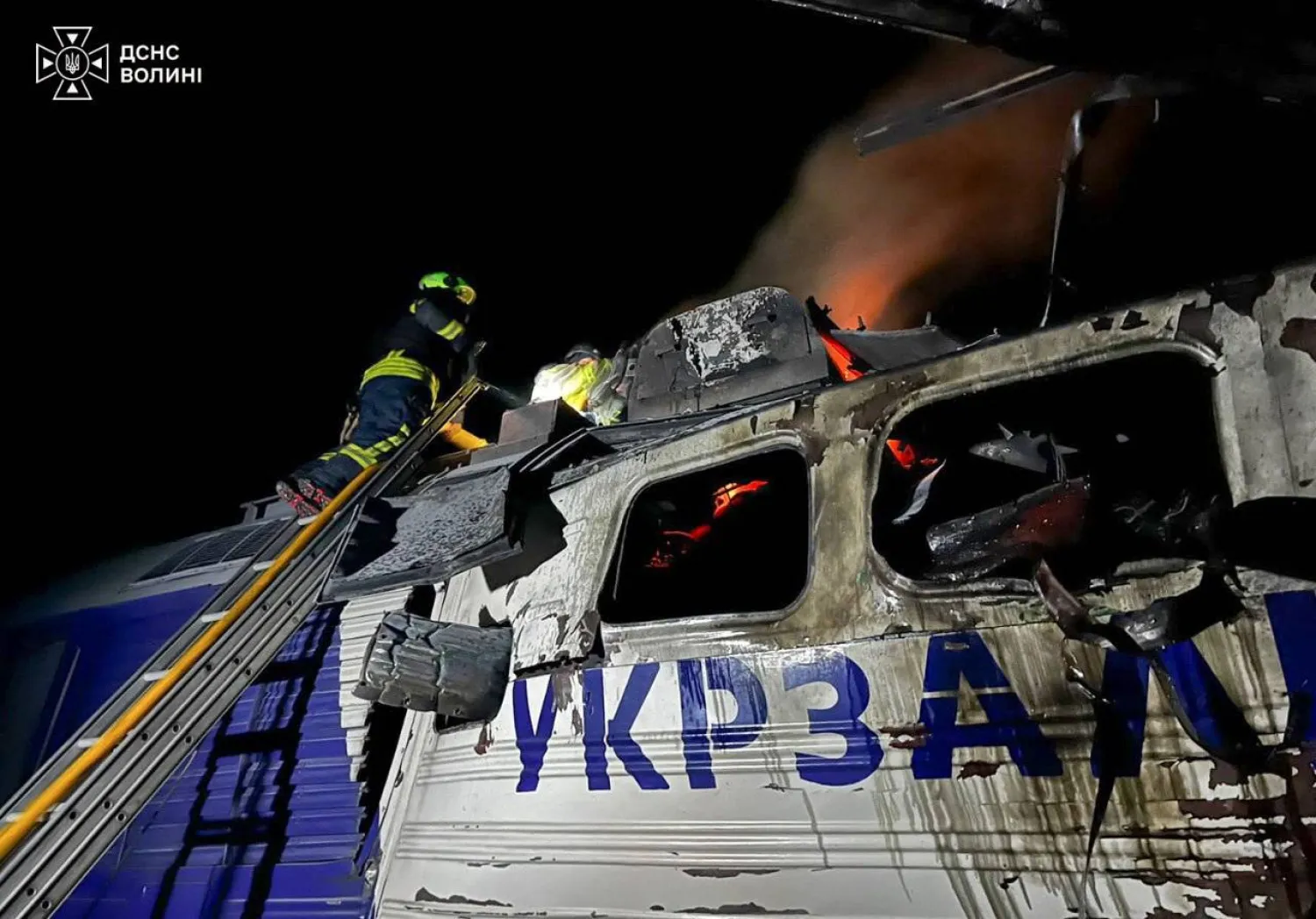
A handout picture taken and released by Ukrainian State Emergency Service on September 15, 2026 shows firefighters extinguishing a fire in a train locomotive after it was targeted by a Russian drone in the Volyn region, amid the Russian invasion of Ukraine. (Photo by Handout / Ukrainian State Emergency Service / AFP)
TT

Russia Strikes Kyiv, Other Cities Hours after US Sanctions Passed

A handout picture taken and released by Ukrainian State Emergency Service on September 15, 2026 shows firefighters extinguishing a fire in a train locomotive after it was targeted by a Russian drone in the Volyn region, amid the Russian invasion of Ukraine. (Photo by Handout / Ukrainian State Emergency Service / AFP)

Russia battered the Ukrainian capital Kyiv and other cities with missiles and drones overnight, injuring more than two dozen people, officials said on Thursday, hours after the US Congress approved a major sanctions bill targeting Moscow. 

The US House of Representatives on Wednesday passed the sweeping sanctions and tariff legislation, championed by late Senator Lindsey Graham, designed to tighten the economic squeeze on Russia over its invasion of Ukraine. The bill has now been sent to President Donald Trump to sign into law, Reuters said. 

Ukrainian President Volodymyr Zelenskiy welcomed the passage of the bill, calling it, alongside existing measures, an "extremely powerful tool" that could help force Russia to end a war now entering its fifth year. 

"It ‌is symbolic that ‌the US House of Representatives passed the Lindsey Graham Sanctioning Russia ‌and ⁠Iran Act on ⁠the night of yet another Russian attack on Ukraine with ballistic and other missiles and drones," Zelenskiy said. 

Moscow has escalated its air attacks in recent months on Ukraine, which runs critically low on US-designed interceptors needed to down ballistic missiles. 

The overnight barrage included Oniks anti-ship cruise missiles, ballistic missiles, four cruise missiles and nearly 160 drones, Ukraine's air force said on Thursday. 

It did not specify the number and whether any of the more deadly ballistic missiles were intercepted. 

Zelenskiy said ⁠tougher sanctions were essential to force Russia to return to the ‌negotiating table, after US-backed peace talks unraveled earlier this ‌year. 

"Sanctions must be strong so that all efforts for peace – including our joint diplomatic efforts with the ‌United States, Europe, and our other friends – can succeed," he said. 

DAMAGE IN EIGHT REGIONS 

Zelenskiy ‌said damage was recorded in eight regions across Ukraine, with Moscow hitting energy infrastructure in the Sumy and Odesa regions. 

Russian defense ministry said Moscow had struck vessels used by the Ukrainian military. 

In Kyiv, the wail of air raid alerts and boom of air defenses sounded through the night. Explosions were ‌heard on Thursday morning as an attack with jet-powered drones continued. 

Kyiv Mayor Vitali Klitschko said 18 people, including two children, were wounded ⁠in the city. 

Most of ⁠them where in a damaged 16-storey apartment building, officials said. Damage was recorded in four city districts, including warehouse facilities, and petrol stations, which are now a frequent target of attacks. 

The strike also temporarily disrupted water supply on the left bank of the Dnipro river. 

Six people, including two children, were wounded in the Black Sea port of Odesa, where the attack damaged a 19-storey apartment building, residential buildings and other sites, officials said. 

Three others were wounded in the southeastern city of Zaporizhzhia where a missile strike hit industrial facilities, triggering fire at one of them, authorities there said on Telegram. 

Ukraine has also increased its attacks on Russia, targeting oil facilities and logistics infrastructure to try to undermine Moscow's ability to wage war. 

A Ukrainian drone attack damaged an oil refinery in the Russian city of Yaroslavl, causing a fire that was later doused, the region's governor said on Thursday.


At Least Two Dead as Floods Hit Eastern Spain

Parked cars are half-submerged in a flooded park area after heavy rainfall that hit the area early in the morning, in the town of Algeciras, southern Spain, 18 October 2026. (EPA)
TT

At Least Two Dead as Floods Hit Eastern Spain

Parked cars are half-submerged in a flooded park area after heavy rainfall that hit the area early in the morning, in the town of Algeciras, southern Spain, 18 October 2026. (EPA)

At least two people have died after heavy rain triggered flooding in eastern Spain, authorities said Monday, as rescuers worked to evacuate stranded residents and officials urged people in the Valencia region to stay indoors.

Videos released by Valencia's regional meteorological agency showed streets turned into torrents, sweeping away vehicles in several towns in the provinces of Valencia and Alicante.

"Road travel is impossible, you must stay at home," Juan Carlos Valderrama, the Valencia region's emergency chief, said on Monday morning, warning that intense and persistent rainfall was causing severe flooding.

One person died in Sagunto, local authorities said overnight from Sunday to Monday, while firefighters in neighboring Catalonia reported the death of a woman who fell into a stream.

Emergency services and soldiers from Spain's military emergency response unit were working early on Monday to evacuate people whose homes had flooded, including residents who had taken refuge on rooftops.

"Rescue operations are continuing in areas that are difficult to access. People are urged to avoid all travel," Prime Minister Pedro Sanchez said on X, describing the situation in the Valencia region as "very difficult".

Scientists say human-driven climate change is intensifying the Mediterranean storms that typically hit eastern Spain in autumn as the sea absorbs heat during the summer, leading to increased evaporation and heavier rainfall.

National weather agency AEMET announced Friday that last month was mainland Spain's hottest September on record, after the country registered its warmest summer between June and August.


Nations Seek Reset at UN Talks as Nature Goals off Track

Armenia is hosting the UN COP17 biodiversity talks in its capital Yerevan. KAREN MINASYAN / AFP
TT

Nations Seek Reset at UN Talks as Nature Goals off Track

Armenia is hosting the UN COP17 biodiversity talks in its capital Yerevan. KAREN MINASYAN / AFP

Nearly 200 nations are gathering in Armenia on Monday for critical negotiations as governments come under pressure to salvage a landmark nature pact whose goals are slipping out of reach.

Most countries joined a historic call four years ago to halt and reverse the destruction of nature by 2030 but governments have been slow to act on these pledges, said AFP.

Many goals of the so-called "Paris Agreement for Nature" are falling behind, including a centerpiece commitment to protect 30 percent of Earth's land and oceans.

Some of the toughest objectives of the pact, such as cutting subsidies for fossil fuels and other powerful industries, have made little progress.

"We must honestly admit that collectively, we are not yet on track as needed," Armenia's Prime Minister Nikol Pashinyan said Friday ahead of the formal UN negotiations known as COP17.

The summit comes at a difficult time, with public finances under strain and political attention fixed on conflicts, geopolitical tensions and a global energy crisis.

Only a handful of world leaders, including UN chief Antonio Guterres but mostly heads of state from nearby Central Asian nations, turned up for a high-level session ahead of the formal negotiations.

But the stakes could not be higher, Guterres said at the event on Friday, describing an unrelenting "war on nature" that threatened the very livability of the planet for future generations.

"We need more action, more speed and more will," he said.

"Halfway to 2030, Yerevan is our moment of accountability. It is time to ask ourselves -- are we doing enough?"

- Falling short -

A United Nations scorecard issued ahead of COP17 reported that progress toward the 23 biodiversity targets was being made -- but unevenly, and not at pace to meet the 2030 deadline.

A major tension at the summit will be money, with the report finding that the effort to close a yawning gap in necessary finance "falls far short" of what is needed.

European and other wealthy nations obligated to provide biodiversity finance have been pushing for large emerging economies like China to also contribute.

But attention is likely to focus more on how private capital, not public finances, might help plug the shortfall.

A key priority will be encouraging corporations to donate a share of profits to a near-empty UN fund to support conservation in developing countries.

Guterres also fixed the spotlight on state incentives for extractive industries, scolding governments for "spending money on the wrong things" despite pledging to reform harmful subsidies.

"Subsidizing fossil fuels is subsidizing suicide," said Guterres of the coal, oil and gas that are "boiling our planet and are the scourge of biodiversity".

For the mountainous Caucasus nation of Armenia, the summit is one of the largest international events it has ever hosted, with thousands of visitors expected over the next two weeks.

The hosts have stressed that action -- not new pledges -- would define success at COP17.

"The world does not need a new vision. We have one. What it needs is delivery," Adil Najam, global president of WWF International, said Friday.


Russian FM to Visit Iran as Moscow Looks to Mediate in War

 Russia's Foreign Minister Sergei Lavrov speaks during a joint press conference with Bahrain's foreign minister and the Gulf Cooperation Council (GCC) secretary-general after the 9th Joint Ministerial Meeting of the Strategic Dialogue between GCC and the Russian Federation in Manama on October 18, 2026. (AFP)
Russia's Foreign Minister Sergei Lavrov speaks during a joint press conference with Bahrain's foreign minister and the Gulf Cooperation Council (GCC) secretary-general after the 9th Joint Ministerial Meeting of the Strategic Dialogue between GCC and the Russian Federation in Manama on October 18, 2026. (AFP)
TT

Russian FM to Visit Iran as Moscow Looks to Mediate in War

 Russia's Foreign Minister Sergei Lavrov speaks during a joint press conference with Bahrain's foreign minister and the Gulf Cooperation Council (GCC) secretary-general after the 9th Joint Ministerial Meeting of the Strategic Dialogue between GCC and the Russian Federation in Manama on October 18, 2026. (AFP)
Russia's Foreign Minister Sergei Lavrov speaks during a joint press conference with Bahrain's foreign minister and the Gulf Cooperation Council (GCC) secretary-general after the 9th Joint Ministerial Meeting of the Strategic Dialogue between GCC and the Russian Federation in Manama on October 18, 2026. (AFP)

Russian Foreign Minister Sergei Lavrov was due to arrive in Iran on Monday in his first visit since the outbreak of the Middle East war, as Russia seeks to play a mediating role.

Iranian foreign ministry spokesman Esmaeil Baqaei confirmed the trip on Sunday, saying in a statement that the two sides will discuss "regional and international developments".

Lavrov, who is scheduled to meet with Iranian Foreign Minister Abbas Araghchi, said Moscow's efforts are "aimed at preventing the return of a large-scale war", with talks stalled between Tehran and Washington.

The visit comes after Russian President Vladimir Putin told his Iranian counterpart Masoud Pezeshkian in early October that Moscow was prepared to contribute to mediation efforts.

Russia and Iran, two of the most heavily sanctioned nations in the world, maintain close ties. Their military and economic cooperation has only increased since the Russian invasion of Ukraine in 2022.

The Middle East war began in February with US-Israeli strikes on Iran.

Despite a ceasefire in April, followed by a US-Iran memorandum of understanding in June, hostilities in and around the Strait of Hormuz have not stopped.

Iran claims control over the strategic waterway -- through which one-fifth of the world's hydrocarbons pass in normal times -- and regularly targets vessels that cross without its authorization.

In response, Washington has been maintaining a naval counter-blockade on Iranian ports.

Russia's foreign ministry said discussions during Lavrov's visit were expected to focus on "ways to resolve the acute international crisis triggered by the unlawful aggression of the US and Israel against Iran".

The ministry said the war had been a blow to stability and security "not only in the near and Middle East, but also on a global scale".