Russia Holds Parliamentary Vote in Areas it Seized from Ukraine in the War

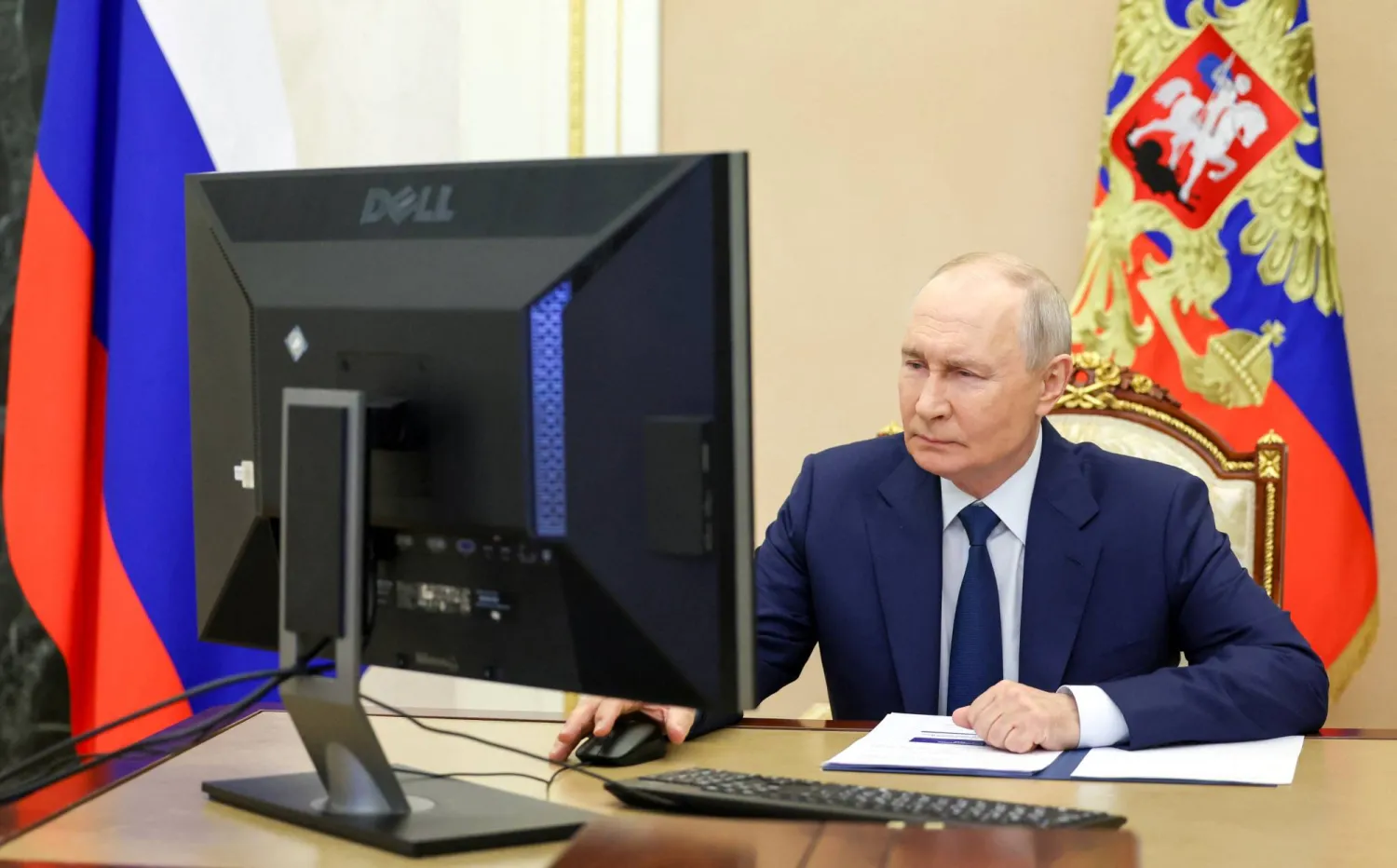
Russian President Vladimir Putin votes online in the parliamentary election in Moscow, Russia, September 18, 2026. Sputnik/Vyacheslav Prokofiev/Pool via REUTERS
TT

Russia Holds Parliamentary Vote in Areas it Seized from Ukraine in the War

Russian President Vladimir Putin votes online in the parliamentary election in Moscow, Russia, September 18, 2026. Sputnik/Vyacheslav Prokofiev/Pool via REUTERS

Russia’s parliamentary election for the first time includes residents of regions that Moscow illegally annexed from Ukraine after the start of its full-scale invasion more than 4 1/2 years ago, part of Kremlin efforts to cement its gains.

Officials in Kyiv vigorously denounced the action as illegal, and a human rights activist described residents there as being coerced to participate in the election, The Associated Press said.

While the vote across Russia started Friday and lasts until Sunday to help boost turnout, balloting actually has been underway in the annexed parts of Ukraine and some areas on the Russian side of the border since the end of last month. Officials cited security reasons for the extended period.

Russian authorities say the Donetsk, Luhansk, Kherson and Zaporizhzhia territories, often referred to by Moscow officials as the “new regions,” have over 3.5 million voters. They were annexed by Russia in September 2022, despite not fully being under Moscow's control. The move has not been recognized internationally.

At one polling station in the Russian-held part of the Donetsk region, voters dropped their ballots in a box as an armed Russian soldier stood nearby and watched.

Putin stressed the importance of voting in the regions

In a speech Wednesday, Russian President Vladimir Putin emphasized the importance of balloting in those regions for the State Duma, the lower house of parliament. Residents there will be voting for the Duma “for the first time since their reunification with Russia.”

He noted that Russian soldiers involved in the fighting also will vote.

Voting also is taking place in Crimea, the Black Sea peninsula that was illegally annexed by Moscow in 2014.

The first wartime election to the State Duma is intended to secure the Kremlin’s political dominance and showcase public support for the war.

“Your choice and resolve will once again demonstrate that millions of people stand behind our fighters, that we are a united people, bound by shared values, historical memory, and love for the Motherland and that nobody can divide or intimidate us, undermine our statehood and political system,” Putin said.

Ukraine urges other countries not to recognize the vote

Authorities in Kyiv called the voting in those territories illegal and urged foreign governments and international organizations not to recognize the election. They warned Ukrainians that taking part in organizing the vote could carry criminal liability.

A coalition of nine Ukrainian human rights groups called on residents of the Russia-held territories to stay away from the polls.

“We urge residents of the temporarily occupied territories, above all, to protect their lives and health and to look after their own safety,” the coalition said in a statement. “Holding Russian elections in the temporarily occupied territories is an attempt to use the electoral process to legitimize the Russian occupation and the attempted annexation of Ukrainian territories.”

European Commission spokesperson Christian Wigand said the voting in Russian-held regions represented "another blatant violation of international law. The European Union does not, and will never recognize either the holding of these, so-called elections, sham elections, in the temporarily occupied territories of Ukraine or their results.”

Activists describe coercion to vote

Violeta Artemchuk, coordinator of the Donbas SOS human rights group who was among those who signed the statement, said members of local election commissions were going house to house, escorted by Russian troops and security agents, to force people to vote.

Moscow-appointed authorities exert pressure on residents, threatening those who work in the public sector with dismissal if they fail to vote and making pensions and other social payments conditional on participating, Artemchuk said.

“For instance, if a person with a disability or a pensioner relies on social assistance and does not take part in the ‘voting,’ they could be added to a list of individuals deemed ‘disloyal’ to the so-called authorities and subsequently deprived of their benefits or humanitarian assistance,” she said.

Volodymyr Fesenko, a political analyst with the Kyiv-based Penta Center, emphasized that "elections held at gunpoint are a farce.”

“The very fact that voting takes place amid endless shelling and bombing reflects the Kremlin’s attitude toward the people and the electoral process in the occupied territories," Fesenko told The Associated Press.

"It’s nothing short of a mockery. Any electoral procedures conducted by the Russian occupation authorities have nothing to do with democracy,” he said.


Gunmen Kill Two Police Officers Escorting Polio Workers in Pakistan

FILED - 28 February 2026, Afghanistan, Torkham: FILE PHOTO - A Taliban fighter checks his weapon next to an armoured vehicle at a checkpoint near Torkham border crossing between Pakistan and Afghanistan. Photo: Sami Jan/dpa
TT

Gunmen Kill Two Police Officers Escorting Polio Workers in Pakistan

FILED - 28 February 2026, Afghanistan, Torkham: FILE PHOTO - A Taliban fighter checks his weapon next to an armoured vehicle at a checkpoint near Torkham border crossing between Pakistan and Afghanistan. Photo: Sami Jan/dpa

Gunmen attacked a police vehicle assigned to protect a polio vaccination team, killing two officers and wounding another in Pakistan's northwest Khyber Pakhtunkhwa province on Tuesday, a police official told AFP.

Militants opened fire on the officers' vehicle while it was travelling near the Afghan border in Mohmand district, police official Ali Rehman Khan said, without specifying which group they believed was behind the attack.

"Two police personnel were martyred and another was injured in the attack. However, no polio vaccination staff were present in the police vehicle," he said.

No group immediately claimed responsibility for the shooting in the border province where security forces are battling an intensifying militancy they say emanates from Afghanistan -- an accusation its Taliban government denies.

In a separate incident in Khyber Pakhtunkhwa's Tank district, four police officers on their way to provide security for a polio vaccination team were abducted on Monday and efforts were underway to recover them, district police official Abdul Samad told AFP.

Pakistan is one of two countries, along with Afghanistan, where polio remains endemic, but militants have killed hundreds of police officers and health workers over the past decade as part of a campaign against the Pakistani state.

Polio, a highly infectious disease mainly affecting children under five, can result in lifelong paralysis but is easily prevented by the oral administration of a few drops of a vaccine.

Misinformation about the vaccine is widespread in rural Pakistan, including false claims that it is part of a CIA plot to prevent Muslims from having children.

Attacks on polio vaccination workers and their police escorts have previously been claimed by the Pakistani Taliban and other militant groups it is linked to.


Spanish Police Dismantle Madrid Housing Protest Camp

Over time, the Sol camp mushroomed into a sprawling warren of tents and tarpaulin. Oscar DEL POZO / AFP
TT

Spanish Police Dismantle Madrid Housing Protest Camp

Over time, the Sol camp mushroomed into a sprawling warren of tents and tarpaulin. Oscar DEL POZO / AFP

Police on Tuesday dismantled a sprawling tent camp in Madrid which had spearheaded protests over Spain's housing crisis for more than a month and prompted early elections, police and activists said.
Officers closed off much of the Spanish capital's emblematic Puerta del Sol square on Tuesday morning as municipal cleaning staff swept away remaining debris, tents and tarpaulin, AFP reporters saw.
The Madrid camp sprang up in September, after Spain's chronic housing crisis burst into the center of public debate following the eviction of an 87-year-old pensioner from her lifelong Madrid home.
The eviction sparked nationwide protests against runaway housing costs and a lack of tenant protections, with tens of thousands of demonstrators hitting the streets.
The Madrid camp has since mushroomed into a sprawling warren of tents and tarpaulin that hosted hundreds of people in a mini-city equipped with a canteen, a clinic and a space for meetings.
On Tuesday, the central government's delegation in the Madrid region said the eviction took place overnight "without incident or episodes of violence", reporting that 334 people were removed and two arrested.
Firefighters, social services and 400 national and municipal police officers took part in the operation, the delegation added.
In a post on Telegram, protest organizers called it "a violent police operation" that left several people injured after being hit or as a result of tear gas.
Flor, a homeless woman who said she had joined the camp from the start, told AFP hundreds of anti-riot police burst into the square in the early hours of the morning.
"They dragged us out, they hit us. They didn't let us take away anything," said the tearful 43-year-old, adding that "all my documents, my phone" had been left behind.
- Housing crisis anger -
After it was set up, Madrid's tent camp was imitated in other cities including Barcelona, Seville and Valencia.
Attempting to placate the public discontent over housing, Socialist Prime Minister Pedro Sanchez's government presented two housing decrees that included curbs on evictions and the automatic renewal of tenant contracts.
But his minority coalition government failed to pass the laws in parliament last month, prompting Sanchez to bring forward to November 29 a general election that was scheduled in 2027.
The Madrid camp sparked tensions between the leftist national government and the conservative-run city and regional authorities, who complained that the protesters were damaging Madrid's image by occupying a central square normally full of tourists and commuters.
Housing costs have soared in Spain in recent years, with rents in Madrid often consuming more than half of the average wage for modest households.
The Bank of Spain estimates the country of around 50 million people is short of 700,000 homes, based on the gap between demand and new construction.
Spain has little public housing, while rents have been driven up by increased demand, including from tourism and population growth linked to immigration, analysts say.
Residents of the most sought-after destinations such as Barcelona also complain that short-term tourist accommodation has dried up supply and driven up prices.


Iran Hangs Two Men Over Involvement in Killing Police Officers

An Iranian woman walks past a portrait of late Iranian supreme leader Ali Khamenei, in a street of Tehran, Iran, 31 October 2026. (EPA)
TT

Iran Hangs Two Men Over Involvement in Killing Police Officers

An Iranian woman walks past a portrait of late Iranian supreme leader Ali Khamenei, in a street of Tehran, Iran, 31 October 2026. (EPA)

Iranian authorities on Tuesday hanged two men after convicting them of involvement in the killing of four police officers during January protests in central Iran, the judiciary said.

"Amirhossein Maleki and Amirhossein Ebrahimi, two armed perpetrators of the January 2026 crime in Isfahan whose brutal and atrocious actions led to the martyrdom of four police officers, were hanged," the judiciary's Mizan Online website reported.

The executions were carried out "after their cases underwent a thorough legal review and their death sentences were upheld by the Supreme Court", following appeals by the defendants, the report said.

A wave of protests erupted in Iran in December over a surge in foreign currency rates and soon escalated into anti-government demonstrations, peaking on January 8 and 9.

Tehran has accused its arch-foes Israel and the United States of fomenting the protests.

According to official figures, more than 3,000 people, including police and security personnel, were killed during the clashes, while rights groups based abroad have cited higher figures.

According to Mizan, the pair "were among the main perpetrators of the crime" and "were armed and present at the scene and had committed multiple criminal acts".

The judiciary said they "were sentenced to death on charges of moharebeh (waging war against God) and corruption on earth, through actions against national security".

In early October, authorities executed Alireza Sepahi and Alireza Raissi for their involvement in the same case.

The number of executions in Iran has surged since the start of the Middle East war, which was started in late February by the United States and Israel.

Amnesty International says Iran carries out more executions than any country except China.