

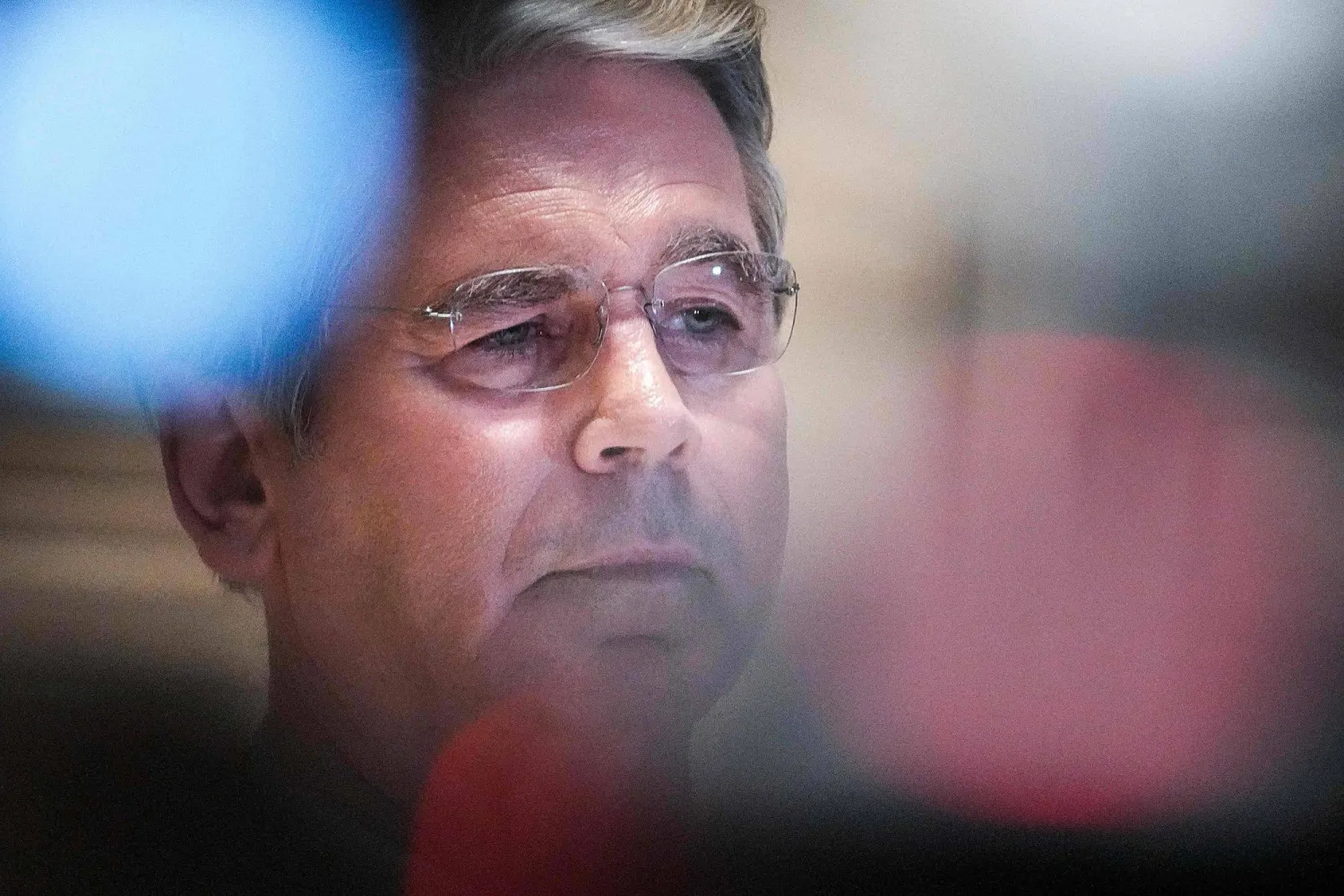

US Treasury Chief Says Iran Airlines to Be ‘Shut Down’ Sept 23

US Treasury Secretary Scott Bessent speaks with the media after meeting with Chinese Vice Premier He Lifeng at JPMorgan Chase headquarters on September 20, 2026, in New York City. (Getty Images/AFP)
TT

US Treasury Chief Says Iran Airlines to Be ‘Shut Down’ Sept 23

US Treasury Secretary Scott Bessent speaks with the media after meeting with Chinese Vice Premier He Lifeng at JPMorgan Chase headquarters on September 20, 2026, in New York City. (Getty Images/AFP)

US Treasury Secretary Scott Bessent warned Monday that Iranian airlines will have trouble functioning globally in two days under the weight of American sanctions, as the Trump administration intensifies pressure on Tehran.

On September 23 "all the Iranian airlines will be shut down around the world," Bessent told CNBC in an interview as the war launched by the United States and Israel nears the seven-month mark.

"If they land, you cannot provide them with fuel, you cannot provide them with landing services, you cannot sell them tickets or you will be knocked out of the dollar system," he added.

The move follows earlier US sanctions on Iran's aviation industry and Bessent's "economic D-Day" threat on Iran and pledge to choke off Tehran financially.

Two Iraqi sources told AFP on Monday that Baghdad would suspend flights by Iranian airlines following the US Treasury's announcement.

Also Monday, Georgia barred Iranian carriers from its land, while Iranian airline Mahan said it suspended service to Türkiye at the request of the Turkish government.

The United States and Iran have been at war since late February, when US-Israeli strikes killed Iran’s supreme leader and senior military officials at the start of a broad offensive.

Tehran countered by blocking the Strait of Hormuz, a vital waterway for energy transit, causing global oil prices to surge as the conflict spread in the Middle East.

Earlier this month, the United States said it imposed sanctions on "all remaining Iranian airlines" that had yet to face such penalties.

The Treasury Department also took aim at targets for supporting Iran's aviation sector, including firms based outside Iran.

Iran's air space was completely shut after the US-Israel alliance launched attacks in late February. Since then, some travel has resumed but only for flights run by Iranian carriers.

Bessent's comments came a day after he met with Chinese Vice Premier He Lifeng for economic talks laying the groundwork for President Donald Trump's summit this Thursday with Chinese leader Xi Jinping.

China is one of Iran's top economic partners and diplomatic backers.

Iran's aviation sector has long grappled with sanctions, which have restricted its ability to acquire aircraft, spare parts and maintenance services.



Washington Mobilizes Allies in the Arctic

US Secretary of State Marco Rubio speaks to members of the media during a signing ceremony on the sidelines of the 81st United Nations General Assembly in New York City, on September 21, 2026. (AFP)
TT

Washington Mobilizes Allies in the Arctic

US Secretary of State Marco Rubio speaks to members of the media during a signing ceremony on the sidelines of the 81st United Nations General Assembly in New York City, on September 21, 2026. (AFP)

US Secretary of State Marco Rubio on Monday stressed the need for investment in the Arctic while meeting with his counterparts from seven countries in the region, on the eve of signing a security agreement on Greenland.

"Allies agreed that Arctic security requires continued investment to safeguard this vital region and deter strategic competitors," State Department spokesman Tommy Piggott said in a readout of the meeting.

"Discussions focused on taking greater responsibility for Arctic security by developing sovereign military and economic capabilities, ensuring investment security, and funding resilient critical infrastructure that ensures reliable access and supports our shared leadership in the Arctic."

The meeting convened top diplomats from Canada, Denmark, Finland, Iceland, Norway, Sweden, the Faroe Islands and Greenland, at a New York hotel on the sidelines of the United Nations General Assembly.

Greenland, Denmark and the United States are due to sign an agreement regarding the Arctic at the UN on Tuesday, the office of Danish Prime Minister Mette Frederiksen said Monday evening.

The agreement was announced Friday by US President Donald Trump, and has not yet been made publicly available.

But Frederiksen said it recognizes the sovereignty and territorial integrity of Denmark, and the right of self-determination for Greenland's people.

Washington said the agreement paves the way to strengthen US military presence in Greenland while ensuring that China and Russia will not be able to establish bases or carry out sensitive investments there without consent.

Monday's discussions also touched on cooperation to develop a fleet of icebreakers between the US, Canada and Finland.

In October, the United States announced the purchase of 11 icebreakers from Finland for the US Coast Guard to add to its fleet of three aging ships.

European Union foreign policy chief Kaja Kallas said recently that Europe needs icebreakers to strengthen its presence in the Arctic, as global warming draws the interest of major powers to the region.

Vast natural resources are becoming increasingly accessible in the Arctic as ice melts and new maritime routes open up due to climate change.

China, Russia and the United States are reinforcing their presence in the strategic Arctic as a result.


UK Joins Call for Limiting UN Security Council Vetoes

11 September 2026, US, New York: A wide view of the UN Security Council chamber during a UN Security Council meeting marking the 25th anniversary of the 11 September 2001 terrorist attacks and examining the evolving global terrorist threat and international efforts to counter terrorism. (dpa)
TT

UK Joins Call for Limiting UN Security Council Vetoes

11 September 2026, US, New York: A wide view of the UN Security Council chamber during a UN Security Council meeting marking the 25th anniversary of the 11 September 2001 terrorist attacks and examining the evolving global terrorist threat and international efforts to counter terrorism. (dpa)

The United Kingdom has signed on to an initiative urging UN Security Council permanent members to withhold their vetoes on matters concerning mass atrocities, such as genocide, countries leading the push said Monday.

The initiative, first proposed by Mexico and France in 2015, now has a total of 128 countries behind it, French foreign minister Jean-Noel Barrot and Mexican counterpart Roberto Velasco said in a joint statement.

It is now just one country shy of reaching a two-thirds threshold of UN member states.

The Security Council has been paralyzed on many issues in recent years amid deep divisions between the five veto-wielding permanent members: France, UK, Russia, China, and the United States.

"By supporting this political declaration, states are demonstrating their commitment to ensuring that the Security Council can fully exercise its primary responsibility for maintaining international peace and security," said Barrot and Velasco.

In May, a diplomatic source told AFP that France was hoping to reach the two-thirds majority before this year's UN General Assembly, which kicks off this week.

Even if adopted with a two-thirds majority, the resolution would be non-binding.

Officials nonetheless hope to make it more politically difficult for a permanent member to use its veto in cases of such dire emergencies.


Eritrean Information Minister Welcomes New Chapter of Cooperation With Washington

Eritrean Information Minister Yemane G. Meskel (X account)
TT

Eritrean Information Minister Welcomes New Chapter of Cooperation With Washington

Eritrean Information Minister Yemane G. Meskel (X account)

Eritrean Information Minister Yemane Gebremeskel welcomed the United States' decision to lift sanctions affecting his country, describing the move as reflecting "a reservoir of constructive political goodwill" and saying it could pave the way for a new chapter in bilateral cooperation, particularly in investment and trade.

In remarks to Asharq Al-Awsat, the minister said the sanctions, which had caused significant economic damage to Eritrea, had sent an important message to the international community.

The United States recently ended the national emergency related to the crisis in Ethiopia, under which sanctions had been imposed on Eritrean entities and individuals over Eritrea's military role in the war in Ethiopia's Tigray region. The conflict ended with a peace agreement in 2022. Washington said the expiration of the emergency reflected changed circumstances underlying the measures.

The US Treasury's Office of Foreign Assets Control subsequently removed from its sanctions list entities and individuals designated under the relevant executive order. These included the People's Front for Democracy and Justice, Eritrea's ruling party, the Eritrean Defense Forces, and the Red Sea Trading Corporation, as well as Eritrean officials.

"Restoring Lost Opportunities"

In his remarks to Asharq Al-Awsat, Gebremeskel said the sanctions that have now been lifted "were not justified by any criteria in the first place and caused significant economic damage."

"Lifting them sends an important message to the international community by removing a political impediment that was not conducive to investment and broader engagement," he said.

He said the details of future cooperation would be determined through appropriate channels and platforms, with a focus on investment and trade.

Asked about the role of Massad Boulos, the US president's senior adviser for Arab and African affairs, Gebremeskel said Boulos had met Eritrean Foreign Minister Osman Saleh on the sidelines of Saleh's recent visit to Cairo.

He said the previous meetings had been "initial discussions to lay the groundwork for broader talks at appropriate levels on comprehensive bilateral cooperation, with a focus on investment and trade," expressing hope that the lifting of the sanctions would accelerate those contacts.

On the immediate implications of lifting the sanctions, he said the move opens "prospects for restoring lost opportunities and moving forward quickly." He said Eritrea has advantages across multiple sectors and is open to investment in areas of mutual benefit, supported by an established legal and administrative framework.

He stressed that "Eritrea's international partnerships have always been based on sustainable ties that enhance mutual and equal benefits, while avoiding imbalanced advantages or structural dependency, principles that have become norms governing bilateral and multilateral cooperation."

Relations With Egypt

On relations with Egypt, he said: "Cooperation with Egypt has developed rapidly over the past decade, not only because of history and geography, but also because the two countries are located in a vital strategic region, particularly along the Red Sea maritime route, and share similar views on mechanisms for cooperation among coastal states to enhance the security of this waterway."

"Eritrea, Egypt, and other like-minded countries in the Horn of Africa and Red Sea region have moved beyond slogans toward mechanisms for joint action to strengthen regional security and stability," he added.

He stressed that "the principles of the Council of Arab and African Coastal States of the Red Sea and Gulf of Aden remain a key platform for multilateral cooperation," alongside convergence in positions on resolving the conflict in Sudan and the situation in Somalia.

On Eritrea's foreign policy priorities for the next phase, he said his country's policy "has always been consistent and transparent, based on building bilateral and multilateral relations within frameworks of equal and mutually beneficial cooperation."

He rejected describing Eritrea as "isolationist," calling the characterization "a false and malicious concept promoted by its critics" that contradicts the country's strategic geographic position, economic potential, and government policies.

"Asmera will seriously seek to capitalize on new diplomatic openings to advance its core national interests," he said.