Argentina Accuses 7 Iranians and a Lebanese Man in 1994 Jewish Center Bombing Case

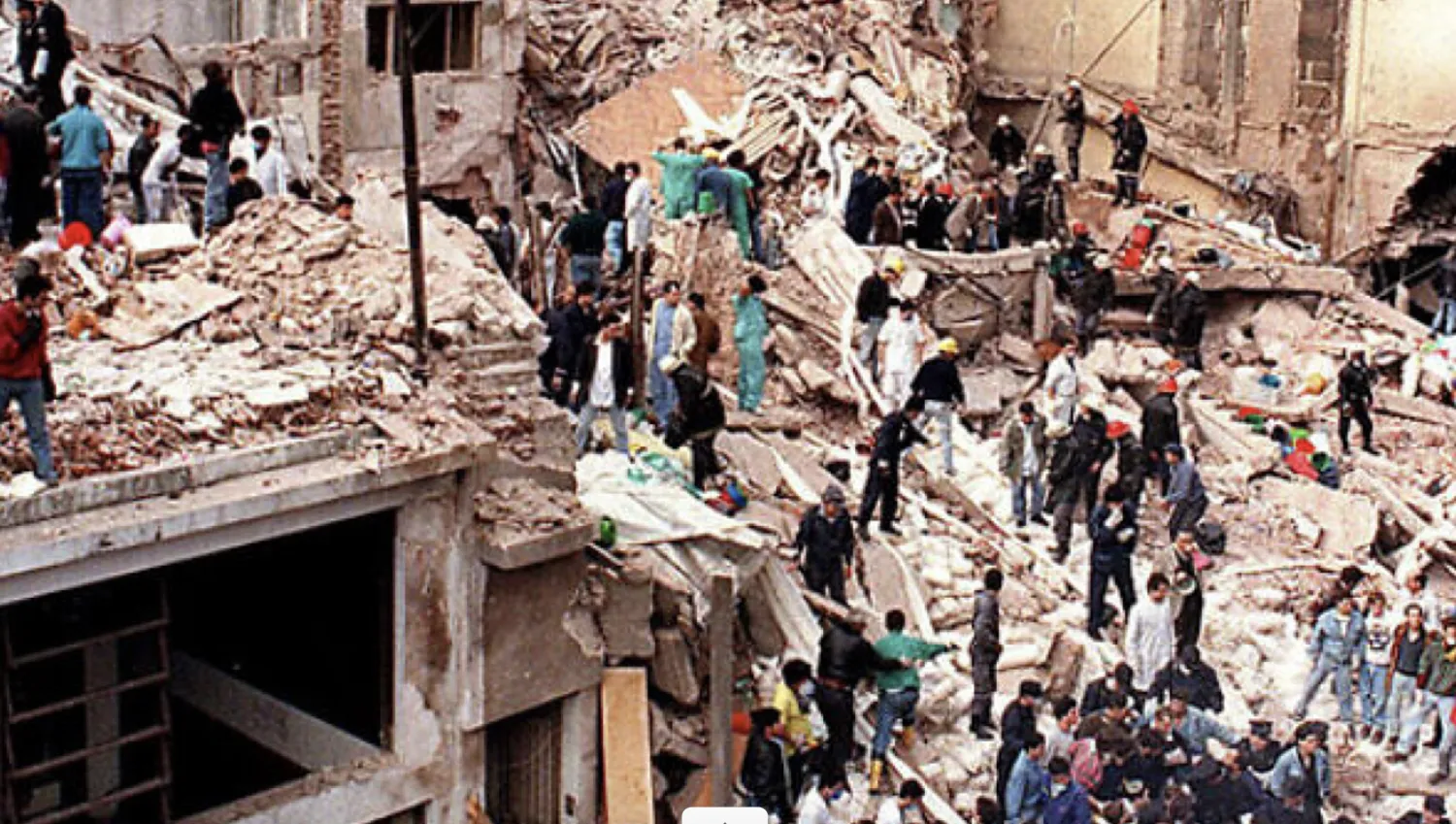
The aftermath of the bombing that targeted a Jewish community center in Buenos Aires (AFP file photo)
TT

Argentina Accuses 7 Iranians and a Lebanese Man in 1994 Jewish Center Bombing Case

The aftermath of the bombing that targeted a Jewish community center in Buenos Aires (AFP file photo)

An Argentine judge on Monday formally charged seven Iranians and a Lebanese citizen for their alleged involvement in the 1994 bombing of a Jewish community center in Buenos Aires.

The decision marks another step toward a possible trial in absentia over the attack on July 18 that year, which killed 85 people and injured 300 more.

No one has ever been arrested over the bombing of the Argentine Israelite Mutual Association (AMIA), which is considered one of the worst tragedies in the South American country's history.

"The decision to carry out the attack was made in August 1993 by the highest echelons of the Iranian regime and entrusted to Hezbollah," Judge Daniel Rafecas wrote in a statement.

Seven of the defendants held high-ranking positions in the Iranian state when the attack occurred.

The Lebanese national was a Hezbollah member.

Two other defendants were removed from the case due to lack of evidence.

A trial is now a real possibility, but the charged individuals may appeal the indictment.

"There's still a whole process to go through," Rafecas told AFP, noting other necessary procedural steps before a trial could happen.

Argentine President Javier Milei, a staunch ally of Israel, celebrated the decision on social media.

"Morality as State Policy," he wrote on X.

Argentina and Israel have long pointed the finger at Iran as the perpetrator of the attack, which Tehran has always denied.

In a move backed by Milei's right-wing administration, Argentine courts authorized the possibility of a trial in absentia last year.

The attack on AMIA occurred just two years after a bomb at the Israeli embassy in Buenos Aires claimed 29 lives.

Monday's ruling suggested that the two incidents could be related. It sought the Argentine Supreme Court's opinion on potentially linking the two cases given Hezbollah's alleged involvement in both.

Argentina is home to Latin America's largest Jewish community.


Democratic 'Blue Wave' Swept Through State Capitals across US

Birds fly in front of the US Capitol at sunrise a day after the US midterm elections. ROBERTO SCHMIDT / AFP
TT

Democratic 'Blue Wave' Swept Through State Capitals across US

Birds fly in front of the US Capitol at sunrise a day after the US midterm elections. ROBERTO SCHMIDT / AFP

The blue wave Democrats rode to retake control of the US Congress this week extended into state-level races, as the party won majorities in a number of legislatures previously held by Republicans.

Democrats secured new trifectas -- control of both chambers of the legislature and the governor's seat -- in at least five states in Tuesday's midterms, flipping at least 11 state legislative chambers from Republican control, according to data from NGO State Navigate late Wednesday.

The victories mean the party will have the power to lead policy decisions on everything from health care to taxation in states such as Texas and Georgia, where they had long taken a backseat.

"Democrats are on track to have their largest net gain in state legislative seats in the 21st century," Chaz Nuttycombe, State Navigate's executive director, told AFP.

"It's not a blue wave; it's a blue cataclysm."

Among the most striking results are in Texas, where Democrats wrested the majority in the state's lower chamber from Republicans for the first time since 2002 while also winning the governorship.

In Georgia, Keisha Lance Bottoms turned the governor's seat blue for the first time in more than two decades, and Democrats similarly flipped control of the legislature's lower chamber.

- Far from Washington gridlock -

President Donald Trump has vowed to use his veto powers to reject legislation from the incoming Democratic Congress, a move that could lead to gridlock at the national level.

Experts have suggested the state-level gains could circumvent that issue.

Democrats this week won complete control of government in five states -- Wisconsin, Michigan, Minnesota, Pennsylvania and Nevada -- and were on the verge of doing the same in Arizona as of early Thursday.

"They won't have to be frustrated by vetoes and Senate filibusters, which are no doubt going to frustrate Democrats at the national level," said Thad Kousser, a professor at the University of California, San Diego, referring to the state Democratic trifectas.

The victories will allow Democrats the freedom to legislate on prominent policy points.

Kousser noted that many of the most pressing issues in voters' lives are now decided at the state level, referencing the 2022 Supreme Court decision ending federal abortion protections and giving states the power to dictate their own abortion laws.

Data centers and artificial intelligence have also emerged as top issues as the Trump administration has shied away from regulatory action.

In Texas, Democratic Governor-elect Gina Hinojosa campaigned on tighter regulations for AI data centers.

"The key issues that matter most for Americans' daily lives are things like education, criminal justice and medical care, and those policies are primarily made by states," Kousser said.

Nuttycombe of State Navigate put it this way: "State governments are much more efficient than Congress and can actually get things done."

"Some of these states haven't had Democratic trifectas in decades; the legislators will feel they have a lot of catching up to do."


Iran Says Two Tankers and Tugboat Caught Fire in Hormuz

FILE PHOTO: Vessels at the Strait of Hormuz, as seen from Musandam, Oman, November 3, 2026. REUTERS/Stringer/File Photo
TT

Iran Says Two Tankers and Tugboat Caught Fire in Hormuz

FILE PHOTO: Vessels at the Strait of Hormuz, as seen from Musandam, Oman, November 3, 2026. REUTERS/Stringer/File Photo

Two oil tankers and a tugboat caught fire in the Strait of Hormuz, Iran's Revolutionary Guards said, according to local media on Thursday.

Since the outbreak of the Iran war on February 28, Tehran has severely restricted traffic through the strategic waterway, which normally carries about one-fifth of global oil consumption.

The United States has in response imposed a blockade on Iranian ports and helped tankers travel the strait.

"Last night, in two separate incidents, a large oil tanker attempting to pass through the illegal passageway south of the Strait of Hormuz suffered a fire after striking a mine and was brought to a halt," the Guards told the Fars news agency.

"Another supertanker was halted by a massive fire while exiting the eastern Strait of Hormuz. A tugboat that had approached the supertanker to extinguish the fire also caught fire."

Fars also reported the IRGC navy's electronic warfare unit had taken control of two LUCAS drones, a US-developed model short for Low-cost Uncrewed Combat Attack System.


France Workers Strike, March for 'Dignified Wage'

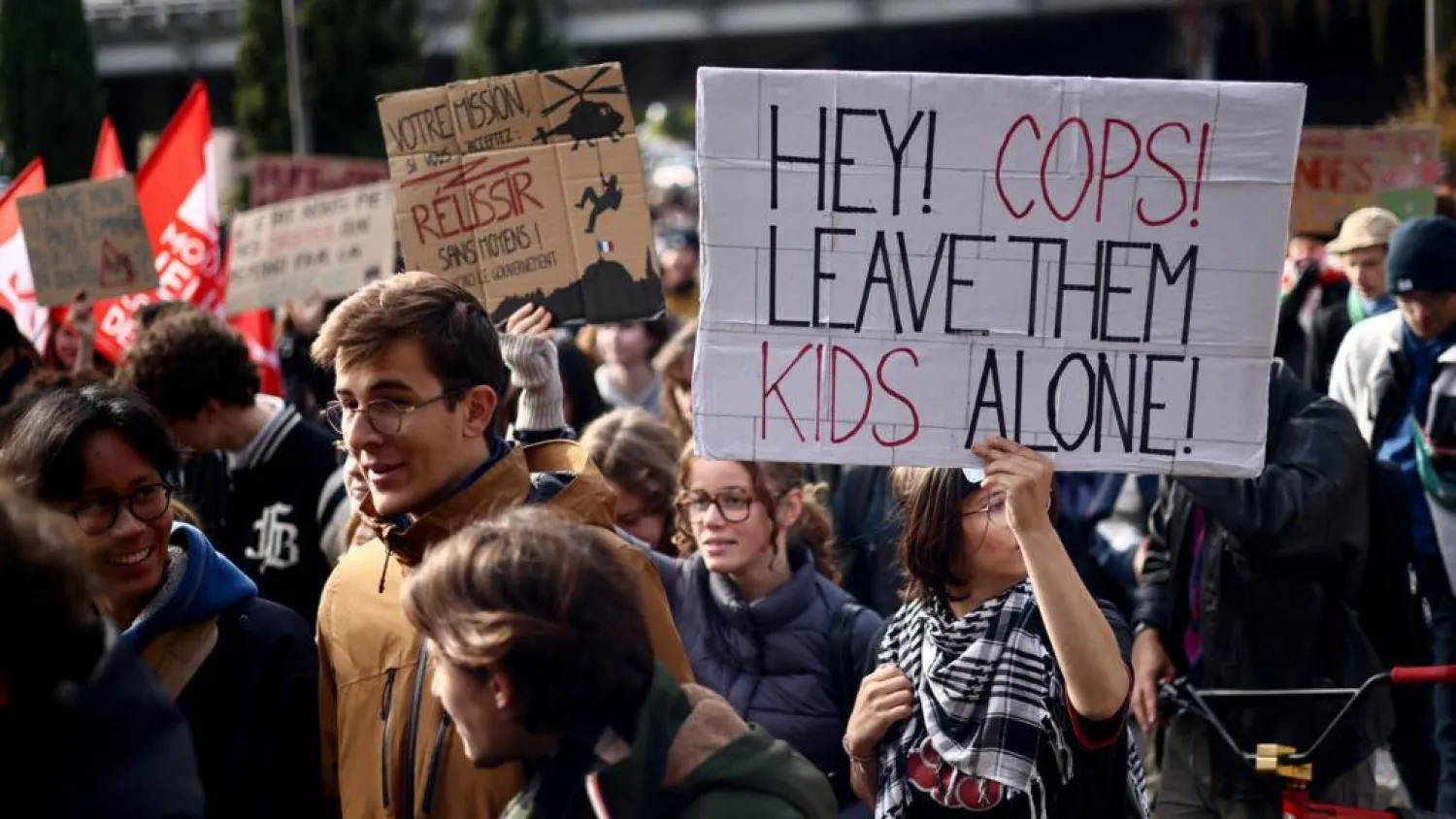
The high school student movement that began with youth protesting dismal learning conditions. Alex MARTIN / AFP/File
TT

France Workers Strike, March for 'Dignified Wage'

The high school student movement that began with youth protesting dismal learning conditions. Alex MARTIN / AFP/File

Striking workers marched across France against the rising cost of living on Thursday, with hundreds of thousands of people expected to take to the streets nationwide in a new escalation following weeks of protest. 

The demonstrations come as the eurozone's second largest economy battles to redress its finances, six months ahead of elections to replace centrist President Emmanuel Macron, with the far right leading in opinion polls, AFP said. 

The high school student movement that began with youths protesting over learning conditions has coincided with widespread anger over the rising cost of living and inequality, which culminated on October 17 in the worst rioting France has seen in years. 

Sylvie Larneury, 61, a healthcare manager, and her 61-year-old partner, an IT specialist, were on strike Thursday so they could join the march in the central city of Clermont-Ferrand. 

"We're fed up. We're not starving, but we have to help our children even though they've studied," she said. 

"We've had enough of social injustice," she added, criticizing what she called "a repressive government that defends its own interests and not those of the majority". 

The unions are calling for across-the-board wage raises, tax reforms and better learning conditions for young people and have complained about police restrictions on certain protests. 

Protesting in the city of Lyon, winegrower Martin Thiberge said he wanted to take part in demonstrations he saw as drawing together people from across French society. 

"We want to make a living from our work, to make a dignified wage," he said. 

Authorities estimated some 500,000 to 700,000 people would protest across the country on Thursday, while as many as 80,000 people were expected to march from 2:00 pm (1300 GMT) in the capital Paris. 

Unions hoped for a turnout comparable to France's pension reform protests in 2023 that saw over one million people march. 

- School blockades - 

Dozens of high-schoolers protested in several cities, with the government reporting blockades at 81 out of the country's 3,700 high schools. 

A high school student association said classes had been suspended at 1,000 such secondary schools, including those blockaded and those closed on a day of strikes. 

Around 16 percent of teachers nationwide were on strike, the education ministry said. 

In Paris, police used tear gas to try to prevent students from blocking access to the Helene-Boucher high school, an AFP reporter said. 

Public and private education unions have called for strike action, as well as unions representing rail workers, public hospitals and postal services. 

Train travel experienced some disruption on Monday morning. 

At the capital's Montparnasse train station, a psychologist who gave her name as Jeanne said her trip had been delayed. 

"It's tedious to get up early, wait, and then see your train cancelled, but it's understandable there's a strike," she said. 

- Police violence alleged - 

Interior Minister Laurent Nunez announced Wednesday that 70,000 police officers and security forces would be deployed across the country, promising "an extremely firm response" to any "acts of violence" or disorder. 

The protests have been largely peaceful, though some disintegrated into clashes with police, who have fired tear gas and water cannon to disperse crowds. 

An attempted murder investigation has been launched after petrol bombs were thrown at security forces in Paris on Saturday. 

The police response has been criticized as heavy-handed and internal police investigations have been launched over allegations of brutality against demonstrators. 

Several teenage protesters have been seriously wounded and thousands arrested. 

Similar protests have erupted in other European countries in recent weeks in Denmark, Germany and Italy.