


Trump Says US and Iranian Officials Met Tuesday, Shortly After Warning He May ‘Annihilate’ Iran

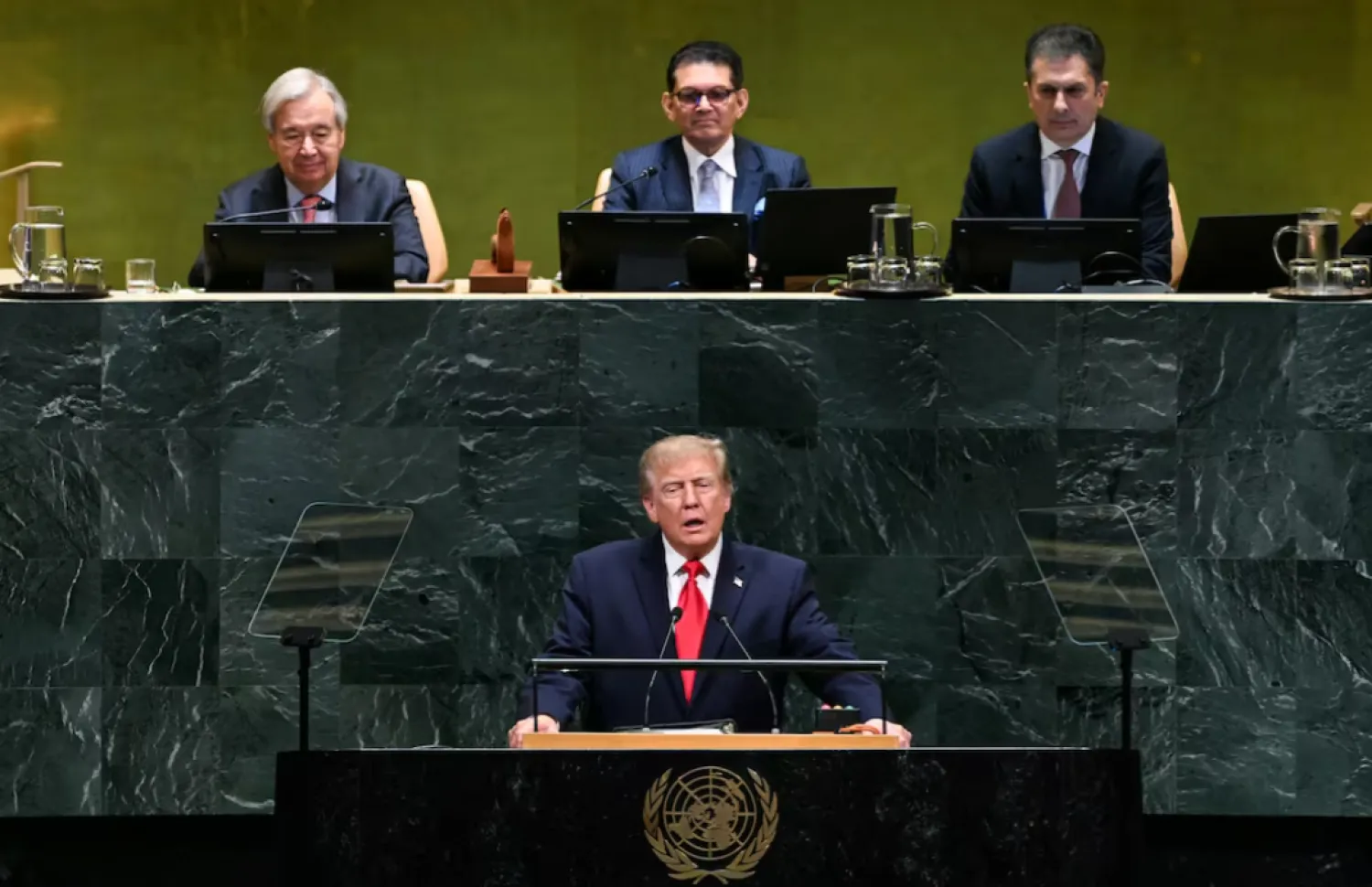
US President Donald Trump speaks during the 81st United Nations General Assembly at the United Nations Headquarters in New York City, US, September 22, 2026. BRENDAN SMIALOWSKI/Pool via REUTERS
TT

Trump Says US and Iranian Officials Met Tuesday, Shortly After Warning He May ‘Annihilate’ Iran

US President Donald Trump speaks during the 81st United Nations General Assembly at the United Nations Headquarters in New York City, US, September 22, 2026. BRENDAN SMIALOWSKI/Pool via REUTERS

President Donald Trump said US and Iranian officials met Tuesday, an unexpected engagement that came even as he threatened in his address to the UN General Assembly that he may “annihilate” the country if a deal isn’t reached soon to end the nearly seven-month war. 

Trump told reporters that his chief envoys, Steve Witkoff and Jared Kushner, met with the Iranian officials on the sidelines of the annual gathering of world leaders but he offered few details about how the discussions transpired or the substance of the exchange. 

“It was a very good meeting,” Trump said. The president later added that the Iranian officials were “not the highest level, but it’s something.” 

The engagement comes after months of US-Iran communications languishing following the collapse of a short-lived ceasefire that was brokered in June. US and Iranian negotiators met separately with Qatari and Pakistani mediators in Doha in early July for indirect talks. 

Earlier Tuesday, Secretary of State Marco Rubio said that Trump is open to meeting with Iran’s president, Masoud Pezeshkian, while he’s in New York for the General Assembly. 

“This is a president that will meet with anybody for the most part, because he believes that engaging with people is important if you’re going to solve problems,” Rubio said on NBC’s “Today” show. “It doesn’t mean you’re going to end up agreeing with them, but it’s important.” 

Trump also met on Tuesday with leaders and senior officials from Gulf Cooperation Council nations — Saudi Arabia, Bahrain, Kuwait, Oman, Qatar, and United Arab Emirates — as well as Jordan to discuss the way ahead with the war in Iran. 

In his address to the General Assembly, Trump made the case that he's shown fortitude while other leaders have equivocated as he defended his decision to start a war with Iran. 

But Trump also suggested that he could be at a crossroads in the conflict even as he called on Iran to fully reopen the Strait of Hormuz and return to the negotiating table to find a settlement to end the conflict. 

“I have a big decision to make,” Trump said. “Will a deal be made with Iran that lets them rebuild and create a far greater country than it ever was before, maybe one of the greatest in the Middle East or even the world. Or do I annihilate Iran and do it quickly, never giving them a chance to kill and destroy people and countries again?” 

The president's comments came in his wide-ranging address to the international body in which he also celebrated this year's US military operation to oust Venezuelan President Nicolás Maduro from power, a new agreement to expand the US military presence in Greenland, and pushed back against calls for greater regulation of the artificial intelligence industry. 

But at the heart of the address was a fulsome defense of the war and pushback on the notion that Iran has shown a measure of resilience. 

“The terrorist regime is behaving badly, not because they are strong and confident, but because they are weak and desperate," Trump said. 

Most of Iran's delegation walked out of the chamber as Trump railed against Tehran. 

Trump's speech began a busy day of diplomacy 

After his speech, Trump gathered with Danish Prime Minister Mette Frederiksen and Greenlandic Prime Minister Jens-Frederik Nielsen on the sidelines of the General Assembly to sign a new security agreement. 

The deal, announced last week, came together after Trump repeatedly threatened to “take over” Greenland, a territory of NATO-ally Denmark, by military force if necessary. Trump said Tuesday the US will immediately begin the process of developing a larger military presence in Greenland including “building two very major military bases.” 

Under the deal, Greenland remains Denmark’s territory. 

Trump also held talks with new British Prime Minister Andy Burnham, Japanese Prime Minister Sanae Takaichi and Ukrainian President Volodymyr Zelenskyy. He's expected to hold a more informal meeting on Tuesday evening with Venezuela's acting President Delcy Rodríguez, according to the White House. 

Trump also took part in an event on the Shield of Americas, an initiative Trump launched with Latin American countries earlier this year focused on combatting violent cartels. 

Iran war looms large at General Assembly  

The visit to the UN comes as Trump's foreign policy approach — particularly his decision to start a war with Iran — has become a drag on his fellow Republicans' hopes of retaining control of both chambers of Congress during the coming midterm elections. Nevertheless, Trump made the case in his speech that the world is better off for his leadership. 

“I have no interest in leaving dangers to grow for another day,” Trump said. 

In last year's address at the UN, Trump claimed the US had “demolished” Iran's nuclear capabilities after he ordered the June 2025 bombardment of three key facilities. 

He returned to the General Assembly nearing the seven-month mark of a new war against Iran that he insists is necessary to address a nuclear threat posed by Iran. 

The war has grown more complicated even though strikes by the United States and Israel have killed much of Iran's top leadership and destroyed its air force and navy, while a US blockade of Iranian oil has left Tehran in economic shambles. 

The energy market continues to be spooked by the war and oil prices remain elevated. At the same time, territorial grabs by the Yemen-based Houthi militants, another Iranian-backed group, near the Bab al-Mandeb Strait has now made it treacherous for oil carriers to use that Red Sea shipping lane. 

Trump's frustration with Russia-Ukraine war mounts  

In his address, the president also touched on Russia's continuing war against Ukraine — a conflict that during his 2024 campaign he predicted would be resolved on Day One of his second term. He once again expressed hope that the conflict will soon be resolved. 

Trump hasn't obscured that his patience is being tested by Ukraine's targeting of Russia's diesel refineries — an issue that's added to the global oil markets' volatility — and Russia's targeting of Ukraine's energy grid. 

Trump last week asserted that he got the two sides to agree to not target each other's energy infrastructure. 

Zelenskyy had said he was willing to go along with Trump's plan if Russia abided by it. Russia said it could only go along with Trump's energy truce proposal if Western energy sanctions on Moscow were lifted first. 

The two sides have continued carrying out strikes on refineries and other energy infrastructure. 

Trump noted that last week he signed a new sanctions bill targeting Moscow. It empowers him to impose up to 100% tariffs on the top five importers of Russian oil or natural gas. 

The legislation includes an exception for countries that import less than 15% of Russia’s natural gas exports and have taken significant steps to reduce those imports. Trump, however, has yet to enact the stiff penalties. 

“If necessary, I will have to use them,” Trump said. “It’s time to stop the killing.” 


Trump's New Press Secretary Admits Failing Bar Exam

President Donald Trump speaks to the reporters as he walks to board Marine One on the South Lawn of the White House, Tuesday, Oct. 13, 2026, in Washington, as White House press secretary Katie Zacharia looks on. (AP Photo/Julia Demaree Nikhinson)
TT

Trump's New Press Secretary Admits Failing Bar Exam

President Donald Trump speaks to the reporters as he walks to board Marine One on the South Lawn of the White House, Tuesday, Oct. 13, 2026, in Washington, as White House press secretary Katie Zacharia looks on. (AP Photo/Julia Demaree Nikhinson)

New White House Press Secretary Katie Zacharia acknowledged on Thursday that she had failed the bar exam, a prerequisite for practicing law in the United States, as her credentials face scrutiny.

Zacharia has described herself as a lawyer during television appearances and on social media, and listed herself as general counsel of a California-based conservative nonprofit.

But the legal credentials of the press secretary, who President Donald Trump appointed last week, were called into question after she gave an inconclusive answer about where she had passed the bar exam.

The 41-year-old graduated from Pepperdine University's law school in 2011, but obtaining a law degree does not automatically qualify someone to practice law.

In a Fox News interview on Thursday, host Sean Hannity asked Zacharia: "You took the bar exam, but you didn't pass the bar exam, correct?"

"Yes," she responded.

In a separate interview with conservative media outlet Real America's Voice on Thursday, Zacharia said she had registered to take the bar exam but was "distracted and overwhelmed" by plans to move to China with her husband.

"The results are somewhat inconsequential because I knew I wouldn't need the bar in China," AFP quoted her as saying.

Foreign nationals cannot sit China's bar exam, although they can undertake certain legal work at Chinese law firms.

Hannity later asked Zacharia if she had ever taken the bar exam a second time, to which she said: "I did not."

"I had four kids in six years," she said. "It was never my intent to go into the practice of law."

Zacharia said on Real America's Voice that "many people in the field" had assured her that she could "label myself a lawyer," given her law degree and experience in business law gained in China, where she worked at a Beijing law firm.

She added that she could "provide legal analysis, not legal advice."

"I was very careful how I executed this."

The Campaign for Accountability, a political ethics organization, called on Wednesday for the California Bar Association to launch an investigation.

"In California, calling yourself a lawyer without a license isn't puffery; it's a crime," the organization said in a press release.

Zacharia held her first White House press briefing on Tuesday with an unusually short press conference, answering questions from only three journalists.

She succeeded Karoline Leavitt, a loyal Trump supporter and often combative press secretary, who stepped down in August to care for her young children.


Teen Sentenced to 20 Years for UK Murder Plot Tied to Iran-linked Group

A red double-decker bus rides past as a Union Jack flag flutters on the Victoria Tower at the Houses of Parliament in London, Britain, October 15, 2026. REUTERS/Isabel Infantes
TT

Teen Sentenced to 20 Years for UK Murder Plot Tied to Iran-linked Group

A red double-decker bus rides past as a Union Jack flag flutters on the Victoria Tower at the Houses of Parliament in London, Britain, October 15, 2026. REUTERS/Isabel Infantes

A Norwegian teenager who planned to commit murder in Britain after being recruited by a Swedish organized crime group linked to the Iranian government was on Friday sentenced to 20 years' detention.

Johannes Natland, now 19, was arrested in a hotel room in Huddersfield, northern England, in March ⁠2025 with two ⁠firearms and ammunition in his possession.

Natland was recruited by the Foxtrot Network, a Swedish organized crime group used by the Iranian state and sanctioned by ⁠both Britain and the United States, prosecutors said.

He admitted possessing a semi-automatic pistol, a revolver and ammunition, but denied conspiracy to murder and claimed he did not intend to carry out the plan.

But he was convicted in July after a retrial ⁠and ⁠was sentenced at London's Woolwich Crown Court to detention for 20 years.

Natland was the latest young adult to stand trial in Britain and elsewhere over serious criminal acts allegedly carried out after being recruited online for money, often as an unwitting proxy for a foreign state.


UN: Millions May Be Forced to Move as Climate Change Hits South Asia

International Organization for Migration (IOM) chief Amy Pope, seen here in 2023, warned of a lack of urgency globally about the risks that vulnerable communities are facing. Fabrice COFFRINI / AFP
TT

UN: Millions May Be Forced to Move as Climate Change Hits South Asia

International Organization for Migration (IOM) chief Amy Pope, seen here in 2023, warned of a lack of urgency globally about the risks that vulnerable communities are facing. Fabrice COFFRINI / AFP

Climate change is threatening livelihoods and forcing people from their homes across South Asia, but technology and government action could help limit the damage, the UN migration chief told AFP on Friday.

Rising seas, flooding and drought threaten homes and farmland, Amy Pope, Director General of the International Organization for Migration (IOM), said during a visit to New Delhi.

In the Himalayas, she pointed to Nepal's August 26 disaster, when a mountain and glacier collapse triggered deadly flooding, where IOM sent humanitarian aid to help.

In a worst-case scenario, up to 40.5 million people in South Asia may be forced to move by 2050, according to IOM.

"When they can't produce food, when they can't feed their livestock, it increases the likelihood of displacement," said Pope. "The first adaptation is often for people to move."

Pope said climate change was also accelerating urbanization in India.

"As people seek shelter from heat, they're going into urban centers," she said.

- 'Migration as a tool' -

The risks are particularly acute in South Asia, where vast populations and limited resources leave many communities vulnerable.

"There's a lack of urgency globally about the risks that vulnerable communities are facing," Pope said, warning that funding to help residents prepare for climate change remained inadequate.

"The cost of a humanitarian disaster is in the billions. The cost of investing in some of the resilience measures can be far less," she said.

Better data and artificial intelligence could help governments identify communities at risk before disaster strikes, Pope said.

"With the advancements in AI forecasting, you can now better anticipate those communities that are at high risk of displacement," Pope said.

By combining weather forecasts with information about local livelihoods, authorities can identify which communities most need help.

"If you know a community is at risk, we don't need to wait until they're displaced to respond," she said.

Measures could include improving farming methods, training people for other jobs and, where necessary, relocating communities repeatedly hit by floods or drought.

Finding the money for such programs is a major obstacle, Pope said, with governments often struggling to navigate the systems available to fund climate adaptation.

India's investments in early-warning systems, disaster response and technology offer grounds for optimism, she said. But no government can meet the scale of the challenge alone.

International migration can also help people earn a living while filling labor shortages abroad.

South Asia already has established migration routes, offering opportunities to build on existing links.

"Here we have government partners who recognize both the threats to their communities but they're also using migration as a tool for development," Pope said.

She warned that growing demand for workers must be matched by safe, legal routes to employment.

Otherwise, migrants risk exploitation by traffickers and smugglers, including through fraudulent overseas job offers.

India's technological capacity could also help its workers compete internationally as artificial intelligence reshapes employment, Pope said.

AI could threaten some jobs, particularly those involving routine analysis of documents and reports, but other sectors still rely heavily on human labor.

"If we can marry that capacity with the labor mobility, so that the workers are being skilled for those jobs as they're emerging, they will be ahead," Pope said.

"This is a place where I have more optimism than in places where we're dealing with the most acute crises," she said.
