
Trump Says US and Iranian Officials Met Tuesday, Shortly After Warning He May ‘Annihilate’ Iran

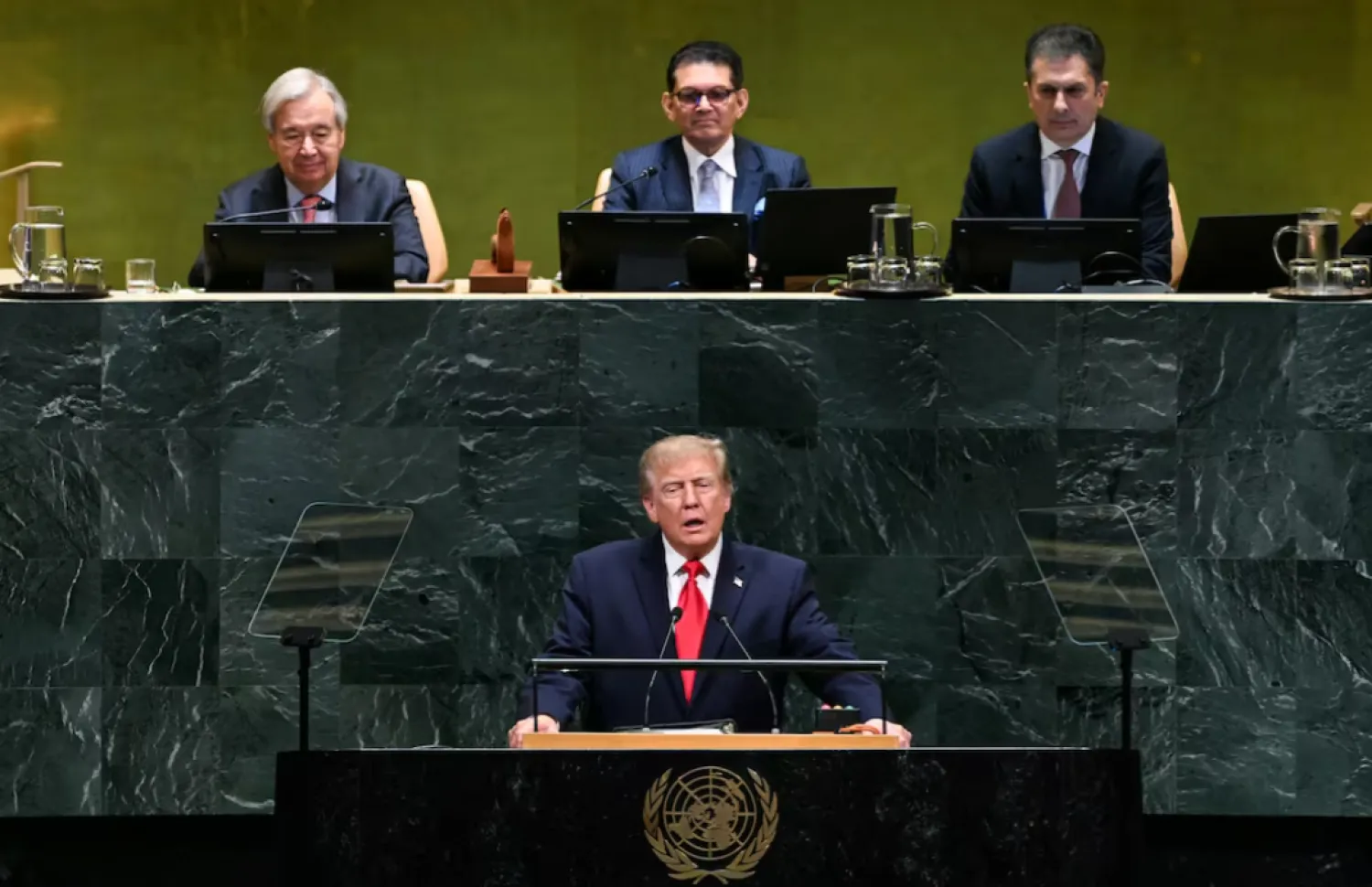
US President Donald Trump speaks during the 81st United Nations General Assembly at the United Nations Headquarters in New York City, US, September 22, 2026. BRENDAN SMIALOWSKI/Pool via REUTERS
TT

Trump Says US and Iranian Officials Met Tuesday, Shortly After Warning He May ‘Annihilate’ Iran

US President Donald Trump speaks during the 81st United Nations General Assembly at the United Nations Headquarters in New York City, US, September 22, 2026. BRENDAN SMIALOWSKI/Pool via REUTERS

President Donald Trump said US and Iranian officials met Tuesday, an unexpected engagement that came even as he threatened in his address to the UN General Assembly that he may “annihilate” the country if a deal isn’t reached soon to end the nearly seven-month war. 

Trump told reporters that his chief envoys, Steve Witkoff and Jared Kushner, met with the Iranian officials on the sidelines of the annual gathering of world leaders but he offered few details about how the discussions transpired or the substance of the exchange. 

“It was a very good meeting,” Trump said. The president later added that the Iranian officials were “not the highest level, but it’s something.” 

The engagement comes after months of US-Iran communications languishing following the collapse of a short-lived ceasefire that was brokered in June. US and Iranian negotiators met separately with Qatari and Pakistani mediators in Doha in early July for indirect talks. 

Earlier Tuesday, Secretary of State Marco Rubio said that Trump is open to meeting with Iran’s president, Masoud Pezeshkian, while he’s in New York for the General Assembly. 

“This is a president that will meet with anybody for the most part, because he believes that engaging with people is important if you’re going to solve problems,” Rubio said on NBC’s “Today” show. “It doesn’t mean you’re going to end up agreeing with them, but it’s important.” 

Trump also met on Tuesday with leaders and senior officials from Gulf Cooperation Council nations — Saudi Arabia, Bahrain, Kuwait, Oman, Qatar, and United Arab Emirates — as well as Jordan to discuss the way ahead with the war in Iran. 

In his address to the General Assembly, Trump made the case that he's shown fortitude while other leaders have equivocated as he defended his decision to start a war with Iran. 

But Trump also suggested that he could be at a crossroads in the conflict even as he called on Iran to fully reopen the Strait of Hormuz and return to the negotiating table to find a settlement to end the conflict. 

“I have a big decision to make,” Trump said. “Will a deal be made with Iran that lets them rebuild and create a far greater country than it ever was before, maybe one of the greatest in the Middle East or even the world. Or do I annihilate Iran and do it quickly, never giving them a chance to kill and destroy people and countries again?” 

The president's comments came in his wide-ranging address to the international body in which he also celebrated this year's US military operation to oust Venezuelan President Nicolás Maduro from power, a new agreement to expand the US military presence in Greenland, and pushed back against calls for greater regulation of the artificial intelligence industry. 

But at the heart of the address was a fulsome defense of the war and pushback on the notion that Iran has shown a measure of resilience. 

“The terrorist regime is behaving badly, not because they are strong and confident, but because they are weak and desperate," Trump said. 

Most of Iran's delegation walked out of the chamber as Trump railed against Tehran. 

Trump's speech began a busy day of diplomacy 

After his speech, Trump gathered with Danish Prime Minister Mette Frederiksen and Greenlandic Prime Minister Jens-Frederik Nielsen on the sidelines of the General Assembly to sign a new security agreement. 

The deal, announced last week, came together after Trump repeatedly threatened to “take over” Greenland, a territory of NATO-ally Denmark, by military force if necessary. Trump said Tuesday the US will immediately begin the process of developing a larger military presence in Greenland including “building two very major military bases.” 

Under the deal, Greenland remains Denmark’s territory. 

Trump also held talks with new British Prime Minister Andy Burnham, Japanese Prime Minister Sanae Takaichi and Ukrainian President Volodymyr Zelenskyy. He's expected to hold a more informal meeting on Tuesday evening with Venezuela's acting President Delcy Rodríguez, according to the White House. 

Trump also took part in an event on the Shield of Americas, an initiative Trump launched with Latin American countries earlier this year focused on combatting violent cartels. 

Iran war looms large at General Assembly  

The visit to the UN comes as Trump's foreign policy approach — particularly his decision to start a war with Iran — has become a drag on his fellow Republicans' hopes of retaining control of both chambers of Congress during the coming midterm elections. Nevertheless, Trump made the case in his speech that the world is better off for his leadership. 

“I have no interest in leaving dangers to grow for another day,” Trump said. 

In last year's address at the UN, Trump claimed the US had “demolished” Iran's nuclear capabilities after he ordered the June 2025 bombardment of three key facilities. 

He returned to the General Assembly nearing the seven-month mark of a new war against Iran that he insists is necessary to address a nuclear threat posed by Iran. 

The war has grown more complicated even though strikes by the United States and Israel have killed much of Iran's top leadership and destroyed its air force and navy, while a US blockade of Iranian oil has left Tehran in economic shambles. 

The energy market continues to be spooked by the war and oil prices remain elevated. At the same time, territorial grabs by the Yemen-based Houthi militants, another Iranian-backed group, near the Bab al-Mandeb Strait has now made it treacherous for oil carriers to use that Red Sea shipping lane. 

Trump's frustration with Russia-Ukraine war mounts  

In his address, the president also touched on Russia's continuing war against Ukraine — a conflict that during his 2024 campaign he predicted would be resolved on Day One of his second term. He once again expressed hope that the conflict will soon be resolved. 

Trump hasn't obscured that his patience is being tested by Ukraine's targeting of Russia's diesel refineries — an issue that's added to the global oil markets' volatility — and Russia's targeting of Ukraine's energy grid. 

Trump last week asserted that he got the two sides to agree to not target each other's energy infrastructure. 

Zelenskyy had said he was willing to go along with Trump's plan if Russia abided by it. Russia said it could only go along with Trump's energy truce proposal if Western energy sanctions on Moscow were lifted first. 

The two sides have continued carrying out strikes on refineries and other energy infrastructure. 

Trump noted that last week he signed a new sanctions bill targeting Moscow. It empowers him to impose up to 100% tariffs on the top five importers of Russian oil or natural gas. 

The legislation includes an exception for countries that import less than 15% of Russia’s natural gas exports and have taken significant steps to reduce those imports. Trump, however, has yet to enact the stiff penalties. 

“If necessary, I will have to use them,” Trump said. “It’s time to stop the killing.” 


Far-Right Israeli Minister Seeks Defense Post in Next Government

 Israel's far-right National Security Minister, Itamar Ben-Gvir, holds a press conference ahead of Israel's general elections in October, in Jerusalem, September 22, 2026. (Reuters)
Israel's far-right National Security Minister, Itamar Ben-Gvir, holds a press conference ahead of Israel's general elections in October, in Jerusalem, September 22, 2026. (Reuters)
TT

Far-Right Israeli Minister Seeks Defense Post in Next Government

 Israel's far-right National Security Minister, Itamar Ben-Gvir, holds a press conference ahead of Israel's general elections in October, in Jerusalem, September 22, 2026. (Reuters)
Israel's far-right National Security Minister, Itamar Ben-Gvir, holds a press conference ahead of Israel's general elections in October, in Jerusalem, September 22, 2026. (Reuters)

Israel's far-right National Security Minister Itamar Ben-Gvir said Tuesday he will seek the post of defense minister in the next government, as the country prepares for next month's elections.

Ben-Gvir, who is a key minister in the right-wing coalition of Prime Minister Benjamin Netanyahu, regularly sparks international outrage with his provocative statements and political stunts.

"The reason I am putting myself forward is that the time has come to change the mindset within the army," Ben Gvir said, at a press conference in Jerusalem.

"The time has come to transform the State of Israel's security doctrine with a single objective -- decisive victory on every front," he added.

The firebrand minister put forward a "security plan" that includes the "encouragement of voluntary emigration" of Palestinians from both Gaza and the occupied West Bank, disarming what he called the "terrorist" Palestinian Authority, and increased support for Israeli soldiers.

Earlier in September, Ben-Gvir presented a detailed plan to "encourage" Palestinians from the Gaza Strip to move abroad.

Although members of the ruling right-wing coalition have made multiple statements about transferring Palestinians out of Gaza, it is unclear to what extent their remarks will be followed by action.

Forced displacement of civilians in occupied territory is considered a war crime under the Geneva Conventions.

Ben-Gvir's announcement that he is seeking the defense post caused an uproar among Israeli opposition leaders.

Gadi Eisenkot, a key contender for the premiership, accused his main rival Netanyahu on X of having "lost it" by accepting "criminal Ben-Gvir" in his coalition.

In his youth, Ben-Gvir was charged more than 50 times for incitement to violence or hate speech, but boasts he was cleared in the vast majority of those cases.

According to Israeli media, he was not drafted into the military due to his involvement in extremist far-right groups.

The October 27 vote is expected to be close, and there is no guarantee that the parties currently in power will remain so after then.

According to a Channel 16 survey published Sunday, Ben-Gvir's Otzma Yehudit (Jewish Power) party is polling at seven percent, which would grant it eight out of 120 seats in Israel's parliament, the Knesset.


Trump Hails Burnham as ‘Natural Business Person’ After First Meeting

 President Donald Trump meets with Britain's Prime Minister Andy Burnham during the United Nations General Assembly, Tuesday, Sept. 22, 2026, at the UN headquarters. (AP)
President Donald Trump meets with Britain's Prime Minister Andy Burnham during the United Nations General Assembly, Tuesday, Sept. 22, 2026, at the UN headquarters. (AP)
TT

Trump Hails Burnham as ‘Natural Business Person’ After First Meeting

 President Donald Trump meets with Britain's Prime Minister Andy Burnham during the United Nations General Assembly, Tuesday, Sept. 22, 2026, at the UN headquarters. (AP)
President Donald Trump meets with Britain's Prime Minister Andy Burnham during the United Nations General Assembly, Tuesday, Sept. 22, 2026, at the UN headquarters. (AP)

US President Donald Trump hailed Andy Burnham on Tuesday as a "natural business person" at what the new British leader's team described as a smooth first face-to-face meeting.

After days of preparation for the Trump meeting, Burnham emerged relatively unscathed, with the US leader only taking issue with what he called a "terrible deal" to cede sovereignty of the Chagos Islands, home to a US-British air base.

Otherwise, Trump praised Burnham, saying Britain's seventh prime minister in a decade was someone with whom he could do business and a patriot who had put Britain on the up after replacing the former prime minister, Keir Starmer, in July.

"I think right now, based on my relationship with the prime minister, Andy, I think that ... we're doing very well," Trump said after they met on the sidelines of the United Nations General Assembly in New York for around 40 minutes.

"I think he's a natural business person. We've had a lot of discussions, even before this meeting we were talking with each other numerous times on the phone."

'ENCOURAGING MEETING'

Burnham, who travelled to New York on Monday to take part in the UN assembly, had ‌said little beforehand ‌about his expectations for the meeting with Trump, saying only that in their two phone calls he ‌had found "a ⁠connection" with the ⁠US president.

Afterwards, he repeated that earlier conversations had established that connection "and that very much came through today".

"(I) can certainly work with him. It was a very encouraging meeting," Burnham told reporters, saying the two leaders had found "common ground" on dealing with cost-of-living pressures, ending the conflict in the Middle East and reindustrializing nations to spur economic growth, among other issues.

"He was very upbeat about the country's (Britain's) prospects, which, to be honest, was great to hear."

Before arriving in New York, Burnham had sought common ground with Trump on AI, a focus of his comments to the UN on Monday in which he described the technology as having the ability to bring "huge benefits" to the British and global economy.

Trump has said he wants to cherish AI rather than stifle its growth, dismissing fears ⁠about it as a hoax and "sick conspiracy". The US leader has said concerns can be addressed through the ‌existing justice system without extra regulation — an issue that might cause some friction with Britain.

Yet, ‌while the two leaders seemed to find common ground on a number of issues, there were some pitfalls.

Trump again criticized Britain's move, under Starmer, to cede ‌sovereignty of the Chagos Islands while retaining control of Diego Garcia air base on a 99-year lease.

Trump called the agreement with Mauritius, ‌now on hold, a "terrible" deal. "It's amazing how strategic it is, and I think the prime minister is going to be looking at it," he said.

Burnham later told reporters he had inherited the problem and would work to find a resolution between the different sides. "It was clear that we need to come to that agreement, but I'm confident we can find it working with our US partners," he said.

Burnham also showed a willingness to disagree with Trump if it is ‌in his nation's interest, saying he would "stand firm in the face of any threats" to the right of Falkland Islanders to self-determination and to remain British.

In August, Trump said he was reviewing the ⁠United States' neutral position on the ⁠remote archipelago in the South Atlantic. Days later Argentine President Javier Milei — who will address the UN on Wednesday — said he would impose sanctions on oil companies drilling in the islands.

And the British leader navigated some other bilateral sticking points. Trump appeared unmoved over Britain's decision to block imports from Israeli settlements in the occupied West Bank, while its decision not to back the US over the Iran war was also skated over.

OPENS WAY FOR BURNHAM TO FOCUS ON AI

With the meeting done, Burnham turns his focus for UNGA to AI and his support for the technology, which he hopes will help Britain assume a leading role globally.

At an earlier business roundtable, Burnham said he would make the case for Britain in a speech later on Tuesday to help establish "a single set of global principles and standards" to unlock the potential of AI.

Describing Britain as being stuck in 10 years of political turbulence since voting to leave the European Union in 2016, Burnham told business leaders he wanted to usher in a period of stability and embrace AI, while being clear-eyed on the risks.

"So outside Downing Street, on my first day, I said I want to be the circuit breaker," he told the roundtable, including Tim Cook, executive chairman of Apple, and Citigroup CEO Jane Fraser.

"(To) bring forward a very clear path that everyone can understand, a 10-year plan for Britain ... so that nobody's in any doubt at all about what we're trying to do."


Trump Renames AI ‘Super Intelligence’ as Leaders Jostle Over Dangers

US President Donald Trump speaks during the 81st session of the UN General Assembly at the UN Headquarters on September 22, 2026 in New York City. (Getty Images/AFP)
TT

Trump Renames AI ‘Super Intelligence’ as Leaders Jostle Over Dangers

US President Donald Trump speaks during the 81st session of the UN General Assembly at the UN Headquarters on September 22, 2026 in New York City. (Getty Images/AFP)

President Donald Trump on Tuesday announced that the US government would rename artificial intelligence "super intelligence" in official communications, as world leaders jostled over how to address the dangers of the fast-advancing technology.

AI has become a major topic at the UN General Assembly after incidents of the technology falling out of the control of humans and warnings by company insiders drew global alarm and calls for better government supervision of the industry.

Speaking to the assembly, Trump stood by his firm opposition to regulating AI, while arguing the word "artificial" undersold the technology and voicing hope the rest of the world would adopt the new term.

Super Intelligence "sounds much better" and "it's much more accurate," he said.

The rebrand is the latest in a series of renamings pursued by the Trump administration, which changed the Gulf of Mexico to the "Gulf of America" via executive order last year and, in August, renamed Lake Ontario "Lake America" amid a trade dispute with Canada.

The US leader also compared the warnings of AI safety advocates to warnings about climate change, whose human causes are affirmed by the overwhelming consensus of the scientific community.

"The United States totally rejects any attempt to construct a globalist scheme to control... artificial intelligence," he said.

"Every major new technology brings challenges, and superintelligence is no exception," he added.

"The very same people who said we'll all be dead in 12 years because of global warming... are now saying that AI is going to kill us all, that robots are going to attack us, and that everything is going to be a total disaster."

Ahead of the UN assembly, leaders of more than 20 mostly European countries urged binding safety measures for advanced AI, warning that the technology's development could outpace the ability to control it.

AI superpowers China and the United States did not endorse the idea.

- 'Vassals' -

Speaking on the sidelines of the UN meeting, Prime Minister Andy Burnham said he planned to use Britain's role as host of the Group of 20 next year to push for a "single set of global principles and standards" around AI, according to Bloomberg.

French President Emmanuel Macron proposed building AI technology independent from the great powers.

"I don't want anyone to become the vassal of one of the great powers," Macron told the UN General Assembly, apparently in reference to China and the US.

"Our investment capabilities must be pooled to build a cutting-edge open-source AI model, which we will share. We should not depend on somebody else."

The US-based AI giants themselves are increasingly asking for global coordination on AI safety, with OpenAI's Sam Altman set to address the UN Security Council on Wednesday.

Anthropic chief Dario Amodei and Hugging Face co-founder Clement Delangue will also participate remotely, a French official said Tuesday.

France, which holds the Security Council presidency this month, initiated the meeting and believes AI's threat to international peace and security has not been sufficiently discussed at the UN.

UN chief Antonio Guterres, meanwhile, called for the US and China to start a dialogue on the technology's future akin to US-Soviet engagement at the height of the Cold War.

"Governments with the greatest AI capabilities have the greatest responsibilities to humanity, to establish channels for dialogue," Guterres said in his address to the assembly.

"At a pivotal moment during the Cold War, strategic rivals came to recognize the need to manage shared existential risks."

China and the US are currently discussing creating a communication channel for AI concerns in anticipation of a Washington summit meeting between Trump and Chinese President Xi Jinping on Thursday.