

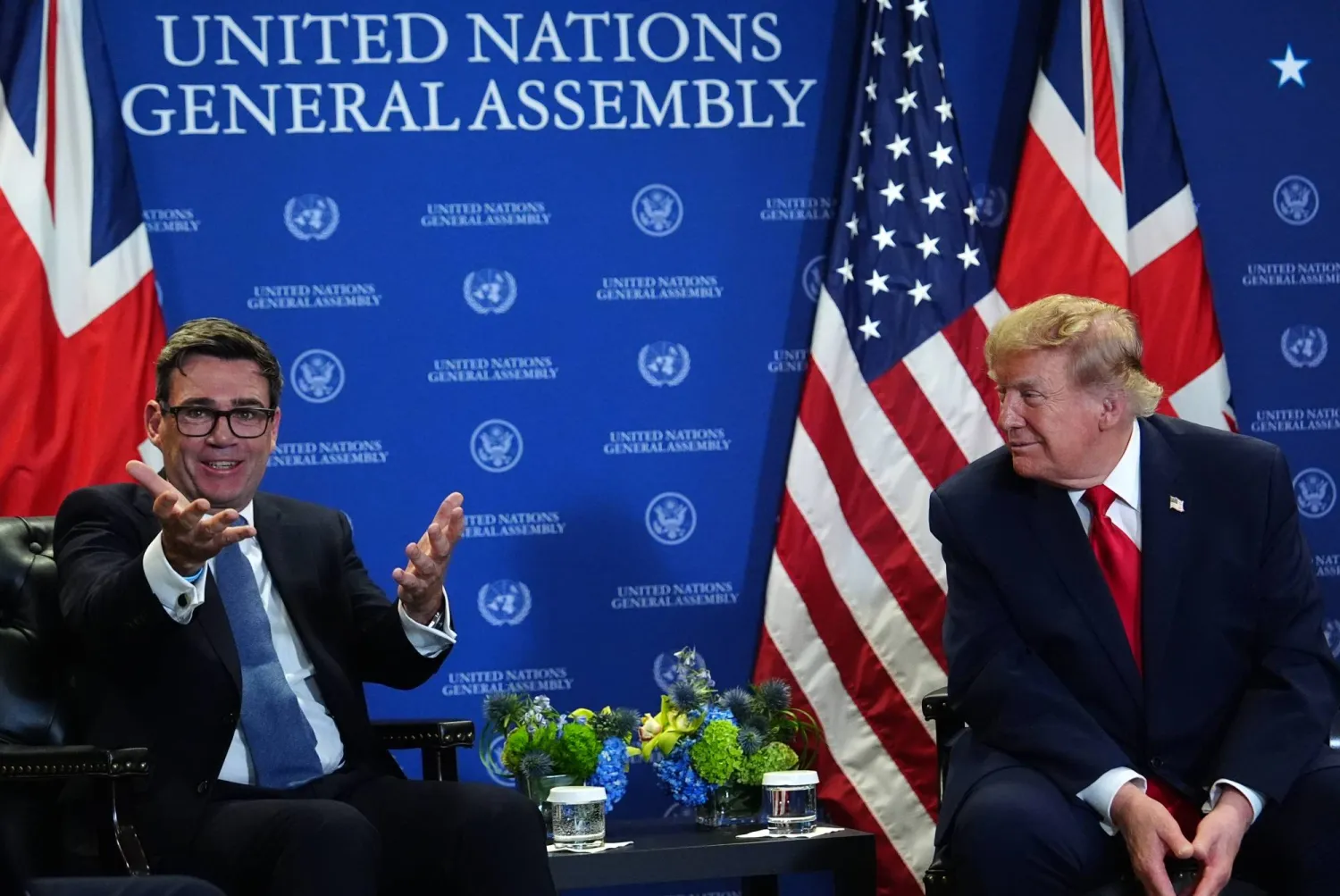

Trump Hails Burnham as ‘Natural Business Person’ After First Meeting

 President Donald Trump meets with Britain's Prime Minister Andy Burnham during the United Nations General Assembly, Tuesday, Sept. 22, 2026, at the UN headquarters. (AP)
President Donald Trump meets with Britain's Prime Minister Andy Burnham during the United Nations General Assembly, Tuesday, Sept. 22, 2026, at the UN headquarters. (AP)
TT

Trump Hails Burnham as ‘Natural Business Person’ After First Meeting

 President Donald Trump meets with Britain's Prime Minister Andy Burnham during the United Nations General Assembly, Tuesday, Sept. 22, 2026, at the UN headquarters. (AP)
President Donald Trump meets with Britain's Prime Minister Andy Burnham during the United Nations General Assembly, Tuesday, Sept. 22, 2026, at the UN headquarters. (AP)

US President Donald Trump hailed Andy Burnham on Tuesday as a "natural business person" at what the new British leader's team described as a smooth first face-to-face meeting.

After days of preparation for the Trump meeting, Burnham emerged relatively unscathed, with the US leader only taking issue with what he called a "terrible deal" to cede sovereignty of the Chagos Islands, home to a US-British air base.

Otherwise, Trump praised Burnham, saying Britain's seventh prime minister in a decade was someone with whom he could do business and a patriot who had put Britain on the up after replacing the former prime minister, Keir Starmer, in July.

"I think right now, based on my relationship with the prime minister, Andy, I think that ... we're doing very well," Trump said after they met on the sidelines of the United Nations General Assembly in New York for around 40 minutes.

"I think he's a natural business person. We've had a lot of discussions, even before this meeting we were talking with each other numerous times on the phone."

'ENCOURAGING MEETING'

Burnham, who travelled to New York on Monday to take part in the UN assembly, had ‌said little beforehand ‌about his expectations for the meeting with Trump, saying only that in their two phone calls he ‌had found "a ⁠connection" with the ⁠US president.

Afterwards, he repeated that earlier conversations had established that connection "and that very much came through today".

"(I) can certainly work with him. It was a very encouraging meeting," Burnham told reporters, saying the two leaders had found "common ground" on dealing with cost-of-living pressures, ending the conflict in the Middle East and reindustrializing nations to spur economic growth, among other issues.

"He was very upbeat about the country's (Britain's) prospects, which, to be honest, was great to hear."

Before arriving in New York, Burnham had sought common ground with Trump on AI, a focus of his comments to the UN on Monday in which he described the technology as having the ability to bring "huge benefits" to the British and global economy.

Trump has said he wants to cherish AI rather than stifle its growth, dismissing fears ⁠about it as a hoax and "sick conspiracy". The US leader has said concerns can be addressed through the ‌existing justice system without extra regulation — an issue that might cause some friction with Britain.

Yet, ‌while the two leaders seemed to find common ground on a number of issues, there were some pitfalls.

Trump again criticized Britain's move, under Starmer, to cede ‌sovereignty of the Chagos Islands while retaining control of Diego Garcia air base on a 99-year lease.

Trump called the agreement with Mauritius, ‌now on hold, a "terrible" deal. "It's amazing how strategic it is, and I think the prime minister is going to be looking at it," he said.

Burnham later told reporters he had inherited the problem and would work to find a resolution between the different sides. "It was clear that we need to come to that agreement, but I'm confident we can find it working with our US partners," he said.

Burnham also showed a willingness to disagree with Trump if it is ‌in his nation's interest, saying he would "stand firm in the face of any threats" to the right of Falkland Islanders to self-determination and to remain British.

In August, Trump said he was reviewing the ⁠United States' neutral position on the ⁠remote archipelago in the South Atlantic. Days later Argentine President Javier Milei — who will address the UN on Wednesday — said he would impose sanctions on oil companies drilling in the islands.

And the British leader navigated some other bilateral sticking points. Trump appeared unmoved over Britain's decision to block imports from Israeli settlements in the occupied West Bank, while its decision not to back the US over the Iran war was also skated over.

OPENS WAY FOR BURNHAM TO FOCUS ON AI

With the meeting done, Burnham turns his focus for UNGA to AI and his support for the technology, which he hopes will help Britain assume a leading role globally.

At an earlier business roundtable, Burnham said he would make the case for Britain in a speech later on Tuesday to help establish "a single set of global principles and standards" to unlock the potential of AI.

Describing Britain as being stuck in 10 years of political turbulence since voting to leave the European Union in 2016, Burnham told business leaders he wanted to usher in a period of stability and embrace AI, while being clear-eyed on the risks.

"So outside Downing Street, on my first day, I said I want to be the circuit breaker," he told the roundtable, including Tim Cook, executive chairman of Apple, and Citigroup CEO Jane Fraser.

"(To) bring forward a very clear path that everyone can understand, a 10-year plan for Britain ... so that nobody's in any doubt at all about what we're trying to do."



Hormuz Under Fire as a New Wave of Attacks Targets Ships

Oil tankers sail near the Strait of Hormuz (Reuters)
TT

Hormuz Under Fire as a New Wave of Attacks Targets Ships

Oil tankers sail near the Strait of Hormuz (Reuters)

The risks facing maritime navigation in the Gulf are escalating, with an unprecedented rise in attacks on ships and oil tankers since the outbreak of the war.

The latest developments are heightening concerns over the security of global energy supplies and pushing oil prices higher.

As the United States and Iran trade military pressure around the Strait of Hormuz, the cost and risks of passage through the strategic waterway are increasing, amid uncertainty over the fate of negotiations aimed at ending the war.

According to data compiled by the Financial Times from UKMTO reports and European security sources, 24 ships were hit in the two weeks to October 11. The next most intense period of attacks was during the first two weeks of March, when 13 ships were hit.

An unknown projectile struck a tanker 68 nautical miles northeast of Jubail on Friday, UKMTO said in a report ⁠on Saturday.

All crew members ⁠were safe and had been evacuated, it said, adding that no environmental impact had been reported.

UKMTO later ⁠issued a second report on Saturday that a tanker was attacked by a rocket-propelled grenade from a small boat 78 nautical miles northeast of Jubail on Friday, damaging its aft port quarter. All crew members ⁠were ⁠safe, it said, while the full extent of the damage and the environmental impact was not yet known.

Iran's Revolutionary Guards on Saturday said two oil tankers were on fire in the Strait of Hormuz after hitting mines in the waterway.

"A supertanker in violation of regulations, carrying more than two million barrels of crude oil and attempting to pass illegally through the Strait of Hormuz, struck a mine, triggering an explosion and a fierce fire," the Revolutionary Guards said.

Later Saturday, Guards said "a second offending supertanker was engulfed in a massive blaze after hitting a naval mine," adding it also carried "more than two million barrels of crude oil" and was attempting to pass the Strait.

The repercussions of the escalation are not limited to the safety of ships and their crews, but extend directly to oil flows from the Gulf to global markets.

Oil flows out of the Gulf reached an average of 15.5mn barrels per day in September, their highest level since the war began, according to commodities platform Kpler. But since then exports have plummeted as new Iranian strikes sharply reduced the number of ships transiting the strait.

Only 2.9mn barrels of oil were carried through the waterway on October 11, according to figures published by Kpler on Tuesday, the lowest level this month.

That effected oil prices. Brent touched $110 a barrel for the first time since May on Friday on worries that escalating tensions in the Middle East could further tighten supplies.

These developments are raising concerns that continued disruptions to shipping could place further pressure on energy markets, particularly if restrictions on tanker traffic persist or attacks expand to target more vessels and facilities linked to oil exports.

The risks are not limited to higher crude oil prices. Supply disruptions could also drive up transportation, insurance, and fuel costs, adding to inflationary pressures on energy-importing economies.


North Korea Says Tested AI-assisted Torpedo System

North Korea has tested a "new-type" precision-guided torpedo system that uses artificial intelligence for target detection and guidance, state media reports. ANTHONY WALLACE / AFP/File
TT

North Korea Says Tested AI-assisted Torpedo System

North Korea has tested a "new-type" precision-guided torpedo system that uses artificial intelligence for target detection and guidance, state media reports. ANTHONY WALLACE / AFP/File

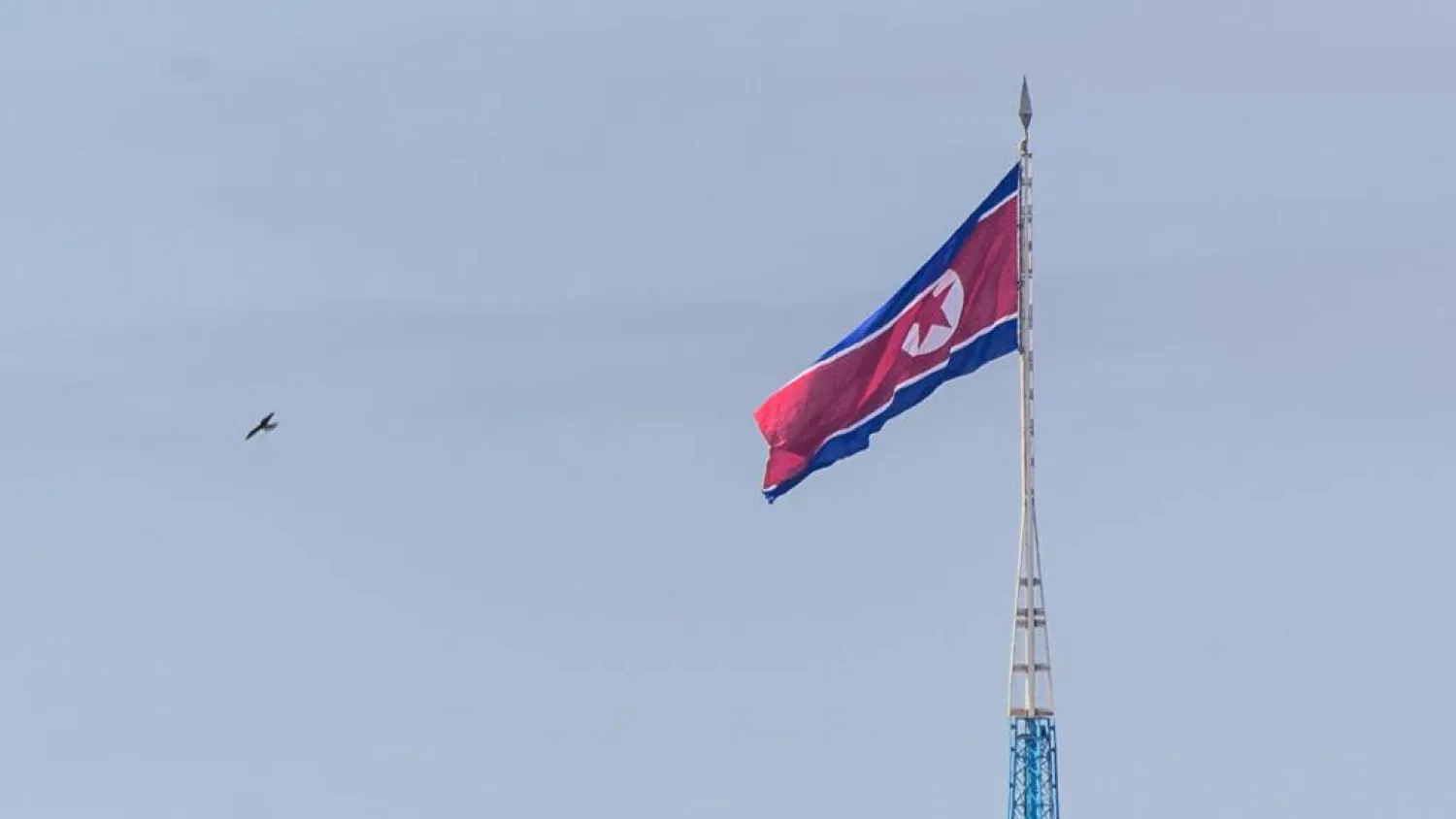
North Korea said Saturday it had successfully tested a new torpedo system that uses artificial intelligence for target detection and guidance.

The Korean Central News Agency said the weapon tested Thursday was a “super-speed, precisely guided” torpedo system named Zam-2.0. It didn't explain what was meant by artificial intelligence.

The report added that test verified the weapon’s propulsion systems, which were developed through more than 180 tests over the past five years.

South Korea’s military, which often accuses the North of exaggerating its military technologies, did not immediately comment on KCNA’s report.

North Korea has been ramping up weapons demonstrations in recent weeks, including conducting its first underwater-launched missile tests in nearly three years, as leader Kim Jong Un shifts his focus to naval capabilities after years of ballistic missile development. Experts say the missile tests, carried out Wednesday, likely involved a yet-to-be-deployed submarine that Pyongyang has said is designed to launch nuclear weapons.

North Korea also tested hypersonic missile systems of various ranges on Sept. 20 and Oct. 3 as it seeks to expand its arsenal of weapons designed to overwhelm missile defenses in South Korea and Japan. Kim Yo Jong, the powerful sister of North Korean leader Kim Jong Un, claimed that the missiles tested on Oct. 3 also used artificial intelligence technology.

But some experts say that while North Korea is likely improving its guidance software, it's doubtful that the country's weapons really have advanced digital capabilities such as autonomous target designation,

Kim Jong Un in recent years has halted all diplomacy and cooperation with South Korea and described it as a permanent enemy, as a yearslong stalemate in nuclear negotiations with Washington drags on.


Russia Hails Trump Waiving Sanctions as 'Historic'

FILE - US President Donald Trump greets Russian President Vladimir Putin, Aug. 15, 2025, at Joint Base Elmendorf-Richardson, Alaska. (AP Photo/Julia Demaree Nikhinson, File)
TT

Russia Hails Trump Waiving Sanctions as 'Historic'

FILE - US President Donald Trump greets Russian President Vladimir Putin, Aug. 15, 2025, at Joint Base Elmendorf-Richardson, Alaska. (AP Photo/Julia Demaree Nikhinson, File)

Russia on Saturday hailed US President Donald Trump's move to waive new sanctions on it as "historic", as Ukraine worries he is taking Moscow's side in Europe's worst conflict since World War II.

Trump signed an executive order Friday that waived sweeping US sanctions targeting Russia's energy revenues amid a clash with Ukrainian President Volodymyr Zelensky.

The decision came despite Russia increasing strikes on Ukraine -- especially its capital, Kyiv -- in the fifth year of its offensive, which has killed hundreds of thousands of people and displaced millions.

"The Trump administration's suspension of the Graham Act is an important and truly historic moment," Kirill Dmitriev, envoy for Russian President Vladimir Putin, said on social media.

The Lindsey Graham Act -- named after the deceased US senator who sponsored the bill -- targeted Russia's energy and defense sectors, as well as Putin and the so-called "shadow fleet" of tankers used by Moscow to circumvent Western sanctions.

The Kremlin and Putin have not yet reacted to the move, which is a major diplomatic win for Moscow.

Dmitriev said the act would have caused "serious damage first and foremost to the US economy and global markets".

Trump's waiver comes after he struck a deal with Putin to ease existing sanctions on Russia in exchange for Moscow releasing large amounts of diesel onto global markets.

He announced the executive order Friday, shortly after Putin appeared in military uniform and said Moscow aims to capture the rest of east Ukraine.

US-led talks to end the war in Ukraine have not led to a breakthrough. Both Putin and Zelensky have frustrated Trump in the past with a lack of progress in halting the grinding war.

The move is bound to spook Ukraine's European allies, who worry the White House is taking the Kremlin's side.

Zelensky rallied his allies Friday on a visit to Brussels for a European Union summit, urging them to keep financing Ukraine's fight and insisting he was standing up for his country amid the row with Trump.

Russian forces struck Ukraine's southern city of Kherson Saturday after Trump's announcement, killing one person and wounding 22, local officials said.

- Putin vows more -

Russia has increased strikes on Kyiv in recent weeks, squeezing the city as Ukrainians brace for another winter of war.

Ukraine has been struggling to shoot down Russian missiles and has been left scrambling to boost defenses ahead of winter.

Russia controls large swathes of eastern and southern Ukraine and Putin has repeatedly said Moscow intends to seize the rest of east Ukraine by force.

"On the whole I see a positive trend in the operations of the troop groupings," Putin told army leaders Friday, dressed in military attire.

"Undoubtedly, one of the main objectives remains the liberation of the Donetsk People's Republic," he added, using the Kremlin's name for the eastern Donetsk region.

European leaders put on a show of unity with Zelensky Friday as he grappled with Trump.

"This is no time to withdraw the support to Ukraine. This is no time to relieve Russia's sanctions," said European Council chief Antonio Costa.

"Now it is time to increase our support, to increase our pressure."

European concerns have been heightened by disruptions to a critical US-provided satellite system that has hampered Ukraine's ability to counter Russia's intense bombardments.