


Trump Says His Ballroom Will House a Drone Port. The Secret Service Already Has One Next Door

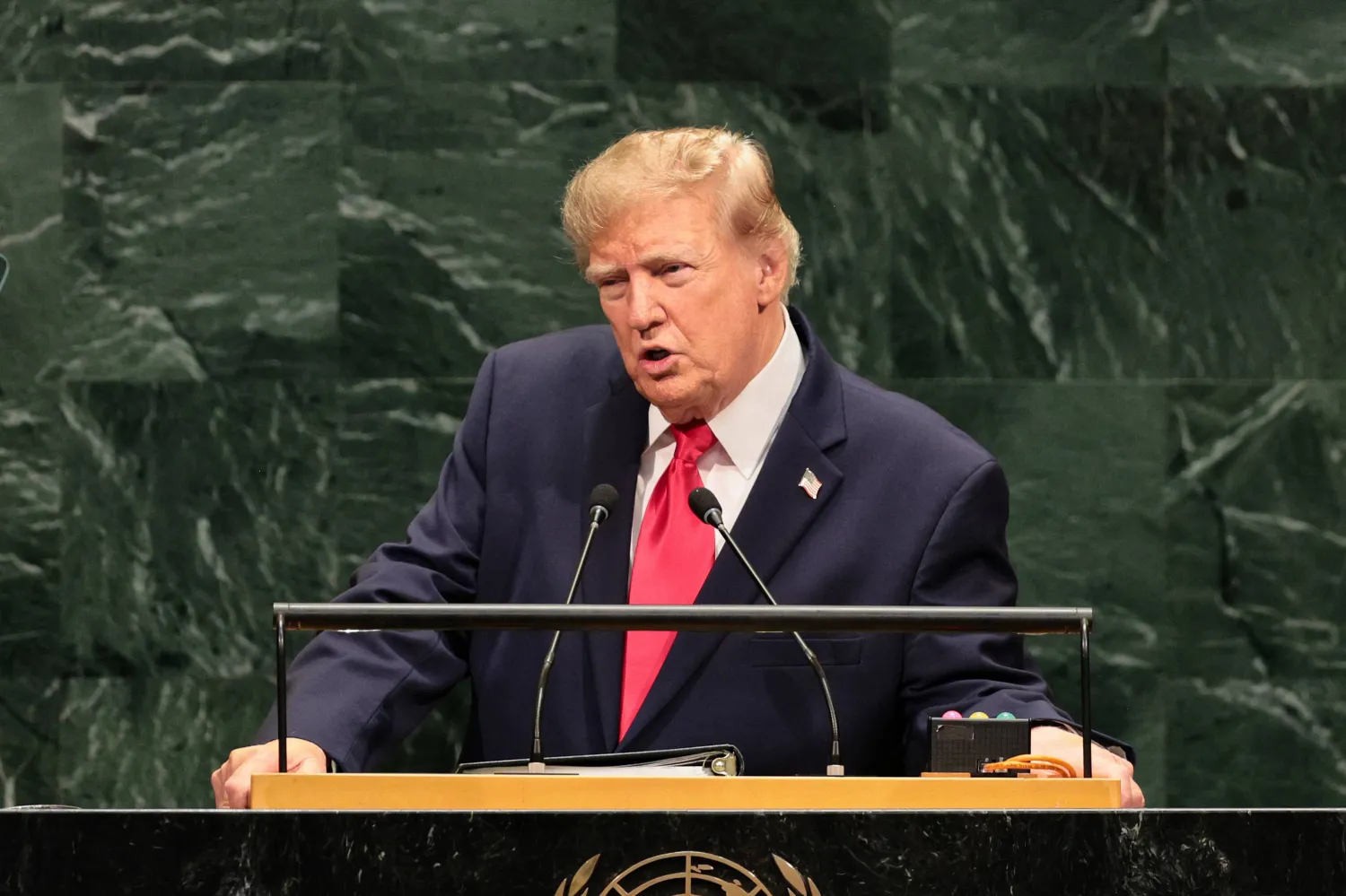
NEW YORK, NEW YORK - SEPTEMBER 22: US President Donald Trump speaks during the 81st session of the United Nations (UN) General Assembly at UN Headquarters on September 22, 2026 in New York City. Michael M. Santiago/Getty Images/AFP
TT

Trump Says His Ballroom Will House a Drone Port. The Secret Service Already Has One Next Door

NEW YORK, NEW YORK - SEPTEMBER 22: US President Donald Trump speaks during the 81st session of the United Nations (UN) General Assembly at UN Headquarters on September 22, 2026 in New York City. Michael M. Santiago/Getty Images/AFP

President Donald Trump's AI-fueled vision for a drone port he intends to install atop the new White House ballroom includes missile-bearing unmanned aerial vehicles and gun-toting troops, ostensibly to protect the 18-acre complex and the nation’s capital.

A few hundred feet away, a drone port, run by the US Secret Service and not the military, is already quietly operational. Equipped with cameras and sensors to scope out potential threats from a bird’s-eye view, the small UAVs stand on alert in four gray weatherproof boxes until deployed at officers' commands, The Associated Press.

The agency is using a model known as “drone as first responder,” deploying speedy unarmed drones from outdoor stations to serve as flying cameras. That model has been adopted by hundreds of police agencies across the US, often powered by AI software to help dodge obstacles or track targets.

The existence of the surveillance drones on a Treasury Department building adjacent to the White House complex has not been previously reported, and could undercut Trump's legal claims that the ballroom construction is necessary “to protect the White House and surrounding region from aerial attacks.” The need for the drone port underpinned Trump's national security defense for the construction project — a justification he is now citing for the construction of a massive arch outside the gates of Arlington National Cemetery.

The installation is thus far markedly less imposing than the vision outlined by Trump, with its rows of futuristic attack drones, apparently modeled after those used in US military strikes, that drone experts describe as outlandish.

“To be honest, if a drone was so close to the White House that it needed interdiction, it’s already gotten too far,” said Matt Sloane, co-founder of SkyfireAI, which makes software for drones used by public safety agencies.

It would be more realistic for the White House to build something akin to what the Secret Service is using next door, Sloane said: “The drone takes off and does some type of perimeter sweep or whatever, and then puts itself back in the box.”

The White House did not comment for the story. The Secret Service declined to comment on the specifics of its drone operations but said the new docks are separate from Trump's ballroom drone port.

The details of Trump’s ballroom drone port remain murky

Security of the president and the White House complex is generally the domain of the Secret Service, which works in close concert with the White House Military Office and other military elements when needed.

Trump has said the drone port came at the request of US military officials. Speaking to reporters in May, he said the building’s plans were expanded to meet the request: “They wanted more drone capacity,” he said. On social media, he boasted that the drone port might end up being the “most sophisticated” in the world.

What Trump is ultimately aiming to build, and how far it goes beyond what has already been installed, remains unclear. Beyond Trump’s AI images, some of which he filed in his appeal to the US Supreme Court to lift lower courts' blocks on the construction, the White House has not disclosed what kinds of drones will be used or for what tactical purpose.

The Secret Service is using smaller surveillance drones that are a fraction of the size of the attack drones depicted in Trump’s AI images. The US Air Force bought similar drones from Skydio in April to protect bases across the Middle East. The company also supplied drones to help protect World Cup matches this year.

The Secret Service has been building out its drone- and counter-drone programs for years. But work has accelerated since the 2024 attempted assassination of Trump at a campaign rally in Butler, Pennsylvania, when the agency failed both to take action against a drone used by the shooter to scout out the attack and to fly one of its own to provide overwatch of the event.

In the weeks that followed, tethered and untethered surveillance drones became commonplace at campaign rallies and large events at the White House complex.

In an online video released by the agency highlighting their deployment, the Secret Service said the Skydio drones are used to provide “real-time situational awareness” and “aerial overwatch."

“It allows you to see the threat before it becomes an issue, and to task assets accordingly,” Dustin Talbott, of the Secret Service’s Aviation and Airspace Security Division, said in the video. “We no longer wait for the threat to reveal itself. We find it first.”

Skydio did not provide comment for this story.

Trump's drone port vision would face logistical hurdles

Trump has made it a priority to build a stronger drone presence around the White House, responding to an increase in political violence and the evolution of drone warfare.

Paul Eckloff, a former supervisor of the Secret Service’s presidential protection division, said the Russia-Ukraine war has highlighted the risks posed by drones, even off-the-shelf models that can cause massive damage. Drones now represent one of the largest emerging threats the White House must defend against, he said.

During Trump’s first term, conversations about drones often centered on their use in places like Iraq and Syria, said Javed Ali, who served on the National Security Council during that time and now teaches national security at the University of Michigan. Since then, it has become a matter of domestic security, he said.

Yet there would be major logistical hurdles involved in putting a busy drone port on top of the White House, he said. “There’s a whole host of questions, like who is responsible for overseeing it, and how would there be any de-confliction with commercial airspace?” he said.

Complexities around federal oversight were laid bare this year when the US military used a laser to shoot down a drone near El Paso, Texas, only to find it belonged to Customs and Border Protection. The mishap briefly led the FAA to close nearby airspace.

A drone hub at the White House would navigate crowded and complex airspace around Washington, not far from Reagan Washington National Airport and flight paths shared by other military aircraft.

Opponents say the White House is becoming a fortress

Trump started talking about the drone port in May, weeks after a federal judge halted ballroom construction but allowed work on security components to continue. Trump later went on to refer to the ballroom as a “military complex,” leaning on that security role as a legal justification.

The Supreme Court in August cleared Trump to continue construction as the legal challenge moves ahead.

Opponents say the president is going too far in his hardening of the White House, turning it into something closer to a fortress. Edward Lengel, a former chief historian for the White House Historical Association, said Trump has militarized the White House at a scale that’s at odds with its legacy as “the people’s house.”

“It turns it into a big giant porcupine that has its spines pointing out against the people and against the world,” Lengel said.

Trump has argued that the White House was in “very bad condition” when he returned to office, saying it had become vulnerable to modern threats.

At times, he has expressed concerns about his own safety and the risks posed by drones and other air threats. Speaking at a Rose Garden dinner for law enforcement officials in May, Trump quickly glanced up from the lectern as a low bird flew overhead.

“I thought that was a drone,” Trump said, bringing laughs from the crowd. “They make them in all different sizes nowadays — they can be very destructive, as you’ve probably heard."



US Judge Backs CNN, MS Now, Politico Access to White House

US President Donald Trump speaks on stage in Wasilla, Alaska, US, October 13, 2026. REUTERS/Evan Vucci
TT

US Judge Backs CNN, MS Now, Politico Access to White House

US President Donald Trump speaks on stage in Wasilla, Alaska, US, October 13, 2026. REUTERS/Evan Vucci

A federal judge blocked on Tuesday the White House from banning CNN, MS Now and Politico journalists, following President Donald Trump's decision to ban the news outlets last month.

District Judge Timothy Kelly ruled that the Trump administration must grant the journalists access to the White House while the lawsuit filed by the three outlets against the ban proceeds.

Kelly said the outlets were "likely to succeed not only on their due process claim, but also on their two First Amendment claims."

The First Amendment upholds the right to a free press.

Trump barred CNN, MS NOW and Politico from the White House on September 18 for distributing what he called "fake news" and "fiction and lies."

The three outlets filed a joint lawsuit seeking a preliminary injunction against the ban.

A court order temporarily restored the White House credentials of the journalists, AFP reported. That ban was set to expire Tuesday.

"The Court will extend the relief it already ordered, which will continue to preserve the status quo while this case proceeds," Kelly wrote in an opinion accompanying Tuesday's order.

"President Trump likely banned Plaintiffs from the White House because he believes that their reporting is generally inaccurate and biased against him," Kelly added.

Trump has long attacked media that have aired critical coverage of him, repeatedly blasting the press as the "enemy of the people."


US Ambassador to Greece Resigns over Allegations of Improper Conduct

Kimberly Guilfoyle speaks alongside President Donald Trump, during a Greek Independence Day celebration in the East Room of the White House in Washington, March 24, 2025 (Brendan Smialowski/AFP via Getty Images)
TT

US Ambassador to Greece Resigns over Allegations of Improper Conduct

Kimberly Guilfoyle speaks alongside President Donald Trump, during a Greek Independence Day celebration in the East Room of the White House in Washington, March 24, 2025 (Brendan Smialowski/AFP via Getty Images)

US President Donald Trump’s Ambassador to Greece Kimberly Guilfoyle resigned on Tuesday over allegations of misconduct, but said she’ll “vigorously defend” herself.

Trump’s administration said earlier Tuesday it had asked Guilfoyle to leave her post after she faced severe criticism over allegations she engaged in improper and possibly illegal conduct before and during her tenure in Athens.

The announcement, after days of comments and speculation, came in response to a question to freshly minted White House press secretary Katie Zacharia at her first media briefing Tuesday morning. Zacharia said Guilfoyle “has been a wonderful asset to the team, and we wish her well.”

On Monday, Trump expressed his unhappiness at reports about her alleged conduct.
“Well, we’re looking at it,” Trump told reporters at the White House when asked if he was considering firing Guilfoyle. “We’re not happy.”

Those comments came a day after the AP, citing a senior US official, reported that Trump and Secretary of State Marco Rubio are “extremely pissed off.”

Since late September, the Wall Street Journal has detailed numerous accounts of questionable conduct by Guilfoyle. Its first report said that she had told guests at a reception that the United States could undermine the Greek government if it chose to, promoted the business interests of one particular Greek construction and energy company and allowed its lobbyist into private diplomatic meetings.

The Journal cited text messages that Guilfoyle had asked a Trump donor and supporter to pay a $100,000 credit card bill just before her confirmation hearing, promising him access to administration officials if he did.

Guilfoyle addressed the accusations directly in a post on X, saying, “These allegations are false, and I intend to vigorously defend my name, my reputation, and my integrity.”

“I have dedicated my professional life to fighting for justice, standing up for what is right, and defending the values that make America exceptional,” she said. “I will not allow false accusations to define my decades of public service.”

In a statement released late Sunday, Guilfoyle’s lawyers denied she had done anything wrong and claimed that the money she was seeking from a Trump donor was payment for services — public appearances and speaking engagements that predate her ambassadorial nomination — that had not been paid.

The lawyers, David Schwartz and Jesse Binnall, also rejected allegations of impropriety related to Guilfoyle’s travel on private planes, saying that before every such trip she “sought, obtained and followed State Department guidance and followed the Department’s travel regulations.”

A US official, who also spoke on the condition of anonymity to discuss personnel matters, told AP that the State Department’s inspector general was looking into the allegations, which first began surfacing in the Journal late last month and have since multiplied.

The official could not say if a formal IG probe had begun.

The top two Democrats on the House Foreign Affairs and Senate Foreign Relations committees, Rep. Gregory Meeks of New York and Sen. Jeanne Shaheen of New Hampshire, as well as the ranking member on the House Committee for Oversight and Government Reform, Rep. Robert Garcia, D-Calif, have already called for an investigation into Guilfoyle.

In Greece, opposition parties had called on the Foreign Ministry to summon Guilfoyle to respond to the allegations made against her.

“This, most importantly, is an issue of national dignity,” Sia Anagnostopoulou, a former deputy foreign minister, said in parliament Friday.

Foreign Minister Giorgos Gerapetritis responded that Guilfoyle had been treated “the same way as every other ambassador” and argued that an official summons had not been necessary.

Guilfoyle is a former Fox News Channel host and California prosecutor who was married to Democrat Gavin Newsom when he was San Francisco’s mayor, before he became California’s governor. She later was engaged to Trump’s son Donald Trump Jr.


Demonstrations Backing France’s Protesting Students Gather Strength

CGT unionists stand amid tear gas fired by riot police during a demonstration of high-school students in Lyon, southeastern France on October 13, 2026, as part of a nationwide high school mobilization. (AFP)
TT

Demonstrations Backing France’s Protesting Students Gather Strength

CGT unionists stand amid tear gas fired by riot police during a demonstration of high-school students in Lyon, southeastern France on October 13, 2026, as part of a nationwide high school mobilization. (AFP)

Tens of thousands of people joined rallies across France on Tuesday to support protesting high school students demanding better conditions in a major challenge to President Emmanuel Macron as his term winds down.

Some 161,500 people turned out in the rallies, according to the interior ministry -- more than double the 71,500 estimate it gave for demonstrations on Thursday last week.

Although most of the demonstrations were peaceful, violence erupted on the sidelines of one of two Paris marches that the interior ministry said drew 41,500 people.

AFP journalists saw some cars set on fire and police fired tear gas in the Invalides square as masked youths tried to erect barricades across roads and threw objects. Tear gas was also fired during a demonstration in Lyon.

Swedish activist Greta Thunberg took part in one demonstration in the Paris suburb of Saint-Denis. She said she had joined the protests because "our future is being robbed".

French unions said 480,000 people took part in the rallies and the numbers suggested increased street opposition to the government just six months before a vote for a successor to Macron, who is completing his maximum second mandate.

The latest agitation came as the centrist government launched a debate in parliament on a cost-cutting budget, facing fierce opposition from the left and right, while France's worsening debt has spooked the bond market.

Pressure will increase as on Saturday national demonstrations against the cost of living are to take place, and unions and student groups see the two protest currents merging.

The students have been given strong backing by the far-left opposition France Unbowed (LFI) party whose leader and presidential hopeful Jean-Luc Melenchon was seen among crowds in Paris.

- Dialogue, 'not repression' -

Thousands also marched in the cities of Nantes, Lyon, Lens, Strasbourg, Toulouse, Bordeaux and Marseille, according to police and AFP reporters.

"We stand in solidarity with the high schools that are worse off. We need real measures and proper dialogue, not repression," said 16-year-old Emeline, outside a Marseille school.

"We're here because we really feel we're not being heard by the government," said Nina, 17.

The student movement sprang up last month at lycees -- high schools for those aged 15 to 18 -- with students blocking the entrances to many schools to demand better classroom conditions.

Perceived heavy-handed police action against the students drove many to join Tuesday's demonstrations.

One teen lost his hand when he picked up a police stun grenade during the protests, while another lost an eye, and another teeth when an officer fired a teargas canister in his face.

Police have opened internal investigations into 36 allegations of violence against demonstrators, according to Interior Minister Laurent Nunez who said nearly 900 police had suffered injuries during the protests.

Some 147 teaching staff have been injured, the education ministry said.

- 'Not budging' -

"We're not giving up the fight, whether it's for the high school students who were hit with a harsh crackdown, or for denouncing police violence," said Patricia, a 20-year-old university student in Paris who did not give her last name.

Some Indian tourists who wandered into the Paris demonstration said they were unnerved.

"Initially we were terrified," said Snehil Jain, a 45-year-old visiting Paris for a week with his wife.

"We had seen the media images of violence around these protests. But then we saw it was a peaceful protest, so we were OK then."

France's education ministry said 214 schools, mostly high schools, were closed Tuesday.

University student union l'Union Etudiante reported 90 percent of universities had closed nationwide to show support.

French students say they are determined to press their demands over absent teachers, dilapidated buildings, overcrowded schedules and other grievances.

They have dismissed a government pledge -- made after last week's demonstrations -- to send 3,000 substitute teachers to the 114 worst-affected schools.

"We are continuing the blockades. We are not budging," said Naouel, a high school student in Brest. She said she hoped the protests would continue after the half-term holidays, in late October.

On Monday, Macron had urged restraint from protesters, saying the issues "deserve time, consultations, discussion and respect".