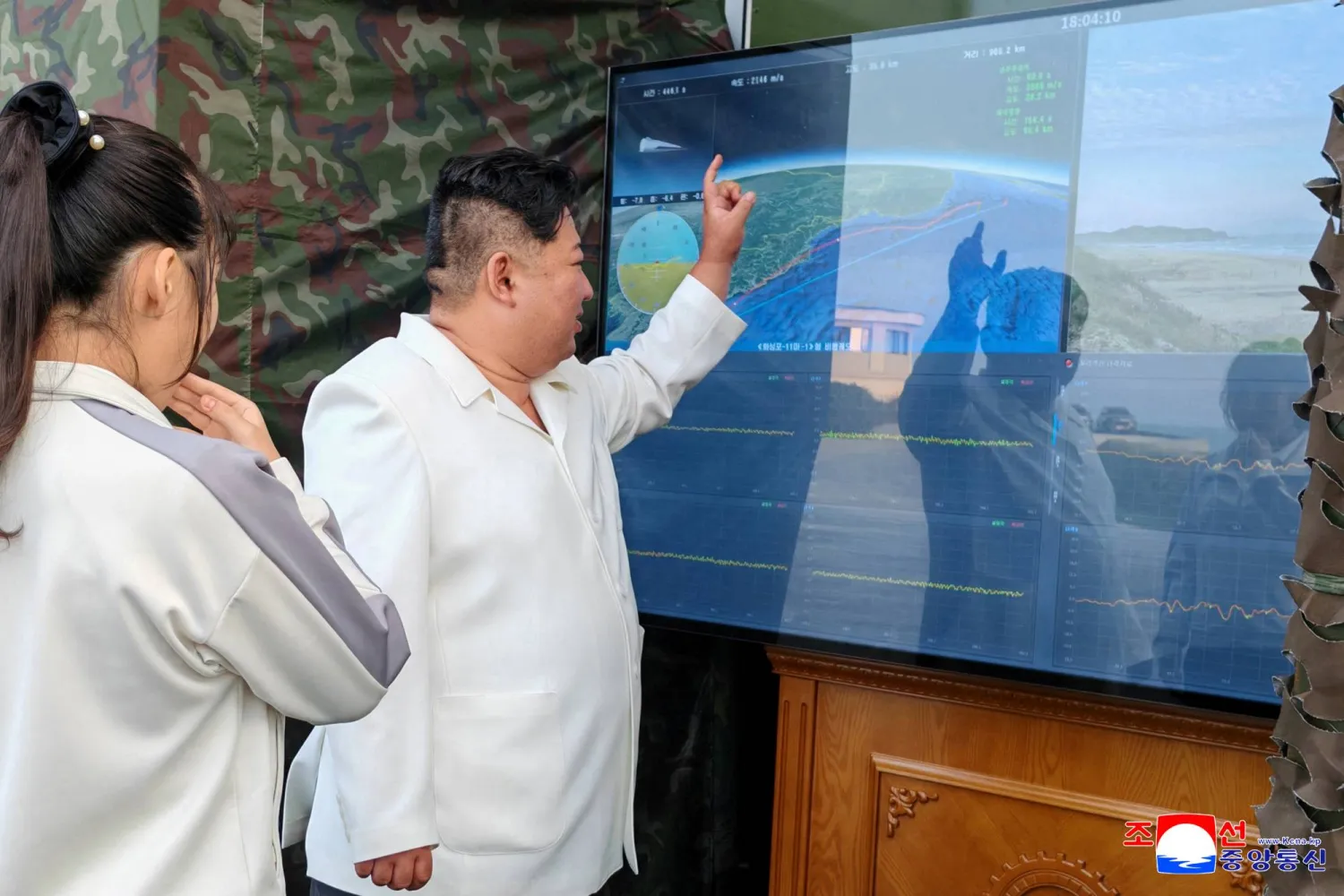
North Korea Conducted Test of Upgraded Rocket Launcher System, KCNA Says

North Korean leader Kim Jong Un, accompanied by his daughter Kim Ju Ae, attends a test of a new type of weapon in Pyongyang, North Korea, in this picture released by North Korea's official Korean Central News Agency on September 22, 2026. (KCNA via Reuters)
TT

North Korea Conducted Test of Upgraded Rocket Launcher System, KCNA Says

North Korean leader Kim Jong Un, accompanied by his daughter Kim Ju Ae, attends a test of a new type of weapon in Pyongyang, North Korea, in this picture released by North Korea's official Korean Central News Agency on September 22, 2026. (KCNA via Reuters)

North Korea conducted a test firing of an upgraded 240mm guided multiple rocket launcher system on Tuesday, state news agency KCNA reported on Thursday.

The test proved the accuracy and superiority of the range-extended rockets, which use an autonomous precision guidance system, KCNA said.

The rockets are able to ‌strike targets ‌100 km (62 miles) away in ‌a ⁠trajectory flight mode ⁠and 115 km away in a combined glide mode, it added.

The development of such rockets assures North Korea of a significant change in the firepower readiness along the southern border, the ⁠news agency said, effectively ‌referring to the ‌one it shares with South Korea.

Pak Jong-chon, ‌vice-chairman of the Central Military Commission who ‌oversaw the test, stressed the need to concentrate the deadliest and most destructive attack forces on the southern border, KCNA said.

South ‌Korea's defense ministry did not immediately respond to an emailed ⁠Reuters ⁠request for comment

Pyongyang has been steadily upgrading its tactical and conventional arsenal that it intends to deploy near the border with South Korea.

In June, North Korean leader Kim Jong Un oversaw tests of key weapons, including an upgraded rocket launcher and tactical missiles, that the country said would also be used to defend its southern border.


Outgoing UN Chief Makes Final Climate Push at New York Summit

United Nations Secretary-General Antonio Guterres addresses the 81st United Nations General Assembly at UN headquarters in New York City, US, September 22, 2026. (Reuters)
TT

Outgoing UN Chief Makes Final Climate Push at New York Summit

United Nations Secretary-General Antonio Guterres addresses the 81st United Nations General Assembly at UN headquarters in New York City, US, September 22, 2026. (Reuters)

Outgoing UN chief Antonio Guterres on Wednesday hailed the "unstoppable" rise of renewable energy and urged countries to develop firm plans to quit fossil fuels in his final climate meeting at the world organization's New York headquarters.

Speaking a day after denouncing "Big Oil" for treating the atmosphere like an "open sewer," the 77-year-old secretary-general used his opening speech to sound a note of hope.

"Renewables are the cheapest, fastest, and most secure source of new electricity almost everywhere," he said. "Clean energy has gone from alternative to unstoppable."

He called on countries to lift their emissions cutting targets and release concrete plans to quit fossil fuels -- a cause given a boost by Germany, Europe's biggest economy, which issued its roadmap hours before Guterres' swansong address as a summit convener.

Germany is the third country to do so, after France and the Netherlands.

"We are the first generation with the tools to end the fossil fuel age -- and the last who can avert climate catastrophe," Guterres concluded.

The former Portuguese prime minister made climate change a defining issue of his nine-year tenure that ends on December 31, and was hailed by Rachel Cleetus of the nonprofit Union of Concerned Scientists as "an extraordinary climate champion," for consistently elevating the voices of the most vulnerable during his term.

The stakes are clearer than ever, as the impacts of climate change surge around the world -- from heat waves and wildfires in Europe to catastrophic flooding in Nepal and Tibet triggered by a glacier collapse.

Extreme weather events are set to worsen with a strengthening El Nino cycle that has already tied a record for intensity, months from its peak.

And the world is set to shoot past -- at least temporarily -- 1.5C of warming. Scientists say temperature increases above that level will bring on worse climate-linked catastrophes.

- Türkiye tempers expectations -

His remarks at the "High-level Event on Climate Action and the Just Transition" were followed by Australian Prime Minister Anthony Albanese and Turkish President Recep Tayyip Erdogan.

The two countries are co-hosting COP31 climate talks in Antalya in November in an unusual arrangement, with Australia running the talks but Türkiye hosting the event and rallying support for voluntary pledges.

"Action is not optional. For Australia, as it must be for all of us, that action starts at home," said Albanese, touting the fact that during the height of the last Australian summer, half of the power for the grid came from renewables.

Yet his climate change and energy minister Chris Bowen is traveling to India this week for talks on strengthening Australia's oil supplies.

Erdogan followed and appeared to temper expectations about the degree of ambition at COP31.

"Any proposal that fails to reconcile our climate objectives with social and economic realities will be doomed to fail," he said.

- Emissions cuts, financing, electrification -

Guterres asked leaders to accelerate the greening of their economies and mobilize climate financing for developing countries. Momentum is also gathering for electrification: switching combustion-based systems, like in heating and vehicles, to electricity.

Türkiye has advanced a "35x35" target to increase electricity's share of global energy consumption to 35 percent by 2035. However, it has not specified that the electricity should be generated by renewables, which is key to tackling climate change.

Global renewable power capacity grew by a record amount last year. But as energy demand increases -- not least from AI data centers and air conditioning in a warming world -- clean energy is not growing fast enough to displace fossil fuels.

Pledges for Nepal -- where thousands remain missing after a devastating August 26 flood -- could also feature at the summit.

Nepalese Foreign Minister Shisir Khanal recently told Kantipur TV that financial support "is not a matter of charity; it is a matter of legal and moral liability" for his climate-vulnerable country, which produces negligible emissions.


US Invites Putin to December G20 Meeting, Possible Trump Summit

Russian President Vladimir Putin holds a meeting with members of the Russian government via videoconference at the Novo-Ogaryovo state residence, outside Moscow, Russia, 23 September 2026. (EPA/Vyacheslav Prokofyev / Sputnik / Kremlin Pool)
TT

US Invites Putin to December G20 Meeting, Possible Trump Summit

Russian President Vladimir Putin holds a meeting with members of the Russian government via videoconference at the Novo-Ogaryovo state residence, outside Moscow, Russia, 23 September 2026. (EPA/Vyacheslav Prokofyev / Sputnik / Kremlin Pool)

The United States has invited Russian President Vladimir Putin to a December G20 meeting in Miami, Florida where he could hold a summit with President Donald Trump, US Secretary of State Marco Rubio said on Wednesday.

The Kremlin said Russia would consider the invitation.

Rubio, speaking after meeting ‌Russian Foreign ‌Minister Sergei Lavrov on the sidelines ‌of ⁠the UN General ⁠Assembly, said the US remained open to engaging with Russia on the war in Ukraine, despite stalled efforts to bring an end to the conflict.

"We’ve invited President Putin to the G20. We think ⁠it’s an opportunity for him to ‌engage not just ‌with the president but with other world leaders. ‌We hope that’s an invitation he’ll accept," ‌Rubio said.

Putin and Trump met in Anchorage, Alaska in August last year, but Putin has not visited the lower 48 states since ‌before Russia's full-scale invasion of Ukraine.

Russian news agencies quoted Kremlin spokesman ⁠Dmitry ⁠Peskov as saying that Russia was "grateful and appreciative for this invitation."

"We will make a decision and work through it via diplomatic channels," he added.

Rubio also said Trump could potentially meet again with China's President Xi Jinping, who arrived in Washington for a state visit on Wednesday, at the G20 summit as well as at the Asia-Pacific Economic Cooperation meeting in Shenzhen.


Heads of AI Firms Tell UN Security Council That It Could Be a Risk to All Humanity

CEO of OpenAI Sam Altman speaks during a UN Security Council meeting on AI and international security under “Maintenance of International Peace and Security” during the 81st session of the UN General Assembly at the UN Headquarters on September 23, 2026 in New York City. (Getty Images/AFP)
TT

Heads of AI Firms Tell UN Security Council That It Could Be a Risk to All Humanity

CEO of OpenAI Sam Altman speaks during a UN Security Council meeting on AI and international security under “Maintenance of International Peace and Security” during the 81st session of the UN General Assembly at the UN Headquarters on September 23, 2026 in New York City. (Getty Images/AFP)

The heads of major artificial intelligence firms pleaded with the United Nations on Wednesday to save the world or at least its people — in the form of somehow regulating the burgeoning technology that they have been designing.

“If managed poorly, I even believe AI could be a risk to humanity as a whole,” said Dario Amodei, chief executive officer of Anthropic. And from his competitor Sam Altman, CEO of OpenAI, came this assessment: “We could lose control of the future to AI.”

Both said the countries of the world, through the UN Security Council, where they testified Wednesday, have to set safeguards of some kind, which would be actual controls to prevent the technology from getting too powerful to rein in.

They also called for the world to make sure that the power of AI isn’t concentrated in one company or country. They said that as they also touted the benefits of the technology for bettering humanity and what Altman called “giving people more power over their own lives.”

Those tech leaders “are telling us in stark terms that it cannot be left to them to prevent disaster from befalling the world,” said United Kingdom Foreign Secretary Ed Miliband said at the Security Council. “We cannot ignore them because they are right.”

AI will be at the heart of G20 discussions

Miliband said when the UK takes control of the G20 next year it will put controlling AI at the heart of discussions, looking for a single set of global standards “to insure that AI development is safe.”

But the United States said don’t do it.

Worries about control of AI are “not a reason to pause its further development or to constrain it with new global governance structure,” said White House Science Adviser Michael Kratsios. “We want you, our allies and partners, to share in the benefits of this technology.”

For most of the world leaders, along with California Governor Gavin Newsom in New York for climate discussions, one of the key questions about AI is this: Who should control life-and-death decisions — human or machine?

Amodei, Altman and Hugging Face CEO Clément Delangue, who spoke via a glitchy remote connection, spoke with the UN’s most powerful council because they and world leaders are trying to figure out not just whether to control AI, but by who, how it could possibly be done and when it might be just too late.

The day before, UN Secretary-General Antonio Guterres warned of “killer robots.” Experts and European leaders said that’s not hyperbole but something that’s either already a grim reality or perilously close.

Amodei called on the nations of the world to agree on not letting AI build biological weapons, figure out how to verify what models have the capability to do and “establish common standards” for testing and for loss of control and misuse.

French Foreign Minister Jean-Noel Barrot, whose country convened Wednesday’s meeting and has fostered various other coalitions and discussions about AI, compared the current state of it to both the runaway computer HAL9000 in the movie “2001: A Space Odyssey” and the dawn of the atomic age.

“Just as with the atom back then, the international community must now regulate AI in order to make the most of its potential and avoid the worst,” Barrot said.

Other leaders and nations are paying close attention to AI

His wasn't the only concern expressed during this high-profile UN meeting week.

Ukrainian President Volodymyr Zelenskyy, speaking at the General Assembly, said some kind of human control over machines must achieved soon. Otherwise, he said, for his country it may be just too late.

“There is already a real possibility that AI, not only people, will begin to decide what happens on the battlefield. And we need peace before we reach that point,” Zelenskyy said.

Last month, a Russian drone seemingly using AI “autonomously made a targeting decision that killed three Ukrainians. Killer robots are technically easy to build, and they are real. We should not be under any illusions otherwise,” said Kentaro Toyama, an information technology professor at the University of Michigan.

The UN meeting unfolded as Chinese President Xi Jinping headed to Washington for a much-anticipated state visit. The US and China are jostling for AI dominance, and AI interests are looking to what comes out of Xi’s discussions with US President Donald Trump.

Ahead of the meeting, US Treasury Secretary Scott Bessent said the two countries had discussed a potential new “notification mechanism” for AI incidents that could impact national security.

But on Tuesday, Trump, lauding AI as “superintelligence,” said the United States would reject efforts to control the technology as it tries to win the development race with China. Kratsios was the one of the few who used that term in the Security Council.

Meanwhile, regional groups in Europe, Asia and elsewhere also are trying to coordinate AI policies, and various nations — and even subcomponents, such as US states — are crafting their own.

Still, UN watchers and risk experts say the world body hasn’t been relegated to the sidelines on AI regulation.

“The UN is not in the driver’s seat of global discussions on AI, but it hasn’t been kicked out of the car yet,” said Daniel Forti, who oversees UN affairs at the International Crisis Group, a think tank.