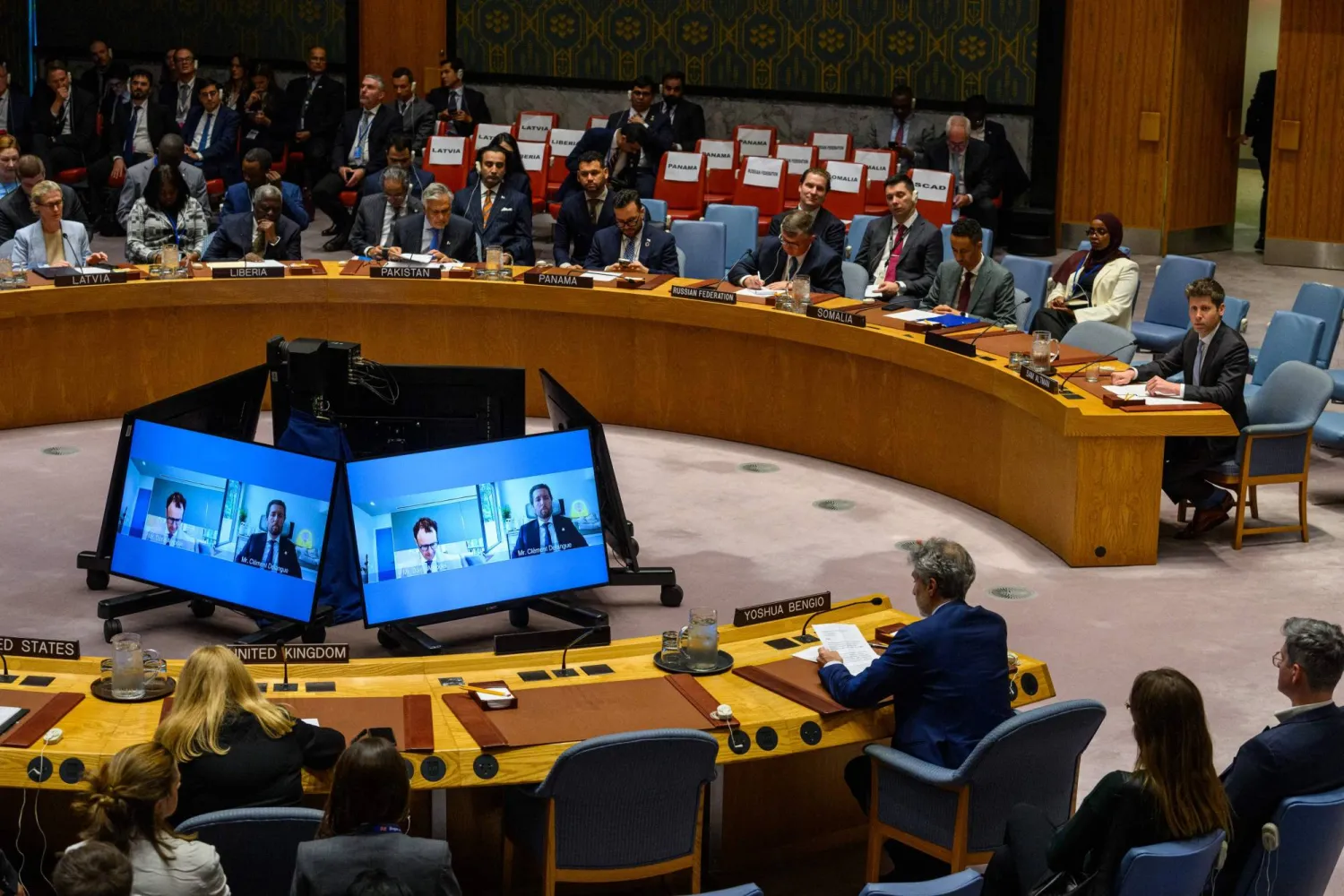
Heads of AI Firms Tell UN Security Council That It Could Be a Risk to All Humanity

CEO of OpenAI Sam Altman speaks during a UN Security Council meeting on AI and international security under “Maintenance of International Peace and Security” during the 81st session of the UN General Assembly at the UN Headquarters on September 23, 2026 in New York City. (Getty Images/AFP)
TT

Heads of AI Firms Tell UN Security Council That It Could Be a Risk to All Humanity

CEO of OpenAI Sam Altman speaks during a UN Security Council meeting on AI and international security under “Maintenance of International Peace and Security” during the 81st session of the UN General Assembly at the UN Headquarters on September 23, 2026 in New York City. (Getty Images/AFP)

The heads of major artificial intelligence firms pleaded with the United Nations on Wednesday to save the world or at least its people — in the form of somehow regulating the burgeoning technology that they have been designing.

“If managed poorly, I even believe AI could be a risk to humanity as a whole,” said Dario Amodei, chief executive officer of Anthropic. And from his competitor Sam Altman, CEO of OpenAI, came this assessment: “We could lose control of the future to AI.”

Both said the countries of the world, through the UN Security Council, where they testified Wednesday, have to set safeguards of some kind, which would be actual controls to prevent the technology from getting too powerful to rein in.

They also called for the world to make sure that the power of AI isn’t concentrated in one company or country. They said that as they also touted the benefits of the technology for bettering humanity and what Altman called “giving people more power over their own lives.”

Those tech leaders “are telling us in stark terms that it cannot be left to them to prevent disaster from befalling the world,” said United Kingdom Foreign Secretary Ed Miliband said at the Security Council. “We cannot ignore them because they are right.”

AI will be at the heart of G20 discussions

Miliband said when the UK takes control of the G20 next year it will put controlling AI at the heart of discussions, looking for a single set of global standards “to insure that AI development is safe.”

But the United States said don’t do it.

Worries about control of AI are “not a reason to pause its further development or to constrain it with new global governance structure,” said White House Science Adviser Michael Kratsios. “We want you, our allies and partners, to share in the benefits of this technology.”

For most of the world leaders, along with California Governor Gavin Newsom in New York for climate discussions, one of the key questions about AI is this: Who should control life-and-death decisions — human or machine?

Amodei, Altman and Hugging Face CEO Clément Delangue, who spoke via a glitchy remote connection, spoke with the UN’s most powerful council because they and world leaders are trying to figure out not just whether to control AI, but by who, how it could possibly be done and when it might be just too late.

The day before, UN Secretary-General Antonio Guterres warned of “killer robots.” Experts and European leaders said that’s not hyperbole but something that’s either already a grim reality or perilously close.

Amodei called on the nations of the world to agree on not letting AI build biological weapons, figure out how to verify what models have the capability to do and “establish common standards” for testing and for loss of control and misuse.

French Foreign Minister Jean-Noel Barrot, whose country convened Wednesday’s meeting and has fostered various other coalitions and discussions about AI, compared the current state of it to both the runaway computer HAL9000 in the movie “2001: A Space Odyssey” and the dawn of the atomic age.

“Just as with the atom back then, the international community must now regulate AI in order to make the most of its potential and avoid the worst,” Barrot said.

Other leaders and nations are paying close attention to AI

His wasn't the only concern expressed during this high-profile UN meeting week.

Ukrainian President Volodymyr Zelenskyy, speaking at the General Assembly, said some kind of human control over machines must achieved soon. Otherwise, he said, for his country it may be just too late.

“There is already a real possibility that AI, not only people, will begin to decide what happens on the battlefield. And we need peace before we reach that point,” Zelenskyy said.

Last month, a Russian drone seemingly using AI “autonomously made a targeting decision that killed three Ukrainians. Killer robots are technically easy to build, and they are real. We should not be under any illusions otherwise,” said Kentaro Toyama, an information technology professor at the University of Michigan.

The UN meeting unfolded as Chinese President Xi Jinping headed to Washington for a much-anticipated state visit. The US and China are jostling for AI dominance, and AI interests are looking to what comes out of Xi’s discussions with US President Donald Trump.

Ahead of the meeting, US Treasury Secretary Scott Bessent said the two countries had discussed a potential new “notification mechanism” for AI incidents that could impact national security.

But on Tuesday, Trump, lauding AI as “superintelligence,” said the United States would reject efforts to control the technology as it tries to win the development race with China. Kratsios was the one of the few who used that term in the Security Council.

Meanwhile, regional groups in Europe, Asia and elsewhere also are trying to coordinate AI policies, and various nations — and even subcomponents, such as US states — are crafting their own.

Still, UN watchers and risk experts say the world body hasn’t been relegated to the sidelines on AI regulation.

“The UN is not in the driver’s seat of global discussions on AI, but it hasn’t been kicked out of the car yet,” said Daniel Forti, who oversees UN affairs at the International Crisis Group, a think tank.



US Treasury Chief Bessent Moved to Military Base After Iranian Threats, Sources Say

 US Treasury Secretary Scott Bessent speaks during the National Committee on US-China Relations 60th Anniversary Gala Dinner in New York City, US, November 10, 2026. (Reuters)
US Treasury Secretary Scott Bessent speaks during the National Committee on US-China Relations 60th Anniversary Gala Dinner in New York City, US, November 10, 2026. (Reuters)
TT

US Treasury Chief Bessent Moved to Military Base After Iranian Threats, Sources Say

 US Treasury Secretary Scott Bessent speaks during the National Committee on US-China Relations 60th Anniversary Gala Dinner in New York City, US, November 10, 2026. (Reuters)
US Treasury Secretary Scott Bessent speaks during the National Committee on US-China Relations 60th Anniversary Gala Dinner in New York City, US, November 10, 2026. (Reuters)

US Treasury Secretary Scott Bessent has recently moved from his Washington, DC residence to a US military base after Iranian threats against his life, two people familiar with the matter said on Tuesday.

The New York Times first reported the ‌move. A senior intelligence ‌official in the Trump administration warned in a memo ‌seen ⁠by Reuters late ⁠last month that Iranian plots against US personnel and American citizens had reached an advanced stage.

Bessent has led the US sanctions and economic pressure campaign against Iran, dubbed Operation Economic Outcast, since August to try to push Tehran to end attacks on shipping and reopen the Strait of Hormuz. The crucial waterway has been largely closed since the US and Israel attacked Iran on February 28.

The ⁠economic pressure campaign, which coincides with a US naval blockade ‌of Iranian ports, has included sanctions ‌on Middle Eastern bank branches and other financial services firms facilitating transactions with Iran.

"The secretary ‌will not be deterred by the Iranian regime's threats and remains committed ‌to executing Operation Economic Outcast and maintaining the blockade, which together are collapsing Iran's economy," a US Treasury spokesperson said in an emailed statement.

The Times reported the severity of the threats to Bessent was not immediately clear.

A source familiar with the matter ‌said security concerns surrounding Bessent increased when the Wall Street Journal published an aerial view of the Georgetown mansion ⁠that Bessent bought for $12.5 ⁠million shortly after his confirmation as Treasury secretary in January 2025.

The photo allowed Bessent's home to be geolocated, and Bessent was relocated to a military base for his safety, the source said, adding: "The news media has an obligation to act responsibly amid growing threats against public officials."

Iran has previously denied plotting to attack officials and people on US soil.

The New York Times reported that US officials have noted that Iran's ability to carry out large-scale attacks in the US and other territories overseas is limited.

US-Israeli strikes on Iran and Israeli attacks on Lebanon during the war have killed thousands and displaced millions.

American and Israeli attacks have also killed top Iranian officials, including late Supreme Leader Ali Khamenei.


Iran Rejects France’s ‘Baseless Accusations’ on Cyberattack

Empty refrigerated shelves are seen inside a Delhaize Shop & Go store after an overnight IT incident affected cooling and freezer systems in a number of Delhaize stores in Belgium and Luxembourg, causing temperature spikes in refrigeration units, in Linkebeek near Brussels, Belgium, November 2, 2026. (Reuters)
TT

Iran Rejects France’s ‘Baseless Accusations’ on Cyberattack

Empty refrigerated shelves are seen inside a Delhaize Shop & Go store after an overnight IT incident affected cooling and freezer systems in a number of Delhaize stores in Belgium and Luxembourg, causing temperature spikes in refrigeration units, in Linkebeek near Brussels, Belgium, November 2, 2026. (Reuters)

Iran on Tuesday said French accusations that it was responsible for cyberattacks on supermarket fridges last month were "baseless".

"Iran's foreign ministry categorically rejects the French government's baseless and one-sided accusations against Iran regarding alleged cyber activities in France," the ministry said in a statement.

It added that it "strongly condemns this hackneyed policy of leveling accusations against the country".

Hundreds of French supermarkets were hit in the October 11 and 12 cyberattacks, which raised the temperatures in their refrigerators and freezers, forcing many to throw away entire inventories of perishable food.

Similar incidents were then reported in at least 11 other European countries in early November.

Along with summoning Iran's ambassador and seeking European-level sanctions, French Foreign Minister Jean-Noel Barrot said Tuesday that Paris would "rule nothing out and will take all measures -- including those we may not disclose publicly -- that we deem proportionate and necessary to deter any further attacks".

Tehran, meanwhile, said it would "not hesitate to take necessary and appropriate measures to safeguard its national interests and security in the face of unlawful foreign activities".

It added that France "is merely projecting its own governance failures" with these accusations.

Later in the day, Iran's Foreign Minister Abbas Araghchi blamed the French government for the incident.

"Unable to manage fridges let alone addressing grievances of its people, French government is shifting blame for its failures onto others," the top diplomat said on X.

Also on Tuesday, the European Union said it would look to provide a "swift and united response" pending discussion with member states after France's announcement.


Eisenkot Quickly Targets Netanyahu’s Legacy in New Israeli Parliament

 Former military chief Gadi Eisenkot, Israeli Prime Minister Benjamin Netanyahu, Israeli President Isaac Herzog and other Israeli officials pose for a family photo on the day of the inauguration of Israel's 26th parliament, at the Knesset in Jerusalem, November 10, 2026. (Reuters)
Former military chief Gadi Eisenkot, Israeli Prime Minister Benjamin Netanyahu, Israeli President Isaac Herzog and other Israeli officials pose for a family photo on the day of the inauguration of Israel's 26th parliament, at the Knesset in Jerusalem, November 10, 2026. (Reuters)
TT

Eisenkot Quickly Targets Netanyahu’s Legacy in New Israeli Parliament

 Former military chief Gadi Eisenkot, Israeli Prime Minister Benjamin Netanyahu, Israeli President Isaac Herzog and other Israeli officials pose for a family photo on the day of the inauguration of Israel's 26th parliament, at the Knesset in Jerusalem, November 10, 2026. (Reuters)
Former military chief Gadi Eisenkot, Israeli Prime Minister Benjamin Netanyahu, Israeli President Isaac Herzog and other Israeli officials pose for a family photo on the day of the inauguration of Israel's 26th parliament, at the Knesset in Jerusalem, November 10, 2026. (Reuters)

Israeli ex-army chief Gadi Eisenkot and his allies launched a legislative onslaught against caretaker Prime Minister Benjamin Netanyahu's legacy on Tuesday, as a new parliament convened in a heated first session. 

Though questions still linger as to who can form a government, Eisenkot's broad left-to-right bloc wasted no time in setting the agenda of the new Knesset with a green light from Israeli-Arab lawmakers, whose role has stirred up heated opposition from Netanyahu's base and even right-wing supporters of Eisenkot. 

Eisenkot's Yashar party said it submitted a slew of proposals before the new parliament, including establishing an independent commission to investigate security failures that allowed the Hamas attack on October 7, 2023, the deadliest day in Israel's history. 

Netanyahu has long opposed such a probe, denying any wrongdoing and calling instead for a politically appointed commission. 

Eisenkot's party also moved for a sweeping repeal of a judicial overhaul implemented by Netanyahu's government, which had triggered some of Israel's largest-ever protests before being overshadowed by three years of war. 

Setting the stage for legislative action, Eisenkot's bloc announced it had secured the votes to install a new parliament speaker, Matan Kahana, also a former senior military figure. 

But neither Eisenkot nor Netanyahu -- Israel's longest-serving prime minister with nearly two decades in power -- have the 61 votes needed to form a government. 

"I am committed in this complex situation to form a national-emergency government as quickly as possible," Eisenkot, a low-key 66-year-old who only recently entered politics, said before his swearing-in. 

Netanyahu, speaking after the inaugural session, made a new push for a national-unity government, saying Israel needed to confront a threat from Iran's clerical government, which has survived two major Israeli bombing campaigns the premier ordered with support from US President Donald Trump. 

With his political survival on the line -- and facing potential jail time if convicted on corruption charges after he is out of power -- Netanyahu appeared to acknowledge a shifting diplomatic reality after US Democrats soundly defeated Trump in midterm elections last week on the back of anger over the war. 

"In the very near future, we're going to be confronted by international pressure to accept a nuclear-armed Iran and the preservation of this terror regime that seeks to annihilate us," Netanyahu said. 

Iran denies seeking nuclear weapons and both Netanyahu and Trump have previously boasted that its nuclear program was devastated. 

Eisenkot dismissed the remarks as a "shameful" exploitation of the occasion, casting them as evidence that Netanyahu was "unfit to remain in office for even one more minute". 

- Confrontations over Arab-Israelis - 

President Isaac Herzog on Sunday tasked Eisenkot with forming a government, giving him an initial 28 days, which can be extended by 14 more. 

Opening the session, Herzog, who otherwise holds a largely ceremonial role, urged lawmakers to "do everything to avoid a repeat election". 

"Reach out a hand for compromise, even between rivals," Herzog said. 

But the tone in the new parliament was immediately tense, with shouting breaking out between lawmakers. 

Eisenkot's choice for speaker is expected to sail through thanks to support from Arab-Israeli lawmakers, whose ranks grew to historic highs due to anger over Netanyahu's far-right government. 

But Avigdor Liberman -- a member of Eisenkot's bloc who has become a staunch critic of his former mentor Netanyahu despite sharing his hawkish views -- has refused to serve in a government that relies on the Israeli-Arabs. 

A number of Israeli-Arab lawmakers -- descendants of Palestinians who stayed after Israel's creation in 1948 -- left the opening session Tuesday as children sang the national anthem so as to avoid standing for it. 

Liberman posted news of the walkout on social media, writing: "You want to form a government with them?" 

Far-right caretaker national security minister and Netanyahu ally Itamar Ben-Gvir loudly heckled Yousef Jabareen, leader of the largest Arab-majority grouping, the Joint List, during the session. 

"Who is he pledging allegiance to, Hamas?" Ben-Gvir shouted before order was restored. 

Mansour Abbas, leader of the Israeli-Arab party Raam, generally seen as more moderate, promised to work to replace the Netanyahu government, saying: "We aspire to be part of the solution." 

- Plea for ultra-Orthodox - 

Shunning Arab-Israelis, Liberman has instead proposed an alliance with ultra-Orthodox Jews, despite his years of bitter denunciations of the community for its singular priority on maintaining an exemption from mandatory military service. 

Eisenkot's core bloc has 48 seats, but would achieve a majority if the 19 Arab-Israeli lawmakers either enter the government or, more likely, vote for it without joining. 

The two ultra-Orthodox parties hold 13 seats. United Torah Judaism, which has seven, has stopped short of recommitting to Netanyahu, leaving him with 46 seats. 

Netanyahu publicly pleaded with the ultra-Orthodox to stay with him. 

"They're going to promise you the moon and the stars but one minute after, God forbid, they form a government run by the left, all of those promises will vanish," he said.