


Heavy Fighting, Internet Disruption as Ethiopia Conflict Rages

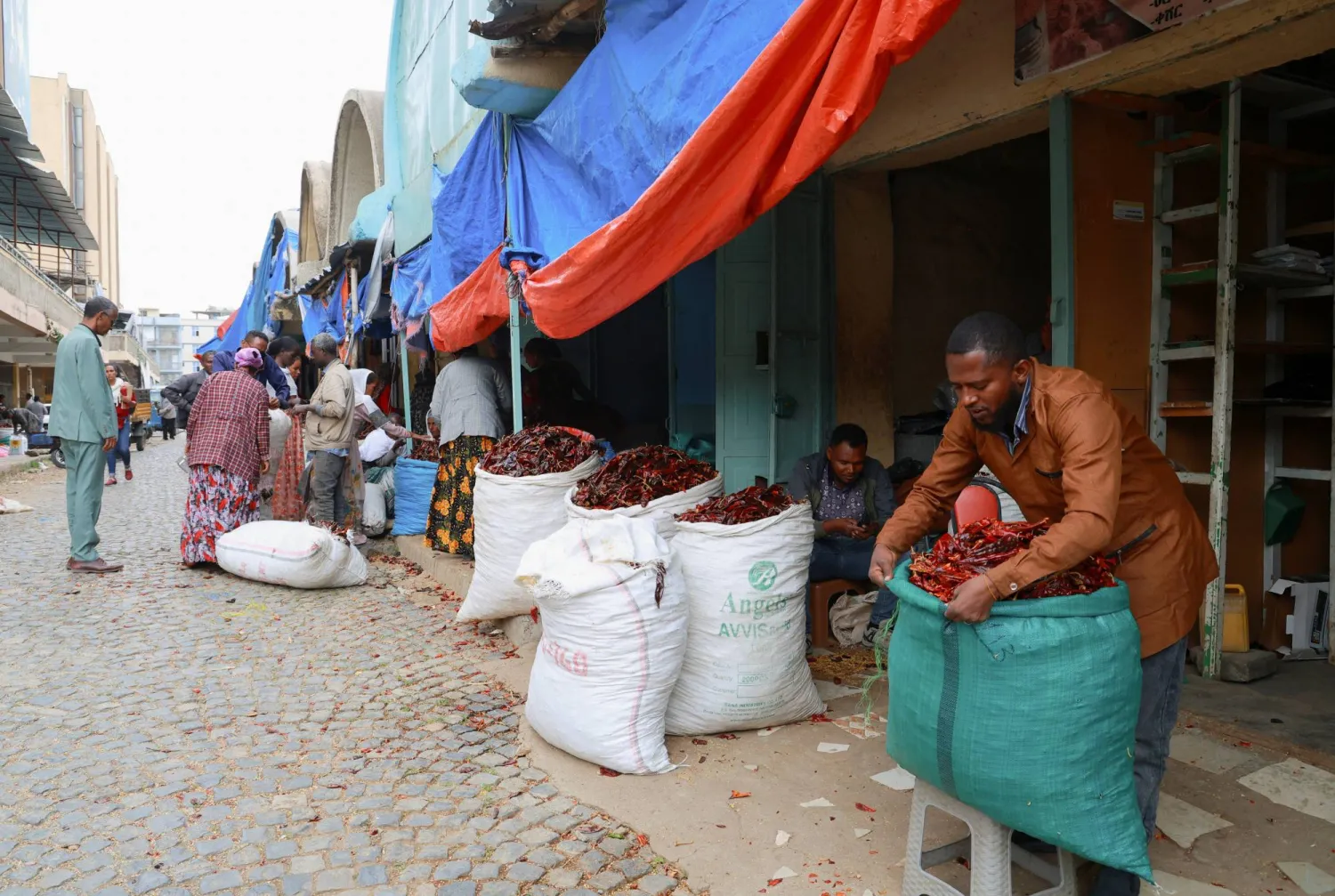
A man holds a sack of dried pepper at a local market, as tensions intensify after the forces launched a major offensive against the federal government in multiple locations, in Mekelle, Tigray Region, Ethiopia, September 24, 2026. Obtained by REUTERS
TT

Heavy Fighting, Internet Disruption as Ethiopia Conflict Rages

A man holds a sack of dried pepper at a local market, as tensions intensify after the forces launched a major offensive against the federal government in multiple locations, in Mekelle, Tigray Region, Ethiopia, September 24, 2026. Obtained by REUTERS

Ethiopian forces battled overnight to repel an assault by Tigray rebels in the Afar region, a humanitarian source said Friday, with reports of an internet blackout in the north of the country.

Rebels in the northern Tigray region seized local airports and launched attacks into the neighboring states of Afar and Amhara this week, saying they were once again in a "full-blown war" with the federal government.

Locals fear a repeat of the telecoms blackout and supplies blockade imposed on Tigray during the last civil war in 2020-2022 that killed an estimated 600,000 people.

Online monitor Netblocks said there was an "internet disruption in northern Ethiopia corresponding to reports of a telecoms blackout in Tigray". AFP was unable to contact sources in the region by phone on Friday.

A humanitarian source in Afar said there was "heavy fighting overnight" around the town of Abala that sits in the mountains on the border with Tigray.

"The federal forces pushed the rebels from entering the town," the source said, adding that a drone was used by the army.

Heavy clashes occurred in North Wollo Zone of Amhara on Thursday, including around the UNESCO World Heritage sites in Lalibela, home to Ethiopia's famed rock churches.

Analysts say the Tigray People's Liberation Front (TPLF) appears to be repeating its strategy from the last war -- pushing south through Amhara towards the capital, Addis Ababa, while the offensive in Afar is likely aimed at cutting off supplies from Djibouti, which provides almost all of Ethiopia's international trade cargo, including fuel.

The TPLF has forged an alliance with six other armed groups around the country in a bid to overthrow the government of Prime Minister Abiy Ahmed.

"The alliance is likely trying to seize settlements alongside key infrastructure routes to undermine federal government's ability to supply," Edward Bach of consultancy firm Verisk Maplecroft told AFP.

The government has a significant military advantage, however, with a large arsenal of drones, an army numbering some 500,000.

The renewed fighting comes at an awkward moment for the United States, which only this month lifted sanctions on Ethiopia and Eritrea related to atrocities committed during the last civil war, saying the "national emergency... has expired".

The US embassy sided with Ethiopia's government this week, saying it was "disappointed to see the leadership of the TPLF... launch a large-scale offensive".

The conflict could also draw in neighboring Eritrea, which fears landlocked Ethiopia is planning to invade it to gain access to the Red Sea.

- Panic buying -

Back in Tigray, prices for basic goods have been spiking as locals raced to stock up on supplies.

"There is panic in the community," Samuel Gebreslassie, 37, who works in a spice shop in the Tigray capital, Mekelle, told AFP on Thursday.

"There is deep fear that banks, telecom networks, electricity and basic goods could be cut off again."

The TPLF ruled the whole of Ethiopia from 1991 to 2018 before being sidelined with Abiy's rise, eventually triggering a civil war marked by widespread war crimes and sexual violence.

The Pretoria Peace Agreement of 2022 maintained an uneasy calm until last year, but was never fully implemented, with around one million people still displaced.

Sporadic clashes then resumed, with the federal forces launching multiple drone strikes in Tigray in recent months and massing troops at the border.

Rights groups have accused the TPLF of a campaign of forced recruitment this year as it prepared for renewed conflict.



US 'Must Choose' Whether to End War: Iran President to Fox News

Pezeshkian took a defiant stand at the UN, for which he travelled to the United States, telling the world that Iran would not 'bend at the knee' to Washington. TIMOTHY A. CLARY / AFP/File
TT

US 'Must Choose' Whether to End War: Iran President to Fox News

Pezeshkian took a defiant stand at the UN, for which he travelled to the United States, telling the world that Iran would not 'bend at the knee' to Washington. TIMOTHY A. CLARY / AFP/File

It is for the United States to choose whether to end its war in Iran as Tehran does not wish to continue fighting, Iranian President Masoud Pezeshkian told Fox News in an interview aired Thursday.

Pezeshkian took a defiant stand at the UN Wednesday, for which he travelled to New York, telling the world that Iran would not "bend at the knee" to Washington -- even as US President Donald Trump acknowledged ongoing US-Iran talks.

"When we can resolve issues through dialogue, we shouldn't resort to killing one another. But with the instigations conducted by Israel, they have imposed this war on us," he said in remarks translated by the broadcaster.

"But we do not wish to continue. It's America that must choose whether it wants to end this or not."

Pezeshkian insisted Iran was ready to strike a deal with Trump to end the conflict.

"Why is it that within two weeks after the signing of an agreement, they chose to blow it up?" he said of the collapse of a shaky ceasefire.

"If the current American government, within international legal frameworks, wishes to reach an agreement, fine. If not, before the (US midterm) elections or after the elections, what difference does it make for us?"

Iranian Foreign Minister Abbas Araghchi took part in a meeting with Trump's roving envoy Steve Witkoff and son-in-law Jared Kushner on the sidelines of the UN General Assembly in New York. Their talks did not immediately yield a breakthrough.

- Houthi backers? -

As violence raged between Yemen's Houthi militant movement -- widely seen to be Iran-backed -- and the Yemeni government forces, Pezeshkian insisted the Houthis do not take direction from Tehran's government.

Washington and the Yemeni government, accuse Iran of backing the Houthi militant movement.

"The Houthis are responsible for their own actions. They don't take directions from us as those who are resisting in the region, based on the situations that have been imposed on them," Pezeshkian said, according to the broadcaster's translation of his remarks.

"We have contacts with them. There is no systematic relationship," he added.


Pope Leo in France: The Issues on the Table

Pope Leo's trip is the first papal state visit to France since Benedict XVI's in 2008. Filippo MONTEFORTE / AFP
TT

Pope Leo in France: The Issues on the Table

Pope Leo's trip is the first papal state visit to France since Benedict XVI's in 2008. Filippo MONTEFORTE / AFP

Pope Leo XIV is to begin an official visit to France on Friday, with several thorny issues hanging over the trip, from clerical sexual abuse to the country's new assisted dying law.

Here are some of the key issues the pontiff is expected to face while on the first official visit to France by a head of the Roman Catholic Church in 18 years:

- Clerical abuse -

The Vatican announced in August that Pope Leo XIV will meet victims of clerical sexual abuse during his visit.

The leader of the world's 1.4 billion Catholics has promised to further efforts to reform the Church in the wake of the global sexual abuse scandal.

A 2021 inquiry found that clergy or lay members of the Church had abused about 330,000 people as minors in France, over the span of 70 years.

The Church's reputation has since been hit by further scandals, including a raft of sexual abuse accusations against charity icon Abbe Pierre and widespread physical and sexual abuse at the Notre-Dame de Betharram boarding school in southwestern France.

The first pontiff from the United States is due to meet seven victims on Sunday in Lourdes, a town in southwestern France.

Those to speak to the pope include a former student at Betharram who is now 80 years old.

The format is similar to one the pope used in Spain in June, where Pope Leo promised the Church would make "additional efforts" to change.

Mosaics that once adorned the Lourdes sanctuary have been covered up after accusations that the artist behind them, a Slovenian priest called Marko Rupnik, abused a community of adult religious women in the 1990s.

- Assisted dying law -

France's parliament passed legislation in June establishing a right to assisted dying for some adults suffering from an incurable condition.

The move drew strong criticism from the Catholic Church in France, which denounced the bill as a serious "rupture".

Cardinal Jean-Marc Aveline, head of the French bishops' conference, said "the defense of the dignity of human life" was at the heart of the pope's message.

"How will he convey this in France? We shall see," he added.

Martin Dumont, the secretary-general of a religion research institute in France, said it was possible Pope Leo would raise the subject.

"But I would be very surprised if he took a confrontational stance," Dumont said, suggesting the pope could instead highlight the need to care for the elderly and vulnerable.

- Presidential election -

France is just seven months away from the first round of its presidential election to replace President Emmanuel Macron, making Pope Leo's visit unusual as pontiffs rarely travel to a country so close to a major vote.

Far-right leader Marine Le Pen's anti-immigration National Rally party views next year's contest as its best chance yet to take power.

Migration, which is set to be a hot-button issue in the election, was a key focus on Pope Leo's trip to Spain in June, where he condemned "indifference" towards migrants.

In France, he is due to visit an association providing support for migrants, a "strong signal", according to Dumont.

- Europe's role -

Pope Leo's trip will be the first papal state visit to France since Benedict XVI's in September 2008.

Coming after his visit to Spain, it highlights the pope's interest in engaging with historically Catholic but increasingly non-religious European countries that were largely overlooked by his predecessor, Francis.

Pope Leo is due to deliver several speeches, including at the UN culture agency UNESCO and in the northeastern city of Metz, near the German border.

His program in Metz includes a meeting entitled "To the roots of Europe for peace and unity".

While he is unlikely to single out any political actors during his visit to France, his message will inevitably carry political weight, said Charles Mercier, a director at France's Ecole Pratique des Hautes Etudes.

"By choosing to defend European integration, the Pope is already giving his visit a political direction," said Mercier.

The pope also places considerable importance on multilateralism and sees Europe as a counterweight to global powers, said Francois Mabille, director of the Geopolitical Observatory on Religion.

That includes "Europe's role in relation to what he calls 'imperial logics' -- namely the United States, China and Russia," Mabille said.


Moscow ‘Will Not Pause’ Military Operations in Ukraine, to Review Putin's Participation in G20 Summit

A split screen showing top US diplomat Marco Rubio (left) and his Russian counterpart Sergei Lavrov (AFP) 
TT

Moscow ‘Will Not Pause’ Military Operations in Ukraine, to Review Putin's Participation in G20 Summit

A split screen showing top US diplomat Marco Rubio (left) and his Russian counterpart Sergei Lavrov (AFP) 

Moscow again said it “will not pause” its military operations in Ukraine for fear that Europe might exploit a temporary halt to supply Kyiv with more weapons, also stating that it is still reviewing the US invitation for President Vladimir Putin to attend the upcoming G20 Summit in Miami.

“We are not going to have a pause in our special military operation,” Russian Foreign Minister Sergei Lavrov told the UN Security Council on Wednesday, accusing Europe of wanting to use a halt to the fighting to “pump the Kyiv regime with weapons.”

On Wednesday, US secretary of state Marco Rubio raised concerns the Ukraine war could spread, amid warnings in the UK and Europe over the threat posed by an increasingly hostile Russia.

Speaking at the UN in New York, America’s top diplomat said, “One of the concerns we have, among many, about the war between Russia and Ukraine is that it could metastasize and spread into other places, that it could grow into somewhere else, be it through a hybrid attack, be it through a sabotage attack, be it through a misunderstanding – some pilot went the wrong way and all of a sudden you’ve got active combat.”

He said the US has raised that in multiple meetings with multiple countries because it is of real concern.

Rubio’s remarks came shortly after his meeting with Lavrov on the sidelines ‌of ⁠the UN General ⁠Assembly in New York.

Despite his concerns, Rubio said Russia and Ukraine have both expressed interest in a limited ceasefire covering energy and grain sectors.

Washington invited Putin to a December G20 meeting in Miami, Florida where he could hold a summit with Trump, according to Rubio.

He said Washington remains open to engaging with Russia on the war in Ukraine, despite stalled efforts to bring an end to the conflict.

The G20 summit will take place at the president’s golf resort, Trump National Doral Miami, from Dec. 14-15.

On Thursday, the Kremlin said Russia would consider the invitation.

Kremlin spokesman Dmitry Peskov told reporters in Moscow that the Russian government was grateful for the invitation extended to Putin to attend the G20 summit in Miami, adding that officials would determine their position through diplomatic channels.

“We will determine our position (on whether to take part in the event or not) and work it out through diplomatic channels,” Peskov said when asked about the invitation, declining to specify whether Putin would attend the gathering in person or participate virtually.

Trump has been trying since returning to the White House in January last year to ⁠broker an end to the war in Ukraine, but without achieving a breakthrough.

Peskov reiterated Russia's ⁠position that it is seeking a peace settlement, not a temporary ceasefire.

For his part, President Volodymyr Zelensky told leaders at a “Crimean Platform” summit on the sidelines of the UN that Kyiv was ready for a maritime truce in the Black Sea based on proposals such as those put forward by Egypt, India and ⁠Türkiye.

Ukraine and its allies are racing to secure limited agreements on energy infrastructure and Black Sea shipping before winter, fearing renewed Russian strikes on power and heating facilities, while Moscow continues to show little interest in wider negotiations to end the war.

Trump met with Zelenskiy on Tuesday to discuss a ceasefire on energy-related targets.

“Ukrainians understand that this winter could be very harsh for us. But in response, we will have no choice but to make it painful for Russia too,” Zelensky told the UN General Assembly during the annual gathering of world leaders in New York.

“When someone gives Russia more money through trade, they are giving this war more time. That is precisely why we insist on restricting trade with the aggressor, and that is precisely why we ourselves are cutting into Russia’s revenues,” he said.

Lavrov will deliver Russia's address at the United Nations General Assembly on Saturday, while Putin is skipping the New York gathering as he has for over a decade.

Meanwhile, Zelensky said Ukraine has transferred two captured North Korean soldiers to South Korea, prompting Seoul to express regret that ‌the move had been disclosed publicly despite an agreement to keep it private.

Announcing the transfer in an address to the General Assembly, Zelensky said the two men had recently been sent to South Korea after being captured while fighting for Russia in the war against Ukraine.

“These guys are not easy to capture alive. One of them, when he realized he was going to be taken prisoner, tried to kill himself. And he was shocked that fate did not let him die,” Zelensky said in his speech.

Ukraine captured the two North Koreans in Russia's Kursk region ⁠in January 2025. They were the first North Korean soldiers to be captured alive since the country joined the Russia-Ukraine war in 2024.

Zelensky said at the time that he would hand them over to North Korean leader Kim Jong Un if he could facilitate their exchange for Ukrainians held captive in Russia.

Human rights groups, however, urged him to send them to South Korea, citing the risks of punishment the soldiers faced. South Korean media reported that the two captured soldiers had expressed their desire to defect to South Korea.

The transfer comes as South Korea has voiced support for efforts to revive dialogue with North Korea and Trump has renewed his willingness to engage with Pyongyang.

South Korean President Lee Jae Myung said it was “deeply regretful” that Ukraine had made the transfer public, adding that the two sides had agreed not to disclose it.

“The repatriation of North Korean prisoners is a highly sensitive issue with significant implications for diplomacy, national security, and ‌the situation ⁠on the Korean Peninsula,” Lee said in an X post.

North Korea has sent an estimated 14,000-15,000 troops to support Russia's war since 2024, according to Ukrainian and ⁠South Korean estimates, with most deployed in the Kursk region to help repel a Ukrainian incursion.

Pyongyang has also supplied Russia with millions of artillery and mortar rounds, as well as ballistic missiles, long-range artillery systems and multiple-launch rocket systems, according to Ukrainian and independent assessments.

Meanwhile, around 10 powerful explosions rocked the Ukrainian capital in the early hours of Thursday, according to AFP journalists on the scene, as authorities issued a missile alert.

The explosions, which set off car alarms, came a day after a series of Russian strikes that killed at least seven people in Ukraine and sparked fires in Kyiv.

Shortly before the blasts rang out, the Ukrainian Air Force had issued a warning that Russian ballistic missiles were heading toward Kyiv and its surroundings and the Chernigiv region north of the capital.

The Ukrainian capital, home to around 3 million people, has been the target of particularly intense drone attacks over the past few days, amid a marked escalation in long-range strikes on both sides of the front line.

Also, seven people were killed in a Russian strike on a farm in the Kharkiv region of eastern Ukraine on Thursday, Prime Minister Sergiy Koretsky said, after a wave of attacks across the country.

“In the morning, a drone struck an agricultural enterprise, killing seven people and injuring 10,” he wrote on Telegram.