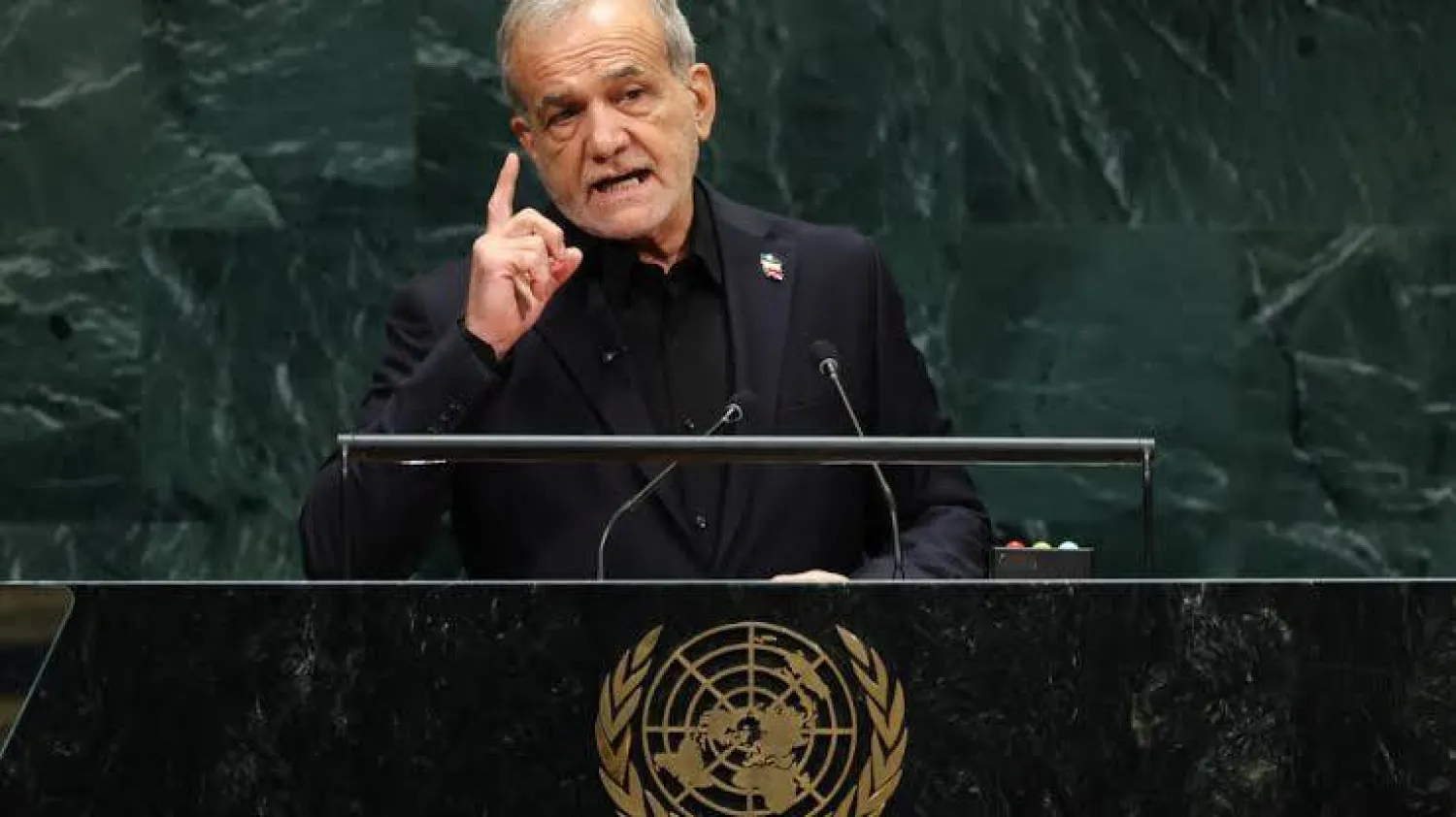
US 'Must Choose' Whether to End War: Iran President to Fox News

Pezeshkian took a defiant stand at the UN, for which he travelled to the United States, telling the world that Iran would not 'bend at the knee' to Washington. TIMOTHY A. CLARY / AFP/File
TT

US 'Must Choose' Whether to End War: Iran President to Fox News

Pezeshkian took a defiant stand at the UN, for which he travelled to the United States, telling the world that Iran would not 'bend at the knee' to Washington. TIMOTHY A. CLARY / AFP/File

It is for the United States to choose whether to end its war in Iran as Tehran does not wish to continue fighting, Iranian President Masoud Pezeshkian told Fox News in an interview aired Thursday.

Pezeshkian took a defiant stand at the UN Wednesday, for which he travelled to New York, telling the world that Iran would not "bend at the knee" to Washington -- even as US President Donald Trump acknowledged ongoing US-Iran talks.

"When we can resolve issues through dialogue, we shouldn't resort to killing one another. But with the instigations conducted by Israel, they have imposed this war on us," he said in remarks translated by the broadcaster.

"But we do not wish to continue. It's America that must choose whether it wants to end this or not."

Pezeshkian insisted Iran was ready to strike a deal with Trump to end the conflict.

"Why is it that within two weeks after the signing of an agreement, they chose to blow it up?" he said of the collapse of a shaky ceasefire.

"If the current American government, within international legal frameworks, wishes to reach an agreement, fine. If not, before the (US midterm) elections or after the elections, what difference does it make for us?"

Iranian Foreign Minister Abbas Araghchi took part in a meeting with Trump's roving envoy Steve Witkoff and son-in-law Jared Kushner on the sidelines of the UN General Assembly in New York. Their talks did not immediately yield a breakthrough.

- Houthi backers? -

As violence raged between Yemen's Houthi militant movement -- widely seen to be Iran-backed -- and the Yemeni government forces, Pezeshkian insisted the Houthis do not take direction from Tehran's government.

Washington and the Yemeni government, accuse Iran of backing the Houthi militant movement.

"The Houthis are responsible for their own actions. They don't take directions from us as those who are resisting in the region, based on the situations that have been imposed on them," Pezeshkian said, according to the broadcaster's translation of his remarks.

"We have contacts with them. There is no systematic relationship," he added.


Iran Proposes Reopening Hormuz Within 7 Days

FILE PHOTO: Vessels at the Strait of Hormuz, as seen from Musandam, Oman, September 23, 2026. Picture taken through a window. REUTERS/Stringer/File Photo
TT

Iran Proposes Reopening Hormuz Within 7 Days

FILE PHOTO: Vessels at the Strait of Hormuz, as seen from Musandam, Oman, September 23, 2026. Picture taken through a window. REUTERS/Stringer/File Photo

Iran has submitted a proposal to the United States to end their war and reopen the Strait of Hormuz within seven days, its foreign minister told media outlets in New York.

"If certain conditions are met, the strait will be open within seven days and talks will start," Abbas Araghchi, who is in the US for the UN General Assembly, told media outlets including the New York Times and The Guardian.

Japanese news agency Kyodo was the first to report the proposal, citing a senior Iranian official on Tuesday.

Iranian media, however, denied the Kyodo report, while authorities in Tehran have not clarified their position.

Araghchi also met for talks on Tuesday with US President Donald Trump's envoy Steve Witkoff.

Iran has previously set out seven conditions for ending the war and reopening the strait.

According to Araghchi, as quoted by the New York Times, the latest plan calls for a cessation of all hostilities in the Middle East for seven days, including in Lebanon.

It also calls for the release of frozen Iranian assets estimated to be worth at least $12 billion, as well as the lifting of sanctions on Iranian oil and an end to the US naval blockade of Iran.

On the seventh day of the truce, Iran would reopen Hormuz.

Araghchi said he was waiting for a US response to the plan and maintained that China supported the proposal.

Chinese President Xi Jinping is visiting the United States this week where he is meeting with Trump for talks.

Hossein Mohebi, a spokesman for the Revolutionary Guards, the ideological arm of Iran's military, told AFP in an exclusive interview on Tuesday that ending hostilities in Yemen was also among Tehran's demands.

The US and Iran signed a memorandum of understanding in June that aimed to end the war, reopen the strait and launch talks on Iran's nuclear program.

But the deal broke down shortly afterwards when Iran fired on commercial ships in Hormuz that it accused of deviating from its approved route through the waterway.

Iran requires ships to obtain authorization before passage, citing security and sovereignty reasons.

Ships that refuse to comply are regularly targeted, while the United States sporadically bombs Iranian coastal areas in retaliation.


An Explosion Near the Acropolis in Greece Injures at Least 2 People and Collapses a Building

Firefighters work at the scene following a powerful blast that caused a building to collapse and injured at least two people in Athens' Plaka district, Friday, Sept. 25, 2026. (AP Photo/Petros Giannakouris)
TT

An Explosion Near the Acropolis in Greece Injures at Least 2 People and Collapses a Building

Firefighters work at the scene following a powerful blast that caused a building to collapse and injured at least two people in Athens' Plaka district, Friday, Sept. 25, 2026. (AP Photo/Petros Giannakouris)

A powerful blast shook the Greek capital’s tourist district of Plaka, near the ancient Acropolis, on Friday morning, causing a building to collapse and injuring at least two people who had to be rescued from an adjacent building, authorities said.

The fire department said the explosion occurred in an old two-story building in the Plaka district, the historic part of Athens that lies at the foot of the Acropolis hill, Greece’s most visited ancient monument. The building collapsed, while neighboring buildings were also damaged, The Associated Press said.

Firefighters rescued two women from an adjacent building, with police saying both were being transported to a hospital. Local media said a passer-by was also slightly injured by the blast.

Police cordoned off the area, while the fire department said rescue crews were checking whether any more people might be trapped.

Video footage from the scene showed rubble strewn across the street, with parked cars smashed by falling debris.

The cause of the explosion was not immediately clear, but local media said a gas leak was suspected.


Pope Leo in France: The Issues on the Table

Pope Leo's trip is the first papal state visit to France since Benedict XVI's in 2008. Filippo MONTEFORTE / AFP
TT

Pope Leo in France: The Issues on the Table

Pope Leo's trip is the first papal state visit to France since Benedict XVI's in 2008. Filippo MONTEFORTE / AFP

Pope Leo XIV is to begin an official visit to France on Friday, with several thorny issues hanging over the trip, from clerical sexual abuse to the country's new assisted dying law.

Here are some of the key issues the pontiff is expected to face while on the first official visit to France by a head of the Roman Catholic Church in 18 years:

- Clerical abuse -

The Vatican announced in August that Pope Leo XIV will meet victims of clerical sexual abuse during his visit.

The leader of the world's 1.4 billion Catholics has promised to further efforts to reform the Church in the wake of the global sexual abuse scandal.

A 2021 inquiry found that clergy or lay members of the Church had abused about 330,000 people as minors in France, over the span of 70 years.

The Church's reputation has since been hit by further scandals, including a raft of sexual abuse accusations against charity icon Abbe Pierre and widespread physical and sexual abuse at the Notre-Dame de Betharram boarding school in southwestern France.

The first pontiff from the United States is due to meet seven victims on Sunday in Lourdes, a town in southwestern France.

Those to speak to the pope include a former student at Betharram who is now 80 years old.

The format is similar to one the pope used in Spain in June, where Pope Leo promised the Church would make "additional efforts" to change.

Mosaics that once adorned the Lourdes sanctuary have been covered up after accusations that the artist behind them, a Slovenian priest called Marko Rupnik, abused a community of adult religious women in the 1990s.

- Assisted dying law -

France's parliament passed legislation in June establishing a right to assisted dying for some adults suffering from an incurable condition.

The move drew strong criticism from the Catholic Church in France, which denounced the bill as a serious "rupture".

Cardinal Jean-Marc Aveline, head of the French bishops' conference, said "the defense of the dignity of human life" was at the heart of the pope's message.

"How will he convey this in France? We shall see," he added.

Martin Dumont, the secretary-general of a religion research institute in France, said it was possible Pope Leo would raise the subject.

"But I would be very surprised if he took a confrontational stance," Dumont said, suggesting the pope could instead highlight the need to care for the elderly and vulnerable.

- Presidential election -

France is just seven months away from the first round of its presidential election to replace President Emmanuel Macron, making Pope Leo's visit unusual as pontiffs rarely travel to a country so close to a major vote.

Far-right leader Marine Le Pen's anti-immigration National Rally party views next year's contest as its best chance yet to take power.

Migration, which is set to be a hot-button issue in the election, was a key focus on Pope Leo's trip to Spain in June, where he condemned "indifference" towards migrants.

In France, he is due to visit an association providing support for migrants, a "strong signal", according to Dumont.

- Europe's role -

Pope Leo's trip will be the first papal state visit to France since Benedict XVI's in September 2008.

Coming after his visit to Spain, it highlights the pope's interest in engaging with historically Catholic but increasingly non-religious European countries that were largely overlooked by his predecessor, Francis.

Pope Leo is due to deliver several speeches, including at the UN culture agency UNESCO and in the northeastern city of Metz, near the German border.

His program in Metz includes a meeting entitled "To the roots of Europe for peace and unity".

While he is unlikely to single out any political actors during his visit to France, his message will inevitably carry political weight, said Charles Mercier, a director at France's Ecole Pratique des Hautes Etudes.

"By choosing to defend European integration, the Pope is already giving his visit a political direction," said Mercier.

The pope also places considerable importance on multilateralism and sees Europe as a counterweight to global powers, said Francois Mabille, director of the Geopolitical Observatory on Religion.

That includes "Europe's role in relation to what he calls 'imperial logics' -- namely the United States, China and Russia," Mabille said.