‘I Reject their Proposal,’ Says Trump after Iran’s Offer on Hormuz

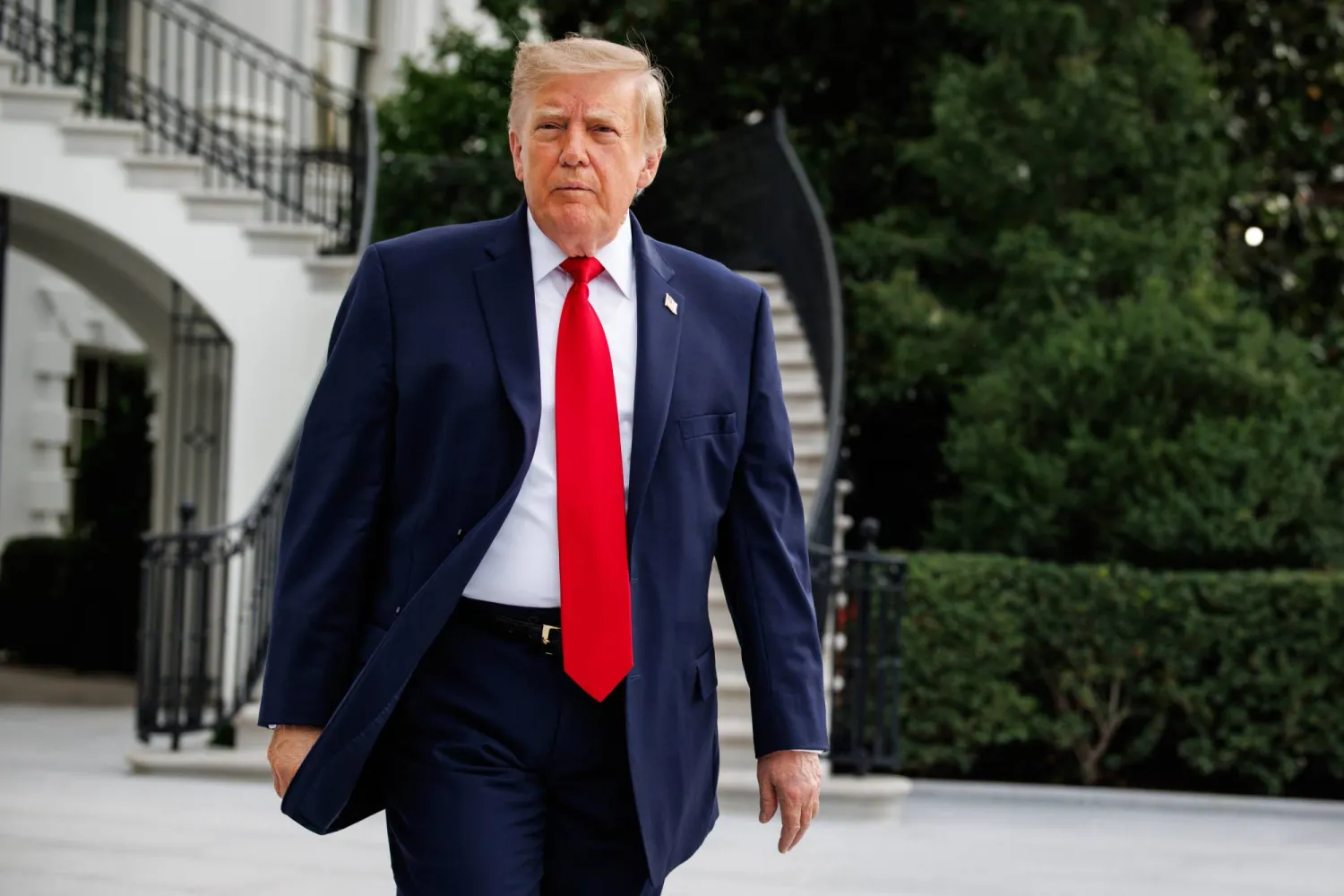
US President Donald Trump walks out of the South Portico towards members of the press before departing from the new South Lawn helipad in Marine One at the White House in Washington, DC, USA, 26 September 2026. EPA/Samuel Corum / POOL
TT

‘I Reject their Proposal,’ Says Trump after Iran’s Offer on Hormuz

US President Donald Trump walks out of the South Portico towards members of the press before departing from the new South Lawn helipad in Marine One at the White House in Washington, DC, USA, 26 September 2026. EPA/Samuel Corum / POOL

US President Donald Trump on Saturday rejected a truce deal proposed by Iran that Tehran said could have reopened the Strait of Hormuz to shipping within a week if Washington met certain conditions.

The waterway is key to the world's energy supply and is now central to the conflict between the US and Iran, which is at a stalemate after nearly seven months.

"I reject their proposal," Trump told reporters outside the White House before leaving for a college football game. "They want to make a deal where they open the Strait immediately because they're losing so badly.

"They want to make a deal and I think that's fine. I like making a deal too," he said.

Iran's President Masoud Pezeshkian, who was on his way back to Tehran after attending the UN General Assembly in New York, told CBS News the proposal had been developed "in coordination" with supreme leader Mojtaba Khamenei, according to an excerpt from the video interview shared by Iranian media.

Iran's plan calls for a cessation of all hostilities in the Middle East, including in Lebanon, according to Foreign Minister Abbas Araghchi, who met earlier in the week with Trump's envoy Steve Witkoff.

He said the conditions were the same as those laid out in a memorandum of understanding signed with the US earlier this year, which called for the release of frozen Iranian assets, the lifting of sanctions on Iranian oil and an end to the US naval blockade.

On the seventh day of the truce, Iran would reopen Hormuz. Pezeshkian told CBS that the "process will begin from the very day they accept it."

In New York, Pezeshkian met with UN Secretary-General Antonio Guterres, according to his office, and said: "Iran has not walked away from the negotiating table but, given past experiences, it no longer trusts the United States."

Araghchi said at the UN: "Iran has conveyed to the United States, through Qatar, a concrete seven-day plan. If the necessary conditions are met, the strait can be reopened, and normal maritime passage restored within seven days."

"The choice now rests with the United States. Iran does not accept coercion, threats or intimidation, and Iran will not surrender its sovereign rights under pressure," he added.

However, within hours of his comments The Wall Street Journal reported that Trump was skeptical that Tehran would meet his demands and expects to renew the US bombing campaign.

Trump also posted an image to his Truth Social platform of a map showing the Strait of Hormuz circled and labelled "Trump Strait."

Hossein Mohebi, a spokesman for Iran's Revolutionary Guards, was quoted by Tasnim news agency as saying: "We will not cease punishing the US until Iran's seven conditions are met."


At Least Two Dead as Floods Hit Eastern Spain

Parked cars are half-submerged in a flooded park area after heavy rainfall that hit the area early in the morning, in the town of Algeciras, southern Spain, 18 October 2026. (EPA)
TT

At Least Two Dead as Floods Hit Eastern Spain

Parked cars are half-submerged in a flooded park area after heavy rainfall that hit the area early in the morning, in the town of Algeciras, southern Spain, 18 October 2026. (EPA)

At least two people have died after heavy rain triggered flooding in eastern Spain, authorities said Monday, as rescuers worked to evacuate stranded residents and officials urged people in the Valencia region to stay indoors.

Videos released by Valencia's regional meteorological agency showed streets turned into torrents, sweeping away vehicles in several towns in the provinces of Valencia and Alicante.

"Road travel is impossible, you must stay at home," Juan Carlos Valderrama, the Valencia region's emergency chief, said on Monday morning, warning that intense and persistent rainfall was causing severe flooding.

One person died in Sagunto, local authorities said overnight from Sunday to Monday, while firefighters in neighboring Catalonia reported the death of a woman who fell into a stream.

Emergency services and soldiers from Spain's military emergency response unit were working early on Monday to evacuate people whose homes had flooded, including residents who had taken refuge on rooftops.

"Rescue operations are continuing in areas that are difficult to access. People are urged to avoid all travel," Prime Minister Pedro Sanchez said on X, describing the situation in the Valencia region as "very difficult".

Scientists say human-driven climate change is intensifying the Mediterranean storms that typically hit eastern Spain in autumn as the sea absorbs heat during the summer, leading to increased evaporation and heavier rainfall.

National weather agency AEMET announced Friday that last month was mainland Spain's hottest September on record, after the country registered its warmest summer between June and August.


Nations Seek Reset at UN Talks as Nature Goals off Track

Armenia is hosting the UN COP17 biodiversity talks in its capital Yerevan. KAREN MINASYAN / AFP
TT

Nations Seek Reset at UN Talks as Nature Goals off Track

Armenia is hosting the UN COP17 biodiversity talks in its capital Yerevan. KAREN MINASYAN / AFP

Nearly 200 nations are gathering in Armenia on Monday for critical negotiations as governments come under pressure to salvage a landmark nature pact whose goals are slipping out of reach.

Most countries joined a historic call four years ago to halt and reverse the destruction of nature by 2030 but governments have been slow to act on these pledges, said AFP.

Many goals of the so-called "Paris Agreement for Nature" are falling behind, including a centerpiece commitment to protect 30 percent of Earth's land and oceans.

Some of the toughest objectives of the pact, such as cutting subsidies for fossil fuels and other powerful industries, have made little progress.

"We must honestly admit that collectively, we are not yet on track as needed," Armenia's Prime Minister Nikol Pashinyan said Friday ahead of the formal UN negotiations known as COP17.

The summit comes at a difficult time, with public finances under strain and political attention fixed on conflicts, geopolitical tensions and a global energy crisis.

Only a handful of world leaders, including UN chief Antonio Guterres but mostly heads of state from nearby Central Asian nations, turned up for a high-level session ahead of the formal negotiations.

But the stakes could not be higher, Guterres said at the event on Friday, describing an unrelenting "war on nature" that threatened the very livability of the planet for future generations.

"We need more action, more speed and more will," he said.

"Halfway to 2030, Yerevan is our moment of accountability. It is time to ask ourselves -- are we doing enough?"

- Falling short -

A United Nations scorecard issued ahead of COP17 reported that progress toward the 23 biodiversity targets was being made -- but unevenly, and not at pace to meet the 2030 deadline.

A major tension at the summit will be money, with the report finding that the effort to close a yawning gap in necessary finance "falls far short" of what is needed.

European and other wealthy nations obligated to provide biodiversity finance have been pushing for large emerging economies like China to also contribute.

But attention is likely to focus more on how private capital, not public finances, might help plug the shortfall.

A key priority will be encouraging corporations to donate a share of profits to a near-empty UN fund to support conservation in developing countries.

Guterres also fixed the spotlight on state incentives for extractive industries, scolding governments for "spending money on the wrong things" despite pledging to reform harmful subsidies.

"Subsidizing fossil fuels is subsidizing suicide," said Guterres of the coal, oil and gas that are "boiling our planet and are the scourge of biodiversity".

For the mountainous Caucasus nation of Armenia, the summit is one of the largest international events it has ever hosted, with thousands of visitors expected over the next two weeks.

The hosts have stressed that action -- not new pledges -- would define success at COP17.

"The world does not need a new vision. We have one. What it needs is delivery," Adil Najam, global president of WWF International, said Friday.


Russian FM to Visit Iran as Moscow Looks to Mediate in War

 Russia's Foreign Minister Sergei Lavrov speaks during a joint press conference with Bahrain's foreign minister and the Gulf Cooperation Council (GCC) secretary-general after the 9th Joint Ministerial Meeting of the Strategic Dialogue between GCC and the Russian Federation in Manama on October 18, 2026. (AFP)
Russia's Foreign Minister Sergei Lavrov speaks during a joint press conference with Bahrain's foreign minister and the Gulf Cooperation Council (GCC) secretary-general after the 9th Joint Ministerial Meeting of the Strategic Dialogue between GCC and the Russian Federation in Manama on October 18, 2026. (AFP)
TT

Russian FM to Visit Iran as Moscow Looks to Mediate in War

 Russia's Foreign Minister Sergei Lavrov speaks during a joint press conference with Bahrain's foreign minister and the Gulf Cooperation Council (GCC) secretary-general after the 9th Joint Ministerial Meeting of the Strategic Dialogue between GCC and the Russian Federation in Manama on October 18, 2026. (AFP)
Russia's Foreign Minister Sergei Lavrov speaks during a joint press conference with Bahrain's foreign minister and the Gulf Cooperation Council (GCC) secretary-general after the 9th Joint Ministerial Meeting of the Strategic Dialogue between GCC and the Russian Federation in Manama on October 18, 2026. (AFP)

Russian Foreign Minister Sergei Lavrov was due to arrive in Iran on Monday in his first visit since the outbreak of the Middle East war, as Russia seeks to play a mediating role.

Iranian foreign ministry spokesman Esmaeil Baqaei confirmed the trip on Sunday, saying in a statement that the two sides will discuss "regional and international developments".

Lavrov, who is scheduled to meet with Iranian Foreign Minister Abbas Araghchi, said Moscow's efforts are "aimed at preventing the return of a large-scale war", with talks stalled between Tehran and Washington.

The visit comes after Russian President Vladimir Putin told his Iranian counterpart Masoud Pezeshkian in early October that Moscow was prepared to contribute to mediation efforts.

Russia and Iran, two of the most heavily sanctioned nations in the world, maintain close ties. Their military and economic cooperation has only increased since the Russian invasion of Ukraine in 2022.

The Middle East war began in February with US-Israeli strikes on Iran.

Despite a ceasefire in April, followed by a US-Iran memorandum of understanding in June, hostilities in and around the Strait of Hormuz have not stopped.

Iran claims control over the strategic waterway -- through which one-fifth of the world's hydrocarbons pass in normal times -- and regularly targets vessels that cross without its authorization.

In response, Washington has been maintaining a naval counter-blockade on Iranian ports.

Russia's foreign ministry said discussions during Lavrov's visit were expected to focus on "ways to resolve the acute international crisis triggered by the unlawful aggression of the US and Israel against Iran".

The ministry said the war had been a blow to stability and security "not only in the near and Middle East, but also on a global scale".