US, Iran Separately Talk with Mediators in Latest Bid to End War

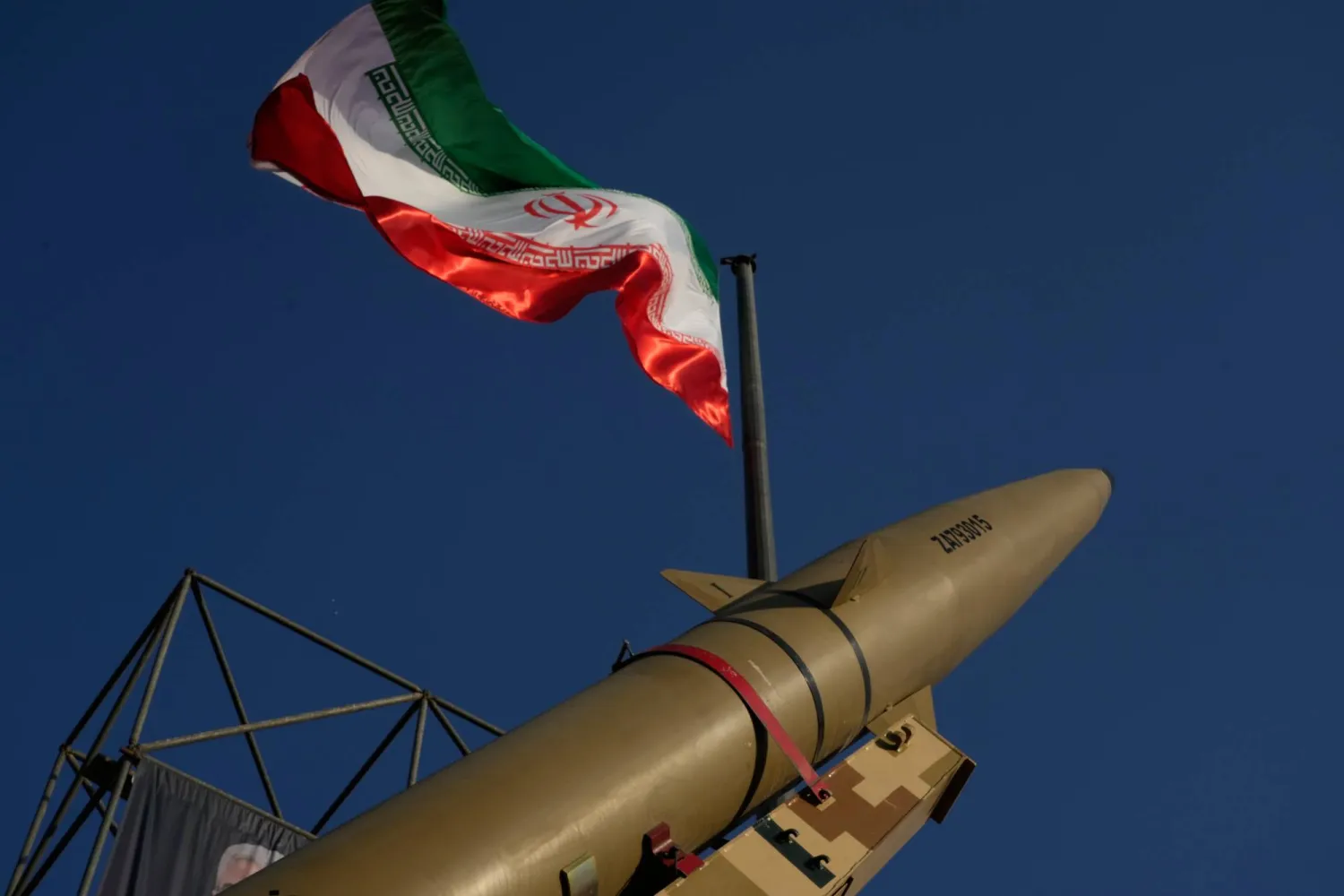
 An Iranian missile is displayed under the country's national flag in a military exhibition commemorating the anniversary of the start of the 1980-88 Iraq-Iran war at Baharestan Square, in Tehran, Monday, Sept. 28, 2026. (AP)
An Iranian missile is displayed under the country's national flag in a military exhibition commemorating the anniversary of the start of the 1980-88 Iraq-Iran war at Baharestan Square, in Tehran, Monday, Sept. 28, 2026. (AP)
TT

US, Iran Separately Talk with Mediators in Latest Bid to End War

 An Iranian missile is displayed under the country's national flag in a military exhibition commemorating the anniversary of the start of the 1980-88 Iraq-Iran war at Baharestan Square, in Tehran, Monday, Sept. 28, 2026. (AP)
An Iranian missile is displayed under the country's national flag in a military exhibition commemorating the anniversary of the start of the 1980-88 Iraq-Iran war at Baharestan Square, in Tehran, Monday, Sept. 28, 2026. (AP)

US and Iranian officials spoke separately with mediators on Monday as part of a renewed effort to end seven months of war, according to officials of both countries.

Any further talks are expected to focus on an amended version of a seven-day proposal that Iran presented last week on the sidelines of the United Nations General Assembly, an official briefed on the negotiations told Reuters.

The war began in late February with US and Israeli attacks on ‌Iran, killing ‌thousands of people over seven months and shocking global markets ‌as ⁠vital waterways for ⁠oil remained choked. The US and Iran have twice previously agreed to ceasefires in mediated peace talks, in April and June. Those agreements quickly unraveled.

Iranian Foreign Minister Abbas Araghchi, who remained in New York after attending the General Assembly, said Iran expected to receive the US response to its latest ceasefire proposals and its conditions for restoring passage of maritime traffic in the Strait of Hormuz, according to state ⁠news agency IRNA.

"If the Americans claim they are seeking ‌an agreement or a peaceful solution, we ‌have presented that solution," Araqchi said.

US officials separately spoke with mediators on Monday, US President Donald ‌Trump told reporters at the White House, without giving further details.

TRUMP HAS ‌FLAGGED FURTHER TALKS THIS WEEK

Iran's seven-day plan envisages an end to all hostilities in Iran and Lebanon, the unfreezing of billions of dollars' worth of Iranian assets, an end to sanctions on Iranian oil and the lifting of the US blockade on Iranian ‌ports.

Iran would then allow the reopening of the Strait of Hormuz, a vital conduit for oil tankers, and the ⁠two sides would ⁠also resume talks on Iran's nuclear program and Trump's wish to seize or eliminate its highly enriched uranium.

Trump said on Saturday he had rejected Iran's proposal, saying Iran wanted a swift agreement because of the crippling economic pressure it is under. However, he also told Axios on Sunday that he expected US negotiators to engage in further talks this week.

Araghchi said on Sunday that mediators had not formally conveyed a US rejection, and that Iran was awaiting Washington's definitive position before deciding its next steps.

"Our conditions are clear, and any move toward reopening the Strait of Hormuz is contingent on these conditions being met," he said on Sunday, adding that only a negotiated solution could resolve the impasse.


Taiwan Issues Warnings as Typhoon Champi Nears

Typhoon Champi is expected to sweep past Taiwan's northeast coast, bringing strong winds and heavy rains. I-Hwa Cheng / AFP
TT

Taiwan Issues Warnings as Typhoon Champi Nears

Typhoon Champi is expected to sweep past Taiwan's northeast coast, bringing strong winds and heavy rains. I-Hwa Cheng / AFP

A powerful typhoon headed towards Taiwan on Thursday, triggering the cancellation of dozens of flights and prompting warnings for locals to prepare for heavy rain, strong winds and giant waves.

Typhoon Champi is expected to sweep past Taiwan's northeast coast on Friday and Saturday as it moves towards China and Japan, Taiwan's Central Weather Administration (CWA) said.

Champi is packing maximum sustained wind speeds of 213 kilometers (132 miles) per hour, according to the latest update from the Joint Typhoon Warning Center, said AFP.

It was previously classed as a super typhoon, with reported maximum sustained wind speeds of nearly 300 kph, but it has since weakened.

"Everyone is urged to remain vigilant and be prepared for the strong winds and heavy rains brought by the typhoon," Taiwanese President Lai Ching-te said in a Facebook post.

Champi is the latest in a busy Pacific storm season turbo-charged by the El Nino weather phenomenon that has caused unprecedented warming in the equatorial Pacific.

The storm is expected to dump up to 900 millimeters (35 inches) of rain in the mountainous regions of northern and northeastern Taiwan from Thursday to Saturday, and whip up waves more than six meters (20 foot) tall.

More than 23,000 military personnel are on standby to help with rescue efforts. Over 150 domestic and international flights were cancelled for Thursday ahead of the storm.

"Typhoon Champi is expected to have its most significant impact starting all day tomorrow through the first half of Saturday," CWA forecaster Jason Cheng told AFP.

"Currently, the typhoon has a storm radius of 320 kilometers... Compared to the previous Typhoon Bavi, Champi's storm area is not as vast," Cheng said.

Millions of people in eastern China also braced for torrential downpours and flash flooding in the coming days.

China's Ministry of Water Resources initiated a level four emergency response on Thursday for flooding in Shanghai and the coastal provinces of Jiangsu, Zhejiang and Fujian.

Level four is the lowest in China's emergency response hierarchy.

The ministry warned that Champi could bring "a period of significant rainfall" from Friday to Sunday, with "heavy to torrential downpours" expected in some areas, including "most of Shanghai and eastern Zhejiang".

Japan's two major airlines cancelled more than 110 flights from Thursday to Saturday.

The United Nations said Wednesday that the El Nino gripping the planet is heading off the charts, and that countries should take urgent action to prepare for the worst.

El Nino is expected to peak in December, but the human impact is set to last into 2027 and beyond.

The warming phase of a natural climate cycle, El Nino temporarily raises sea temperatures in the tropical Pacific, triggering changes in weather that can increase the risk of drought and flooding, and exacerbate man-made global warming.


France Reports 1st Human Shamonda Virus Case, Says No Health Risk

A health care worker administers a dose of Ervebo vaccine against the Ebola virus in Beni, North Kivu province, eastern Congo, Friday, Oct. 16, 2026. (AP Photo/Sebastien Kitsa Musayi)
TT

France Reports 1st Human Shamonda Virus Case, Says No Health Risk

A health care worker administers a dose of Ervebo vaccine against the Ebola virus in Beni, North Kivu province, eastern Congo, Friday, Oct. 16, 2026. (AP Photo/Sebastien Kitsa Musayi)

French health authorities said Thursday that the Shamonda virus, which usually affects livestock, had been detected in a human for the first time, in a severely immunocompromised patient who died earlier this month.

"Despite circulating in Africa and Asia for several decades, the Shamonda virus has never previously been detected in humans," the health and agriculture ministries said in a joint statement.

They said there was "no health risk to the general public identified at this time,” adding that the human infection appeared to be "an exceptional case involving a severely immunocompromised patient" hospitalized for a serious medical condition.


Seoul Sees No Signs of New North Korean Weapons on Border

A North Korean guard post and a giant loudspeaker on the north side of the Demilitarised Zone. Jung Yeon-je / AFP
TT

Seoul Sees No Signs of New North Korean Weapons on Border

A North Korean guard post and a giant loudspeaker on the north side of the Demilitarised Zone. Jung Yeon-je / AFP

South Korea's military said Thursday it had seen no signs of newly deployed North Korean weapons on their shared border, hours after Pyongyang said new "counter means" would be put on alert along its length.

Pyongyang has rejected claims it was behind an explosion that injured three South Korean soldiers last month inside the Demilitarized Zone (DMZ), the heavily mined buffer area that has divided the two Koreas since their 1953 armistice, and mockingly dismissed calls for an apology, said AFP.

The country on Monday called the situation along the border "grave", saying it was considering deploying additional "tactical strike means" to the area.

On Thursday, Kim Yo Jong, the powerful sister of leader Kim Jong Un, said the North would place loudspeakers on standby along the border "within days" and had put unspecified "new counter means" on alert.

The statement came less than 24 hours after Kim Yo Jong announced Pyongyang had moved new troop units into "firing position" after a visit to the border.

Both countries have occasionally turned to loudspeakers blaring propaganda across their shared border and other psychological warfare methods.

But Seoul's military said Thursday that it has seen no sign of new weapons being deployed so far.

"We have not observed any signs that North Korea is deploying new types of weaponry," Jang Do-young, spokesperson for the Joint Chiefs of Staff, told reporters.

"Nevertheless, given their claims, we are keeping a close watch on the situation," he added.

Asked about the North's loudspeaker claims, Jang said "routine maintenance work" had been observed even before it had issued its latest statements.

He added that Pyongyang's recent flurry of statements only suggested that the South's ongoing efforts to clear landmines inside the DMZ were "proving effective".

On Tuesday, North Korea decried what it claimed were nearly 1,000 "provocative" loudspeaker broadcasts and numerous warning shots fired by South Korean forces between October 1 and 17.

Seoul's military said Pyongyang was attempting to shift the blame for escalating military tensions, while confirming the use of loudspeakers and warning shots as "legitimate defensive measures".

Seoul has accused Pyongyang of "a clear violation of the Armistice Agreement" over the explosion that injured South Korean soldiers in the DMZ.

President Lee Jae Myung, meanwhile, has called for the North to return to dialogue, an overture Kim Yo Jong has slammed as "the climax of the farce".

North Korea has separately tested a slew of weapons recently, including a "new-type" precision-guided torpedo system and an intermediate-range hypersonic missile, both of which were said to use AI technology.