


Trump Says Top Tech Firms Have Signed Accord to ‘Self-Police’ AI Development

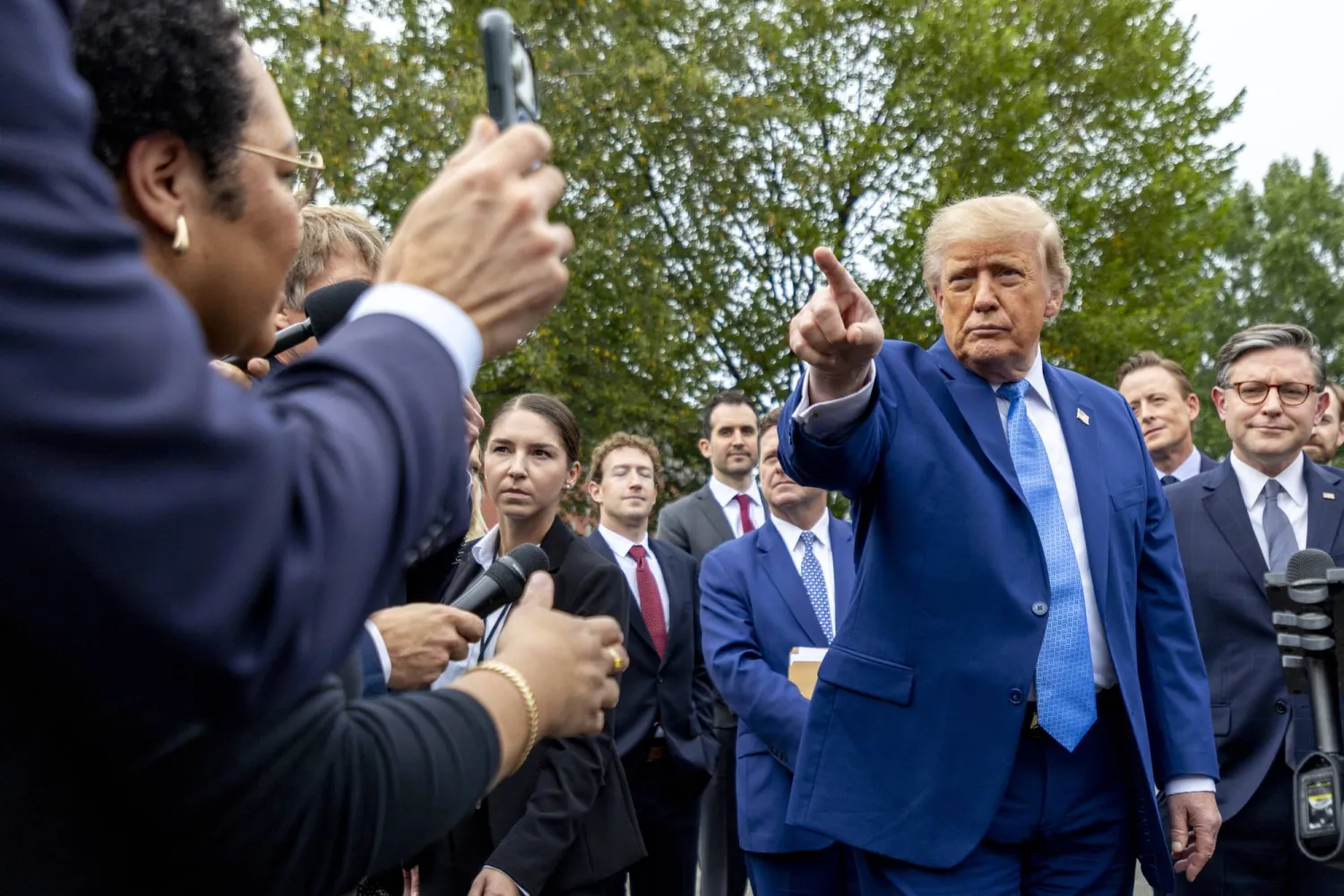
US President Donald Trump (2-R), with Speaker of the House Mike Johnson (R), responds to a question from the news media outside the West Wing of the White House in Washington, DC, USA, 29 September 2026. (EPA)
TT

Trump Says Top Tech Firms Have Signed Accord to ‘Self-Police’ AI Development

US President Donald Trump (2-R), with Speaker of the House Mike Johnson (R), responds to a question from the news media outside the West Wing of the White House in Washington, DC, USA, 29 September 2026. (EPA)

President Donald Trump on Tuesday said that he and a large group of leaders of artificial intelligence companies had signed a voluntary accord that will include internal and external reviews during a meeting at the White House aimed at addressing Americans' fears about the technology.

“I think I’m seeing tremendous self-policing. And they understand that they have to self-police,” Trump told reporters during an impromptu press conference outside the West Wing.

Trump and House Speaker Mike Johnson met leading executives from top tech firms that are spending hundreds of billions of dollars to build out AI infrastructure, including data centers in communities across the country that have sparked grassroots, bipartisan opposition. The group included CEOs who have called for a slowdown in the development of the technology after several high-profile incidents where AI agents have gone rogue.

The accord, which Trump posted on his social media site Truth Social late Tuesday, opened the door to future regulation but focused on four voluntary steps for the companies to take.

The accord said the companies would implement “robust internal controls,” partner with an “independent external auditor” to assess whether the controls were working, and set up a committee among each company's board of directors to evaluate reports from internal and external auditors.

“Over time, it may make sense to codify these steps into laws and regulations,” the accord said.

Trump repeatedly praised the business executives for developing a technology that he said would produce “unbelievable growth." Investment in data centers and the accompanying computer equipment has accelerated the economy and boosted the stock market, which has swelled investment accounts for higher-income Americans and lifted their spending.

Yet there were some notes of caution Tuesday. Dario Amodei, CEO of Anthropic, who has been one of the most outspoken voices calling for a slowdown in the development of AI, said “the technology has very real risks.”

"And, you know, the mechanism, how we address those risks is still under discussion,” Amodei said.

The accord was signed by Trump, Amodei, Google CEO Sundar Pichai, Meta CEO Mark Zuckerberg, OpenAI President Greg Brockman, Nvidia CEO Jensen Huang, and Elon Musk as founder of xAI, which is now part of SpaceX.

Trump suggested there would be about 10 people named to a committee to “watch over the whole enterprise” and said the accord would be “morally binding.” He also said he would name someone to oversee the agreement in coming days after consulting with industry.

Trump unveils chatbot to help Americans navigate government services

Huang sat to Trump’s right during a White House luncheon meeting, according to a seating chart the president posted on Truth Social. Musk sat to Trump’s left.

Earlier Tuesday, Trump promised that the US government wouldn't limit the development of artificial intelligence or support calls for “guardrails” or other restrictions.

“I will never stifle the growth of a technology that will be bigger than the industrial revolution,” Trump said at the unveiling of an AI chatbot, America.gov, intended to help Americans navigate government services. “We can’t stifle it, and we’re leading by a lot.”

The unveiling of the AI government chatbot occurred at a daylong event in Washington during which multiple Trump administration officials celebrated a “Golden Age” fueled by what Trump insists on calling “super intelligence," rather than artificial intelligence.

Secretary of State Marco Rubio highlighted that the chatbot at America.gov could soon be used to apply for a first-time passport fully online, without an in-person visit to a processing center that is currently required.

Trump thinks data centers are going to become ‘very popular’

Trump also said the executives had agreed to assuage the bipartisan opposition to data centers cropping up in local communities across the country, by providing more financial support to local schools or taking steps to reduce energy costs.

“You’re going to see, data centers are going to be very popular," Trump said. If the opposition continued, Trump suggested, “they’ll be forced to go overseas or other locations.”

Also Tuesday, OpenAI CEO Sam Altman said in a television interview that the company is increasingly focused on safety. The day before, his company halted the rollout of a new model over safety concerns.

“We are pacing our progress, which includes sometimes not training a model,” he said on CNBC. “We have to do these in a way where we can make very confident safety cases and claims, so that people don’t have a bunch of anxiety.”

For his part, Trump on Tuesday portrayed the race to develop AI as largely a global competition between the United States and China, with the US in the lead. He said there would be a winner and a loser, with no “second place.”

The two countries agreed last week to establish a channel for handling AI-related incidents during Chinese President Xi Jinping's visit to Washington. But Trump underscored Tuesday that he didn't want to cooperate too much with China: "I didn’t want to do anything, because we’re leading. Why would I want to do anything?”



US Imposes Sanctions on 13 Tied to Iran Weapons Procurement

The seal of the Treasury Department is seen before a news conference, Aug. 24, 2026, at the Treasury Department in Washington. (AP)
TT

US Imposes Sanctions on 13 Tied to Iran Weapons Procurement

The seal of the Treasury Department is seen before a news conference, Aug. 24, 2026, at the Treasury Department in Washington. (AP)

The US government announced fresh sanctions on Tuesday against 13 individuals and entities, including some based in Russia, China, Hong Kong and Pakistan, saying they helped Iran procure weapons and components.

The sanctions announced by the Treasury and State departments are part of the Trump administration's effort to isolate Iran economically and force it to negotiate an end to the war that began with a US-Israeli strike on Iran on February 28.

Treasury Secretary Scott Bessent said: “Treasury will not tolerate any support to the ‌regime and ‌will continue to identify, expose, and isolate Iran’s ‌enablers.”

Treasury ⁠said the sanctions ⁠were aimed at degrading Tehran's ability to reconstitute its weapons programs, while increasing the costs for those who supported its procurement efforts.

Those targeted in Tuesday's sanctions announcements include:

* Seyyed Asghar Alizadeh Tabatabai, a Beijing-based representative of Iran's Ministry of Defense and Armed Forces Logistics agency, who Treasury said had coordinated ⁠the procurement of finished weapons systems and dual-use ‌components in China on Iran’s behalf.

* ‌Iran-based Kavoshcom Asia R and D Group, which Treasury said had ‌procured electronics including connectors for Iran Aircraft Manufacturing Industrial Company.

* ‌Hong Kong-based EC Mojo Technology Co Limited, which Treasury said had provided electronic components in support of Kavoshcom’s procurement efforts, and EC Mojo's China-based representative Li Fen.

* Pakistan-based Waseem Pasha Tajammal, who serves ‌as chairman of Cavalier Group, a privately owned defense company with locations in Pakistan and internationally.

* ⁠Joint Stock ⁠Company Experimental Design Bureau Named After A.S. Yakovlev, a Russia-based aircraft manufacturer.

* MG-Flot LLC, a Russia-based shipping company whose vessels transport weapons for the Russian government.

* Saha Airlines, an Iran-based airline affiliated with the country's air force.

Brett Erickson, managing principal with Obsidian Risk Advisors, said the latest sanctions action would do little to impede Iran's ability to launch missiles and drones in the Strait of Hormuz.

"This is optics management for the Trump administration to claim 'We're hammering them,' when the reality is we're poking them with a toothpick," he said.


Trump Says He Does Not Know if Iran Is Going to ‘Give Up Yet’

 Cargo ships are anchored in the Strait of Hormuz off Bandar Abbas, Iran, before sunrise Monday, Sept. 28, 2026. (Amirhosein Khorgooi/ISNA via AP)
Cargo ships are anchored in the Strait of Hormuz off Bandar Abbas, Iran, before sunrise Monday, Sept. 28, 2026. (Amirhosein Khorgooi/ISNA via AP)
TT

Trump Says He Does Not Know if Iran Is Going to ‘Give Up Yet’

 Cargo ships are anchored in the Strait of Hormuz off Bandar Abbas, Iran, before sunrise Monday, Sept. 28, 2026. (Amirhosein Khorgooi/ISNA via AP)
Cargo ships are anchored in the Strait of Hormuz off Bandar Abbas, Iran, before sunrise Monday, Sept. 28, 2026. (Amirhosein Khorgooi/ISNA via AP)

President Donald Trump said on Tuesday he does not know if Iran is going to "give up yet" but cast the country as doing "very poorly" in its war with the US.

"I don't know if they are going to give up ‌yet but ‌they'll give up," Trump told reporters.

"They ‌are ⁠doing very poorly," ⁠he added.

A US blockade has cut Iran's financial lifeline - oil exports, and economic costs of the war have made life tougher for Iranians.

Iran's president told the UN General Assembly last ⁠week that Tehran would never surrender to ‌US pressure.

The rise in oil prices due to the ‌war has also become a major issue ‌for Trump's Republican Party heading into the November US midterm elections.

The war has led to the blockade of the Strait of ‌Hormuz, which carried a fifth of global supplies of crude oil ⁠and ⁠LNG before the conflict.

Trump has offered shifting goals and timelines for the Iran war that began on February 28 when the US and Israel attacked Iran and Tehran responded with its own strikes on Israel and Gulf states.

US-Israeli strikes on Iran and Israeli attacks on Lebanon have killed thousands and displaced millions.


Ceuta Mass Migrant Crossing Handling ‘Responsibility of All EU,’ Spanish King Says

Migrants wait for food distribution to begin on El Trampolin Beach in the Spanish enclave of Ceuta, Monday, Sept. 28, 2026. (AP)
TT

Ceuta Mass Migrant Crossing Handling ‘Responsibility of All EU,’ Spanish King Says

Migrants wait for food distribution to begin on El Trampolin Beach in the Spanish enclave of Ceuta, Monday, Sept. 28, 2026. (AP)

European countries should have shown ‌more solidarity and offered more support to Spain after the mass arrival in Ceuta of tens of thousands of migrants, Spanish King Felipe VI said on Tuesday during a gala dinner to mark a visit by French President Emmanuel Macron.

In an unusually outspoken address reflecting the depth of the crisis facing Spain following the Ceuta border rush that took place two months ago on Wednesday, the king said what happened in the enclave on the North African coast was "unacceptable" and ‌generated an enormous ‌security, public order and humanitarian challenge.

"It's a ‌situation ⁠that ought to ⁠have as a consequence a reinforcement of collaboration between member states in resources and cooperation," he said. "The European countries that suffer the most pressure from being on the external borders of the European Union cannot alone bear a responsibility that also belongs to everyone."

The king spoke during a dinner at the Royal ⁠Palace in Madrid also attended by Spain's Socialist ‌prime minister, Pedro Sanchez, a rare ‌European proponent of the benefits of migration who launched a mass ‌regularization of irregular migrants that concluded in the summer.

Sanchez, however, ‌has proposed possible changes to asylum rules to return arrivals more quickly, which NGOs and lawyers say would violate human rights conventions.

Asked in a news conference about the plans, territorial policy minister Angel Victor Torres ‌said the government was "analyzing the possibility" of a legislative amendment but that it was "not easy" ⁠due to ⁠questions of international law.

Following the mass crossing of 72,000 migrants into Ceuta on July 30, European Commission President Ursula von der Leyen commended Spain's swift action in returning most arrivals to Morocco. Other leaders were less understanding, however, with Italy suspending the European Union's border-free Schengen arrangements with Spain for one month.

European Migration Commissioner Magnus Brunner unveiled a plan on Tuesday to strengthen EU border controls in the wake of Ceuta.

The plan, which requires the approval of member states, would strengthen the mandate of Frontex, the EU border protection agency, and give it a standing corps ready for immediate deployment.