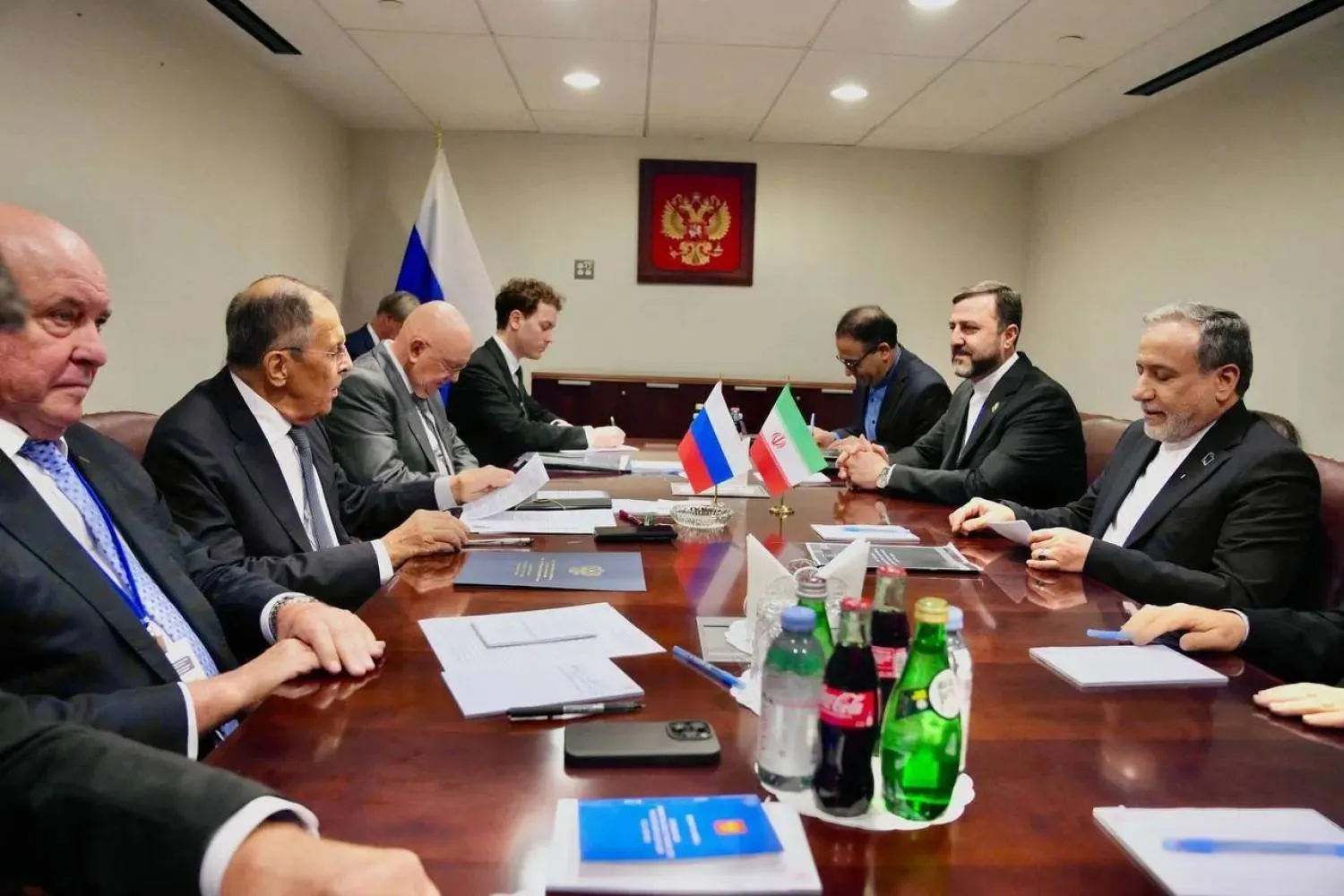
Russia Opposes Iran Leaving Nuclear Non-Proliferation Treaty

Iranian Foreign Minister Abbas Araghchi meets his Russian counterpart, Sergei Lavrov, on the sidelines of the UN General Assembly in New York last week (Iranian Foreign Ministry) 
TT

Russia Opposes Iran Leaving Nuclear Non-Proliferation Treaty

Iranian Foreign Minister Abbas Araghchi meets his Russian counterpart, Sergei Lavrov, on the sidelines of the UN General Assembly in New York last week (Iranian Foreign Ministry) 

Russia does not want Iran to quit the nuclear Non-Proliferation Treaty (NPT) and counts on it remaining a party to the agreement, the Kremlin said on Tuesday.

Kremlin spokesman Dmitry Peskov responded to recent comments from Iranian officials about a possible exit from the treaty, which requires signatories not to develop or acquire nuclear weapons.

“This statement requires further clarification. We would not want Iran to withdraw from the NPT,” Peskov said.

The remarks came after Iranian First Deputy Parliament Speaker Ali Nikzad indicated that lawmakers are considering a “triple-urgency” bill on withdrawal.

Nikzad said the draft is under review, including its international implications, and could be brought to a plenary session for same-day consideration once registered.

The First Deputy Speaker also said that Tehran, which became a party to the treaty in March 1970, has no trust in the International Atomic Energy Agency (IAEA), or IAEA chief Rafael Grossi, because he conducts “merely superficial inspections and submits negative reports against Iran.”

Why Shouldn’t We Develop a Nuclear Weapon?

In an interview with state television in August, Mohsen Rezaei, secretary of Iran’s Supreme National Security Council, asked, “Why shouldn’t we develop a nuclear weapon so that nobody can attack us?”

Rezaei argued that Iran had subjected itself to extensive international monitoring, joined the Nuclear Non-Proliferation Treaty, yet its nuclear facilities were ultimately attacked.

He did not announce any change in Iran’s nuclear doctrine or a decision to build a bomb. The secretary of Iran’s NSC later said in a press interview that the issue of withdrawal was under consideration within Iran, and that US and Israeli attacks could push Tehran to withdraw from the NPT.

On Monday, more than 30 former Iranian officials had issued an open letter calling for withdrawal from the NPT, arguing that continued membership no longer served national interests and urging relevant bodies to begin legal steps promptly.

The petition includes former Intelligence Minister Heydar Moslehi, former Justice Minister Gholam-Hossein Elham, and former First Vice President Mohammad-Reza Rahimi from the Mahmoud Ahmadinejad administration.

Committed Member

On the sidelines of the UN General Assembly in New York, Iranian Foreign Minister Abbas Araghchi told NBC on Sunday that Iran is a “committed member” of the NPT treaty.

In response to a question about his country’s need for 60% enriched uranium, he said: “We enrich uranium to 60% for peaceful purposes, and this is in line with our obligations under the NPT. We are not violating the NPT.”

Araghchi also said that Iran is ready to discuss with the US a possible deal on uranium enriched to 60%, but for this it is necessary to restore trust between the parties.

He noted that Tehran has already offered Washington to agree on the available reserves of such material in 2025 and 2026.

The UN agency remains unable to verify the status, size, or whereabouts of Iran's enriched uranium stockpile or determine if enrichment activities have been suspended following the June 2025 military strikes. Iran possessed 440.9 kilograms of uranium enriched up to 60% before the start of the Israel-Iran War on June 12.

Option on Table

On September 20, the chairman of the Iranian Parliament's National Security and Foreign Policy Commission, Ebrahim Azizi, told the Mehr news agency that the option of Iran’s withdrawal from the NPT is on the table.

“Legislative proposals titled ‘Plan for Withdrawal from the NPT’—backed by the signatures of numerous MPs—have been drafted and submitted to both the Parliament's National Security and Foreign Policy Commission and the Office of the Deputy for Legislation,” he said.

However, Azizi added, withdrawing from NPT requires “taking effective measures and coordinating with all pillars of the government as well as adoption of a unified decision within the Islamic Establishment.”

On the same day, Iranian MP Hossein Ali Haji Deligani said given the country's current circumstances and recent attacks against it, remaining in the NPT offers Iran nothing but harm.

He noted that a bill proposing Iran's withdrawal from the NPT has been submitted to parliament's presiding board and is awaiting the speaker's approval to be put to an open session.

Hassan Qashqavi, a spokesman for the National Security Committee, said last Wednesday that Iran “will not stand idly by,” regardless of whether the US threats are carried out or not.

Last week, Javan newspaper, a newspaper affiliated with Iran’s Revolutionary Guard Corps (IRGC), wrote that the question of remaining party to the treaty had become tied to the relationship between “commitment” and “security,” citing attacks on Iran’s nuclear facilities and the subsequent suspension of field verification operations.


US and Iran on Alert for a Resumption of War

US carriers Theodore Roosevelt and George Washington sailing at a location given as Arabian Sea, in this screen grab obtained from a video released on November 17, 2026. US Central Command/Handout via REUTERS
TT

US and Iran on Alert for a Resumption of War

US carriers Theodore Roosevelt and George Washington sailing at a location given as Arabian Sea, in this screen grab obtained from a video released on November 17, 2026. US Central Command/Handout via REUTERS

The US has sent mixed messages on its next steps on Iran as Tehran gets ready for war following an increase in reciprocal strikes between the two sides.

Israeli media reported that CENTCOM commander Brad Cooper met on Wednesday with Israeli military officials, while Reuters cited sources saying that the head of Israel’s intelligence agency, the Mossad, had pressed Washington to carry out joint strikes against Iran.

Signs of a new US attack have intensified at a time when reports indicate that the two sides continue to exchange limited, undeclared military strikes.

Iranian Army Commander-in-Chief Amir Hatami said that the military’s readiness is improving moment by moment, adding that the armed forces are monitoring the enemy’s movements with vigilance and precision, in what appeared to be a reference to US preparations.

He warned that any Iranian response to a new attack would be more devastating.

Meanwhile, the head of Iran’s judiciary, Gholam-Hossein Mohseni Ejei, said that the US president intends to launch a new attack on Iran.

Ejei added that Iranian forces now possess capabilities that were not available during the 40-Day War.

At the same time, the Basij militia announced that extending the range of Iran’s missiles has been incorporated into the plans of the country’s armed forces, based on directives from Supreme Leader Mojtaba Khamenei.


Iran Shadows Washington’s Moves in Lebanon as Visits, Calls Fuel Race for Influence

Ali Larijani, former senior adviser to Khamenei, with Lebanese Parliament Speaker Nabih Berri (File photo: Lebanese Parliament Media Office)
TT

Iran Shadows Washington’s Moves in Lebanon as Visits, Calls Fuel Race for Influence

Ali Larijani, former senior adviser to Khamenei, with Lebanese Parliament Speaker Nabih Berri (File photo: Lebanese Parliament Media Office)

Iran is keeping a close watch on Washington's moves in Lebanon and moving swiftly to counter them.

From dispatching senior officials to Beirut to calling Parliament Speaker Nabih Berri directly, Tehran has repeatedly sought to match or respond to US diplomatic initiatives in a contest for influence over Lebanese decision-making.

The message, according to the pattern of Iranian moves, is clear: Tehran will not let Washington dictate Lebanon's next chapter alone.

"Every time a US official visits Beirut, an Iranian official follows, even when there is nothing to discuss," a former Lebanese prime minister told Asharq Al-Awsat.

The pattern has become more pronounced in recent years, particularly since the 2024 war, the former premier said.

Ministerial sources said Iranian envoys typically follow US diplomatic moves with visits and meetings, particularly with Tehran's Lebanese allies, to gauge Washington's latest positions and learn what was discussed behind closed doors.

The contacts are also part of an exchange of political messages between Tehran and Washington, the sources told Asharq Al-Awsat.

Iran, they said, wants to show that it still holds the Lebanese card — and retains the leverage to shape political settlements.

The pattern was particularly evident in the autumn of 2024, as international efforts, led largely by Washington, intensified to halt Israel's war on Lebanon.

Iranian Foreign Minister Abbas Araghchi visited Beirut on Oct. 4. A week later, Iranian Parliament Speaker Mohammad Baqer Qalibaf arrived, saying he had diverted his trip to Switzerland to deliver a "message of support" from then-Supreme Leader Ali Khamenei.

The diplomatic maneuvering continued in November as a US ceasefire initiative gained ground.

On Nov. 14, US Ambassador Lisa Johnson handed Berri a draft of Washington's ceasefire proposal.

The following day, Ali Larijani, then an adviser to Iran's supreme leader, arrived in Beirut for talks with Berri and then-Prime Minister Najib Mikati.

He declared Iran's support for "any decision Lebanon makes to achieve a ceasefire."

Tehran's Familiar Playbook

Former Lebanese minister Boutros Harb sees little new in Tehran's approach.

Iran, he said, has long treated Lebanese groups aligned with it as subordinates, speaking and negotiating on their behalf rather than allowing Lebanon to pursue an independent negotiating position based on its national interests.

But the stakes are now higher, Harb told Asharq Al-Awsat.

Lebanon has an opportunity to capitalize on international diplomatic efforts, he said, while Iran is working to prevent the Lebanese file from being separated from its own negotiations with Washington.

Tehran wants to keep that card in hand to demonstrate that it remains an influential regional player, he added.

"Tehran treats Lebanon as an Iranian province, as though there were no state or government," Harb said.

He acknowledged that Lebanon's political landscape had changed to some extent under President Joseph Aoun and Prime Minister Nawaf Salam.

"But unfortunately, the card is still in Iran's hands, and it is exploiting it to preserve its regional role," he said.

Lebanon Tied to US-Iran Talks

By 2026, Tehran's diplomatic push had increasingly shifted from visits to telephone calls carrying political messages tied to negotiations with Washington.

The shift became particularly apparent after Iran announced that it had told mediators any ceasefire agreement with the United States and Israel must also halt Israeli attacks on Lebanon.

On April 1, Berri said Araghchi had conveyed Iran's insistence that any agreement include Lebanon.

"What applies to Tehran applies to Beirut," Berri quoted the Iranian foreign minister as saying.

The pattern resurfaced on July 9, when a US diplomatic move in Beirut coincided with a visit by an Iranian delegation led by Deputy Foreign Minister Vahid Jalalzadeh.

While US Ambassador Michel Issa met Aoun to discuss implementation of the Lebanese-Israeli framework agreement, the Iranian delegation held talks with Berri and Deputy Prime Minister Tarek Mitri.

The latest episode came on Nov. 16, following a Beirut visit by US Ambassador to the United Nations Mike Waltz.

Waltz met Lebanon's president, prime minister and parliament speaker and urged Hezbollah to voluntarily hand over its weapons to the state.

"No country can have two armies," he said.

That same day, Qalibaf called Berri, stressing Iran's "special interest" in Lebanon.

Regional calm, he said, could not return without an end to the war in Lebanon and the restoration of Lebanese sovereignty over all its territory.

Hezbollah's Weapons: Another Front

Iran's response to US moves has not been confined to ceasefire diplomacy.

The same pattern emerged in August 2025, when Lebanon's government decided to draw up a plan to bring all weapons under state control, amid US pressure to carry it out.

On Aug. 13, Ali Larijani, then secretary of Iran's Supreme National Security Council, visited Beirut and met Lebanon's president, prime minister and parliament speaker.

He opposed foreign pressure over Hezbollah's weapons, calling instead for "dialogue among the Lebanese" and warning against imposing "foreign dictates on Lebanon."

Five days later, US envoy Tom Barrack and deputy US envoy Morgan Ortagus arrived in Beirut to follow up on Washington's roadmap for placing weapons exclusively under state control and to discuss security issues.


Turkish Court Hands New Sentence and Political Ban to Jailed Istanbul Mayor, Media Says

Istanbul Mayor Ekrem Imamoglu greets his supporters as they gather in front of his office as a Turkish court sentenced Imamoglu to more than two years in prison and imposed a political ban for insulting public officials, in Istanbul, Türkiye, December 14, 2022. (Reuters)
TT

Turkish Court Hands New Sentence and Political Ban to Jailed Istanbul Mayor, Media Says

Istanbul Mayor Ekrem Imamoglu greets his supporters as they gather in front of his office as a Turkish court sentenced Imamoglu to more than two years in prison and imposed a political ban for insulting public officials, in Istanbul, Türkiye, December 14, 2022. (Reuters)

A ‌Turkish court on Wednesday sentenced jailed Istanbul mayor Ekrem Imamoglu to a further two years in prison for violating the election law and imposed a new political ban on him, local media reported.

Imamoglu was one of nine defendants sentenced to two years and one month in prison in a ‌case concerning ‌the opposition Republican People's Party's (CHP) ‌convention ⁠in November 2023, state ⁠broadcaster TRT Haber said.

CNN Turk and other media reported that the court imposed a political ban on Imamoglu, who before his arrest was seen as the main potential ⁠challenger to President Recep Tayyip Erdogan.

The defendants were ‌accused of making improper inducements to encourage ‌people to vote for Ozgur Ozel ‌when the CHP elected him as leader at the 2023 congress. They denied the allegations.

Courts previously imposed political bans ‌on Imamoglu in 2022 and 2025 and sentenced him to more ⁠than ⁠six years in prison. He is appealing against both of the earlier bans.

Imamoglu was previously convicted in several other cases and went on trial in March in a sweeping corruption trial of more than 400 defendants linked to the Istanbul municipality. He denies the corruption charges, which carry prison sentences amounting to hundreds of years.