


Russia Attacks Ukrainian Energy Grid, Forcing Power Cuts as Winter Looms

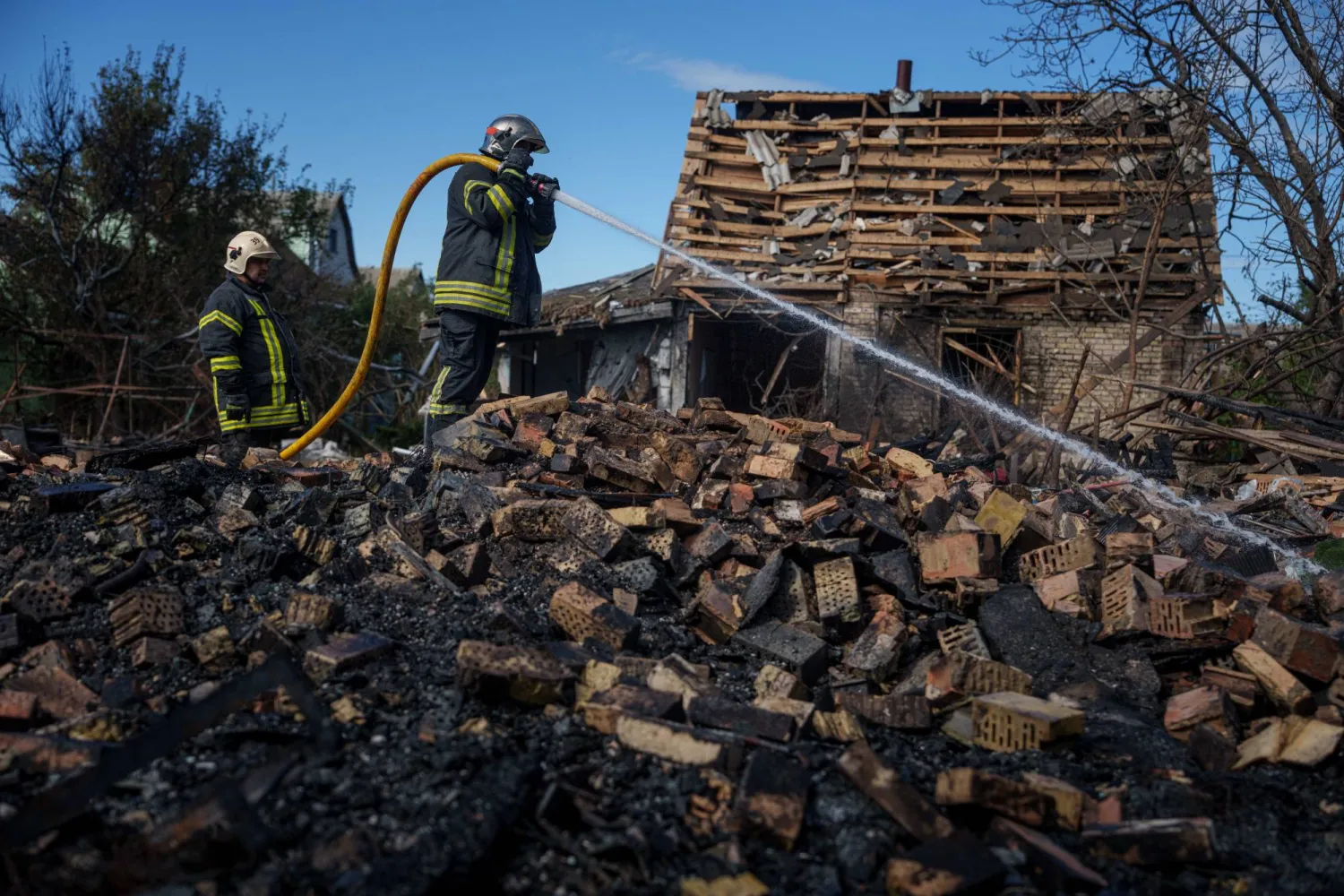
 Rescue workers put out a fire at a residential house destroyed in a Russian missile strike on Vyshhorod, Kyiv region, Ukraine, Wednesday, Sept. 30, 2026. (AP)
Rescue workers put out a fire at a residential house destroyed in a Russian missile strike on Vyshhorod, Kyiv region, Ukraine, Wednesday, Sept. 30, 2026. (AP)
TT

Russia Attacks Ukrainian Energy Grid, Forcing Power Cuts as Winter Looms

 Rescue workers put out a fire at a residential house destroyed in a Russian missile strike on Vyshhorod, Kyiv region, Ukraine, Wednesday, Sept. 30, 2026. (AP)
Rescue workers put out a fire at a residential house destroyed in a Russian missile strike on Vyshhorod, Kyiv region, Ukraine, Wednesday, Sept. 30, 2026. (AP)

Russia unleashed a widely anticipated air campaign against Ukraine's energy grid on Wednesday, hitting power facilities and infrastructure around Kyiv and other regions in the heaviest combined attack on energy sites in months.

The strikes, in which Ukrainian officials said seven people were killed, followed days of intensifying drone barrages primarily on the capital, a prelude to what many Ukrainians expect to be a winter of attacks intended to plunge cities into cold and darkness when Ukraine is short of air defenses.

Ukraine's state power grid operator Ukrenergo said it had imposed emergency power cuts as a result of the attack in Kyiv and three surrounding regions — the first time such a measure had been imposed in the capital since the spring.

Russian attacks last winter, which brought record-low temperatures, ravaged power and heating systems, ‌forcing Ukrainians to adapt ‌to dire circumstances.

CAPITAL SHROUDED IN SMOKE

Some of the capital's trams and trolley buses ground to ‌a halt ⁠due to the ⁠outages as people headed home from work. Kyiv's water utility said pressure in the water system was reduced.

"Russia has escalated to massive strikes on energy infrastructure," Prime Minister Sergii Koretskyi said on X after the attacks overnight.

"Since summer, there's barely been a day without an attack on our energy infrastructure. But a combined strike of this scale hasn't happened since the end of last heating season."

Kyiv residents awoke on Wednesday to a city shrouded in fog from the smoke of attacks, which authorities said damaged a key power plant and other energy facilities around the capital.

Ukraine's air force said its air defenses had intercepted 254 of 285 Russian drones deployed until early evening.

It said 174 drones were high-flying ⁠and faster jet-propelled models, which are harder to intercept. Russian forces had also launched a ballistic ‌missile attack.

A child was among the seven dead across Ukraine, President Volodymyr Zelenskiy said, ‌with critical infrastructure coming under attack in five regions. Further damage was reported in another five regions, he added.

Zelenskiy visited a military command post near ‌the town of Lyman near the eastern frontline and praised what he said were gains against Russian forces during a counteroffensive.

He ‌said Ukrainian forces had recaptured 176 sq. km. (29.3 sq. miles) of territory since the start of the operation.

Russia said its forces had struck power plants in the Kyiv region, an industrial complex in Odesa region, and port infrastructure in Ismail in the southwest.

Kyiv Mayor Vitali Klitschko said debris had been found at a Western embassy, but offered no further details. The overnight attack triggered a more than 12-hour air-raid alert.

Drone strikes continued in Kyiv into ‌the early evening.

Near-constant daytime sirens and explosions have become a fixture of daily life in Kyiv, where drone attacks have killed around a dozen people over the past week alone.

PM ⁠ORDERS POWER BACKUP CHECKS

Ukrainian Foreign Minister ⁠Andrii Sybiha described Wednesday's attack by Russia as a "deliberate" distraction from its grinding battlefield offensive in eastern Ukraine, which has slowed since last year.

"Moscow is increasing the pressure on Ukrainian civilians as winter approaches, trying once again to turn cold, darkness, and disruption of normal life into weapons," he said on X.

Forecasters say they expect freezing temperatures at night in Kyiv in the coming days.

Russia, which began its full-scale invasion in February 2022, denies targeting civilians although it has pounded cities and towns across Ukraine.

Koretskyi, the prime minister, said he had instructed local authorities to check the readiness of backup power systems at critical facilities and speed up installations.

Authorities in recent weeks and months have been building protective facilities and aiming to diversify energy generation before Russia's expected winter campaign.

However, Ukrainian human rights ombudsman Dmytro Lubinets said there was a critical shortage of urban shelters, describing the civil-defense system as having "completely failed".

DRONES CROSS INTO MOLDOVA

In Moldova, on Ukraine's western border, the defense ministry said three drones had crossed into its airspace over the course of the day.

NATO members Romania and Poland both scrambled military jets, the countries said, and flights at the Polish airports of Lublin and Rzeszow were suspended for a time.

Ukraine has also stepped up attacks on Russia, striking oil refineries and online retailers to undermine its war effort.




Drone, Missile Attacks Wound 9 as Ukraine Prepares for Talks with Russia and the US

The site of the Russian missile strike near a kindergarten in Kyiv, Ukraine, 07 November 2026, amid the Russian invasion. EPA/SERHII DILIN
TT

Drone, Missile Attacks Wound 9 as Ukraine Prepares for Talks with Russia and the US

The site of the Russian missile strike near a kindergarten in Kyiv, Ukraine, 07 November 2026, amid the Russian invasion. EPA/SERHII DILIN

Drone and missile attacks struck across Ukraine on Saturday, wounding at least nine people, as Kyiv and Moscow prepared for new talks next week with the United States.

Negotiators from Russia, Ukraine and the US are to meet on Tuesday in Abu Dhabi, the capital of the United Arab Emirates, for talks aimed at ending the war. The new round of negotiations would be the fourth brokered by the Trump administration, the most recent having been in Geneva in February.

Western governments backing the peace initiative are seeking a new formula to break the impasse while acknowledging that territorial and security questions remain unresolved.

The Russian missiles that hit overnight across the Ukrainian capital, Kyiv, damaged homes and commercial properties, triggering new power and water outages, national and city authorities said.

Kateryna Korniichuk, 64, was at home with her granddaughter when an attack hit.

“The first blast wave threw us against that wall and then against the other wall, because we were in the corridor. It’s very hard. No sleep, no peace — nothing. The children aren’t sleeping, and neither are we," she told The Associated Press. “I’m old, I can handle it, but what have the children done wrong?”

Strikes also prompted officials to close Kyiv's 816-meter-long (892-yard-long) Northern Bridge, a major route connecting the city with large residential areas on the east bank of the Dnipro River.

Kyiv Mayor Vitali Klitschko said that work was already underway to repair the city's Northern Bridge and that water pressure in Kyiv had been stabilized.

Earlier Saturday, he had described the city's energy situation as "extremely difficult, affecting the city’s heating and water supply systems.”

In a statement Saturday, Ukrainian President Volodymyr Zelenskyy said Russia was preparing for trilateral talks by “launching ballistic missiles at Ukraine’s critical infrastructure.”

Later, he said that Moscow was stepping up strikes to build pressure on Ukraine ahead of the Abu Dhabi talks. “Russia perceives diplomacy in its own peculiar way – as a form of aggression,” he wrote in an online post.

The Ukrainian leader said that Russia fired 36 ballistic missiles at Kyiv and the surrounding region overnight, of which only four were shot down due to a lack of Patriot interceptors.

Zelenskyy also said that Russia had used North Korean-made ballistic missiles to strike energy facilities, citing preliminary findings from investigations at impact sites.

The barrage involved 172 drones over Kyiv and 12 other regions, wounding nine people, including a child, he said.

“When Russia tries to plunge Kyiv — a city of millions — and the entire country into a blackout, Ukraine must not be left to face this alone,” Zelenskyy said. He urged greater US support and attention from Congress, calling for bipartisan backing for Ukraine and stronger sanctions on Russia.

Ukraine’s Energy Ministry said Saturday’s missile attacks damaged networks that carry electricity from nuclear power plants to Kyiv and central regions, as well as multiple other power facilities. It said outages were most widespread in the Kyiv and central Zhytomyr regions, as well as in the eastern regions of Kharkiv, Donetsk and Dnipropetrovsk.

The outages were separate from scheduled rolling blackouts imposed to protect the grid, which remain in effect across much of Ukraine.

Russia’s Ministry of Defense confirmed Saturday that it had targeted the Northern Bridge, saying that it facilitated the transport of weaponry, military hardware and specialist equipment for Ukraine’s armed forces.

It also said that it had targeted an industrial facility in the capital producing Flamingo missiles, as well as a power station, an electrical substation, and a plant producing ammunition, explosives and gunpowder in the wider Kyiv region. It also confirmed striking an electrical substation in the Zhytomyr region.

Meanwhile, in southern Ukraine, a recovery operation continued into its sixth day in the village of Komyshuvakha, devastated on Monday when multiple Russian guided bombs slammed into a former school and nearby shelter as residents waited for humanitarian aid.

Emergency services said they had recovered nine more bodies in the previous 24 hours, bringing the death toll early Saturday morning to 55. Dozens of people remain missing.

Village resident Mykola Krasnov, 72, said he was still looking for his wife but had heard no word from rescuers.

“She went to get humanitarian aid, and a three-ton bomb was dropped there. Where is she?” he said. “She didn’t come home, and they didn’t find her body there. She isn’t in the morgue, and she isn’t here alive.”

The village of Komyshuvakha is located near the front line in the Zaporizhzhia region.

A Ukrainian attack killed one person in Russia’s Belgorod region when a drone hit a private home in the town of Grayvoron, local officials said Saturday.

Russia’s Ministry of Defense said its forces shot down 411 Ukrainian drones overnight over 10 Russian regions, including Belgorod. Drones were also destroyed over the annexed Ukrainian peninsula of Crimea and the Black and Azov Seas, it said.

The head of Russia’s southwestern Saratov region, Gov. Roman Busargin, wrote on social media that a drone attack damaged “civilian infrastructure” and several residential buildings in the area. Russian media outlets later reported that the Saratov Oil Refinery had been hit and shared images of plumes of smoke over the city.

The head of Russia’s Oryol region, Gov. Andrey Klychkov, also said Saturday that a Ukrainian attack had damaged commercial warehouse and production sites in the regional capital, as cited by state media.

Russian media outlets reported that a Ukrainian attack sparked a blaze at Oryol’s Proton-Electrotex plant, which produces components for military equipment.


Iran Says it Has Lifted its Self-imposed Limit on Missile Ranges

A banner depicting US President Donald Trump, Israeli Prime Minister Benjamin Netanyahu, US Vice President JD Vance and US Special Envoy Steve Witkoff is displayed on a street in Tehran, Iran, November 4, 2026. Majid Asgaripour/WANA (West Asia News Agency) via REUTERS
TT

Iran Says it Has Lifted its Self-imposed Limit on Missile Ranges

A banner depicting US President Donald Trump, Israeli Prime Minister Benjamin Netanyahu, US Vice President JD Vance and US Special Envoy Steve Witkoff is displayed on a street in Tehran, Iran, November 4, 2026. Majid Asgaripour/WANA (West Asia News Agency) via REUTERS

Iran’s Revolutionary Guard said Saturday it has lifted a self-imposed limit of 2,000 kilometers on the range of its ballistic missiles, suggesting the country may seek to develop missiles capable of reaching more distant targets as fears of renewed all-out war rise.

The comments by the spokesman of the Revolutionary Guard came days after the country’s supreme leader, Mojtaba Khomeini, warned that “any kind and level of threat” from the US or Israel would face a response without geographic limits.

Asked at a Tehran news conference about the limit on missile ranges, Gen. Hossein Mohebbi said: “That restriction has been lifted for us.”

He did not say whether Tehran had missiles capable of exceeding the limit, saying only Iran would “demonstrate these capabilities in practice” rather than make statements.

Iran is not known to have missiles that can go beyond the 2,000-kilometer limit. However, US officials have said technology from Iran’s space program can be repurposed to build intercontinental ballistic missiles.

The Iranian military, meanwhile, said a tanker east of the Strait of Hormuz had hit a mine and caught fire. It did not identify the tanker's flag or destination. It said the vessel had turned off its navigational beacon and was sailing in a “prohibited area.”


Iranian Discontent Heightens Cross-Border Threat to Syria, Experts Say

Photos released by Syrian media showing drugs seized in Serghaya.
TT

Iranian Discontent Heightens Cross-Border Threat to Syria, Experts Say

Photos released by Syrian media showing drugs seized in Serghaya.

Syrian authorities' announcement late Friday that they had foiled a major drug-smuggling operation from Lebanon in the Serghaya area of rural Damascus drew attention for one particular reason: the operation was handled by Defense Ministry troops rather than internal security forces, security expert Diaa Qaddour told Asharq Al-Awsat.

Another military analyst linked the growing tensions along Syria's borders with Lebanon and Iraq to Iran's dissatisfaction with the Syrian government.

The Defense Ministry's Media and Communications Department said border guards had intercepted an attempt to smuggle narcotics into Syria from Lebanon near Serghaya, along the border in the Damascus countryside.

The smugglers opened fire on the patrol, prompting troops to return fire and forcing the gunmen to retreat into Lebanese territory, the ministry said.

According to Syria's Internal Security Forces, the authorities seized 280 kilograms of hashish and 28,000 Captagon pills.

The incident followed extensive raids carried out by the Lebanese Army on November 4 in the rugged outskirts of Arsal, which led to the arrest of suspected smugglers and the interception of vehicles attempting to cross the border illegally.

It also came days after Syrian authorities arrested members of a cell allegedly plotting an attack on the Homs oil refinery. Damascus accused the cell of having ties to Lebanon's Hezbollah, an allegation the group denied.

Speaking to Asharq Al-Awsat, Qaddour accused Hezbollah of stepping up what he described as terrorist activities inside Syria, including attacks targeting sensitive sites.

He warned that the border region had become extremely volatile, with tensions liable to escalate at any moment, requiring Syrian security forces to remain on constant alert.

Damascus has been working to strengthen security cooperation with neighboring countries in an effort to close illegal border crossings and dismantle cross-border smuggling networks.

Security coordination topped the agenda during Iraqi Prime Minister Ali Al-Zaidi's visit to Damascus on October 28, when he led a high-level ministerial delegation.

Border control was also a priority in talks between the Syrian government and a Lebanese delegation headed by Deputy Prime Minister Tarek Mitri, which visited Damascus on November 2.

Since the start of the country's liberation, Damascus has sought to reassure its neighbors by tightening border controls and reopening crossings in ways that benefit both sides economically.

Military affairs analyst Rashid Hourani described the approach as "border-crossing diplomacy."

Speaking to Asharq Al-Awsat, Hourani said Damascus had sought to resolve its disputes with neighboring countries by securing its borders and ensuring they posed no threat to Syria or its neighbors.

But developments along the Syrian-Lebanese and Syrian-Iraqi borders, he argued, point to growing Iranian frustration with Damascus.

He attributed Tehran's displeasure partly to Syria's success in tightening border security and partly to recent discussions about its possible participation in the Makkah Agreement, alongside an announcement that Damascus would provide Saudi Arabia with military expertise to confront the Houthis, Iran's ally in Yemen.

"Iran therefore sought to cause trouble for Syria and instructed Hezbollah, whose regional influence has diminished, to stir up tensions along the Syrian border," Hourani said.

He argued that a similar dynamic was at play along the Iraqi border, where Iranian-backed militias exert considerable influence over decision-making within the country's military and security institutions.

Securing Syria's borders remains one of the most pressing security challenges facing Damascus.

Qaddour assessed the threat entering Syria across its borders as "moderate to high in the near term," although he said it could still be contained if current security efforts were sustained.

He identified the border with Lebanon as particularly vulnerable because of its rugged terrain and numerous illegal crossings.

The Iraqi border, by contrast, has seen substantial fortification through the construction of walls and trenches, while active security coordination with Jordan has helped authorities intercept major smuggling shipments.

Hourani also pointed to Syria and Jordan's participation in an anti-ISIS alliance established in March 2025 alongside Türkiye, Iraq and Lebanon.

He said their membership in the coalition made it likely that the two countries would overcome the fallout from a Jordanian military operation in Syria's Daraa Governorate, where an operational error resulted in civilian casualties.

Meanwhile, recent developments have underscored the growing security threat along the Syrian-Lebanese border, with successive operations exposing what analysts describe as coordinated attempts to destabilize Syria.

Qaddour said drug trafficking remained the most serious threat, with evidence pointing to longstanding links between smuggling networks, elements of Syria's former regime and Hezbollah.

He also warned of an increasingly troubling development: smuggling cartels resorting to armed resistance against security forces.

The latest incident, in which smugglers exchanged fire with Syrian troops before fleeing into Lebanon, illustrated the growing danger, he said.

Qaddour argued that the situation demanded more than routine security coordination.

He called for tighter joint control over illegal crossings, expanded intelligence sharing and a systematic crackdown on cross-border criminal networks.

He also raised the possibility of urgent operations at particularly vulnerable points along the Lebanese border, warning that failure to close these security gaps could turn them into a persistent source of instability for both countries.